
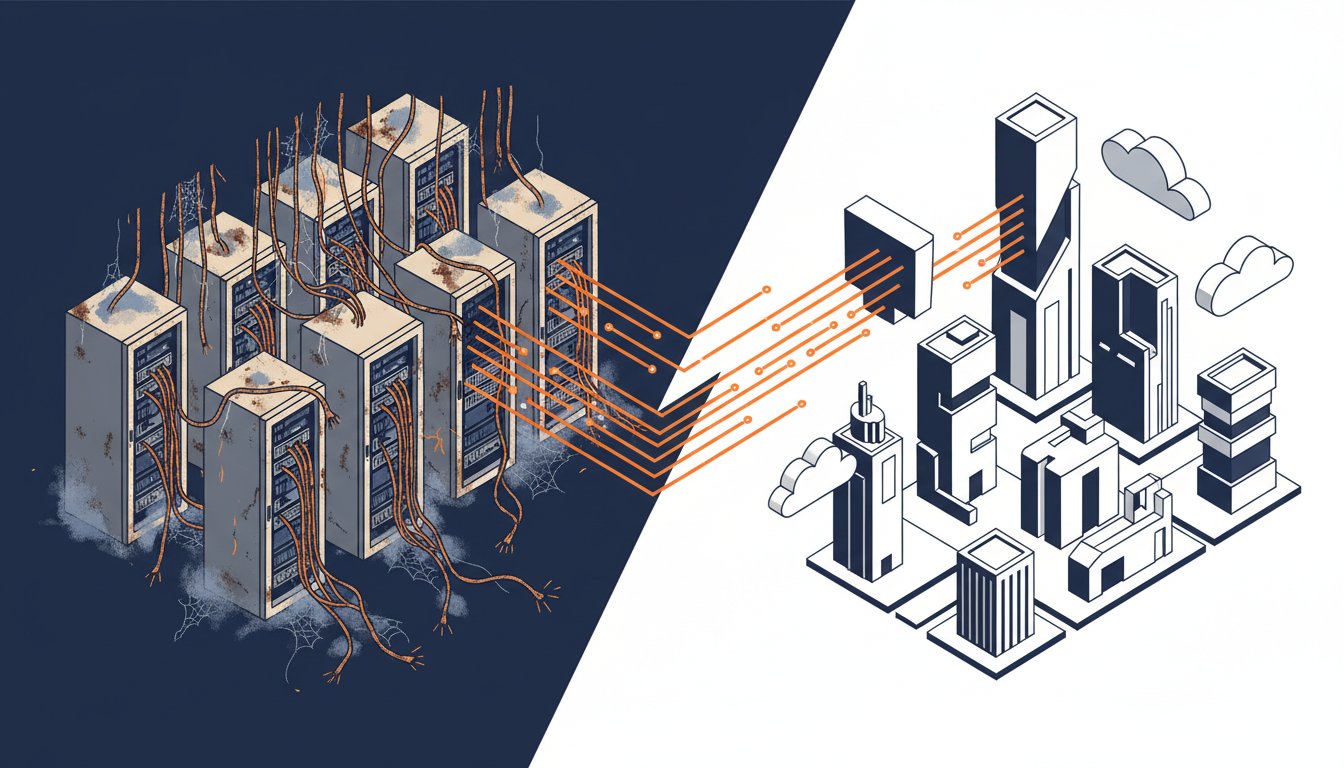
Did you know that maintaining a single legacy copper line can now cost your business up to $2,700 per month? As AT&T begins decommissioning 500 wire centers this June 2026, on-premise pbx maintenance costs are shifting from a manageable line item to a critical infrastructure liability. You likely feel the pressure of these rising expenses every time an unpredictable repair invoice hits your desk or a legacy technician becomes impossible to find. It’s a frustrating cycle of paying more for hardware that’s doing less for your bottom line.
We’re here to provide the technical clarity you need to break this cycle. As infrastructure engineers, we’ll help you identify the hidden technical debt in your server room and explain why aging POTS lines for fire and safety systems are now your biggest compliance risk. This analysis provides a clear total cost of ownership framework to justify modernization. We’ll break down the hardware refresh cycles, software licensing fees, and LTE POTS replacement strategies required to ensure your business is built to stay current so you never fall behind. You’ll gain a path toward predictable monthly expenses and reduced liability through disciplined engineering.
Key Takeaways
- Identify the four pillars of technical debt that transform simple repair invoices into long term infrastructure liabilities.
- Analyze how the 2026 copper network shutdown and skyrocketing POTS rates directly impact your on-premise pbx maintenance costs and life safety compliance.
- Master a standardized TCO framework that accounts for the hidden five year hardware refresh cycle and ongoing software rigidity.
- Explore how an industry first Device Lifecycle and Technology Refresh Policy provides the predictability and governance needed to modernize without capital expenditure spikes.
- Gain the engineering insights required to transition from reactive repairs to a managed, secure, and compliant communications environment.
Defining On-Premise PBX Maintenance Costs in 2026
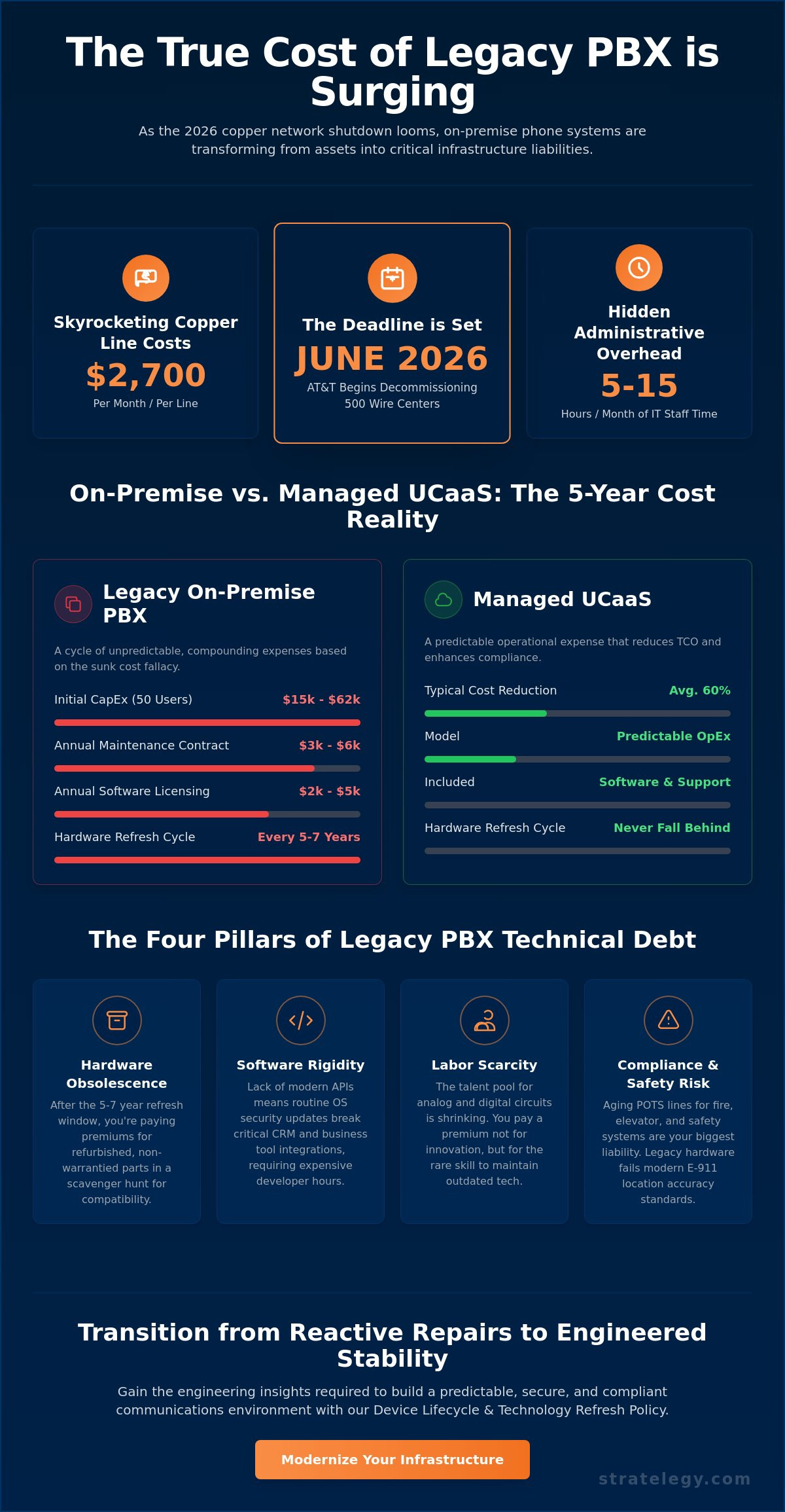
On-premise pbx maintenance costs represent the total capital and operational expenditures required to keep legacy hardware functional and compliant. For most organizations, this isn’t just a single invoice. It’s a complex web of direct expenses like hardware repairs, software patches, and vendor support contracts. It also includes indirect burdens like power consumption, dedicated server room cooling, and the 5 to 15 hours of IT staff time required every month just to manage basic system tasks. These costs are often obscured within broader IT budgets, making it difficult for leadership to see the true financial drain. Ultimately, on-premise PBX maintenance is the sum of physical upkeep and the accumulating technical debt of an aging infrastructure.
To understand the full scope of these expenses, businesses must categorize their spending into three primary areas:
- Direct Hardware Upkeep: The price of replacement cards, handsets, and power supplies for systems that manufacturers no longer support.
- Compliance and Connectivity: The rising cost of maintaining legacy copper lines for emergency services as carriers phase out older networks.
- Administrative Overhead: The lost productivity of internal teams who must troubleshoot connectivity issues instead of focusing on strategic initiatives.
The Shift from CapEx to OpEx Reality
Many business owners fall victim to the sunk cost fallacy. They believe that because they spent $15,000 to $62,000 on a Business telephone system years ago, it’s cheaper to keep it operational. This logic fails in 2026. Maintenance contracts for a 50 person deployment now range between $3,000 and $6,000 per year. When you factor in annual software licensing, which costs between $2,000 and $5,000, these fees often exceed the cost of a modern UCaaS subscription within 36 months. Businesses switching to cloud based systems report an average cost reduction of 60 percent. Inflation in 2026 has also driven up the price of specialized legacy components. Shipping a refurbished circuit board for a discontinued system now carries a premium that didn’t exist three years ago. You aren’t just paying for parts; you’re paying for the scarcity of a dying technology.
The Infrastructure Engineering Perspective
We view your communications as a foundational utility. Like electricity or water, your phone system must be predictable and secure. Legacy systems are failing to meet 2026 governance standards. They struggle with modern E-911 location accuracy requirements and lack the sentiment analysis tools that modern businesses use to stay competitive. Relying on aging hardware creates a volatility that no disciplined engineer would accept. As carriers like AT&T move to decommission facilities in 500 wire centers this June 2026, the risk of a total infrastructure failure becomes a mathematical certainty rather than a possibility. True communications excellence requires a shift from reactive repairs to engineered stability. This perspective ensures that your business stays operational even as the underlying public networks undergo their most significant transformation in decades.
The Four Pillars of Legacy PBX Technical Debt
Technical debt is the silent killer of modern IT budgets. While you might see a flat monthly fee on a service contract, the underlying liabilities of an aging system continue to compound over time. These liabilities generally fall into four distinct pillars that drive up on-premise pbx maintenance costs beyond sustainable levels. Understanding the true scale of on-premise pbx maintenance costs requires looking past the monthly vendor check and analyzing the structural risks of your hardware environment.
- Hardware Obsolescence: The typical hardware refresh cycle for a legacy PBX system is 5 to 7 years. Past this window, finding replacement parts becomes a scavenger hunt. You’re no longer buying new components; you’re paying a premium for refurbished circuit boards that often carry no long term warranty.
- Software Rigidity: Legacy systems lack the agility of modern APIs. When your server OS updates for security reasons, it often breaks custom integrations with your CRM. Fixing these connections requires expensive developer hours that offer zero new functionality.
- Labor Scarcity: The pool of engineers who understand analog and digital circuits is disappearing. You pay a premium not for innovation, but for the rare ability to keep old wires humming.
- Operational Downtime: A single motherboard failure can take your entire office offline for days. Without a cloud failover, you lose revenue every hour you wait for a technician to arrive on site with a spare part.
Evaluating these hidden liabilities is the first step toward engineering a more predictable infrastructure that serves your business goals.
The Expertise Gap: Paying for Vanishing Skills
The pool of engineers who understand legacy telephony has shrunk by 40 percent since 2020. This scarcity has created a seller’s market for technical support. If your lead IT person retires, they often take decades of undocumented system configurations with them. This leaves your organization in a dangerous knowledge silo. Emergency dispatch fees are another hidden drain. When the system fails, you aren’t just paying for the part. You’re paying for the ’emergency’ status and the travel time of a specialist who may be located hundreds of miles away. These unbudgeted invoices can easily double your expected annual spend in a single afternoon.
The Physical Burden: Power, Space, and Cooling
Dedicated server rooms consume significant resources that cloud solutions eliminate entirely. A standard PBX rack requires continuous HVAC cooling to prevent thermal failure. In a modern office design, that ‘telco closet’ represents valuable real estate that could be repurposed for productive workspace. When you calculate the annual kilowatt hour consumption and the square footage value of the equipment room, the physical footprint alone becomes a major expense. Maintaining this environment is a 24/7 commitment to power and climate control that adds no value to your customer experience. It’s a foundational utility cost that only goes up as local energy rates rise.
The Compliance Liability: POTS Obsolescence and Life Safety Risks
The physical wires connecting your office to the world are disappearing. While internal hardware failures are a major concern, the external infrastructure represents a growing and volatile portion of on-premise pbx maintenance costs. Major carriers are aggressively decommissioning their copper networks, with AT&T beginning its first major phase of wire center shutdowns in June 2026. This phase-out has created a pricing crisis for businesses still tethered to traditional lines. POTS line costs have increased by over 300% in some regions due to carrier abandonment. In some documented cases, businesses are paying as much as $2,700 per month for a single analog line that formerly cost a fraction of that price.
Beyond the financial drain, legacy systems create a significant compliance gap. On-premise PBX hardware was never designed for the granular location requirements of modern emergency services. These systems often struggle with E-911 location accuracy, failing to provide the precise dispatchable location data required by current regulations. Relying on aging copper for fire alarms and elevator phones is a dangerous gamble. If a line fails during a crisis, the resulting litigation and regulatory fines far outweigh the expense of modernization. As infrastructure engineers, we prioritize the stability of these life safety paths to ensure your business remains compliant and your people stay protected.
LTE POTS Replacement: A Maintenance Necessity
Modernizing the “last mile” of your connectivity is the only way to eliminate the unpredictability of copper pricing. By engineering secure, LTE-based bridges for legacy panels, we provide a reliable path for critical data that doesn’t rely on failing physical wires. These cellular alternatives are specifically certified for fire and life safety, offering 24/7 uptime through battery backups and diverse network paths. This transition doesn’t just reduce your monthly recurring costs; it provides a supported, managed solution that fits into a long term governance strategy. You gain peace of mind knowing your emergency systems are built to stay current.
Regulatory Risks and Insurance Premiums
Non-compliant communication systems are increasingly viewed as a high risk liability by business insurers. New 2026 standards for fire panel connectivity and emergency reporting require supervised, reliable paths that legacy copper can no longer guarantee. If your infrastructure fails to meet these updated codes, you may face spiked insurance premiums or even policy cancellation. Proactive engineering allows you to avoid the “emergency upgrade” premium that vendors charge when a legacy line finally goes dark. By addressing these compliance risks today, you secure your infrastructure against the sudden failures that lead to unbudgeted capital expenditures and legal exposure.
Calculating the TCO: On-Premise Maintenance vs. Managed UCaaS
A true total cost of ownership (TCO) analysis requires looking beyond the monthly per-user fee. While many vendors focus solely on software features, we evaluate the foundational stability of your communication environment. To standardize the comparison, you must account for the inevitable capital expenditure spikes that define legacy systems. For instance, a 10 person team can save approximately $57,000 over three years by choosing a cloud system over a traditional one. These savings come from eliminating the hardware refresh cycle, which typically occurs every 5 to 7 years and requires an investment between $15,000 and $62,000 for a mid-sized team. When these spikes are averaged into your on-premise pbx maintenance costs, the financial case for modernization becomes undeniable.
Predictability is the hallmark of disciplined engineering. Managed UCaaS provides a Zero CapEx model that preserves your business capital for growth rather than sinking it into depreciating hardware. Instead of dealing with variable repair invoices that fluctuate based on parts availability, you move to a fixed, operational expenditure. This shift allows for better governance and more accurate long term budgeting. You can calculate your potential savings by auditing the hours your team currently spends on reactive maintenance.
The Hidden Costs of “Staying Put”
The opportunity cost of maintaining an aging server is staggering. Your IT team likely spends between 5 and 15 hours every month on patches and troubleshooting for an on-premise system. That’s time they aren’t spending on high value projects that drive revenue. Beyond the labor drain, legacy systems often lack omnichannel support. This deficiency directly impacts customer retention in a market that expects seamless communication across voice, text, and chat. There’s also the security risk. An unpatched legacy gateway is a prime target for a data breach, and the cost of remediation far exceeds the price of a modern subscription.
Managed Services: The Engineering Advantage
A managed UCaaS platform shifts the burden of maintenance to the provider. This eliminates the need for specialized on-site labor and the premium fees associated with vanishing technical skills. Your software is always current, meaning you receive the latest security updates and features without manual intervention. For multi-site organizations, centralized management reduces administrative overhead significantly. You gain a unified infrastructure that’s built to stay current, ensuring your business never falls behind. This methodical approach to communication ensures that your foundation is solid, secure, and ready for future growth.
Engineering Predictability: Stratelegy’s Device Lifecycle & Refresh Policy
Communication infrastructure should be a source of stability, not a recurring financial crisis. Most businesses treat their phone systems as a static asset, leading to a cycle of neglect followed by expensive, emergency replacements. We take a different path. Stratelegy’s industry first approach to hardware longevity replaces the chaos of aging hardware with a disciplined, proactive replacement strategy. Our Technology Refresh Policy is designed to eliminate the maintenance spike that typically hits every five years. By engineering a continuous lifecycle, we ensure your business is built to stay current so you never fall behind the technology curve.
This approach fundamentally changes the financial landscape of your organization. Instead of managing unpredictable on-premise pbx maintenance costs, you enter into a strategic infrastructure partnership. We don’t just sell software; we manage the foundational reliability of your entire communication stack. This shift from a vendor client relationship to a partnership means we’ve already thought of the problems you haven’t encountered yet. We prioritize security, governance, and predictability over mere software features, allowing your leadership team to focus on growth rather than hardware failure.
Our Device Lifecycle Policy
Hardware failure is a mathematical certainty, but it doesn’t have to be a business disruption. Our Device Lifecycle Policy manages the refresh of desk phones and infrastructure hardware on a rolling basis. This ensures that every piece of equipment in your facility is always under warranty and fully supported. In one recent engagement, we reduced a client’s maintenance overhead by 45 percent through a managed migration that replaced their failing legacy system with a modern, engineered environment. This proactive model eliminates the need for expensive, specialized labor and the scavenger hunt for refurbished parts. You gain peace of mind knowing that your communication tools are always operational and secure.
Ready for True Communications Excellence?
The first step toward infrastructure stability is a clear understanding of your current liabilities. We begin with a comprehensive infrastructure audit to identify hidden technical debt and security gaps. This includes a strategic plan for replacing expensive, unreliable POTS lines with our resilient LTE solutions. These bridges ensure that your fire panels and elevator phones remain compliant without the volatility seen in the legacy copper market. Contact Stratelegy today for a comprehensive TCO analysis and see how a managed infrastructure can transform your bottom line. Our team of engineers is ready to build a foundation that supports your business for the long term.
Secure Your Infrastructure Against Technical Debt
The 2026 copper sunset is no longer a distant threat; it is a current financial reality. As carriers decommission facilities across 500 wire centers this June, the volatility of on-premise pbx maintenance costs will only accelerate. You’ve seen how technical debt compounds through hardware obsolescence and skyrocketing analog line rates. Continuing to patch a legacy system isn’t just a maintenance choice. It’s a growing liability that threatens your operational stability and regulatory compliance.
True communications excellence requires a shift from reactive repairs to engineered predictability. We are infrastructure engineers who prioritize your long term governance over simple software features. We offer an industry first Device Lifecycle and Technology Refresh Policy to ensure your hardware never falls behind. Our specialized LTE POTS replacement provides the certified reliability your fire and life safety systems demand. Eliminate maintenance headaches with Stratelegy’s Managed UCaaS. Let’s build a foundation that stays current so your business can move forward with confidence.
Frequently Asked Questions
What is the average annual maintenance cost for an on-premise PBX?
Average on-premise pbx maintenance costs for a 50 person team range from $3,000 to $6,000 per year. This figure covers basic vendor support contracts and physical hardware upkeep. It doesn’t include annual software licensing, which typically adds another $2,000 to $5,000 to the budget. When you account for the 5 to 7 year hardware refresh cycle, the total expenditure often exceeds the cost of modern managed alternatives.
Why are my PBX repair costs increasing every year?
Repair costs are rising because the supply of refurbished parts is dwindling while specialized labor becomes more expensive. The pool of technicians who understand legacy analog circuits has decreased by 40 percent since 2020. You aren’t just paying for a fix; you’re paying for the scarcity of a technology that major manufacturers no longer support. This creates a volatile environment where a single component failure leads to unpredictable and inflated invoices.
Can I keep my legacy desk phones if I move to a cloud-based UCaaS?
While some adapters exist, keeping legacy phones often compromises the security and functionality of a modern UCaaS platform. Most organizations find that the cost of maintaining old handsets exceeds the value of a hardware refresh. Our Device Lifecycle policy provides next-generation hardware as part of a managed service. This ensures your business utilizes advanced features like sentiment analysis and omnichannel routing without the burden of owning depreciating assets.
Is it possible to replace POTS lines for fire alarms without changing the whole phone system?
Yes, you can replace aging copper lines with LTE POTS replacement solutions without overhauling your entire phone system. These bridges provide a dedicated cellular path for fire panels and elevator phones that is independent of your PBX. This modernization is a critical compliance step as carriers like AT&T begin decommissioning 500 wire centers in June 2026. It eliminates the skyrocketing costs of traditional copper while ensuring 24/7 life safety monitoring.
How does a Technology Refresh Policy reduce long-term maintenance costs?
A Technology Refresh Policy eliminates the massive capital expenditure spikes that occur every 5 to 7 years. By engineering a proactive replacement schedule, we ensure your hardware is always under warranty and running the latest firmware. This model shifts your budget from unpredictable repair costs to a steady, operational expenditure. It’s built to stay current so your infrastructure never becomes a liability or a bottleneck for growth.
What happens to my on-premise PBX maintenance if the manufacturer goes out of business?
If a manufacturer goes out of business, your system enters a state of high-risk technical debt where security patches and official parts are no longer available. Maintenance becomes dependent on the secondary market for used components and third-party technicians. This lack of vendor support creates significant governance risks. It’s often the primary driver for a managed migration to a supported infrastructure that guarantees long term stability and compliance.
How do electricity and cooling costs factor into the PBX TCO?
Physical infrastructure requires dedicated power and HVAC cooling that can significantly inflate your total cost of ownership. A traditional PBX server generates heat that demands 24/7 climate control to prevent thermal failure. When you add the square footage value of the “telco closet” to the annual kilowatt-hour consumption, the utility burden becomes substantial. Moving to a cloud-based model eliminates this physical footprint and the associated overhead costs.
What is the risk of delaying a PBX upgrade until the hardware fails?
Delaying an upgrade until hardware fails exposes your business to total operational downtime and emergency vendor premiums. You lose the ability to plan for a migration, often resulting in a rushed implementation that bypasses critical security and governance checks. The cost of lost revenue during an outage, combined with the “emergency” status fees for technicians, far outweighs the price of a disciplined, proactive modernization strategy.