

One third of enterprise leaders now spend over an hour every single day resolving collaboration friction, a hidden tax that costs organizations up to $16,491 per manager annually. You likely recognize the quiet exhaustion in your own teams as they navigate fragmented silos, where 54% of employees report significant communication issues when forced to use more than 10 different apps. With UCaaS prices rising by 20% and further OEM hardware increases arriving in February 2026, the pursuit of a leaner, more elegant tech stack has become a commercial necessity.
This guide demonstrates why reducing communication tool sprawl is not merely a cost-cutting exercise; it’s a strategic realignment designed to restore organizational focus. You’ll discover how to transform disjointed applications into a unified, high-performance architecture that eliminates data silos and lowers your total cost of ownership. We’ll provide a clear framework to consolidate your messaging, video, and phone systems into a single-pane-of-glass platform that empowers your workforce and secures your strategic agility for the years ahead.
Key Takeaways
- Identify the structural weaknesses caused by “shadow IT” and eliminate the financial drain of zombie subscriptions that silently erode your operational budget.
- Master the transition from a fragmented, app-centric model to a unified UCaaS platform to enhance both internal focus and your Net Promoter Score.
- Deploy a curated framework for reducing communication tool sprawl by conducting a rigorous audit of functional overlaps and mapping real-world usage patterns.
- Secure your enterprise against the inherent vulnerabilities of a diluted tech stack while achieving a leaner, more resilient communication architecture.
- Discover how modernizing legacy assets through LTE POTS replacement creates a harmonized foundation for transformative growth and strategic agility.
The Anatomy of Fragmented Systems: Defining Communication Tool Sprawl
Communication tool sprawl is the silent architect of organizational friction. It manifests as an uncontrolled proliferation of disparate messaging, video, and voice platforms that grow without a centralized vision. This expansion rarely happens by design. Instead, it’s often the result of “shadow IT,” where departments independently adopt specialized tools to solve immediate bottlenecks. While these choices provide temporary relief, they bypass the strategic alignment necessary for a cohesive enterprise architecture. At Stratelegy, we view this ad-hoc adoption not as a lack of discipline, but as a missed opportunity for transformative growth. By 2026, the industry has reached a definitive turning point. The era of managing isolated, best-of-breed apps is ending, giving way to unified, multi-modal platforms that harmonize every touchpoint within a single ecosystem.
The Three Pillars of Communication Fragmentation
To begin reducing communication tool sprawl, one must first identify where the fractures exist within the digital workspace. Fragmentation typically clusters into three distinct pillars that drain collective focus. Collaboration silos emerge when internal teams are divided across competing enterprise chat applications, creating digital borders that hinder the fluid exchange of ideas. Customer experience silos represent a deeper disconnect, where front-office contact center solutions operate in total isolation from back-office communication tools. Finally, infrastructure silos persist when organizations maintain legacy copper lines alongside modern cloud solutions, creating a redundant and expensive hybrid environment that offers no clear path to modernization.
Why ‘Best-of-Breed’ Often Leads to ‘Worst-of-Sprawl’
There’s a deceptive allure to choosing the “best” tool for every specific task. However, specialized tools eventually hit a tipping point where their unique benefits are outweighed by the “integration tax.” This is the tangible cost of time and capital required to make disparate systems communicate with one another. When your data stack becomes too complex, as 62% of data teams currently using over 10 tools can attest, the technology starts to hinder rather than help.
The human cost is equally significant. With 83% of knowledge workers now relying primarily on digital messaging for daily operations, the “toggle tax” has become a pervasive drain on mental energy. This is the psychological friction of switching between a dozen different applications just to complete a single workflow. True reducing communication tool sprawl requires moving beyond these fragmented silos toward a refined, platform-centric model that restores both operational efficiency and intellectual elegance to the workplace.
The Hidden Costs and Security Risks of a Diluted Tech Stack
Beyond the visual clutter of a crowded taskbar lies a more insidious threat to organizational health. The financial erosion caused by zombie subscriptions, which are paid licenses that remain active yet unused, silently drains capital that could otherwise fuel transformative growth. With UCaaS industry prices seeing a 20% lift in 2025 and entry-level tiers for providers like DialPad Connect Pro or RingCentral RingEx starting at $25 per user monthly, these redundant costs scale rapidly. Reducing communication tool sprawl is no longer just an IT preference; it’s a fiscal imperative to protect your bottom line from the “enshittification” of vendors who prioritize revenue growth over innovation.
Quantifying the Financial Impact of Sprawl
The true cost of fragmentation extends far beyond overlapping licensing fees. IT departments face a mounting burden of labor hours spent managing disparate vendor relationships, security patches, and hardware maintenance. This technical debt creates a significant opportunity cost, stripping your leadership of the strategic agility needed to pivot in a volatile market. When leaders lose significant time to collaboration friction, the organization effectively pays a heavy penalty for its own inefficiency. A streamlined communication architecture allows for a strategic consolidation that converts these lost hours back into productive output.
The Security and Compliance Perimeter
A diluted tech stack is a porous one. Each additional messaging app or video platform expands your attack surface, providing cyber threats with multiple entry points into your sensitive data. Maintaining rigorous standards like HIPAA or SOC2 becomes a logistical nightmare when records are scattered across five different platforms. This complexity is particularly dangerous given the 2026 regulatory environment. For instance, the OSHA GHS Revision 7 deadline on January 19, 2026, requires precise label and Safety Data Sheet updates that fragmented systems simply cannot guarantee.
Legacy infrastructure adds another layer of risk. Retaining ancient POTS lines for fire safety or life safety connectivity is a precarious strategy. These copper lines lack the intelligent monitoring of modern cloud solutions and are increasingly expensive to maintain as semiconductor costs drive up hardware prices in early 2026. By consolidating to a high-security, single-pane-of-glass platform, you replace these vulnerabilities with a resilient foundation. This shift ensures that your compliance with new mandates, such as California’s “Workplace Know Your Rights Act” notice due by February 1, 2026, is handled through a unified, auditable system. Ultimately, reducing communication tool sprawl is the only way to achieve a truly harmonized and secure operational environment.
Fragmentation vs. Unified Communications: A Strategic Comparison
The choice between an app-centric model and a platform-centric architecture is fundamentally a choice between chaos and composure. In an app-centric environment, organizations accumulate specialized tools for messaging, video, and voice in isolation. While each individual application might excel at its specific task, the collective result is a fragmented ecosystem that obscures the customer journey. This fragmentation directly erodes your Net Promoter Score (NPS) as customers experience disjointed handoffs between departments. Transitioning to a platform-centric model, specifically Unified Communications as a Service (UCaaS), represents a commitment to reducing communication tool sprawl by placing every interaction within a single, coherent framework.
A unified platform does more than just simplify the interface; it democratizes data. When your communication stack is fragmented, 49% of data teams describe their stack as too complex to provide a unified view of engagement. Consolidation allows for sophisticated AI-driven insights that are impossible to achieve in silos. Since 75% of leaders whose teams use AI report better collaboration, the strategic value of a unified data set becomes clear. A single-tenant architecture ensures that these insights aren’t just data points, but actionable intelligence that drives enterprise efficiency.
UCaaS: The Foundation of Architectural Elegance
UCaaS is the cornerstone of a modern, high-performance communication architecture. It merges voice, video, and messaging into a single strategic asset, providing IT administration with a “single pane of glass” for total oversight. This visibility is vital for managing the 20 hours a week that workers now spend on digital communication tools. Unlike on-premise silos that require manual updates and redundant hardware, cloud-native UCaaS platforms offer effortless scalability. This architectural elegance ensures that your infrastructure grows in harmony with your business, rather than becoming a bottleneck of technical debt.
Closing the Gap Between UCaaS and CCaaS
One of the most persistent legacy mistakes in enterprise design is the separation of the contact center (CCaaS) from internal communications (UCaaS). This divide creates an artificial barrier between front-line agents and the subject matter experts who can resolve complex issues. By integrating these two worlds, you empower your team with “Agent Assist” AI that has access to the organization’s entire knowledge base. This synergy significantly improves first-call resolution rates by connecting agents to experts instantly. Reducing communication tool sprawl through this specific integration doesn’t just lower costs; it creates a seamless feedback loop that transforms the customer experience into a competitive advantage.
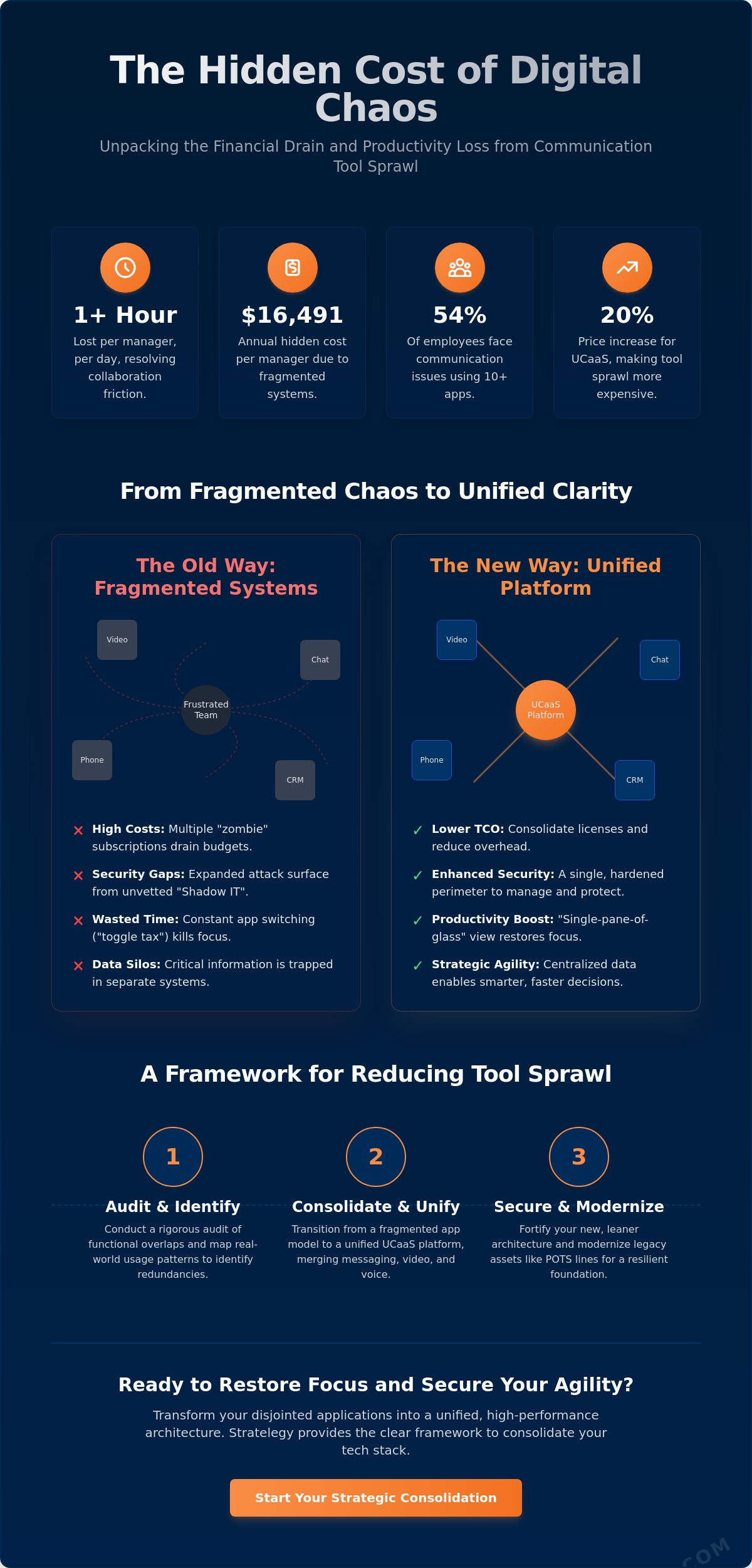
A Curated Framework for Reducing Communication Tool Sprawl
Transitioning from a fragmented landscape to a unified architecture requires more than simple deletion. It demands a disciplined, five-step framework that replaces tactical tool accumulation with a harmonized strategic asset. This process moves through audit, analysis, architecture, execution, and governance to ensure that your communication environment remains both lean and resilient. By reducing communication tool sprawl through this structured approach, you don’t just eliminate redundant costs; you restore the intellectual focus of your entire workforce.
Phase 1: The Communication Audit
The first step is uncovering the “hidden” ecosystem that exists outside of official IT oversight. With 62% of data teams currently using over 10 tools in their stack, many organizations are unaware of the departmental silos operating in the shadows. You must conduct a comprehensive inventory that measures actual engagement against licensed seats. Often, you’ll find that while you pay for 500 licenses, only 200 are active. This is also the critical moment to evaluate legacy infrastructure. Many enterprises still pay for copper POTS lines that offer zero visibility and high maintenance costs. Identifying these lines presents an immediate opportunity for LTE POTS replacement, providing a modern, monitored foundation for your life safety and fire systems. To begin this journey, you can partner with Stratelegy for a professional architectural assessment.
Phase 2: Designing the Unified Ecosystem
Once the audit is complete, you must architect a unified target state. This isn’t about choosing the cheapest vendor, but selecting a primary UCaaS partner that offers the security, 99.999% uptime, and interoperability your enterprise demands. Timing is essential here. As of early 2026, manufacturers are passing along semiconductor cost increases for conference room cameras, audio devices, and headsets. Planning your architecture now allows you to lock in hardware requirements before these February 2026 price hikes impact your budget. During this phase, determine which niche tools are worth keeping as “authorized integrations” rather than isolated silos. A true platform-centric model allows these specialized tools to feed data back into your primary system, maintaining a single-pane-of-glass view for IT administration.
Execution must be phased to minimize disruption to critical business operations. Rather than a “big bang” migration, move department by department, ensuring that business continuity is protected by enterprise-grade cellular routers and redundant connectivity. Finally, establish clear governance. Without policies that prevent the re-emergence of shadow IT, sprawl will inevitably return. By reducing communication tool sprawl and enforcing a curated tech stack, you create a sustainable environment where technology serves the strategy, rather than the other way around.
Stratelegy: Your Partner in Strategic Consolidation
True organizational harmony is never an accident; it is the result of deliberate architectural design. At Stratelegy, we position ourselves as more than a service provider. We are visionary consultants dedicated to transforming the chaos of fragmented systems into a refined, high-performance communication asset. Our role is to guide your enterprise through the complexities of reducing communication tool sprawl, ensuring that every technological choice reinforces your long-term business objectives. We don’t just analyze your current stack; we create a vision where technology and strategy exist in a state of intellectual elegance.
The transition toward a unified framework is a journey from operational friction to commercial grace. Mid-market organizations, in particular, find that our integrated UCaaS and CCaaS solutions provide the scalability necessary for transformative growth. By aligning your front-office engagement with back-office expertise, we eliminate the silos that traditionally hinder the customer experience. This consolidation isn’t a mere IT project. It’s a fundamental shift that restores focus to your leadership and agility to your operations, allowing you to navigate the competitive pressures of 2026 with confidence.
Beyond Connectivity: Strategic Alignment
Modernizing your infrastructure requires a partner who understands the critical nature of life safety and security. Stratelegy specializes in “POTS in a box” solutions, providing a seamless LTE replacement for legacy copper lines that are increasingly expensive and difficult to maintain. As semiconductor costs drive up hardware prices in February 2026, the urgency to move toward these intelligent, monitored solutions has never been greater. We offer a single point of accountability for your entire communication stack, removing the burden of managing multiple vendor relationships and disparate billing cycles.
Our commitment to strategic alignment means we look beyond simple connectivity. We evaluate how your communication architecture impacts employee retention, data security, and overall enterprise efficiency. By choosing a testreszabott keretrendszer (tailored framework), you ensure that your technology stack is as sophisticated as the business it supports. This holistic approach guarantees that your move toward a leaner ecosystem is both permanent and profitable.
The Path Forward: Inquire for a Strategic Review
The time to address the erosion of your operational focus is now. We invite you to schedule a strategic review with our consultants to map your current tool sprawl and design your future state. This consultation provides a clear view of your “zombie subscriptions” and identifies immediate opportunities for cost recovery and infrastructure modernization. We’ll help you navigate the 2026 regulatory environment, ensuring your communication systems are fully compliant with the latest safety and reporting mandates.
Don’t let your organizational potential be capped by the weight of a diluted tech stack. Transition from the noise of fragmented applications to the clarity of a curated, single-pane-of-glass environment. With Stratelegy, you aren’t just reducing communication tool sprawl; you are forging a more resilient, harmonious, and successful enterprise. Let’s begin the work of sculpting a communication architecture that truly reflects the excellence of your brand.
Harmonizing Your Enterprise Communication Architecture
The transition from a fragmented app ecosystem to a unified platform is the definitive step toward reclaiming your organization’s intellectual capital. By prioritizing strategic alignment over ad-hoc adoption, you eliminate the friction that currently hinders your team’s focus and your customers’ journey. Reducing communication tool sprawl is about more than just trimming budgets; it’s about building a resilient, single-pane-of-glass foundation that supports both your internal experts and your front-office agents within a harmonized ecosystem.
Stratelegy provides the visionary guidance needed to navigate this transformation with precision. Our expertise in LTE POTS replacement ensures your critical life safety systems are modernized for the future, while our focus on enterprise-grade UCaaS and CCaaS drives long-term agility for mid-market leaders. We don’t just solve technical problems; we forge a partnership that turns your communication stack into a source of competitive grace. It’s time to replace the noise of disjointed tools with a curated architecture designed for the demands of 2026. Design your unified communication architecture with Stratelegy and step into a more harmonious operational future.
Frequently Asked Questions
What is the most effective way to start reducing communication tool sprawl?
The most effective starting point is a comprehensive cross-departmental audit that maps actual user engagement against your current licensing agreements. This baseline allows you to identify functional overlaps where multiple tools serve the same purpose. By establishing a centralized vision early, you can move from reactive tool adoption to a strategic framework that aligns with your 2026 business goals.
How does tool sprawl impact employee productivity and mental focus?
Excessive tool variety forces employees into a state of constant context switching, which significantly degrades cognitive performance. When workers juggle more than 10 apps, the resulting “toggle tax” leads to fragmented focus and a 20% higher rate of communication breakdowns compared to streamlined teams. This mental fatigue prevents the deep work necessary for high-level strategic execution and long-term innovation.
Can UCaaS completely replace all my legacy communication tools?
Modern UCaaS platforms are designed to serve as a comprehensive single-pane-of-glass solution for messaging, video, and voice. While certain specialized niche tools may still play a role in highly specific workflows, a robust UCaaS architecture eliminates the need for standalone disparate systems. This consolidation is a primary driver for reducing communication tool sprawl, allowing for a more harmonious and manageable tech stack.
What are the security risks of having too many communication apps?
Each additional application creates a new potential entry point for cyber threats, effectively expanding your organization’s attack surface. Fragmented stacks make it nearly impossible to maintain consistent security protocols or meet rigorous compliance standards like SOC2. Consolidating your tools into a single-tenant cloud environment provides a much tighter security perimeter and simplifies the auditing of sensitive data across the enterprise.
How do I handle the migration of legacy fire and security lines during consolidation?
Legacy copper POTS lines should be transitioned to modern LTE replacement solutions that provide intelligent monitoring and enhanced reliability. These “POTS in a box” solutions integrate seamlessly with your unified architecture while ensuring compliance with life safety regulations. This approach replaces unreliable analog hardware with a resilient, cloud-managed foundation that is far easier to oversee and maintain as costs for legacy parts rise.
Is it possible to consolidate tools without losing specific niche features?
Most enterprise-grade UCaaS platforms now offer deep integration capabilities that allow you to retain essential niche functionalities within the primary interface. By treating these tools as authorized integrations rather than isolated silos, you maintain the “single pane of glass” experience. This strategy ensures that your team keeps their required specialized features while still reducing communication tool sprawl at the architectural level.
What is the expected ROI when reducing communication tool sprawl?
ROI is realized through a combination of lower total cost of ownership (TCO) and reclaimed productivity. Beyond the direct savings from eliminated “zombie subscriptions,” organizations often see a reduction in IT labor hours spent on vendor management. When you consider that 70% of data leaders are currently prioritizing stack simplification, the long-term gains in strategic agility and operational elegance are substantial and measurable.
How do I prevent shadow IT from creating new tool sprawl in the future?
Prevention requires a blend of clear governance policies and a platform that genuinely meets employee needs. If your unified system is intuitive and powerful, the incentive for departments to seek outside solutions diminishes. Establish a formal review process for new software requests and conduct annual audits to ensure your communication architecture remains lean and purposefully designed to prevent the return of fragmentation.