

A 2024 industry report found that 68% of enterprise IT leaders delay cloud migrations because they fear operational downtime or the complexities of integrating legacy POTS lines. You likely recognize the tension between the urgent need for a unified communication stack and the technical debt of fire alarms or analog hardware that won’t easily retire. Moving to a cloud-based environment requires more than a simple vendor switch; it demands a comprehensive ucaas implementation checklist that bridges the gap between your current infrastructure and future-ready scalability.
We agree that a transition of this magnitude shouldn’t feel like a disruption, but like a strategic alignment of your digital assets. You’ve seen how user resistance can stall even the most expensive rollouts, yet you know that consolidating your communication costs is essential for long-term growth. This article provides a sophisticated framework designed to turn migration chaos into operational harmony. We’ll walk through a precise roadmap that addresses hardware compatibility, cultural adoption, and the specific steps needed to improve employee collaboration metrics by 30% by the end of 2026.
Key Takeaways
- Define your organization’s strategic “North Star” by aligning long-term business objectives with a rigorous assessment of your technical infrastructure and network orchestration.
- Navigate the complexities of security compliance and legacy system continuity with a comprehensive ucaas implementation checklist designed to safeguard your enterprise during transition.
- Orchestrate a seamless migration through structured platform configuration and targeted pilot programs that cultivate organic user adoption across your most influential departments.
- Transition from deployment to excellence by implementing a governance framework that audits service utilization and optimizes licensing costs against established performance benchmarks.
- Master the art of operational harmony by transforming fragmented communication sprawl into a unified, high-performance ecosystem built for the 2026 business landscape.
Phase 1: Strategic Alignment and Needs Assessment
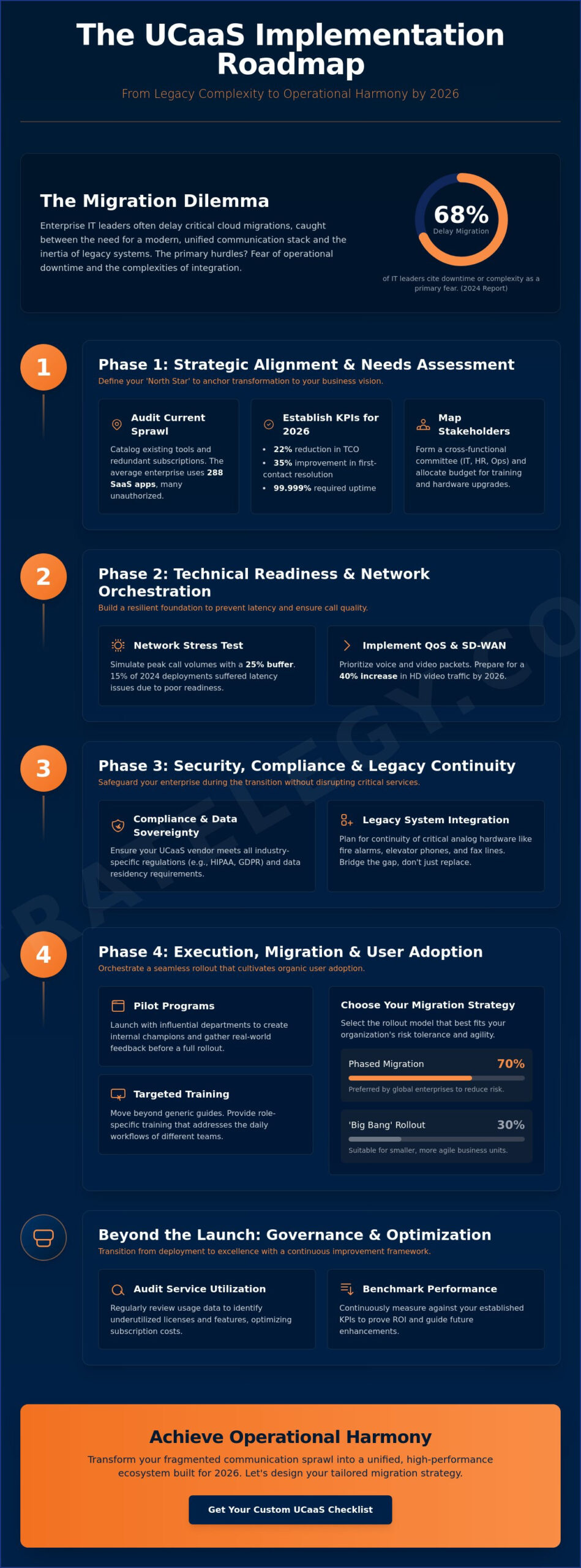
Every architectural masterpiece requires a blueprint that transcends mere utility. In the context of your ucaas implementation checklist, the first phase involves defining a ‘North Star’ that anchors your communication transformation to your overarching business vision. This isn’t merely a technical migration; it’s a deliberate recalibration of how your organization connects, collaborates, and competes. You’re not just buying software; you’re designing a nervous system for your enterprise.
Before building the future, you must catalog the present with clinical precision. Auditing existing communication sprawl reveals the hidden costs of shadow IT and redundant subscriptions. Data from 2024 indicates that the average enterprise utilizes 288 different SaaS applications, many of which are unauthorized messaging or video tools. Identifying these silos is the first step toward achieving Unified Communications (UC) excellence. This audit provides the baseline against which all future progress is measured.
Success remains elusive without measurable benchmarks that reflect both operational efficiency and user experience. You must establish key performance indicators (KPIs) that are both ambitious and quantifiable. Consider these specific targets for your 2026 framework:
- A 22% reduction in Total Cost of Ownership (TCO) within the first 24 months of deployment.
- A 35% improvement in first-contact resolution rates for customer-facing teams.
- A 99.999% uptime requirement to support global operations across multiple time zones.
Establishing Your Strategic Objectives
True leadership distinguishes between ‘nice-to-have’ features and ‘mission-critical’ capabilities. Your objectives must align with 2026 corporate digital transformation initiatives, focusing on agility and data sovereignty. Document the friction within your legacy PBX or fragmented cloud setup. If your current system experiences a 12% drop in call quality during peak hours, that pain point becomes a primary driver for change. This clarity ensures your ucaas implementation checklist remains focused on strategic value rather than superficial features.
Stakeholder Mapping and Resource Allocation
A cross-functional implementation committee serves as the engine of this transformation. This group should include representatives from IT, HR, and Operations, led by an executive sponsor who provides the necessary political and financial capital. Budgeting must extend beyond monthly licensing fees; allocate specific funds for comprehensive user training and network hardware upgrades. Decide early between a phased migration, which reduces risk for 70% of global enterprises, or a ‘big bang’ rollout for smaller, more agile business units. Setting realistic timelines now prevents the friction that often derails complex deployments.
Phase 2: Technical Readiness and Network Orchestration
The transition from strategic vision to technical execution requires a meticulous audit of your digital environment. A comprehensive ucaas implementation checklist must prioritize network orchestration to prevent the latency issues that affected 15% of enterprise deployments in 2024. Organizations must evaluate their current bandwidth capacity against the projected 40% increase in high-definition video traffic expected by 2026. This assessment isn’t merely about volume; it’s about path quality. Implementing SD-WAN allows for intelligent voice prioritization, ensuring that real-time communication packets bypass congestion. As organizations look toward merging Cloud Communication Platforms to unify customer and employee experiences, the underlying network must support these converged streams without degradation.
Network Infrastructure Pre-Flight Check
Technical leaders should conduct “stress tests” that simulate peak-hour concurrent call volumes, specifically targeting a 25% buffer above historical maximums. Configuring Quality of Service (QoS) across all network segments remains non-negotiable. This ensures that voice and video packets receive priority over non-critical data transfers. By 2026, Wi-Fi 6/6E readiness is a prerequisite for mobile-first employees. The 6 GHz band offers the interference-free spectrum necessary for jitter-free communication in dense office environments. To achieve this level of operational harmony, leaders often seek a tailored framework that aligns technical capacity with business objectives.
- Latency Thresholds: Maintain round-trip times below 100ms for optimal voice clarity.
- Jitter Management: Target jitter levels under 30ms to prevent audio distortion.
- Packet Loss: Ensure packet loss remains below 0.5% to avoid dropped connections.
Endpoint and Hardware Strategy
The decision between softphone-only environments and hybrid hardware models dictates the long-term agility of the workforce. While 65% of modern enterprises are moving toward softphone-centric models, specific roles still require dedicated IP phones or sophisticated room systems. Inventorying legacy devices is a critical step; many older systems require analog-to-digital adapters to function within a cloud ecosystem. Standardizing on enterprise-grade peripherals is the final touch in this orchestration. High-fidelity headsets with active noise cancellation and 4K-capable cameras ensure that the professional image of the brand is never compromised by hardware limitations.
Security protocols must be audited with equal precision. Firewall settings require specific configurations to allow VoIP traffic through SIP signaling and RTP media ports without compromising the perimeter. A secure implementation doesn’t just protect data; it preserves the integrity of every conversation, turning technical readiness into a competitive advantage.
Phase 3: Security, Compliance, and Legacy System Continuity
A sophisticated ucaas implementation checklist demands more than a cursory glance at software features; it requires a rigorous audit of the underlying security architecture. Organizations must verify that their chosen provider holds current certifications for HIPAA, SOC2 Type II, or ISO 27001. These aren’t merely badges of honor. They’re essential safeguards for the 82% of enterprises that identify data privacy as their primary migration concern. Before finalizing the transition, it’s vital to Discover Unified Communications as a Service frameworks that prioritize regulatory adherence to ensure the platform aligns with global data residency requirements.
The Critical Role of POTS Replacement
The sunsetting of traditional copper lines, accelerated by FCC Order 19-72, has created a strategic urgency for legacy system continuity. You can’t migrate critical life-safety lines to standard VoIP without significant risk. Fire alarms, elevator phones, and security panels require specialized attention. Most traditional analog lines will see a 90% decommissioning rate by late 2026, making the move to LTE-based POTS replacement solutions a necessity rather than an option. These hardware-software combinations bridge the gap between old-world hardware and modern networks. They provide cellular failover and battery backups that ensure voice services remain operational during power outages, maintaining the architectural integrity of your safety systems.
Security and Governance Protocols
True operational excellence stems from a zero-trust approach to communication. This begins with the implementation of Multi-Factor Authentication (MFA) and Single Sign-On (SSO) across all endpoints to prevent unauthorized entry. Administrative permissions should follow the principle of least privilege, ensuring users only access the tools necessary for their specific roles. Encryption is non-negotiable. All data-at-rest and data-in-transit must utilize AES-256 bit standards to protect sensitive corporate intelligence.
Data retention policies also require a tailored framework. You must establish clear rules for how long recorded calls, video meetings, and chat logs are stored to meet industry-specific legal holds. This level of granularity prevents the chaos of unmanaged data sprawl. In 2026, the resilience of an enterprise’s secure communication architecture serves as the definitive benchmark for its operational maturity and market trust. By integrating these protocols into your ucaas implementation checklist, you transform a simple IT upgrade into a secure, future-proof business asset.
Phase 4: Execution, Migration, and User Adoption
Execution represents the crucible where theoretical planning transforms into operational excellence. At this stage, your ucaas implementation checklist shifts from a roadmap to a rigorous protocol for technical deployment. We begin by configuring the platform environment, defining IVR logic, and establishing user groups that mirror your organizational hierarchy. A pilot program involving a 25-person technical department serves as the initial stress test. This controlled launch allows for the calibration of call flows and latency settings before the enterprise-wide rollout begins. It’s the moment where strategic alignment meets functional reality.
The Migration Workflow
Precision defines a successful migration. We synchronize number porting with existing carriers to ensure service continuity, targeting a transition window of less than 120 seconds for critical business lines. This process involves building complex call routing and auto-attendant logic that reflects modern customer journeys. Integration with CRM platforms like Salesforce or productivity hubs like Microsoft Teams creates a unified ecosystem. According to a 2024 industry report by Gartner, integrated communication environments increase worker productivity by 20% compared to siloed systems. We ensure every API connection is validated and every data packet is prioritized for quality of service.
Ensuring Transformative User Adoption
Technology only delivers value through consistent utilization. We replace generic manuals with ‘Quick Start’ guides tailored to specific roles such as sales, support, and administration. Post-launch support includes scheduled ‘Office Hours’ where users resolve specific workflow challenges in real-time. To drive deeper engagement, we gamify the adoption of advanced features like video collaboration and persistent chat. Research from the Prosci 2023 Benchmarking Report indicates that projects with excellent change management are six times more likely to meet objectives. This phase isn’t just about software; it’s about shifting the organizational culture toward a more agile, connected future. By the time the final user is onboarded, the ucaas implementation checklist has evolved into a foundation for long-term growth.
Ready to refine your digital communication strategy? Partner with Stratelegy for a tailored framework that ensures your enterprise excellence.
Beyond the Launch: Governance and Performance Optimization
The successful deployment of a cloud communication platform is merely the prologue to operational excellence. To ensure your ucaas implementation checklist delivers sustained value, you must transition from integration to rigorous governance. This phase requires a disciplined review of KPI performance against the benchmarks established during your initial discovery phase. You’ll need to scrutinize technical metrics like jitter, packet loss, and mean opinion scores (MOS) to confirm that the network architecture supports the high-fidelity interactions your brand demands.
Effective governance also involves a monthly audit of service utilization. Industry data from 2024 suggests that approximately 28% of enterprise software licenses remain underutilized or entirely inactive. By identifying these gaps, you can optimize licensing costs and reallocate resources toward advanced features like AI-driven sentiment analysis or automated transcriptions. Beyond the data, gathering qualitative user feedback is essential for continuous workflow refinement. Scheduling quarterly business reviews (QBR) with your UCaaS partner ensures that your technology roadmap remains synchronized with your evolving corporate strategy.
- Performance Audits: Compare real-time latency and uptime data against Phase 1 service level agreements.
- Licensing Optimization: Prune inactive seats and adjust user profiles based on actual feature adoption.
- Workflow Refinement: Use employee surveys to identify friction points in mobile handoffs or cross-departmental collaboration.
- Strategic QBRs: Evaluate the partner’s roadmap to leverage emerging 2026 communication trends.
Measuring Success and ROI
Realizing a return on investment requires looking past the initial setup fees. Enterprises typically see a 15% to 22% reduction in direct costs by eliminating legacy PRI circuits and high-maintenance on-premises hardware. Beyond hardware, measure improvements in employee responsiveness; organizations often report a 20% increase in customer satisfaction scores once unified presence and intelligent routing are fully operational. Strategic alignment between your communication framework and organizational goals leads to measurable ROI by turning every interaction into a data-driven asset.
The Stratelegy Advantage: Orchestrating Harmony
Navigating the complexities of a modern enterprise migration requires more than a vendor; it demands a visionary partner. Stratelegy excels at guiding organizations through every phase of this transition, acting as the architect of your digital evolution. We specialize in moving your infrastructure from a state of fragmented chaos to a landscape of sophisticated connectivity. Our approach ensures that your communication tools aren’t just functional, but structurally harmonious and aligned with your long-term vision. To transform your enterprise communications into a competitive masterpiece, Partner with Stratelegy for your UCaaS implementation and experience the intersection of strategy and elegance.
Architecting Your Unified Communication Future
Navigating the complexities of 2026 enterprise communications requires a shift from reactive troubleshooting to proactive orchestration. A successful transition hinges on aligning technical readiness with long-term governance. By adhering to this ucaas implementation checklist, your organization creates a foundation for transformative growth and operational harmony. Research indicates that 85% of top-performing IT leaders prioritize business continuity and life-safety compliance within their 2026 roadmaps to ensure seamless user adoption during the first 12 months post-launch.
Stratelegy provides the sophisticated expertise needed to bridge the gap between legacy limitations and modern efficiency. We’re specialists in enterprise-grade UCaaS and critical LTE POTS replacement, offering nationwide coverage that respects localized strategic needs. It’s time to replace chaos with a refined, well-designed framework that serves your unique vision. Your journey toward a more elegant and resilient infrastructure starts with a single strategic decision.
Design your strategic communication roadmap with Stratelegy
The path to excellence is clear, and your team’s potential is waiting to be unlocked.
Frequently Asked Questions
How long does a typical UCaaS implementation take for an enterprise?
An enterprise-scale transition typically spans 3 to 9 months from the initial audit to final deployment. This duration fluctuates based on four key stages: assessment, design, pilot, and global rollout. Larger organizations with over 5,000 seats often require the full 9-month window to ensure strategic alignment. Following a rigorous ucaas implementation checklist helps maintain this timeline by preventing common delays in network readiness.
What are the biggest risks during a UCaaS migration?
Network latency and low user adoption rates represent the primary threats to operational success. If your infrastructure lacks Quality of Service (QoS) protocols, voice quality drops immediately. Beyond technical failure, a 2023 McKinsey report indicates that 70% of digital transformations fail due to cultural resistance. We mitigate these risks through precise technical staging and comprehensive change management programs that prioritize the human element of technology.
Can we keep our existing phone numbers when moving to UCaaS?
You can retain 100% of your existing phone numbers through the Local Number Portability (LNP) process. This transition requires a Letter of Authorization (LOA) and specific account details from your current carrier. Porting usually takes 7 to 21 business days depending on the carrier’s responsiveness. We recommend initiating this process early in your ucaas implementation checklist to prevent service gaps during the final cutover.
How do we handle emergency lines and fire alarms during the transition?
Critical safety systems like fire alarms and elevator phones must remain on dedicated analog lines or specialized cellular gateways. While UCaaS handles standard voice traffic, it isn’t compliant with certain local fire codes requiring physical copper connections. We advise maintaining separate POTS lines for these two specific categories to ensure 99.999% reliability during power outages. Safety requires this structural redundancy.
What is the difference between UCaaS and CCaaS implementation?
UCaaS focuses on internal productivity and enterprise-wide collaboration, while CCaaS optimizes the external customer experience. A UCaaS deployment serves every employee across the organization. Conversely, CCaaS implementation targets specific contact center agents with tools like IVR and advanced queuing. While they share a cloud foundation, CCaaS requires deeper integration with customer data platforms to drive transformative growth in service metrics.
How much bandwidth does a high-quality UCaaS call require in 2026?
A standard high-definition voice call requires 100 Kbps of symmetrical bandwidth per user. When you transition to 4K video conferencing, this requirement rises to 4 Mbps per stream to maintain visual clarity. We recommend a 20% overhead margin to account for background data traffic and network fluctuations. This precision ensures that your communication remains fluid and professional even during peak usage hours.
Can UCaaS integrate with our existing CRM software?
Modern UCaaS platforms offer native integrations for 95% of leading CRM systems like Salesforce, Microsoft Dynamics, and HubSpot. These connections enable features like click-to-dial and automatic call logging directly within your sales environment. If you use a proprietary system, open APIs allow for a tailored framework that bridges the gap between communication and data. This integration transforms simple calls into actionable business intelligence.
What happens to our legacy hardware after the migration?
You have three primary options for legacy hardware: repurpose it using Analog Telephone Adapters (ATAs), trade it in for credit, or utilize certified recycling programs. Statistics from the 2024 Global E-waste Monitor show that only 17.4% of electronic waste is properly recycled. We guide you toward sustainable decommissioning that aligns with corporate social responsibility goals. Most organizations find that moving to softphones reduces physical hardware needs by 60%.