
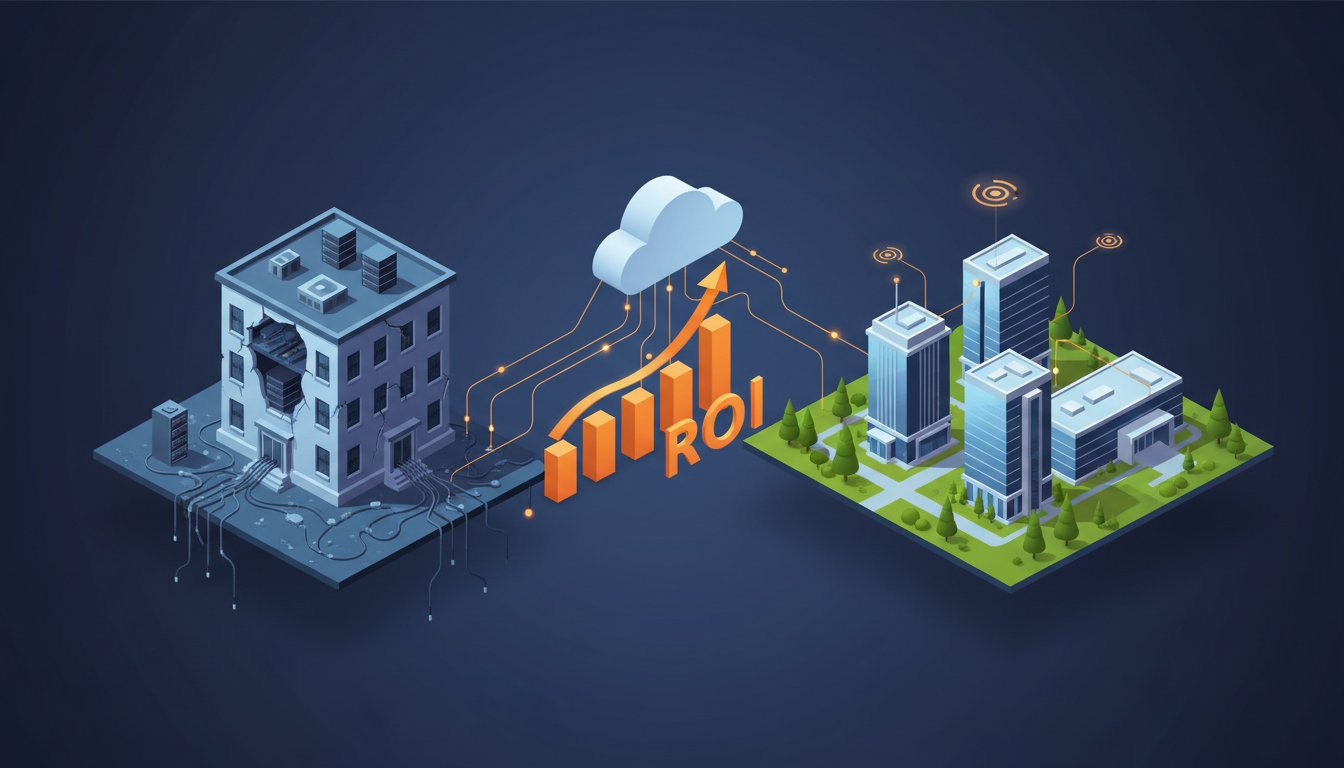
Why do 63% of enterprise leaders struggle to justify cloud migration when the inefficiencies of legacy hardware are so apparent? The challenge isn’t a lack of data, but the absence of a framework that translates technical agility into fiscal certainty. Mastering how to calculate ucaas roi requires moving beyond simple invoice comparisons to a model of strategic alignment. You’ve likely felt the friction of siloed communication costs and the compounding fees of maintaining copper lines that belong to a previous era. It’s difficult to build a case when the most significant gains, such as employee productivity, feel too abstract for a boardroom presentation.
We’ve designed this guide to provide the clarity you need to quantify your communication strategy with precision and professional elegance. We’ll move past surface-level metrics to explore a framework that captures both immediate hardware savings and long-term operational excellence. You’ll learn to identify hidden cost reductions and use a bespoke formula to present an unshakeable business case to your stakeholders. By the end of this guide, you’ll have a sophisticated roadmap to turn communication infrastructure into a driver of transformative growth.
Key Takeaways
- Transition from a narrow cost-cutting mentality to a sophisticated framework that harmonizes immediate CAPEX reductions with long-term strategic efficiency.
- Master the precise methodology of how to calculate ucaas roi by identifying hidden overhead in redundant licenses and consolidating fragmented vendor ecosystems.
- Quantify the impact of operational agility by measuring the productivity gains achieved through seamless, mobile-first communication structures.
- Mitigate enterprise risk by calculating the “Cost of Silence” and comparing legacy system vulnerabilities against the inherent resilience of cloud-based continuity.
- Build an unshakeable business case that transforms raw infrastructure audits into a compelling narrative for your organization’s transformative growth.
The Strategic Framework for UCaaS ROI Analysis
Calculating the return on investment for cloud-based communication is no longer a simple exercise in comparing monthly invoices. To truly understand how to calculate ucaas roi, enterprise leaders must transition from a “phone bill” mentality to a comprehensive view of organizational efficiency. This framework balances immediate capital expenditure reductions with long-term operational fluidity. It’s a shift from viewing technology as a utility to treating it as a catalyst for growth.
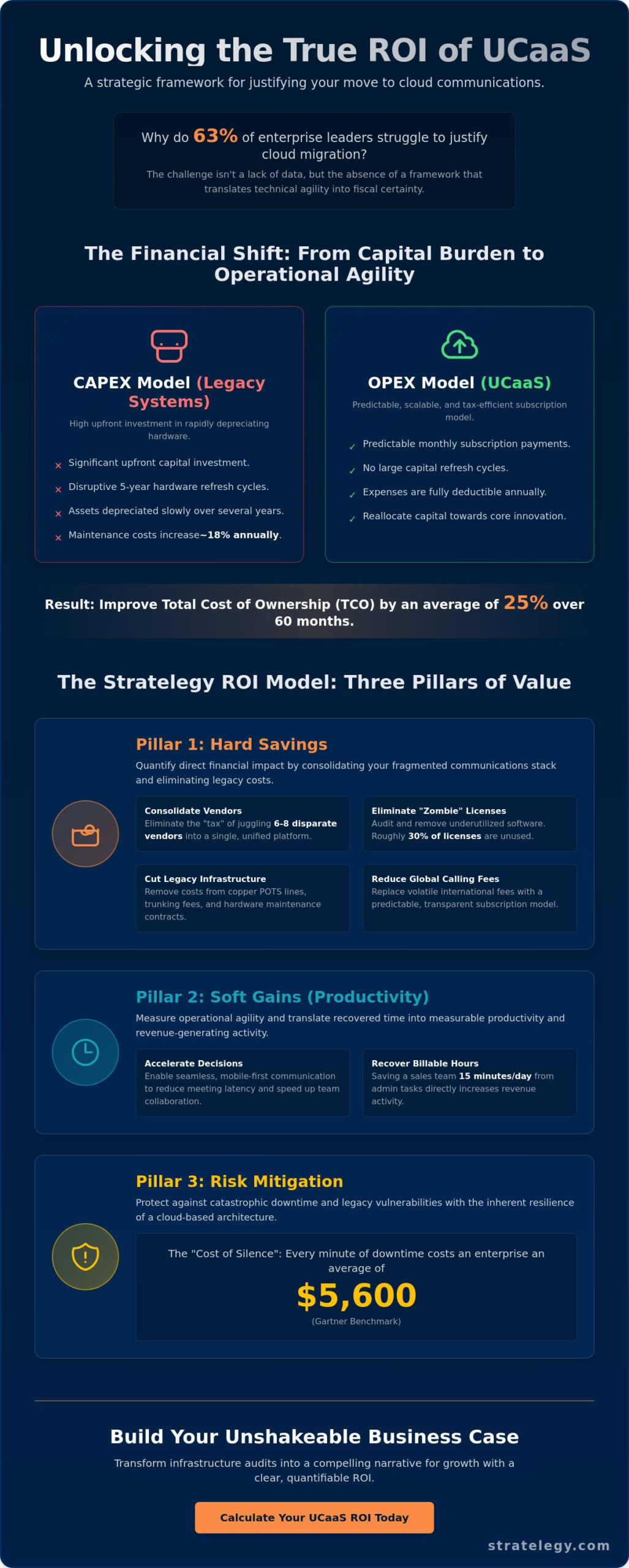
By 2026, the financial burden of maintaining legacy on-premises systems will shift from a sunk cost to a primary liability. Industry data suggests that the cost of maintaining aging hardware increases by roughly 18% annually as spare parts and specialized technical expertise become scarce. Transitioning to Unified Communications as a Service (UCaaS) mitigates this decay, replacing unpredictable repair costs with a predictable, scalable model.
The Stratelegy ROI model rests on three essential pillars:
- Hard Savings: The immediate elimination of trunking fees, maintenance contracts, and disparate vendor invoices.
- Soft Gains: The measurable uptick in employee output, reduced meeting latency, and faster decision cycles.
- Risk Mitigation: The protection against downtime, which can cost enterprises upwards of $5,600 per minute according to historical Gartner benchmarks.
Hard Costs vs. Strategic Value
While invoice-level savings are easily audited, the most profound impact of UCaaS lies in its capacity for transformative business growth. We often categorize “soft benefits” as indirect hard savings because they represent recovered time and resources. For instance, reducing a sales team’s daily administrative burden by 15 minutes through integrated tools translates directly into increased revenue-generating activity. Strategic Synchronization is the deliberate alignment of technological infrastructure with overarching corporate objectives to ensure every digital investment serves a measurable business outcome.
The Shift from CAPEX to OPEX
Moving to a cloud model introduces a level of financial elegance that traditional hardware cannot match. Predictable monthly subscription models eliminate the jarring impact of the five-year hardware refresh cycle, which often requires significant upfront capital. This shift also carries distinct tax advantages; service-based expenses are typically fully deductible in the year they’re incurred, whereas capital assets must be depreciated over several years. By removing physical servers and proprietary handsets from the balance sheet, organizations improve their Total Cost of Ownership (TCO) by an average of 25% over a sixty-month period. This transition allows CFOs to reallocate capital toward innovation rather than infrastructure maintenance.
Quantifying Direct Financial Savings: The Hard ROI
Direct financial impact begins with the aggressive consolidation of a fragmented communications stack. Many enterprises currently juggle six to eight disparate vendors for video, telephony, and messaging, which creates a significant “tax” on both capital and operational focus. By migrating to a single, sophisticated platform, leaders eliminate the overhead of redundant third-party apps and the silent drain of “zombie” licenses. Industry data suggests that roughly 30% of enterprise software licenses remain underutilized or entirely forgotten. Determining how to calculate ucaas roi requires a meticulous audit of these overlapping expenditures to reveal the true baseline of your current spend.
The transition to a unified cloud environment also strips away the escalating costs of international calling and roaming. Traditional carriers often layer complex fee structures onto global communications, but a cloud-native approach treats every endpoint as a local node. This shift results in a predictable, subscription-based model that replaces volatile usage fees with a transparent monthly expenditure. For those seeking a deeper dive into financial modeling, this comprehensive guide to UCaaS and CCaaS ROI provides a robust framework for assessing total cost of ownership and hard cost savings.
Eliminating Legacy Infrastructure and POTS Lines
Traditional copper lines, or Plain Old Telephone Service (POTS), have transitioned from reliable staples to exorbitant liabilities. Major carriers have increased POTS pricing by as much as 500% in specific regions since the 2022 FCC deregulation. Replacing these legacy lines with LTE-based connectivity for fire alarms, elevators, and security systems offers a radical delta in cost. Modernizing these endpoints typically reduces monthly recurring charges by 40% to 60% per line, while simultaneously improving system reliability through cellular redundancy. It’s a clear example of how a
of technology and business goals translates into immediate capital efficiency.
Consolidating Licensing and Maintenance
The “App Overload” tax is a silent profit killer. Maintaining separate contracts for voice, chat, and video results in misaligned renewal cycles and administrative friction. Centralizing these functions under a unified enterprise-grade platform achieves immediate economies of scale. IT labor savings are equally transformative. When updates are vendor-managed in the cloud, internal teams reclaim approximately 20 hours per week previously spent on manual patches and hardware troubleshooting. This allows your most expensive technical talent to pivot toward high-value projects rather than routine maintenance. When you analyze how to calculate ucaas roi, these reclaimed hours must be factored in as a direct reduction in operational overhead.
- Vendor Reduction: Move from 5+ invoices to a single, predictable monthly billing cycle.
- Hardware Elimination: Remove the need for on-site PBX maintenance and expensive server room cooling.
- Labor Optimization: Centralize global system management into a single administrative portal.
Measuring Operational Agility and Productivity
Enterprise leaders often overlook the silent erosion of productivity caused by fragmented tools. True operational agility emerges when communication moves from a series of disconnected events to a synchronized flow. When you analyze how to calculate ucaas roi, the most profound gains often reside in “Time Reclaimed,” a metric that quantifies the recovery of lost billable or productive hours. By consolidating telephony, video, and messaging into a single pane of glass, organizations eliminate the friction that stalls momentum.
The impact is particularly visible in field-based and remote teams. Mobile-first communication protocols ensure that a technician on-site or a consultant in transit possesses the same collaborative power as an office-bound executive. This accessibility directly correlates to a 15% reduction in project cycle times. Faster access to expertise means fewer decision-making delays. When a global team can see real-time presence indicators, they stop wasting cycles on unanswered emails and start resolving bottlenecks through instant, high-context interactions.
The Efficiency of Unified Interfaces
Context switching remains a primary antagonist of deep work. Research from the American Psychological Association suggests that even brief mental blocks created by shifting between applications can cost up to 40% of someone’s productive time. UCaaS mitigates this by centralizing workflows. Modern UCaaS solutions reclaim an average of 30 minutes of productive time daily per employee by centralizing fragmented communication streams. For a workforce of 1,000, this equates to 125,000 hours of recovered capacity annually.
- Integrated Presence: Reduces “internal ping-pong” by 25% through visibility of colleague availability.
- Global Synchronization: Aligns distributed teams across time zones without requiring additional middleware.
- Reduced App Fatigue: Lowers cognitive load, leading to higher employee engagement and lower turnover rates.
AI-Driven Efficiencies in 2026
As we look toward 2026, the framework for how to calculate ucaas roi must incorporate the transformative power of embedded AI. Automated meeting summaries and real-time transcription are no longer luxuries; they’re essential components of the modern toolkit. These features save an estimated 15 minutes of post-meeting administrative work per participant. In the contact center environment, Agent Assist AI provides real-time guidance, which has been shown to reduce Average Handle Time (AHT) by 22% while simultaneously increasing first-contact resolution.
The strategic advantage extends to customer journey analytics. By linking communication data to customer outcomes, leaders can identify exactly where friction occurs. This clarity drives higher Net Promoter Scores (NPS) and strengthens customer retention. A 5% increase in customer retention can lead to a profit increase of 25% to 95%. When communication is seamless, the customer feels the elegance of the operation, turning efficiency into a powerful engine for revenue growth.
Factoring in Risk Mitigation and Business Continuity
Enterprises often overlook the defensive dimensions of their investment when analyzing technology shifts. When you evaluate how to calculate ucaas roi, the framework must account for avoided catastrophes and the preservation of operational integrity. Legacy hardware represents a fragile, single point of failure that requires expensive, redundant on-premise sites to maintain. Cloud-native redundancy replaces these capital-heavy disaster recovery models with distributed, geo-redundant data centers. This transition ensures that critical life safety systems, including E911 and emergency alerts, remain functional even as carriers phase out traditional copper lines under FCC Order 19-72. A strategic migration isn’t just an upgrade; it’s a safeguard against the inevitable obsolescence of aging infrastructure.
The High Cost of Legacy Downtime
Downtime is a direct drain on the balance sheet that many leaders fail to quantify until a crisis occurs. Gartner reports that the average cost of IT downtime is $5,600 per minute. For a global enterprise, an hour of communication silence can translate to $336,000 in lost productivity and missed sales opportunities. Modern UCaaS platforms leverage LTE-based backup and automated failover to maintain connectivity during primary circuit failures. This resilience protects your brand reputation in a market where customers expect 24/7 accessibility. If a client can’t reach your team, they’ll reach for a competitor’s solution. Maintaining an “Always-On” state through a tailored framework is essential for preserving market share and long-term enterprise value.
Security and Compliance as Value Drivers
Security is a strategic asset that directly influences the bottom line. The 2023 Cost of a Data Breach Report by IBM found that the average breach cost reached $4.45 million, a figure that can bankrupt smaller divisions or severely damage shareholder trust. Modern UCaaS platforms provide built-in HIPAA and PCI-DSS compliance, which eliminates the need for fragmented, third-party security layers. This strategic alignment reduces the complexity of annual audits and minimizes regulatory risk. Centralized, encrypted call recording also allows legal teams to streamline discovery processes, often cutting manual review time by 25%. By providing a secure, corporate-sanctioned platform, you effectively eliminate the risks of Shadow IT, where employees use unmanaged applications to discuss sensitive business intelligence.
To ensure your organization remains resilient against evolving threats, you should align your communication strategy with long-term business continuity goals.
Building Your Business Case with Stratelegy
Transforming raw data into a persuasive narrative requires more than just spreadsheets; it demands a vision for future-state operations. Enterprise leaders often find that the challenge isn’t just gathering numbers, but weaving them into a story of strategic alignment. Stratelegy bridges this gap by converting complex metrics into a clear roadmap for transformative growth. We move your organization beyond simple cost-benefit analysis toward a sophisticated ROI narrative that resonates with the C-suite’s long-term objectives. This process ensures that communication modernization is viewed as a catalyst for innovation rather than a mere line-item expense.
The Audit: Uncovering Hidden Infrastructure Costs
A successful transition begins with a rigorous examination of the status quo. Our deep-dive audits frequently reveal that 15% to 25% of legacy telecom spend is tied to redundant services, unused licenses, or forgotten analog lines that have persisted through years of organizational shifts. We identify these inefficiencies through a systematic review of carrier billing, circuit inventories, and hardware maintenance contracts. This process provides the objective validation required by financial stakeholders, ensuring your business case stands on a foundation of verifiable truth. By leveraging enterprise UCaaS solutions, organizations can consolidate these fragmented costs into a single, predictable operational expense that scales with the business. The audit isn’t just about cutting costs; it’s about reclaiming capital to fund future innovation.
- Identification of “ghost” services and abandoned circuits that drain monthly budgets.
- Consolidation of disparate vendor contracts into a unified, manageable framework.
- Validation of current maintenance overhead versus the agility of cloud-based management.
Next Steps for a Customized Assessment
Standardized calculators often fail to capture the nuances of specific industry verticals or global scaling requirements. Stratelegy develops bespoke frameworks that account for your unique geographical footprint and compliance needs. Understanding how to calculate ucaas roi effectively means looking beyond immediate savings to the long-term value of your 2026 corporate vision. Our methodology ensures every dollar is mapped to a specific business outcome, such as reducing IT ticket volume by 40% or increasing remote team responsiveness by 30%. We help you prepare your team for this shift, ensuring the migration to a cloud platform is a cultural evolution toward higher productivity.
The path to communication modernization is most effective when it’s well-designed and purposefully executed. A clear, data-backed proposal demonstrates a path to structural harmony and competitive advantage. Schedule a strategic consultation with Stratelegy to receive a tailored ROI report based on your specific environment and organizational goals.
Architecting a Future of Quantifiable Connectivity
Mastering how to calculate ucaas roi requires a transition from basic cost comparison to a rigorous evaluation of business resilience. Enterprise leaders shouldn’t settle for surface-level metrics. By addressing the 2019 FCC Order 19-72 through enterprise-grade LTE POTS replacement, your organization secures its foundation against the decay of legacy copper lines. Industry data from Metrigy indicates that seamless communication integration yields a 20% boost in operational productivity, a figure that directly impacts your bottom line. Stratelegy leverages a proven track record in national infrastructure modernization to ensure your transition is both fluid and financially sound. We don’t just provide tools; we design sophisticated, custom-tailored communication frameworks that turn technical necessity into a strategic advantage. It’s about creating a system where efficiency and elegance coexist.
Your path to a modernized enterprise starts with a precise, data-driven roadmap. Request Your Strategic UCaaS ROI Assessment to begin your transformation. Let’s redefine what’s possible for your infrastructure together.
Frequently Asked Questions
What is the average ROI period for a UCaaS migration?
Most enterprises achieve a full return on investment within 12 to 18 months of deployment. This timeframe reflects the strategic transition from fragmented capital expenditures to a streamlined operating expense model. By consolidating legacy systems into a unified cloud architecture, organizations typically realize a 30% reduction in total cost of ownership. This rapid recovery allows leadership to redirect capital toward transformative growth initiatives.
How do I calculate the hard cost savings of replacing POTS lines?
You calculate hard cost savings by subtracting the total monthly recurring charges of UCaaS from your current expenditure on analog lines and maintenance. Replacing legacy POTS lines often yields a 40% to 60% reduction in monthly connectivity costs. When you learn how to calculate UCaaS ROI, you must include the elimination of specialized hardware maintenance and long-distance fees. These tangible figures provide the empirical foundation for a robust business case.
Can UCaaS ROI include improvements in employee retention?
UCaaS ROI includes employee retention metrics because flexible communication tools can reduce staff turnover by up to 25% according to industry benchmarks. Modern talent expects seamless remote collaboration capabilities that legacy systems can’t provide. By quantifying the cost of hiring a replacement, which often reaches 50% of an annual salary, firms can translate improved satisfaction into significant bottom-line gains. It’s a vital component of a holistic financial framework.
What are the hidden costs of migration that might affect ROI?
Hidden migration costs typically include network infrastructure upgrades, E911 compliance fees, and contract termination penalties from legacy providers. Organizations often overlook the 20% increase in bandwidth requirements necessary to support high-definition video and voice across distributed teams. Identifying these variables early ensures your financial model remains accurate. A precise audit prevents budget overruns and maintains the integrity of your strategic roadmap.
How does AI impact the ROI of a cloud contact center (CCaaS)?
AI integration within a cloud contact center enhances ROI by reducing average handle times by 20% through automated routing and real-time agent assistance. These intelligent systems allow bots to resolve 70% of routine inquiries without human intervention. This efficiency shift lets your skilled personnel focus on complex problem-solving. The resulting increase in customer lifetime value represents a profound shift from a cost-center to a profit-driver.
Is the ROI for UCaaS different for mid-market vs. enterprise firms?
The ROI for UCaaS differs between mid-market and enterprise firms due to the scale of infrastructure and volume-based pricing structures. Enterprise organizations often see a 15% higher total saving because they consolidate a larger number of disparate legacy systems across global locations. Understanding how to calculate UCaaS ROI at scale requires a nuanced view of centralized management versus local site requirements. Mid-market firms benefit from faster agility, while enterprises gain through massive operational efficiencies.
How do I quantify the value of improved security in my ROI model?
You quantify the value of security by measuring the avoided cost of a data breach, which averaged $4.45 million per incident in 2023. UCaaS providers deliver sophisticated encryption and redundant protocols that individual enterprises often find cost-prohibitive to maintain. By shifting the risk profile to a certified cloud partner, you reduce the statistical probability of downtime and regulatory penalties. This strategic mitigation functions as a safeguard for both corporate reputation and financial health.