
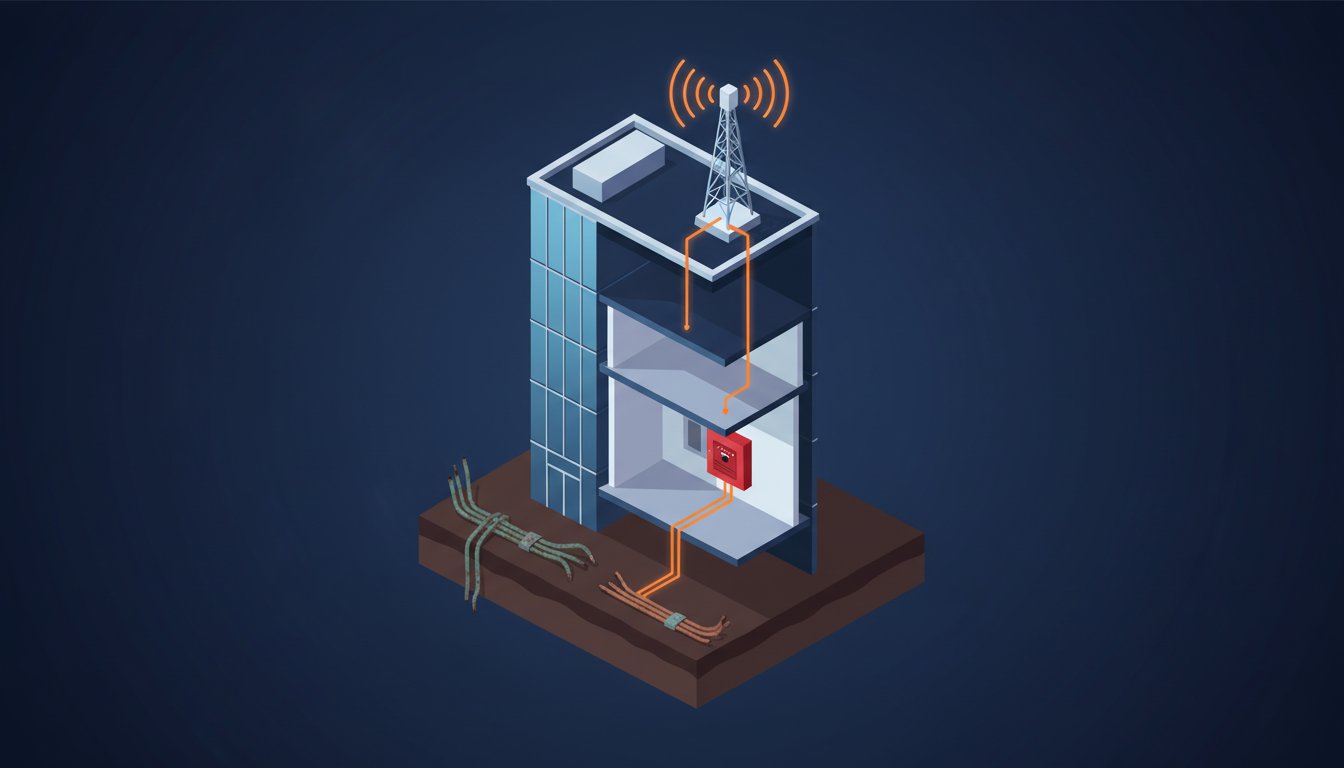
By 2026, the maintenance of traditional copper infrastructure will transition from a legacy expense to a structural liability for over 90% of commercial properties. You’ve likely watched your monthly invoices for nfpa 72 compliant phone lines escalate by as much as 450% since the FCC’s 2019 deregulation order, yet the reliability of these aging circuits continues to diminish. It’s a frustrating paradox where you pay a premium for a service that no longer guarantees the safety it’s legally required to provide.
We understand that the shift toward modern life safety communication requires more than just a hardware swap; it demands a strategic alignment of regulatory compliance and operational resilience. This guide offers a clear roadmap to replace your POTS lines with LTE-based solutions that meet every stringent requirement of the current safety codes. We’ll examine why standard VoIP often fails legal scrutiny, how to secure verified compliance for your fire panels, and the exact steps to achieve permanent cost stability for your emergency infrastructure.
Key Takeaways
- Understand the strategic implications of the 2026 copper sunset and why immediate action is required to maintain life safety integrity.
- Master the rigorous technical requirements for nfpa 72 compliant phone lines, specifically focusing on 5-minute supervision thresholds and 24-hour power resilience.
- Evaluate the “Power Gap” within standard VoIP architectures to ensure your communication paths do not fail during critical local outages.
- Implement a sophisticated framework for auditing legacy POTS lines, mapping each transmission path against the latest national and local building codes.
- Discover how resilient LTE integration provides a seamless, code-compliant bridge between legacy fire panels and modern communication infrastructure.
The Evolution of Life Safety: Understanding NFPA 72 Compliance in 2026
The regulatory landscape for fire safety is undergoing a fundamental transformation. At the center of this shift lies NFPA 72, the definitive National Fire Alarm and Signaling Code that dictates how life safety systems communicate. By 2026, the traditional methods of signal transmission will no longer suffice. Organizations must transition from legacy analog systems to sophisticated nfpa 72 compliant phone lines that meet modern digital standards. This isn’t merely a technical upgrade; it’s a strategic necessity to ensure that critical signals reach emergency responders without delay or distortion.
The Authority Having Jurisdiction (AHJ) serves as the final arbiter in this ecosystem. Local fire marshals and inspectors now scrutinize transmission paths with increased rigor, moving beyond simple dial-tone checks to validate end-to-end signal integrity. Legacy analog signals, once the gold standard, struggle to maintain clarity over aging copper networks that weren’t designed for modern data packets. As we approach 2026, the distinction between a simple connection and a verified communication path becomes the line between compliance and liability. Digital transmission requires a level of precision that decaying copper infrastructure can’t sustain.
The Impact of the FCC Copper Sunset
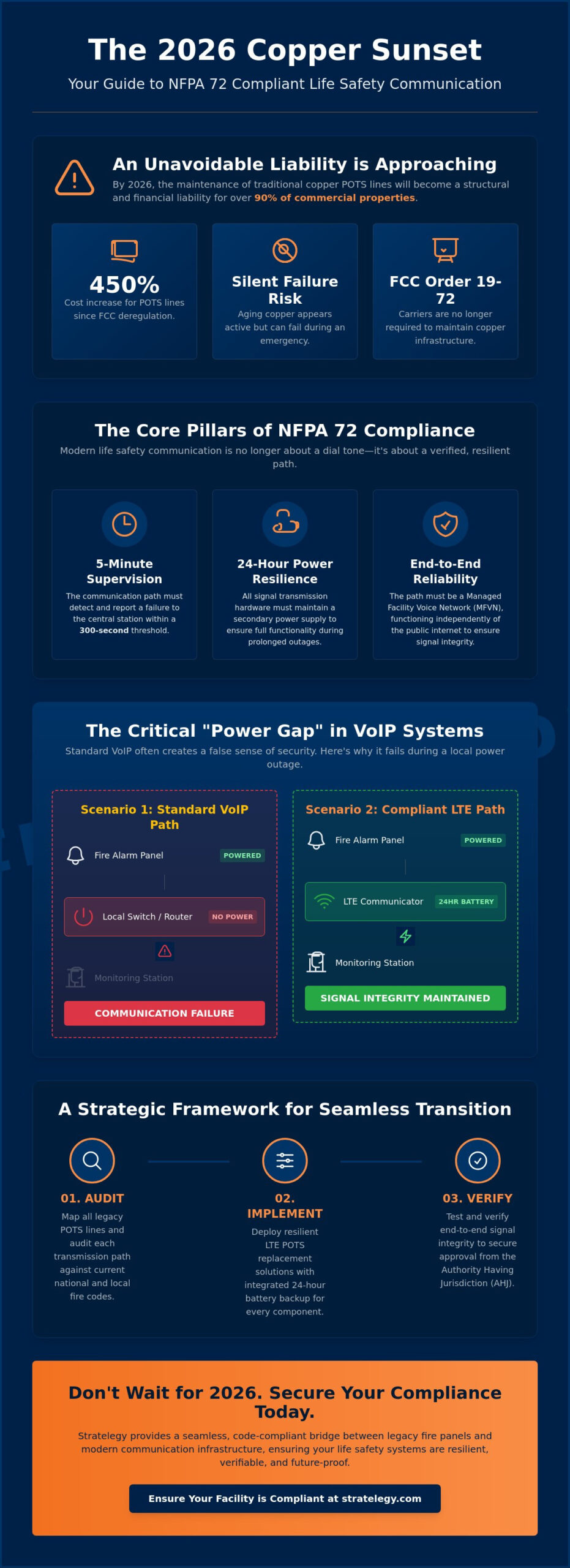
The sunset of Plain Old Telephone Service (POTS) isn’t a future prediction; it’s an active deregulation process initiated by FCC Order 19-72. This mandate removed the requirement for carriers to maintain copper infrastructure at capped rates, leading to maintenance costs that have surged by as much as 450% in certain regions. Beyond the financial burden, aging copper faces the threat of “silent failure.” Corrosion and lack of upkeep mean a line might appear active during a routine test but fail under the stress of an actual emergency. 2026 marks the final pivot point where enterprise-scale replacement moves from an IT recommendation to a mandatory life-safety protocol.
What Constitutes a Compliant Transmission Path?
Modern compliance centers on the Managed Facility Voice Network (MFVN). This framework requires more than just a signal; it demands a dedicated environment with specific characteristics:
- End-to-end reliability: The path must remain functional from the protected premises to the supervising station without relying on the public internet.
- Dedicated power backup: Systems must provide at least 24 hours of standby power to ensure nfpa 72 compliant phone lines remain active during local outages.
- Supervised connectivity: The network must automatically alert the monitoring station if the path is compromised or the signal is lost.
Regulatory language has evolved from “phone lines” to “communication paths.” This subtle shift reflects a broader technological migration toward cellular, IP, and hybrid solutions that offer the resilience analog copper can’t provide. Success in 2026 requires a structured approach to this migration, ensuring every link in the safety chain is both robust and verifiable. It’s about moving from a reactive maintenance model to a proactive, supervised infrastructure.
The Technical Architecture of an NFPA 72 Compliant Communication Path
The transition toward nfpa 72 compliant phone lines requires a meticulous understanding of structural integrity within life safety networks. Modern systems demand more than simple connectivity; they require a sophisticated framework that guarantees signal delivery under the most adverse conditions. According to the 2022 edition of NFPA 72, any communication path must be supervised, meaning the system has to detect a failure and report it to the central station within a 300-second threshold. This 5-minute window represents a significant shift from the 24-hour check-in intervals common in legacy copper environments, forcing a move toward more responsive, digital architectures.
Ensuring signal integrity begins at the Fire Alarm Control Panel (FACP) and extends through every piece of transmission hardware. Every component in this chain must maintain a 24-hour secondary power supply to ensure functionality during prolonged utility outages. Organizations are already abandoning traditional copper foundations to meet these rigorous standards. For example, the University of Arkansas outlined its policy shift in a memorandum regarding Communication Methods for Alarm Systems, citing the inherent unreliability of POTS for modern fire safety. A single-path strategy relies on one medium, while a dual-path strategy utilizes two independent technologies, such as IP and cellular, to eliminate any single point of failure.
Dual-Path Cellular Resilience
LTE-based systems provide the redundant backbone necessary for modern code compliance by utilizing diverse cellular towers. Multi-carrier switching technology allows the communicator to pivot between providers like Verizon, AT&T, or T-Mobile, maintaining a 99.99% uptime that legacy lines can’t match. Dual-path supervision is the gold standard for 2026.
MFVN Standards and Protocol Integrity
Managed Facilities-Based Voice Networks (MFVN) must mimic the precise dial tone and voltage of legacy POTS to ensure Digital Alarm Communicator Transmitters (DACTs) function without error. It’s vital that the transmission path doesn’t compress or distort the alarm codes, as even minor signal degradation can lead to “Fail to Communicate” (FTC) errors at the monitoring station. High-performance, low-latency cellular routers play a critical role here, providing the stable timing required for the complex handshakes between the FACP and the receiver. For leaders seeking strategic alignment between technical compliance and long-term asset protection, these architectural nuances aren’t just details; they’re the foundation of a resilient enterprise.
Evaluating Alternatives: Why VoIP Often Fails the NFPA 72 Test
The transition from analog infrastructure to digital communication often creates a dangerous illusion of compatibility. Many facility managers assume that because a Voice over Internet Protocol (VoIP) system handles office calls with clarity, it possesses the resilience required for nfpa 72 compliant phone lines. This assumption is a strategic oversight. Standard business VoIP systems prioritize cost efficiency and bandwidth compression over the absolute signal fidelity required by fire alarm control panels. When a fire alarm panel attempts to transmit a Contact ID or SIA signal through a compressed VoIP codec, packet loss as low as 1 percent can scramble the data. The monitoring station receives a “failure to communicate” rather than a life saving alert.
The “Power Gap” represents another critical point of failure. NFPA 72 standards require fire alarm communicators to have 24 hours of standby power. While a fire alarm panel has dedicated batteries, the local network infrastructure supporting a VoIP line usually doesn’t. If a building loses power, the routers, switches, and internet gateways typically fail within minutes. Maintaining compliance through VoIP requires an extensive, expensive Uninterruptible Power Supply (UPS) network for every piece of hardware in the signal path. Without this, the communication link vanishes exactly when it’s needed most.
VoIP vs. LTE POTS Replacement
LTE POTS replacement solutions offer a dedicated, supervised path that standard VoIP cannot match. While VoIP shares office bandwidth with high traffic data like video conferencing and large file transfers, LTE solutions operate on isolated cellular frequencies. This architectural separation ensures that emergency signals never compete for priority. The Authority Having Jurisdiction (AHJ) frequently rejects standard VoIP because it lacks end to end supervision. In contrast, LTE dual path communicators provide the constant heartbeat monitoring required to meet modern safety codes. Many institutions have already recognized this technical gap. For instance, the University of Arkansas NFPA 72 Compliance memorandum details their strategic shift away from traditional copper and unreliable digital alternatives toward more robust communication methods.
The Liability of Non-Compliance
Choosing an unvetted communication path introduces profound insurance implications and strategic risks. If a catastrophic event occurs and the fire signal fails to reach the monitoring station due to a non-compliant VoIP connection, the building owner faces immense legal exposure. Insurance providers may deny claims based on the failure to maintain nfpa 72 compliant phone lines as stipulated in the policy. Beyond the financial risk, there’s the operational danger of unmonitored systems. LTE POTS replacement provides a documented, encrypted audit trail that proves compliance during annual inspections. This level of transparency transforms fire safety from a hidden vulnerability into a well managed, strategic asset that protects both human life and corporate capital.
A Strategic Framework for Modernizing Critical Communication Infrastructure
Transitioning to nfpa 72 compliant phone lines requires more than a simple hardware swap; it demands a rigorous architectural shift. Organizations often find themselves managing a fragmented assembly of legacy copper wires that have become both a fiscal burden and a liability. A structured framework ensures that the migration from analog to digital isn’t merely a reactive measure but a strategic alignment of safety and efficiency. This process begins with a clear vision of the future state, where reliability is baked into the very fabric of the communication path.
The National Infrastructure Audit
The first stage involves a comprehensive discovery of the existing footprint. It’s common for large enterprises to discover “ghost” POTS lines hidden in elevator shafts, fire alarm control units, or remote blue light emergency stations. These legacy connections carry monthly surcharges that have increased by over 450% since the FCC issued Order 19-72. By consolidating these disparate lines into a unified, managed cellular framework, leaders can achieve immediate ROI while establishing a more resilient transmission path. Mapping these paths against the specific requirements of local building codes ensures that every connection meets the rigorous standards of modern life safety regulations. A precise audit identifies exactly where the copper ends and where the digital transformation must begin.
Transition and Implementation Logistics
Execution must be surgical to prevent any lapse in protection. A phased migration strategy allows for the systematic cutover of devices without compromising site safety. This process requires precise coordination with monitoring stations to ensure that signals are received and verified the moment the new hardware goes live. Testing and verification procedures are critical. Local fire marshals expect documented proof that the new nfpa 72 compliant phone lines maintain constant connectivity. To meet these expectations, the communication path itself must be under 24/7 supervision, providing real-time alerts if the link is ever compromised.
Selecting a technology partner that offers managed LTE POTS replacement simplifies this complexity. The right partner doesn’t just provide a box; they provide a managed ecosystem that handles signal conversion, battery backup, and carrier redundancy. This approach turns a technical necessity into a streamlined operational advantage, ensuring that your life safety systems remain functional long after the last copper line is decommissioned. The goal is a seamless handoff where the monitoring station sees no interruption, but the facility manager sees a significant reduction in complexity and cost.
Ready to secure your infrastructure before the 2026 deadline? Schedule a strategic audit with Stratelegy to begin your transformation.
Stratelegy: Elevating Life Safety Through Resilient LTE POTS Replacement
Stratelegy defines the intersection of safety and structural elegance. Our approach to nfpa 72 compliant phone lines transcends simple connectivity; we architect resilient systems that protect assets while streamlining complex operations. As the 2026 deadline for copper sunset approaches, the transition from aging analog circuits to digital infrastructure has become a strategic necessity. Stratelegy engineers sophisticated communication architectures that meet the rigorous demands of modern life safety codes while providing the stability that enterprise organizations require.
Our “POTS in a Box” solution represents a masterclass in seamless integration. This technology interfaces directly with legacy fire alarm control panels (FACPs), converting analog signals into secure, encrypted data transmitted over dual-SIM LTE paths. By utilizing diverse carrier networks, we eliminate single points of failure. This architecture ensures 99.99% uptime, which far exceeds the reliability of decaying copper wires. We transform what was once a reactive cost center into a predictable, high-performance managed service. For organizations managing national portfolios, this shift replaces the chaos of multiple local exchange carriers with a singular, refined standard of excellence.
Beyond Compliance: The Strategic Advantage
Life safety systems shouldn’t exist in a silo. Stratelegy aligns these critical paths with your broader digital transformation goals, ensuring that every hardware upgrade contributes to enterprise resilience. A fully managed, supervised cellular path provides real-time visibility into system health, alerting stakeholders to issues before they become life-safety emergencies. Stratelegy serves as a visionary partner in infrastructure, crafting connections that are as aesthetically sound as they are technically superior. This proactive stance allows leadership to focus on growth, knowing their foundational safety systems are monitored by experts.
Commencing Your Infrastructure Modernization
Modernizing a national multi-site portfolio requires more than just a hardware vendor; it demands a single-provider model that can execute at scale. Stratelegy’s white-glove implementation process begins with a comprehensive assessment of your current nfpa 72 compliant phone lines and legacy hardware. We handle the logistical complexity of site audits, carrier coordination, and local authority (AHJ) testing across all 50 states. This centralized approach eliminates the friction of managing disparate vendors and ensures a uniform security posture across every facility. You can consult with a Stratelegy expert on your NFPA 72 compliance strategy to begin the transition toward a more resilient future.
- Eliminate the rising costs of traditional analog line maintenance.
- Ensure 24/7 supervision of all fire and life safety communication paths.
- Standardize hardware across national portfolios for simplified management.
- Future-proof your facilities against the total decommissioning of copper infrastructure.
Securing the Future of Life Safety Infrastructure
The 2026 deadline for copper line decommissioning marks a definitive shift in how enterprises approach emergency communication. Relying on legacy systems or unstable VoIP alternatives creates unnecessary risk, as these paths often fail the stringent latency and power requirements defined by current safety codes. Adopting nfpa 72 compliant phone lines isn’t merely a box to check; it’s a commitment to architectural resilience and long-term operational stability. Stratelegy bridges the gap between aging hardware and modern demands by delivering enterprise-grade LTE reliability that meets full NFPA 72 and UL standards. Our team manages national deployment capabilities to ensure every facility in your portfolio maintains a seamless, high-integrity connection. We don’t just solve a technical problem; we craft a refined framework for safety that stands the test of time. It’s time to replace uncertainty with a solution engineered for the highest stakes. Secure your critical infrastructure with Stratelegy’s LTE POTS replacement today. Your path to a modernized, compliant future is clear and well-designed.
Frequently Asked Questions
Is cellular communication allowed by NFPA 72 for fire alarms?
Yes, NFPA 72 explicitly permits cellular communication as a sole or secondary transmission path for fire alarm systems. This allowance, established in the 2013 edition of the code, recognizes cellular technology as a robust alternative to traditional copper wires. Modern LTE solutions ensure that emergency signals reach monitoring stations with the reliability required for life safety compliance. This transition represents a strategic alignment between regulatory standards and technological evolution.
Can I use my existing business VoIP system for fire alarm monitoring?
Standard business VoIP systems don’t meet the stringent requirements for nfpa 72 compliant phone lines because they lack the necessary power backups and managed network reliability. NFPA 72 requires that communication paths remain operational for 24 hours during a power failure. Most commercial VoIP setups fail this test when local internet hardware loses power. Utilizing a Managed Facilities-Based Network ensures your fire safety infrastructure maintains structural harmony with safety codes.
What is an MFVN and why is it required for NFPA 72 compliant phone lines?
A Managed Facilities-Based Network (MFVN) is a service provider that maintains end to end control over its physical facilities and software. NFPA 72 requires MFVN status because it guarantees the prioritization and delivery of emergency signals without interference from public internet traffic. This framework provides the intellectual elegance of a closed system, ensuring that 100% of fire alarm packets receive the necessary bandwidth to reach the central station instantly.
How does LTE POTS replacement handle power outages?
LTE POTS replacement devices include internal battery backups designed to exceed the 24 hour standby requirement mandated by NFPA 72 Section 10.6.7.2. These systems operate independently of the building’s electrical grid during an emergency. When the power fails, the device seamlessly switches to its internal power source. This ensures that your facility’s safety vision remains intact even during localized infrastructure collapses or extended utility outages.
What happens if a cellular tower goes down? Does my fire alarm still work?
Fire alarm systems equipped with dual-path communicators automatically reroute signals through an alternative path if a primary cellular tower fails. Most advanced LTE devices utilize multi-carrier SIM cards that connect to the strongest available signal from providers like AT&T or Verizon. If one network’s tower experiences a 0% uptime event, the system immediately identifies a secondary tower. This redundancy creates a resilient communication framework that eliminates single points of failure.
How much can a business save by switching from POTS to LTE for fire alarms?
Businesses often see a 60% reduction in monthly communication costs after retiring legacy analog lines. According to FCC reports from 2022, the price of maintaining traditional copper infrastructure has increased by over 300% in some regions as carriers phase out POTS. Transitioning to LTE allows for a more predictable financial model. This strategic shift transforms a ballooning operational expense into a streamlined, cost-effective safety asset.
Does NFPA 72 require dual-path communication for all buildings?
NFPA 72 doesn’t require dual-path communication for every building, provided the single path meets specific supervision criteria. A single communication path is compliant if it’s supervised at intervals of 60 minutes or less, as per the 2013 and later editions. However, many risk managers choose dual-path configurations to achieve a higher level of operational harmony. This choice reflects a commitment to a more robust and sophisticated life safety strategy.
How often must NFPA 72 compliant communication paths be tested?
Modern nfpa 72 compliant phone lines must send a test signal at least once every 24 hours to verify the integrity of the connection. For systems utilizing a single communication path, the 2013 edition of the code requires a supervision interval of 1 hour. These rigorous testing protocols ensure that your monitoring station receives a heartbeat signal 8,760 times per year. This constant verification maintains the structural integrity of your emergency response framework.