
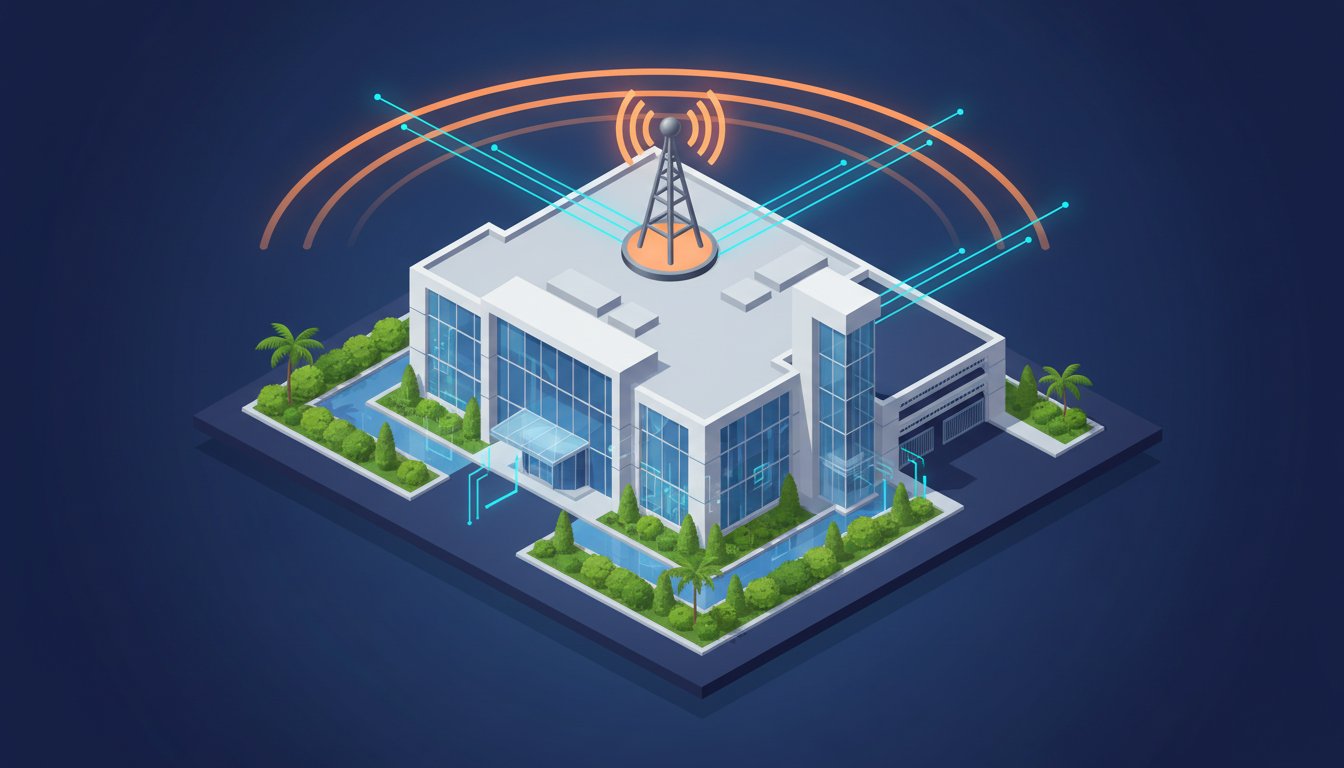
The copper wires currently powering your building’s security are no longer a utility; they’re a strategic liability. Since the FCC Order 19-72 took full effect, major carriers have shifted focus away from legacy infrastructure, leading to a 450% increase in maintenance costs for some property managers since 2022. You’ve likely experienced the frustration of soaring monthly invoices paired with a refusal from carriers to repair failing lines. It’s a precarious position where the safety of your residents and the security of your perimeter rely on a dissolving network. This guide outlines the definitive path for analog line replacement for building access systems, offering a transition from fragile copper to resilient, LTE-based connectivity.
Transitioning to modern technology doesn’t require a total overhaul of your existing hardware. We’ll show you how to achieve a seamless integration that preserves your current entry systems while introducing the precision of remote management. You’ll discover how to stabilize your operational budget and eliminate the constant threat of service outages. We’ll explore the technical frameworks and implementation steps required to transform your building’s access points into a secure, future-proof ecosystem by 2026.
Key Takeaways
- Understand the operational risks posed by the “Copper Sunset” and why transitioning from failing legacy infrastructure is essential for maintaining building continuity.
- Learn how to execute a seamless analog line replacement for building access systems using LTE technology that preserves critical DTMF functionality for intercoms and gates.
- Discover the security advantages of encrypted cellular transmission over vulnerable underground copper, ensuring your entry points remain resilient against physical disruption.
- Gain a strategic framework for auditing your entire building infrastructure to identify and modernize hidden analog lines in elevators and emergency alarm systems.
- Explore how to transform legacy hardware into a harmonized, enterprise-grade ecosystem through the strategic alignment of sophisticated LTE connectivity and cloud technology.
The Obsolescence of Copper: Why Building Access Systems are Failing
By 2026, the structural integrity of the nation’s communications backbone has fundamentally shifted. The reliance on Plain Old Telephone Service (POTS) is no longer a viable operational strategy for modern facilities. Carriers have accelerated the “Copper Sunset,” a systematic withdrawal from maintaining the physical infrastructure that once defined global connectivity. For property managers, this isn’t just a technical shift; it’s a critical vulnerability for gate controllers, keypads, and resident intercoms that still depend on 20th-century wiring.
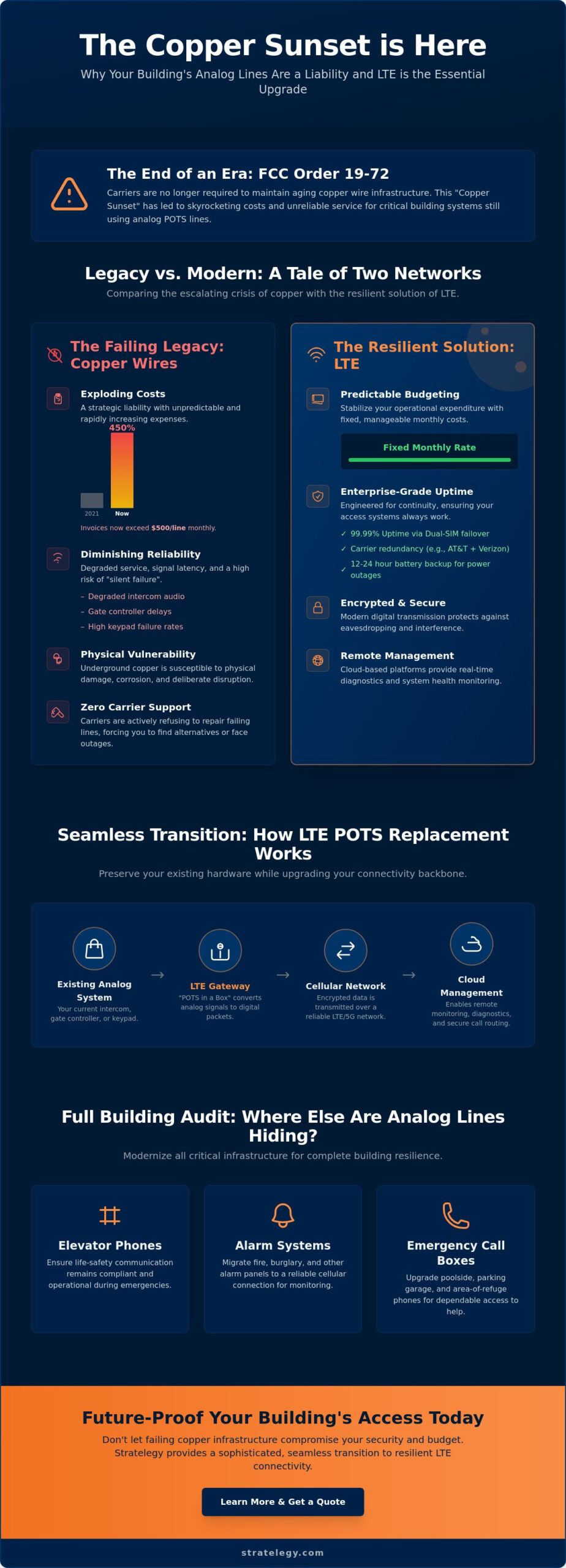
The financial reality of maintaining these legacy connections has reached a breaking point. Since 2022, major telecommunications providers have transitioned from gradual price increases to aggressive, disincentivizing rate hikes. Monthly invoices exceeding $500 per line have become the new standard. This pricing isn’t a reflection of the service’s value, but rather a calculated effort to force a transition. Without a proactive analog line replacement for building access systems, organizations face a future of escalating costs and diminishing service reliability.
The impact is most visible in three specific areas of building management:
- Resident Intercoms: Voice clarity has degraded as carriers stop repairing localized copper loops.
- Gate Controllers: Signal latency causes delays in entry, creating bottlenecks and security risks.
- Keypads and Dialers: High failure rates during peak hours lead to resident frustration and manual overrides.
The FCC Mandate and Carrier Decommissioning
The regulatory environment changed permanently with FCC Order 19-72. This mandate granted carriers “forbearance,” effectively removing the legal obligation to provide analog services at regulated prices or maintain the aging copper network. Carriers are now prioritizing fiber and 5G investments, leaving copper lines to wither. This creates a risk of “silent failure,” where a system appears functional on the surface but lacks the necessary voltage to trigger a gate or transmit clear audio during an emergency. It’s a precarious position for any building owner who values security and seamless access.
The Escalating Cost of Inaction
Modernization is no longer a choice between two technologies; it’s a move toward predictable operational expenditure. Over the last three years, the price trajectory of analog lines has climbed by more than 400% in major metropolitan areas. Beyond the monthly bill, the indirect costs of outages are staggering. When an analog gate controller fails, the immediate expense of hiring manual security guards can reach $40 to $60 per hour. Strategic alignment with digital alternatives allows for a tailored framework where costs are fixed, performance is monitored in real time, and the unpredictability of legacy hardware is finally eliminated.
How LTE POTS Replacement Works for Access Control
Transitioning from copper to cellular isn’t merely a hardware swap; it’s a strategic alignment of legacy stability with modern agility. The “POTS in a Box” architecture functions as a sophisticated translator that captures analog signals from your existing equipment and converts them into encrypted digital packets for transmission over LTE or 5G networks. This process ensures that your analog line replacement for building access systems maintains the reliability of traditional copper while shedding its inherent obsolescence. By digitizing the signal at the edge, the system preserves the integrity of the data while providing a pathway for remote management and real-time diagnostics.
Reliability remains the cornerstone of this modernization, particularly for high-density residential and commercial assets. Most professional-grade gateways utilize dual-SIM configurations to provide carrier redundancy. If one network experiences even a minor dip in performance, the system switches to a secondary carrier instantly to maintain 99.99% uptime. This level of resilience is supported by internal battery backups, typically providing 12 to 24 hours of operation during total power failures, which aligns with FCC guidance on network modernization regarding public safety and service continuity. The system must also deliver impeccable Dual-Tone Multi-Frequency (DTMF) support. These tones serve as the digital handshake between the visitor and the locking mechanism, making precision non-negotiable for intercom functionality.
Bridging the Gap: The ATA and Cellular Gateway
The hardware interfaces directly with existing RJ-11 connections, creating a seamless handoff between generations. By emulating the dial tone and voltage of a traditional central office, the gateway effectively tricks legacy intercoms into functioning as if they were still tethered to copper. This prevents the need for a costly rip-and-replace of the entire entry system. Real-time voice communication within access systems requires a maximum round-trip latency of less than 150 milliseconds to ensure seamless user interactions.
Ensuring Signal Integrity for Gate Controllers
Long-range gate openers often demand specific voltage thresholds that standard consumer hardware cannot provide. Life Safety grade hardware is engineered to deliver the precise 48V to 52V required for consistent gate triggering across long wire runs. By leveraging LTE-M and 5G bands, these systems achieve superior penetration through reinforced concrete and steel, ensuring signals reach the core of the building. This architectural precision is why many property managers are now seeking a tailored framework for digital migration to avoid the pitfalls of consumer-grade hotspots. Unlike residential equipment, these industrial solutions are hardened against interference, ensuring that the first line of building defense remains uncompromised.
Security and Compliance: Copper vs. Cellular vs. VoIP
The transition from legacy copper to modern infrastructure represents more than a technical upgrade; it’s a strategic realignment of building security. Traditional copper lines, while historically reliable, face inherent physical vulnerabilities. Underground cables lack encryption. This makes them susceptible to physical tapping or disruption, a risk factor that 2024 security audits increasingly highlight as a critical failure point. In contrast, enterprise-grade LTE gateways utilize AES-256 encryption, ensuring that every signal transmitted from a gate or lobby remains protected from interception. Modern cellular networks provide a level of data integrity that physical wires simply cannot match in a digital-first world.
The Failure of Pure VoIP in Building Access
Pure VoIP solutions frequently struggle with the specialized requirements of legacy hardware. Many building controllers rely on Dual-Tone Multi-Frequency (DTMF) signals to trigger door releases. In a VoIP environment, even a 1% packet loss can distort these tones, preventing the system from recognizing the “open” command. Standard VoIP setups don’t provide the 48V loop current that older intercoms require for operation. LTE-based analog line replacement for building access systems serves as the stable middle ground. It provides the necessary electrical current and mimics the precise timing of a POTS line, ensuring 99.99% uptime without requiring a total hardware overhaul. This approach creates a bridge between legacy reliability and modern connectivity.
Meeting Regulatory Standards for 2026
Compliance is the foundation of any sophisticated building management strategy. The 2022 edition of NFPA 72 and the UL 864 standards dictate strict requirements for “supervised lines.” These regulations demand that any communication failure is detected and reported within 200 seconds. While traditional copper lines are being decommissioned by providers across the United States, modern LTE replacements meet these safety benchmarks through dual-path communication and cloud-managed monitoring. These systems offer a level of oversight that was previously impossible.
High-security facilities now prioritize these features to maintain their certifications:
- Real-time audit trails: Every access event is logged in a cloud-managed dashboard for immediate review.
- Encrypted protocols: Data transmission utilizes enterprise-grade protocols that exceed standard banking security requirements.
- Supervised connectivity: The system performs automated “heartbeat” checks to ensure the line is active and functional.
Implementing a robust analog line replacement for building access systems ensures that your facility remains compliant with evolving life-safety codes. It transforms a simple utility into a strategic asset, providing the architectural harmony and functional resilience required for the next decade of operations. By choosing encrypted cellular pathways, managers eliminate the physical risks of copper while avoiding the technical instability of pure VoIP setups.
Strategic Implementation: Auditing Your Building Infrastructure
Successful analog line replacement for building access systems begins with a meticulous assessment of the existing ecosystem. It’s not enough to simply swap hardware; you must achieve a strategic alignment between legacy reliability and digital agility. A 2024 industry report indicated that 15% of building operational costs are often tied to redundant or obsolete telecommunications infrastructure. To reclaim these resources, you must first identify every active copper pair. This includes the visible intercoms at the front gate, the silent emergency lines in elevator cabs, and the critical fire alarm panels that maintain life safety compliance.
Before deploying any digital hardware, measuring signal strength at the Minimum Point of Entry (MPOE) is a non-negotiable requirement. Without a robust signal, even the most advanced LTE POTS replacement will fail to meet the 99.99% uptime standards required for modern security. Evaluating the age of your current hardware determines if a simple digital conversion is possible or if a complete hardware refresh is necessary. A 36-month Total Cost of Ownership (TCO) calculation reveals the true value of modernization; this analysis often shows that the maintenance of decaying copper lines exceeds the cost of a transformative digital upgrade within the first 18 months.
Performing a Comprehensive Line Audit
A professional audit uncovers “ghost lines” that remain on monthly invoices despite serving no functional purpose. In large commercial properties, these phantom charges can account for up to 10% of the total telecom spend. After the digital conversion, testing every entry point ensures that signal latency hasn’t compromised the user experience. You must verify signal strength at the exact point of hardware deployment to prevent intermittent connectivity issues that plague poorly planned installations.
Selecting the Right Modernization Partner
The “set it and forget it” mindset is a dangerous liability for building security. Effective analog line replacement for building access systems requires a partner who provides more than just a box. Look for LTE POTS replacement providers that offer 24/7 proactive monitoring and a centralized dashboard for multi-site property portfolios. This visibility transforms reactive maintenance into a streamlined, predictive operation. Selecting a provider with “White Glove” installation ensures that the transition is seamless, professional, and architecturally sound.
Stratelegy’s LTE POTS Replacement: Sophisticated Connectivity
Modernization isn’t merely about surviving the 2026 copper sunset; it’s an opportunity for strategic alignment between legacy physical assets and the boundless potential of cloud technology. Stratelegy approaches analog line replacement for building access systems through a lens of architectural harmony. We don’t just provide a technical fix. We engineer a bridge that connects your current infrastructure to a future of transformative growth. This transition represents a shift from fragile copper wires to a resilient, software-defined ecosystem.
Our solution utilizes enterprise-grade hardware specifically designed to withstand the rigorous demands of high-traffic multi-tenant environments. These aren’t consumer-grade routers. They are industrial-strength gateways that ensure 99.99% uptime for critical entry points. By adopting our managed service model, building owners eliminate the burden of maintenance entirely. We handle the monitoring, the security updates, and the proactive hardware health checks. This allows facility leaders to focus on high-level operations while we ensure the absolute stability of the communication foundation.
Beyond Replacement: A Platform for Building Intelligence
An LTE gateway shouldn’t be a dead-end investment. At Stratelegy, we view these devices as a foundation for broader UCaaS or CCaaS integration. When your building access system is digitized, it becomes a node in a larger intelligence network. Facility managers gain access to real-time alerts and remote diagnostics, often identifying a hardware failure before a tenant even reports it. This proactive stance transforms maintenance from a reactive cost into a managed asset. We invite you to schedule a Strategic Infrastructure Consultation to map out how this connectivity can serve your long-term vision and operational efficiency.
Seamless Integration, Absolute Reliability
The transition to modern connectivity shouldn’t require a “rip-and-replace” of your existing, expensive intercom hardware. Our framework integrates seamlessly with your current equipment, preserving previous capital expenditures while upgrading the underlying signal to a digital standard. We specialize in national-scale deployment, providing a consistent standard of support across your entire property portfolio. It’s a commitment to infrastructure stability that yields measurable peace of mind. Modernize your building access with Stratelegy and turn a technical necessity into a sophisticated competitive advantage.
Mastering the Transition to Resilient Building Access
The sunset of traditional copper infrastructure isn’t a distant threat; it’s a pressing operational reality. Under FCC Order 19-72, carriers have accelerated the decommissioning of legacy networks, making maintenance both difficult and strategically unsound. Transitioning to a modern framework ensures that critical life safety systems remain operational during the 2026 modernization wave. It’s a strategic move that replaces fragmented hardware with a refined, cloud-managed framework designed for long-term stability.
Implementing a strategic analog line replacement for building access systems transforms a legacy liability into a sophisticated asset. Stratelegy delivers enterprise-grade reliability for critical life safety systems through national-scale deployment expertise. Our solutions provide cloud-managed visibility for multi-site portfolios, ensuring every entry point remains secure and visible from a single, elegant interface. We don’t just solve a connectivity problem; we create a harmonious operational structure that aligns with your vision. Secure your building’s future with Stratelegy’s LTE POTS Replacement. Let’s build a resilient foundation for your portfolio’s next decade of growth.
Frequently Asked Questions
Is LTE POTS replacement reliable enough for emergency building access?
LTE POTS replacement solutions are exceptionally reliable, engineered to meet UL 864 and NFPA 72 standards while maintaining 99.99% uptime for critical life-safety communications. These systems utilize dual-SIM technology to provide carrier redundancy across major networks like AT&T and Verizon. By bypassing decaying copper infrastructure, facilities gain a stable connection that eliminates the frequent outages associated with aging analog lines.
Will I need to replace my existing intercom or gate hardware?
You don’t need to replace your existing hardware because modern LTE bridge devices interface directly with legacy RJ-11 connections. This strategic alignment allows property managers to retain their current investment in intercoms and gate controllers while upgrading the underlying communication path. Approximately 95% of legacy systems are compatible with these digital-to-analog conversion units, facilitating a seamless transition without costly infrastructure overhauls.
How much does it cost to replace an analog line for building access?
Costs for analog line replacement for building access systems vary based on the number of lines and the specific hardware required for your facility’s configuration. While individual hardware and installation fees depend on site complexity, industry reports from 2023 indicate that monthly operational expenses for LTE-based lines are often 30% to 50% lower than traditional copper POTS lines. We recommend a site audit to determine the precise ROI for your specific building portfolio.
What happens to the entry system if the power goes out?
The entry system remains functional during power outages because professional-grade LTE replacement units include integrated battery backups that provide 12 to 24 hours of standby operation. This capability ensures compliance with safety regulations like the 2024 International Building Code requirements for emergency communication continuity. Your building access remains secure and operational even when the local grid fails, maintaining the integrity of your security perimeter.
Can I use a standard cellular hotspot for my building intercom?
You shouldn’t use a standard cellular hotspot because consumer-grade devices lack the necessary dial-tone emulation and voltage requirements to trigger analog hardware. Professional LTE solutions provide a regulated 48V loop current and precise ring voltage that standard hotspots cannot replicate. Using non-specialized hardware often results in failed calls or inconsistent gate releases, which compromises the reliability of your analog line replacement for building access systems.
How long does the installation of an LTE POTS replacement system take?
A standard installation typically takes between 2 and 4 hours per unit, depending on the existing wiring architecture and signal strength at the site. Technicians focus on mounting the bridge device, connecting the legacy RJ-11 lines, and verifying signal optimization. This rapid deployment model minimizes disruption to resident access, allowing for a transformative upgrade to your building’s communication framework within a single morning or afternoon.
Are there any recurring fees associated with LTE replacement?
Recurring fees include a monthly service subscription that covers the cellular data transmission and managed monitoring of the connection. These fees replace the traditional monthly bill from the incumbent local exchange carrier, which has seen price increases of over 200% in certain regions since 2019. This subscription model ensures your system receives continuous security patches and maintains a high-priority connection on the cellular network.
Does LTE replacement work for elevator emergency phones as well?
LTE replacement is specifically engineered to support elevator emergency phones and satisfies ASME A17.1 safety codes for elevators and escalators. These systems provide the necessary machine-to-machine data pathways to ensure clear, two-way voice communication with emergency dispatchers. By integrating elevator lines into a unified LTE framework, you create a cohesive and resilient safety infrastructure across your entire property.