
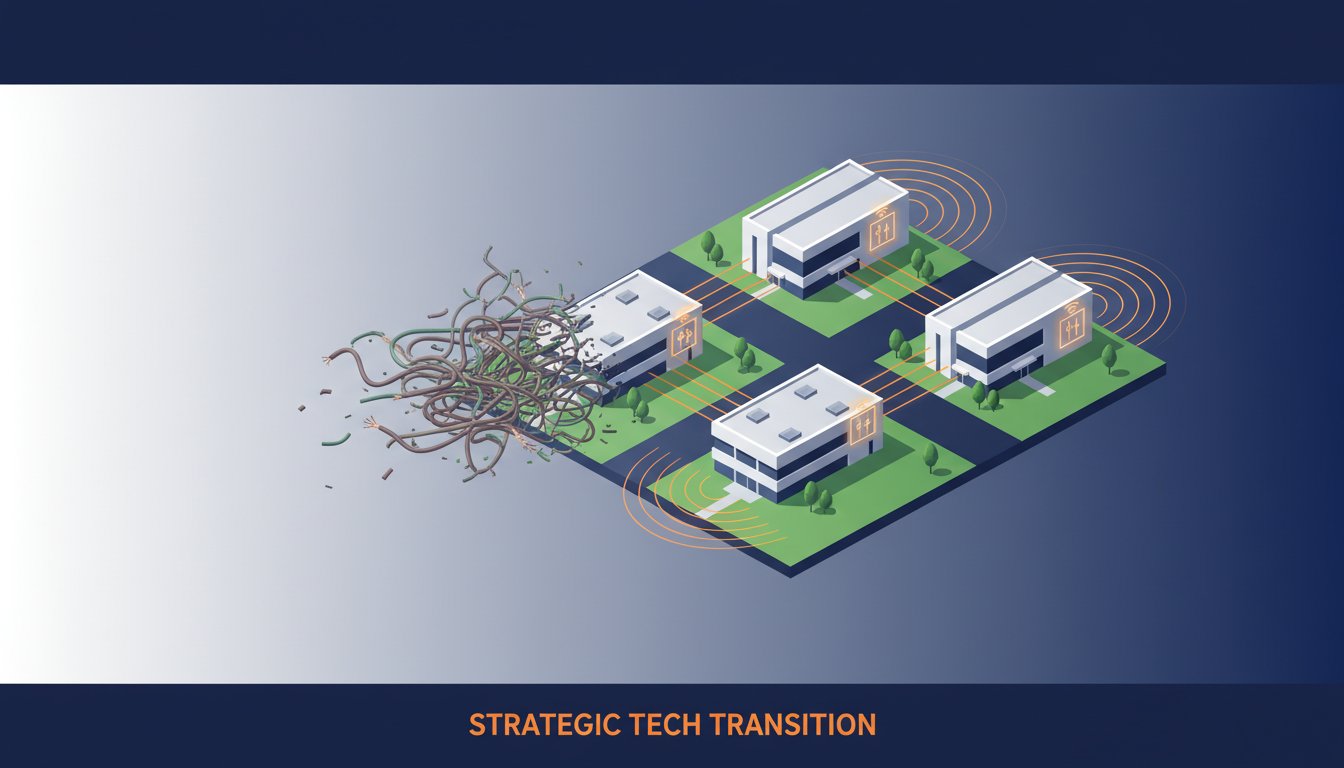
The era of the analog dial tone isn’t just fading; it’s being systematically dismantled under FCC Order 19-72. Since the August 2, 2022, deregulation milestone, service providers have aggressively shifted away from maintenance, leaving enterprises to grapple with the profound fcc copper retirement mandate business impact. You’ve likely noticed that the cost of maintaining a single legacy POTS line has surged by 300% or more since the start of 2024. It’s a calculated phase-out that places the burden of modernization squarely on your shoulders.
We recognize that managing this transition feels like a race against both escalating invoices and rigid regulatory deadlines. This article offers a tailored framework to navigate the 2026 sunset while ensuring your fire alarms and elevator phones remain beyond reproach. You’ll gain a refined understanding of the technical requirements for emergency systems and a roadmap to replace outdated copper with a resilient, modern infrastructure. We’re moving beyond simple survival to achieve a state of strategic alignment and operational harmony.
Key Takeaways
- Grasp the critical 2026 timeline of the FCC Copper Sunset to anticipate how carrier-driven discontinuations will reshape your operational landscape.
- Assess the comprehensive fcc copper retirement mandate business impact to safeguard your organization against escalating maintenance fees and the risk of unmanaged service outages.
- Identify the regulatory gaps where standard VoIP implementations fall short of essential life safety codes, ensuring your fire and emergency systems remain fully compliant.
- Adopt a rigorous inventory and requirement-mapping framework to transform your legacy infrastructure into a modern, strategically aligned communication ecosystem.
- Explore the Stratelegy LTE POTS replacement as a turnkey solution that converts technical necessity into a foundation for enterprise resilience and transformative growth.
The 2026 Landscape of FCC Copper Retirement
The era of traditional telecommunications is reaching a definitive conclusion. What many executives once viewed as a slow decline has accelerated into a mandatory technological migration. This transition, often termed the Copper Sunset, is governed by FCC Order 19-72. This order effectively decoupled carriers from the obligation to maintain the aging Plain Old Telephone Service (POTS) infrastructure. As we look toward 2026, the fcc copper retirement mandate business impact is no longer a theoretical risk; it’s a pressing operational reality.
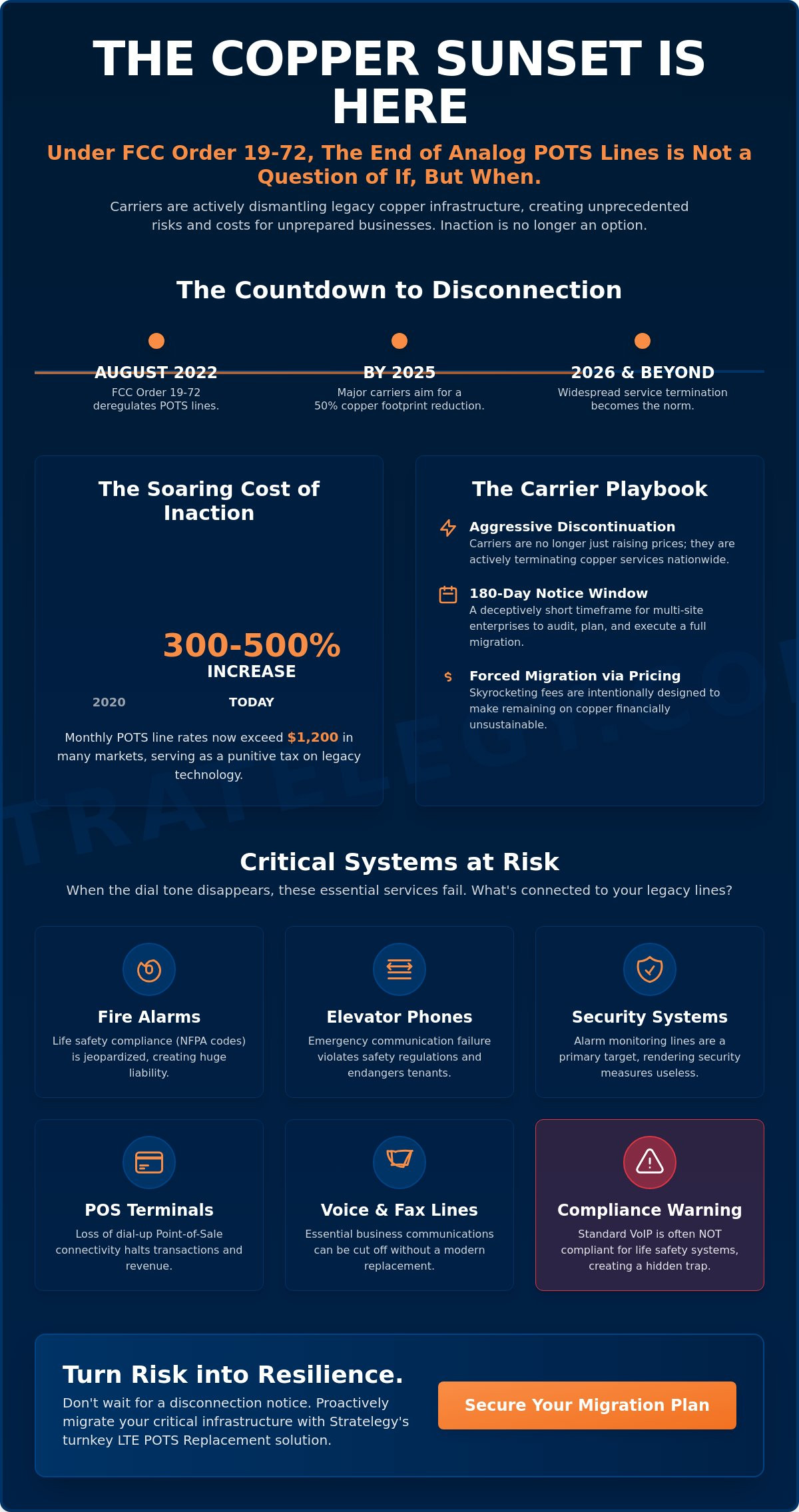
Major carriers like AT&T and Lumen have shifted their strategies from passive maintenance to aggressive discontinuation. AT&T committed to a 50% reduction in its copper footprint by 2025, setting the stage for a 2026 landscape where analog connectivity is the exception rather than the rule. We’ve transitioned from a period of grandfathering, where existing lines were tolerated, to a phase of full service termination across the national grid. This isn’t a mere upgrade. It’s an irreversible move toward IP-based and cellular ecosystems that demand a new level of strategic alignment.
Deconstructing the FCC Regulatory Framework
The regulatory guardrails have fundamentally changed. Under current rules, carriers must provide a 180-day notice to non-residential retail customers before discontinuing service. This six-month window is often insufficient for enterprises with complex, multi-site footprints. Since the FCC no longer requires carriers to maintain legacy pricing, service providers are legally permitted to raise rates to levels that discourage continued use. Their only primary obligation is to ensure that a replacement service, regardless of technology, is available to the consumer.
The Economic Reality of Legacy Maintenance
The financial burden of maintaining archaic copper lines has become unsustainable for providers and subscribers alike. Maintenance costs are skyrocketing as specialized technicians retire and replacement parts become scarce. Reliability is further compromised by copper theft, which increased significantly since 2021 due to rising scrap metal prices. These outages directly impact emergency response systems and critical fire alarms. The cost of inaction is quantifiable. Many businesses now face monthly line rates exceeding $1,200 per circuit. This represents a 400% increase in some markets compared to 2020 prices. Organizations must view this transition not as a technical hurdle, but as a catalyst for creating a more resilient, cost-effective communication framework.
Quantifying the Business Impact: Risk and Compliance
The shift away from legacy infrastructure isn’t merely a technical transition. It represents a fundamental realignment of operational continuity. When the dial tone disappears, the fcc copper retirement mandate business impact manifests as a sudden, often catastrophic cessation of critical functions. Many organizations view these analog lines as secondary, yet they frequently support life-safety systems, elevator phones, and secure point-of-sale terminals. Understanding the fcc copper retirement mandate business impact requires a look at both direct costs and hidden liabilities that emerge when legacy systems fail.
The financial reality is equally stark. Major carriers have increased POTS line rates by as much as 500% in certain markets to accelerate migration. These maintenance fees serve as a punitive tax on inertia. Beyond the balance sheet, compliance risks loom for regulated sectors. In healthcare, a failed emergency line could violate HIPAA safety standards. In finance, it might breach physical security protocols required for insurance coverage. Carriers are increasingly reluctant to cover losses if the underlying infrastructure, such as an alarm line, is deemed non-compliant with modern standards. Assessing business readiness for copper retirement is no longer optional; it’s a prerequisite for risk mitigation.
The 180-Day Transition Window
The FCC requires carriers to provide a 180-day notice before service termination. This timeframe is deceptively short. For an enterprise with 50 locations, a comprehensive audit of every fax machine and alarm panel takes weeks. Strategic planning prevents the emergency installation surcharges that vendors often levy when deadlines approach. A proactive strategic alignment of your infrastructure ensures that migration happens on your terms, not under the pressure of a service cutoff.
Legacy Hardware Obsolescence
Sourcing parts for TDM-based equipment has become a logistical nightmare. Since manufacturers ceased production of many analog components in the mid-2010s, businesses rely on a dwindling secondary market. Aging copper networks also suffer from signal degradation, which causes silent failures in fax transmissions and modems. These lines might show a voltage reading, yet they fail during high-traffic emergencies because the underlying physical wire can’t maintain the necessary data integrity. This creates a false sense of security that vanishes the moment a crisis occurs.
The Life Safety Crisis: Why VoIP Isn’t Always the Answer
Transitioning to digital infrastructure involves more than swapping a desk phone for a softphone. The fcc copper retirement mandate business impact is felt most acutely when legacy life safety systems meet standard Voice over IP (VoIP) protocols. While VoIP excels at office collaboration, it often fails the rigorous standards of NFPA 72 and ASME A17.1. These codes require specific levels of reliability that the public internet cannot guarantee. Traditional copper lines were self-powered by the central office, maintaining 48V of electricity even during local grid failures. Fiber-based VoIP lacks this inherent power, creating a structural vulnerability that requires a sophisticated, tailored framework to resolve.
Digital conversion also introduces signal latency and compression issues. Fire alarm panels communicate using Dual-Tone Multi-Frequency (DTMF) signals. Standard VoIP codecs are designed to compress human speech, which often garbles these precise tones. When a fire panel attempts to send an emergency code to a monitoring station, a “lossy” digital conversion can result in a failed transmission. This isn’t merely a technical glitch; it’s a strategic risk that could lead to delayed emergency response times and significant liability for building owners.
Fire Alarms and Elevator Phones
Modern fire monitoring requirements have evolved to demand dual-path communication. According to NFPA 72 (2022 edition), systems must utilize two separate transmission technologies or a single supervised path that reports failure within one hour. Most commercial buildings must also ensure a 24-hour battery backup for any emergency communication line. Elevator emergency phones, governed by ASME A17.1, present similar challenges. These lines require specialized cellular or managed IP handoffs to ensure trapped passengers remain connected during a network flicker. Achieving strategic alignment between these codes and your hardware requires moving beyond basic internet connections toward dedicated life safety solutions.
Vulnerabilities of Public Internet for Critical Systems
Sending life safety data over the open web introduces unacceptable security risks and technical instability. Jitter and packet loss, while barely noticeable on a video call, can disrupt the precise timing required for legacy alarm signaling. These systems should not sit on the open web where they are vulnerable to external traffic spikes or cyber threats. A Managed Facilities-based Voice Network (MFVN) is a physical service provider facility that provides end-to-end control of the communication path, ensuring the same reliability, power, and signaling integrity as traditional copper loops for 2026 compliance. By moving to an MFVN or a dedicated cellular bridge, businesses can transform their safety infrastructure from a legacy burden into a modern, resilient asset.
Strategic Framework for POTS Replacement
Managing the fcc copper retirement mandate business impact requires more than a tactical patch; it demands a comprehensive architectural redesign. The transition begins with a rigorous inventory audit to uncover the 15% to 20% of copper lines typically overlooked in large-scale enterprises. These legacy connections often sustain mission-critical infrastructure like elevator phones, fire alarm panels, and secure gate access systems that don’t appear on standard IT billing statements. A failure to identify these “ghost lines” before the 2026 sunset can lead to immediate safety violations and operational shutdowns.
Addressing the fcc copper retirement mandate business impact also necessitates a strict requirement mapping phase. Each line must be matched to its specific regulatory framework to ensure continued compliance. Fire safety systems must adhere to NFPA 72 standards, while healthcare data transmission through legacy fax machines requires HIPAA-compliant digital pathways. A successful migration strategy prioritizes these high-stakes connections through a disciplined framework:
- Audit: Cataloging every physical copper termination across all facilities, including those hidden in utility closets.
- Validation: Identifying the specific voltage and signaling requirements of legacy hardware to ensure compatibility with digital converters.
- Selection: Choosing the optimal medium—LTE-M, Fiber, or Fixed Wireless—based on site-specific signal strength and redundancy needs.
- Vetting: Partnering with managed service providers that offer 24/7 proactive monitoring and managed hardware to replace aging copper infrastructure.
- Parallel Execution: Running new digital solutions alongside existing copper for a minimum of 30 days to ensure zero-gap protection during the cutover.
LTE POTS Replacement: The Gold Standard
The “POTS in a Box” architecture serves as the premier solution for emulating analog dial tones over digital networks. These systems utilize dual-SIM cellular routers to achieve 99.99% uptime, automatically switching carriers if one network experiences latency or an outage. This hardware converts the RJ-11 signals of legacy devices into IP packets, ensuring that existing elevator or alarm hardware remains untouched and functional. Centralized cloud dashboards provide a visionary perspective, allowing IT leaders to monitor the health of every critical line across a global footprint from a single interface, transforming a fragmented network into a cohesive, manageable asset.
Comparing Connectivity Mediums
While fiber-based Managed Facilities-Based Voice Networks (MFVN) offer high bandwidth, LTE-M and Fixed Wireless often provide faster deployment cycles, sometimes reducing installation windows from 90 days to under 48 hours. This agility is vital for meeting the aggressive 2026 deadline. Integrating SD-WAN ensures that life safety traffic receives priority over general data, creating a resilient environment that withstands local fiber cuts. This approach future-proofs the organization, ensuring the infrastructure is ready for 5G integration and beyond. For organizations seeking to turn compliance into a competitive advantage, the right partner creates order from the chaos of legacy migration, turning a mandate into an opportunity for operational excellence.
The Stratelegy Approach: Beyond Simple Connectivity
Connectivity isn’t a utility; it’s a strategic asset that dictates the pace of your transformative growth. The fcc copper retirement mandate business impact forces a choice between reactive patchwork and proactive modernization. At Stratelegy, we view this transition as an opportunity to align your communication architecture with long-term enterprise goals. Our LTE POTS Replacement provides a turnkey solution that secures your infrastructure while removing the vulnerabilities of aging copper lines.
True resilience requires a unified, cloud-first strategy. We integrate UCaaS and CCaaS into a cohesive framework, ensuring your team remains connected regardless of physical location. This holistic approach transforms a mandatory compliance hurdle into a competitive advantage. Our experts guide your organization through every phase, from the initial audit of legacy systems to the continuous management of your new, agile environment. We prioritize the following pillars during every transition:
- Strategic Alignment: Ensuring every technology choice supports your broader business objectives.
- Operational Efficiency: Streamlining vendors and reducing the complexity of legacy hardware.
- Future-Proofing: Deploying scalable solutions that adapt to the 2026 horizon and beyond.
Enterprise-Grade Reliability
Managing multi-site infrastructure modernization involves layers of complexity that standard landline providers often fail to address. Stratelegy specializes in orchestrating these transitions for distributed enterprises. Our cellular-based life safety communicators outperform traditional lines by providing dedicated, supervised links for fire panels and elevator phones. In a recent deployment for a national retail chain, our POTS replacement strategy reduced operational costs by 40% by eliminating redundant analog lines and skyrocketing maintenance fees. We don’t just replace wires; we refine your entire operational cost structure through a tailored framework.
Initiating Your Strategic Modernization
Waiting for the next rate hike is a strategic failure. Since the FCC Order 19-72 allowed for price deregulation, legacy line costs have climbed by as much as 500% in certain regions. Stratelegy’s managed LTE solutions offer rapid deployment and predictable pricing models. Our team handles the heavy lifting, ensuring your transition is seamless and your business remains uninterrupted. Secure your infrastructure today before the 2026 sunset leaves your legacy systems in the dark. Contact Stratelegy to design your custom transition framework and turn the fcc copper retirement mandate business impact into a catalyst for your next era of growth.
Mastering the 2026 Connectivity Transition
The 2026 deadline established by FCC Order 19-72 represents a pivotal shift in how modern enterprises manage their essential communications. Ignoring the fcc copper retirement mandate business impact leads to more than just rising maintenance costs; it creates genuine vulnerabilities in life safety systems that require NFPA 72 compliance. Organizations must move beyond reactive fixes. A sophisticated transition to managed LTE ensures that fire alarms and elevator lines remain functional during the nationwide sunset of legacy copper networks. This isn’t just about replacing a wire. It’s about achieving strategic alignment between your physical infrastructure and digital future.
Stratelegy delivers a refined framework for enterprise-scale modernization across your entire national footprint. Our specialized solutions provide 24/7 monitoring and the robust reliability that standard VoIP systems can’t guarantee for critical life safety paths. We transform the chaos of expiring technology into a structured, high-performance asset. Secure your critical infrastructure with Stratelegy’s LTE POTS Replacement solutions today. Taking action now ensures your business remains both compliant and resilient as the landscape evolves.
Frequently Asked Questions
What is the specific FCC order mandating copper retirement?
The primary regulatory driver is FCC Order 19-72, adopted on August 2, 2019, which effectively eliminated the requirement for incumbent local exchange carriers to offer analog loop services at regulated rates. This shift creates a profound fcc copper retirement mandate business impact by allowing providers to sunset legacy infrastructure in favor of modern fiber and wireless alternatives. Organizations must recognize that the three year transition period for many pricing protections ended in August 2022, making immediate migration a strategic necessity.
Can I use a standard VoIP line for my building’s fire alarm system?
You can’t use a standard VoIP line for fire safety because it lacks the 24 hour battery backup and signal integrity required by NFPA 72 standards. Traditional VoIP compression often distorts the DTMF tones that alarm panels use to communicate with monitoring centers, leading to failed transmissions. Professional installations require a managed facility voice network or a UL-listed specialized gateway to ensure life safety signals reach emergency responders without interruption or data loss.
How much are POTS line rates expected to increase in 2026?
Industry data indicates that monthly costs for a single analog line have already surged from a $50 average to over $600 in specific urban markets since the 2019 ruling. By 2026, analysts project these legacy costs will climb by another 200% as carriers use aggressive pricing to discourage the use of aging copper infrastructure. This fiscal pressure serves as a strategic catalyst for businesses to adopt more cost effective, software defined communication frameworks that offer better long term value.
What happens if my business misses the 180-day discontinuance notice window?
If you miss the 180 day discontinuance window, your carrier has the legal authority to terminate your voice and data services without further delay. This abrupt loss of connectivity can disable critical systems like point of sale terminals and building security, leading to immediate operational downtime. Proactive monitoring of carrier notices ensures your organization maintains a seamless transition and avoids the chaos of an unforced service blackout.
Does the FCC copper retirement mandate apply to elevator emergency phones?
The mandate applies to all services delivered over copper, including the emergency phones in your elevators which must comply with ASME A17.1 safety codes. Because these lines are often the last to be modernized, they represent a hidden vulnerability in many corporate real estate portfolios. Transitioning to a cellular or fiber based solution ensures that your emergency communication remains compliant with local building codes even after the physical copper lines are decommissioned.
What is ‘POTS in a Box’ and how does it solve the retirement issue?
POTS in a Box is a specialized hardware gateway that converts analog signals from legacy devices into digital packets for transmission over LTE or fiber networks. It provides the necessary battery backup and loop voltage to power existing equipment like fax machines and alarm panels without requiring a total hardware overhaul. This solution bridges the gap between old world hardware and modern network reliability through a tailored, plug and play framework that preserves your existing investments.
Is cellular (LTE) more reliable than fiber for emergency communication?
Cellular LTE offers a distinct advantage for emergency systems because it doesn’t rely on physical wires that can be severed during construction or natural disasters. While fiber provides massive bandwidth, LTE with a 48 hour battery backup ensures your life safety systems stay online during localized power outages or infrastructure failures. Most high security configurations now utilize a dual path approach, combining fiber and cellular to achieve 99.99% uptime for mission critical pathways.
Will my legacy fax machines still work after the copper retirement?
Your legacy fax machines won’t function reliably on standard digital lines because the timing of analog signals gets disrupted during the digital conversion process. To keep these devices operational, you’ll need an Analog Telephone Adapter that supports the T.38 protocol for real time faxing over IP networks. Integrating these legacy endpoints into a modern fcc copper retirement mandate business impact strategy allows you to preserve existing workflows while upgrading the underlying transport layer to a more resilient standard.