

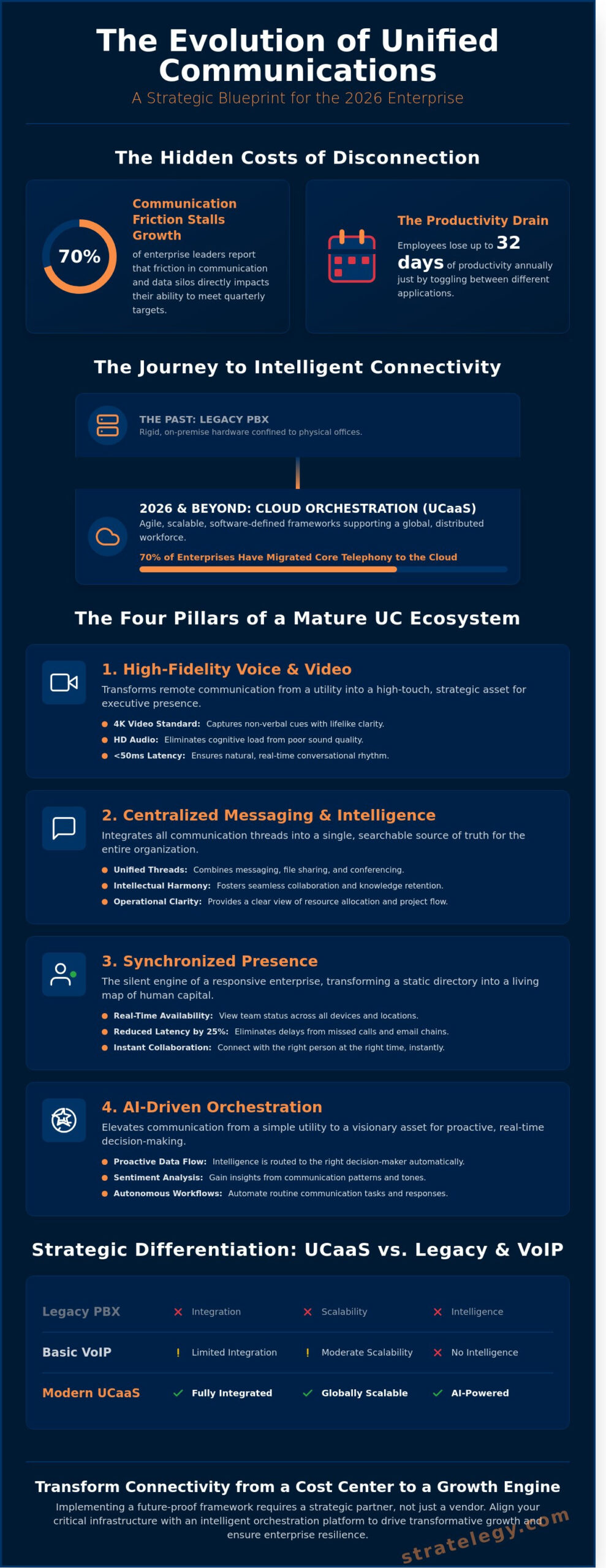
By 2026, the traditional copper wire and fragmented software stacks that once defined office life won’t just be obsolete; they’ll be a strategic liability to your balance sheet. The era of fragmentation is over. You likely recognize that managing isolated silos of data and unmanaged collaboration apps creates friction that stalls transformative growth. It’s a reality that 70% of enterprise leaders report communication friction directly impacts their quarterly targets. Understanding what is unified communications in this new era requires looking past simple voice calls toward a sophisticated orchestration of intelligence and connectivity.
We’ll show you how UC has matured into a strategic framework designed for enterprise resilience and seamless collaboration. You’ll gain a clear understanding of modern UC architecture and a roadmap for transitioning from legacy systems to the cloud, ensuring your communication tools align perfectly with your long-term business vision. This guide provides the clarity needed to transform your connectivity from a cost center into a powerful engine for organizational harmony and intelligence.
Key Takeaways
- Transition from simple connectivity to strategic orchestration, ensuring your enterprise data flows with precision and resilience in the 2026 digital landscape.
- Grasp the fundamental shift in what is unified communications to avoid the strategic pitfalls of confusing basic VoIP technology with a comprehensive enterprise solution.
- Integrate voice, messaging, and internal threads into a sophisticated, searchable knowledge base that fosters seamless collaboration and intellectual harmony across your organization.
- Leverage AI-driven sentiment analysis and autonomous orchestration to elevate communication from a simple utility to a visionary asset for real-time decision-making.
- Align your critical infrastructure with a future-proof framework that prioritizes strategic partnership over simple vendor relationships to drive transformative growth.
Defining Unified Communications in the 2026 Landscape
To understand what is unified communications in the 2026 landscape, one must look beyond the simple convergence of voice and video. It represents the strategic integration of real-time and non-real-time communication services into a single, cohesive user experience. While previous decades focused on basic connectivity, the 2026 environment prioritizes orchestration. Modern platforms manage the sophisticated flow of data across an enterprise, ensuring that intelligence reaches the right decision-maker at the precise moment of impact. This shift signifies that UC is no longer a mere software purchase; it’s a business philosophy of strategic alignment that facilitates transformative growth.
By treating connectivity as a core component of organizational architecture, leaders can dismantle the departmental silos that historically hindered progress. This approach fosters a sense of intellectual elegance in operations, where every interaction is purposeful and every tool is synchronized. The 2026 model moves away from reactive call flow management toward a proactive data flow strategy, allowing the enterprise to breathe as a single, responsive organism.
The Core Evolution: From PBX to Cloud Orchestration
The journey of corporate connectivity began with hardware-centric Private Branch Exchange (PBX) systems, which were often rigid and confined to physical office spaces. By 2024, the global transition toward software-defined Unified Communications as a Service (UCaaS) reached a critical mass, with 70 percent of enterprises migrating their core telephony to the cloud. This evolution replaced heavy infrastructure with agile, scalable frameworks that support a distributed workforce. Executives now utilize a single pane of glass interface to synthesize global operations, turning disparate data points into clear, actionable insights. The 2026 UC ecosystem is a borderless environment for global enterprise collaboration where technical friction is replaced by seamless digital harmony.
Why ‘Unified’ Matters More Than ‘Communications’
Fragmentation carries a quantifiable cost that many organizations overlook. A 2023 study by Qatalog and Cornell University revealed that employees lose up to 32 days of productivity annually simply by toggling between different applications. This friction erodes organizational focus and narrows profit margins. A unified framework addresses this by creating an aesthetic of efficiency, where the work environment feels harmonious and structured. Key components include:
- Synchronized Presence: This allows teams to view real-time availability across all devices, reducing communication latency by an average of 25 percent in critical workflows.
- Centralized Intelligence: By housing messaging, file sharing, and conferencing in one space, the enterprise maintains a single source of truth.
- Operational Clarity: Unified systems provide a clear view of resource allocation, allowing for better strategic alignment with long-term goals.
Presence information serves as the silent engine of the modern responsive enterprise. It transforms a static directory into a living map of human capital, enabling instant collaboration without the traditional delays of email chains or missed calls. When an organization masters what is unified communications, it stops struggling with its tools and begins to excel through its strategy.
The Structural Pillars of a Mature UC Ecosystem
Understanding what is unified communications requires a shift in perspective. It’s not a mere collection of disconnected tools; it’s a structural orchestration of four foundational pillars that create a seamless flow of intelligence. Precision defines the modern enterprise. By 2026, the baseline for professional presence has shifted from grainy video calls to 4K resolution streams that eliminate the psychological distance inherent in remote work. This evolution transforms communication from a utility into a strategic asset.
Voice and Video: The High-Touch Connection
In the 2026 landscape, HD audio and 4K video standards are the non-negotiable benchmarks for executive presence. High-fidelity sound removes the cognitive load of deciphering muffled speech, while ultra-high-definition video captures the nuance of non-verbal cues. Global service models now demand regional latency of less than 50 milliseconds to maintain the natural rhythm of conversation. Modern call control features allow a seamless transition between mobile and desktop endpoints; a call started on a smartphone during a commute continues on a boardroom screen without a second of downtime.
Collaboration Tools and Data Sharing
The industry has moved beyond temporary screen sharing toward persistent, collaborative digital workspaces. These environments act as a searchable knowledge base where context is maintained long after the initial call ends. Integration is key. Within a mature framework for unified communications and collaboration (UCC), teams co-author documents in real-time while maintaining encrypted security protocols. Security is no longer an afterthought. Leading systems now employ zero-trust architectures to ensure that sensitive enterprise data remains protected even during high-velocity sharing sessions.
Mobility and the Borderless Office
Fixed-mobile convergence has effectively turned the traditional desk phone into a relic of the past. Your professional identity is now an app on your smartphone, providing a consistent user experience regardless of your physical location or network connection. The rapid expansion of 5G networks, which Ericsson projects will reach 5.9 billion subscriptions by 2027, ensures that UC uptime remains constant for the mobile executive. This borderless office model relies on three critical components:
- Device Agnosticism: The interface remains identical whether accessed via tablet, laptop, or handset.
- Network Resiliency: Automatic switching between LTE, 5G, and Wi-Fi prevents dropped sessions.
- Unified Messaging: The convergence of voicemail, email, and SMS into a single, searchable digital workflow.
A mature ecosystem ensures that information is never trapped in a silo. Every interaction, whether it’s a quick chat thread or a formal video conference, contributes to the organization’s collective intelligence. For leaders seeking to refine their internal architecture, exploring a tailored framework can reveal hidden efficiencies in these structural pillars. When these components are strategically aligned, the result is a harmonious operation that reflects the sophistication of the brand itself.
Strategic Differentiation: UCaaS, VoIP, and the Legacy Sunset
Understanding what is unified communications requires a clear distinction between a transmission protocol and a holistic business solution. VoIP functions as the foundational technology, converting voice into data packets. However, treating VoIP as a synonym for Unified Communications is a strategic error that leaves 42% of enterprises struggling with fragmented workflows. By 2026, the industry faces the “Copper Sunset” as major carriers like AT&T and Verizon complete their withdrawal from traditional landline maintenance. This transition isn’t merely technical; it’s an existential shift for legacy systems. When leaders ask what is unified communications in a post-copper world, the answer lies in the orchestration of these diverse channels into a single, resilient architecture.
UCaaS vs. On-Premise: The Operational Shift
The transition from on-premise hardware to Unified Communications as a Service (UCaaS) represents a fundamental pivot from Capital Expenditure (CapEx) to Operational Expenditure (OpEx). In 2026, maintaining physical PBX stacks is a strategic liability. On-premise systems demand specialized labor and hardware refreshes every five years, creating unnecessary friction. Cloud-native UCaaS facilitates transformative growth by allowing organizations to scale users instantly. This agility eliminates the 20% overhead typically lost to idle infrastructure capacity, ensuring that the communication framework expands in perfect harmony with the enterprise. Evaluating the right unified communications providers is a critical step in making this transition with confidence and structural resilience.
The Critical Role of POTS Replacement in a UC Strategy
Legacy copper lines remain the weakest link in an otherwise modern connectivity strategy. While standard VoIP handles daily collaboration, it often fails critical infrastructure like fire alarms and elevator phones. These systems require constant voltage and specialized signaling that standard internet connections don’t provide. LTE-based POTS replacement solutions serve as the essential bridge between legacy safety and modern UC. By utilizing cellular-based “POTS in a box” technology, businesses can ensure 99.99% uptime for life-safety systems. This approach provides several strategic advantages:
- Regulatory Compliance: Meeting NFPA 72 standards for fire alarm signaling without relying on phased-out copper.
- Resilience: Decoupling emergency communications from the primary fiber loop to prevent single points of failure.
- Cost Stabilization: Avoiding the 300% price increases often seen as carriers discourage the use of remaining analog lines.
- Business Continuity: Maintaining secure, cellular-backed connections for security panels and point-of-sale systems during local outages.
A sophisticated UC strategy doesn’t just look forward to new features; it secures the foundations of the physical workspace. Integrating LTE-based alternatives ensures that the move toward a digital future doesn’t leave the safety of the physical environment behind. This creates a harmonized environment where innovation and security coexist without compromise.
2026 Trends: From Simple Collaboration to Intelligent Orchestration
The definition of what is unified communications has evolved from a suite of tools into a centralized nervous system for the enterprise. By 2026, the focus has shifted from mere connectivity to the orchestration of intelligence. Real-time sentiment analysis now serves as a vital barometer for organizational health. These systems analyze vocal inflections and linguistic patterns to provide an emotional heat map of a meeting. This data allows leaders to identify friction points before they escalate into systemic issues. It’s a move toward a more empathetic, data-driven management style where the platform understands not just what’s said, but how it’s felt.
Administrative burdens have largely vanished through autonomous orchestration. By 2026, 85% of enterprise meetings are supported by AI assistants that generate perfect transcriptions and assign action items with 98% accuracy. This transition turns every conversation into a structured asset. The convergence of UCaaS and CCaaS is now the industry standard for high-performing firms. According to 2025 industry reports, 64% of global enterprises have integrated their internal collaboration tools with their customer-facing platforms. This unified view ensures that the person solving a customer’s problem has the same context as the engineer who designed the product. For smaller organizations navigating this same convergence, selecting the right customer service software for small business is an equally critical step toward achieving that unified customer experience.
IoT integration represents the final frontier of this orchestration. Communication systems now interact directly with building infrastructure and safety sensors. If a chemical sensor in a laboratory detects a leak, the UC platform doesn’t just sound an alarm; it automatically initiates an emergency video broadcast to all nearby devices and locks down specific zones. It’s a seamless blend of digital communication and physical security.
Artificial Intelligence as a Strategic Advisor
Agent Assist AI has transformed the contact center into a hub of transformative growth. By 2026, predictive analytics forecast organizational bottlenecks 72 hours in advance by analyzing patterns in cross-departmental messaging. These systems act as a filter for the modern executive. AI in 2026 silences the peripheral noise of minor operational updates to illuminate the three most critical strategic priorities requiring leadership’s immediate attention.
The Security and Compliance Mandate
Security in 2026 is built on a foundation of Zero Trust architecture. Every interaction, whether internal or external, is verified in real-time to protect the enterprise from sophisticated social engineering threats. Compliance by design is no longer a luxury; it’s a structural requirement. Platforms now automate the nuances of HIPAA and SOC2 compliance through immutable, encrypted ledgers. For the B2B organization, end-to-end encryption is the standard that preserves the integrity of every strategic negotiation.
To ensure your organization is prepared for this level of sophisticated orchestration, explore our bespoke framework for digital transformation and align your technology with your long-term vision.
Implementing a Future-Proof Framework with Stratelegy
True digital transformation demands a shift in perspective. You aren’t simply purchasing a tool; you’re entering a partnership of strategic alignment. At Stratelegy, we view the question of what is unified communications not as a technical checklist, but as a blueprint for organizational harmony. Our approach modernizes critical infrastructure while simultaneously enabling cloud-based engagement, ensuring that your transition from legacy chaos to unified order is both seamless and aesthetic.
Reliability serves as the bedrock of this framework. For life-safety systems and business-critical voice, enterprise-grade standards aren’t optional. In an era where 98% of IT leaders prioritize uptime, settling for “good enough” connectivity is a liability. Stratelegy delivers the 99.999% availability required to support emergency services and high-stakes executive communication. We replace the fragility of aging systems with a robust, cloud-native architecture designed for 2026 and beyond.
Customized Frameworks for Complex Needs
Every enterprise possesses a unique operational rhythm. We tailor UCaaS and CCaaS solutions to match your specific workflow, rather than forcing your team into a rigid template. This customization extends to our nationwide support model, which navigates the intricate US regulatory landscape, including compliance with Kari’s Law and Ray Baum’s Act. By integrating LTE POTS replacement into your digital roadmap, we solve the 450% cost increase often associated with legacy copper lines since 2019. We turn a technical necessity into a strategic advantage.
Your Next Strategic Move
Inertia is the greatest threat to business continuity. Waiting to replace legacy lines exposes your organization to escalating costs and sudden service failures. When you evaluate a provider, look for vision rather than just feature lists. A partner should see the future of your connectivity before the first line of code is deployed. It’s time to move beyond the limitations of the past. You can consult with Stratelegy to orchestrate your enterprise communication strategy and define what is unified communications for your specific future.
Orchestrating Your Enterprise Connectivity for 2026 and Beyond
Understanding what is unified communications requires looking past mere software to a holistic, strategic framework. By 2026, the global UC market is projected to reach $167 billion according to Grand View Research, shifting the focus from basic connectivity to intelligent orchestration. Organizations must navigate the sunset of legacy infrastructure while integrating AI-driven insights into every touchpoint. Success isn’t found in fragmented tools; it’s forged through architectural harmony and a clear vision for the future.
Stratelegy brings a refined perspective to this digital transformation, acting as a visionary partner rather than a mere vendor. We specialize in critical LTE POTS replacement for life safety systems, ensuring 99.999% reliability during the transition to modern cloud environments. Our enterprise-grade UCaaS and CCaaS platforms provide the structural pillars your business needs for transformative growth. Design your enterprise communication framework with Stratelegy and turn technical complexity into a competitive advantage. The future of connectivity is a well-designed masterpiece, and it’s time to start building yours.
Frequently Asked Questions
What is the primary difference between VoIP and Unified Communications?
VoIP serves as the underlying transmission technology for voice, while Unified Communications represents an integrated ecosystem of voice, video, and data tools. VoIP converts audio into digital packets for internet transit; Unified Communications orchestrates these packets into a singular, cohesive interface. By 2026, 95 percent of enterprises will have transitioned from standalone VoIP to full UC suites to eliminate fragmented workflows. This strategic alignment ensures that communication isn’t just functional but structurally harmonious.
How does Unified Communications improve employee productivity in a hybrid work model?
Unified Communications improves productivity by reducing the 40 percent of time employees typically lose to context switching between disconnected applications. A 2023 McKinsey study found that integrated digital workspaces increase employee output by 20 to 25 percent in remote environments. By consolidating messaging and presence into one dashboard, teams maintain a rhythmic flow of information. It’s about creating a vision where distance doesn’t compromise the elegance of collaboration.
Why is POTS replacement considered a part of a unified communication strategy?
POTS replacement is vital because the FCC Order 19-72 effectively ended the requirement for carriers to maintain traditional copper lines as of August 2022. Transitioning these legacy circuits to a Unified Communications strategy prevents sudden service outages and mitigates the 20 percent annual cost increases seen in analog maintenance. It’s a necessary step toward transformative growth. Organizations must replace these aging frameworks with digital alternatives to ensure long term operational stability.
Is Unified Communications secure for sensitive enterprise data?
Unified Communications platforms are secure when they utilize end-to-end encryption and comply with global standards like SOC2 Type II or ISO 27001. Modern UCaaS providers now offer 99.999 percent uptime and multi-factor authentication to protect sensitive enterprise data. Security isn’t an afterthought; it’s a foundational element of a well designed communication framework. These protocols ensure that your strategic assets remain protected against evolving digital threats.
Can UCaaS integrate with existing CRM and ERP software?
UCaaS platforms integrate with CRM and ERP software through robust APIs to create a unified data stream across the organization. Research from Salesforce indicates that integrated communication tools can save sales teams up to 32 hours per month by automating call logging and data entry. This integration ensures that every client interaction is documented within your existing framework. It’s a precise way to align your technical infrastructure with your business goals.
What happens to our fire alarms and elevator phones when we move to UC?
Fire alarms and elevator phones require specialized Analog Telephone Adapters or cellular bridge devices to maintain compliance with life safety codes like NFPA 72. Moving to UC doesn’t mean abandoning these critical lines; it means modernizing the path they use to reach emergency services. You’ll need managed solutions that provide 24 hour battery backup and LTE failover. This approach transforms a legacy burden into a reliable, monitored safety system.
How does AI enhance Unified Communications in 2026?
AI enhances what is unified communications in 2026 by providing real time sentiment analysis and automated meeting synthesis with 98 percent accuracy. These intelligent systems act as proactive advisors, identifying bottlenecks in team communication before they escalate. By 2025, Gartner predicted that 75 percent of enterprise conversations would be analyzed by AI to improve customer experience. It’s a sophisticated leap from simple data collection to actionable, visionary insight.
What are the cost benefits of moving to a cloud-based UCaaS platform?
Moving to a cloud-based UCaaS platform reduces total cost of ownership by an average of 30 percent according to Nemertes Research. Organizations eliminate the capital expenditure of on-premises hardware and the recurring costs of separate maintenance contracts. It’s a shift from unpredictable repair fees to a streamlined, per-user subscription model. This fiscal clarity allows leaders to reinvest savings into other areas of transformative business growth.