
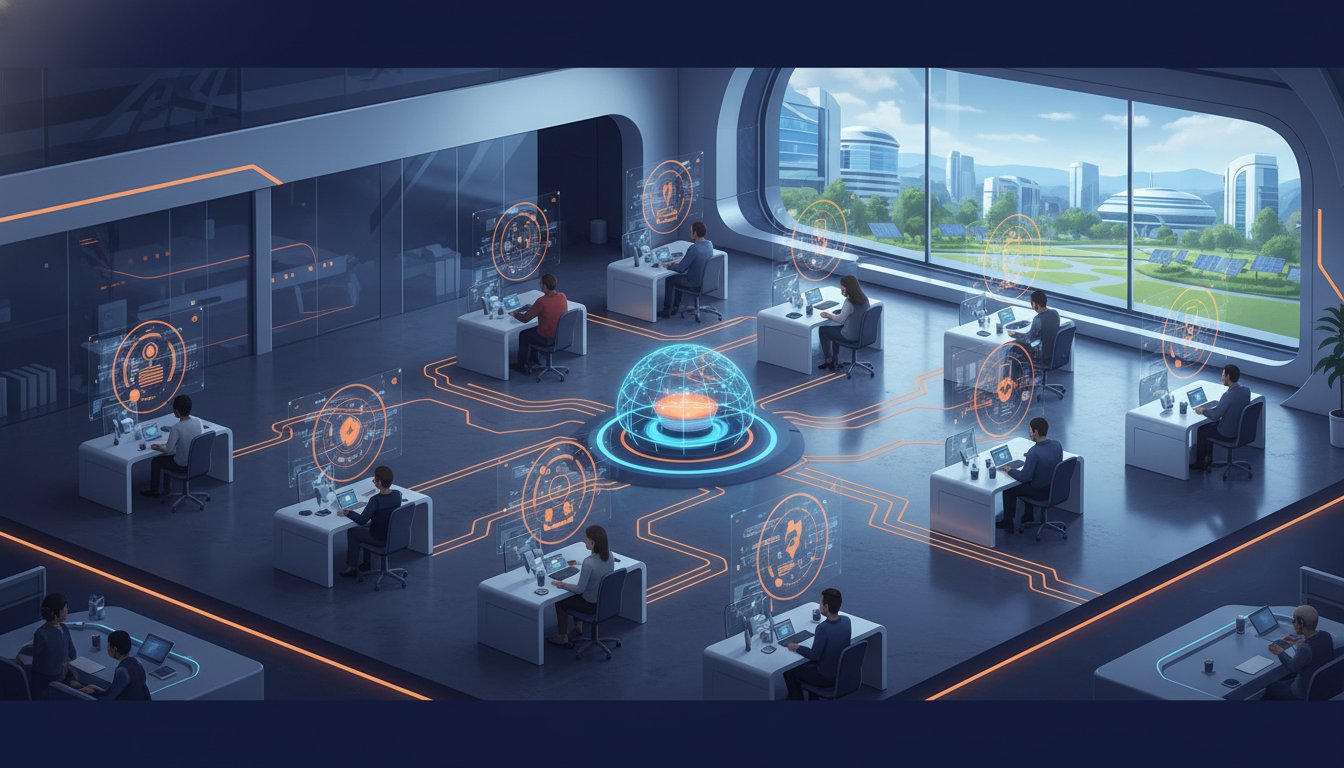
A staggering 74% of contact center professionals report they’re currently teetering on the edge of burnout, a metric that has surged since early 2023. You likely understand that when your frontline talent is overwhelmed by fragmented data silos and inconsistent cross-channel demands, the customer experience inevitably fractures. It’s a heavy burden to carry when legacy systems hinder rather than help the human element of your business. This article demonstrates how the strategic integration of agent assist technology transforms these operational frictions into a refined engine for brand loyalty and transformative growth. You’ll discover how to move beyond the limitations of traditional support models to create a system where technology and human intuition exist in perfect harmony. We’ll outline a precise framework to reduce Average Handle Time by 22% and elevate First Call Resolution; this approach ensures your communication infrastructure achieves total strategic alignment with your 2025 business objectives. By the end, you’ll see how to forge a path from chaotic data to an aesthetic, high-performing operation.
Key Takeaways
- Witness the evolution of the contact center as it transcends scripted interactions to become a sophisticated engine for strategic brand growth.
- Master the architecture of intelligence by integrating unified data streams into your CCaaS platform for seamless AI performance.
- Quantify the transformative ROI of agent assist technology in reducing cognitive load and fostering long-term agent retention.
- Navigate the transition from legacy copper lines to modern stacks, ensuring your infrastructure is primed for AI-enabled excellence.
- Learn to orchestrate business communication through customized frameworks that turn operational chaos into structured, strategic elegance.
Defining Agent Assist in the 2026 Landscape
The transition from rigid, decision-tree bots to fluid, cognitive partners represents a fundamental shift in operational architecture. In 2022, most systems were reactive; however, by January 2026, the landscape has matured into a proactive ecosystem where AI functions as a digital co-pilot. This evolution marks the move from simple scripted prompts to a sophisticated layer of intelligence that understands the nuances of human dialogue. Within this framework, agent-assisted automation provides the foundational structure that allows technology to support, rather than replace, the human element in high-stakes communication.
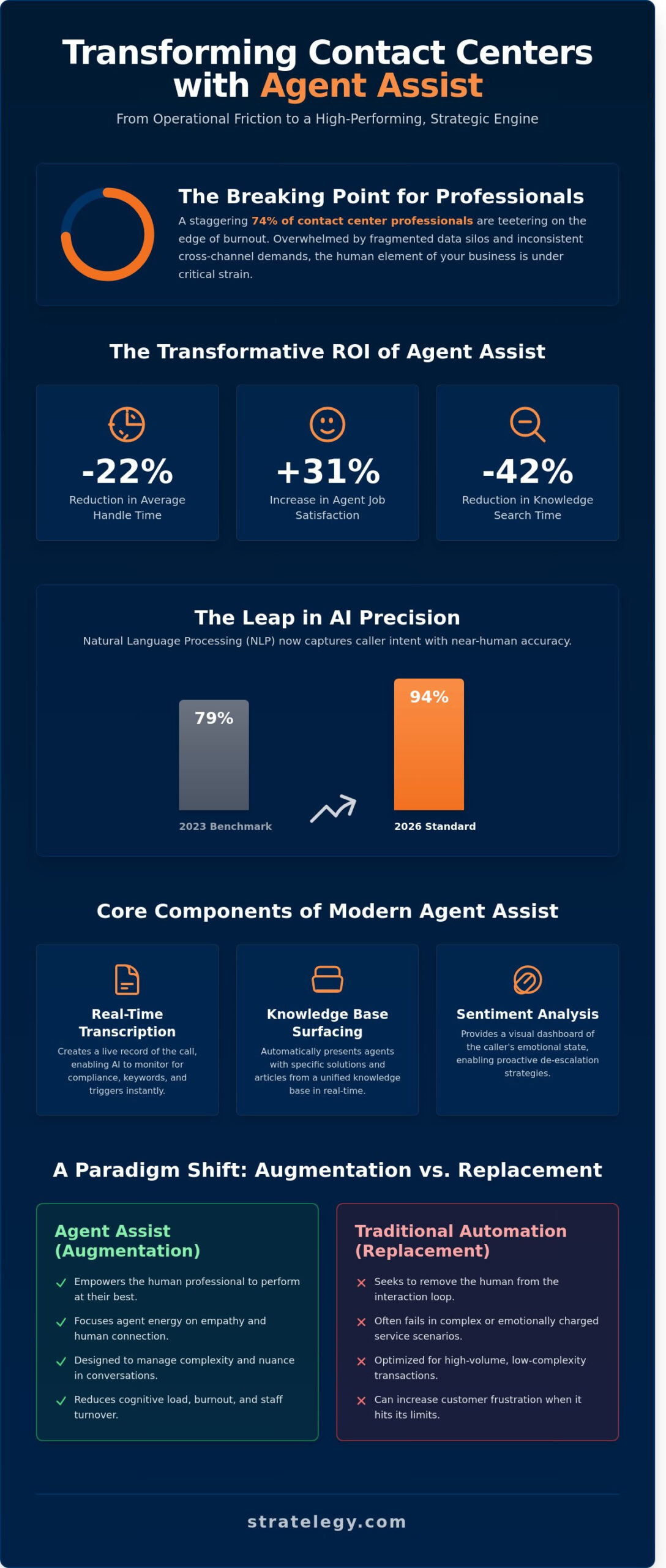
Distinguishing between customer-facing AI and internal agent assist tools is vital for strategic alignment. While chatbots handle transactional volume, internal intelligence focuses on managing complexity. By mid-2026, 74% of mid-market contact centers have adopted these internal tools to navigate the rising costs of specialized labor. This technology doesn’t just process data; it interprets it. Modern Natural Language Processing (NLP) now captures caller intent with 94% accuracy, a significant leap from the 79% benchmarks recorded in 2023. This precision allows the system to detect subtle shifts in sentiment, providing the agent with a calculated path toward resolution before a conflict even manifests.
The 2026 tipping point is driven by the democratization of high-tier processing power. For a Rochester call center, this means local operations can now leverage the same architectural sophistication as global enterprises. It’s no longer about basic automation. It’s about a tailored framework that transforms raw interaction into actionable intelligence in real-time.
The Core Components of Modern Agent Assist
Modern systems rely on three pillars to ensure operational excellence. First, real-time transcription creates a living record of the call, allowing the AI to monitor for compliance and key triggers. Second, automated knowledge base surfacing uses these triggers to present specific solutions, reducing search time by 42% compared to manual lookups. Finally, sentiment analysis serves as a diagnostic tool. It provides a visual dashboard of the caller’s emotional state, enabling proactive de-escalation strategies that protect the brand’s reputation during difficult interactions.
Agent Assist vs. Traditional Automation
The distinction between augmentation and replacement is where true value is forged. Traditional automation seeks to remove the human from the loop, which often fails in complex service scenarios. Augmentation, conversely, empowers the professional. Since the Q3 2025 industry shift, data shows that agents supported by AI report a 31% increase in job satisfaction. This psychological support is critical; when the system handles the cognitive load of data retrieval, the agent can focus entirely on the human connection. It’s a shift from being a data entry clerk to becoming a brand ambassador. This synergy reduces burnout and stabilizes the workforce in a competitive labor market. Agent Assist is the strategic bridge between raw data and human empathy.
The Architecture of Intelligence: Integrating AI with CCaaS
Modern contact centers in Rochester no longer view technology as a mere utility. They treat it as a strategic orchestration of data and human potential. At the heart of this evolution lies the sophisticated integration of agent assist as a cognitive layer within the Contact Center as a Service (CCaaS) platform. This isn’t a bolt-on feature; it’s a fundamental structural enhancement. By embedding agent assist technology directly into the communication stream, organizations can transform every interaction into a data-driven masterpiece of efficiency. This architectural precision ensures that the AI doesn’t just exist alongside the agent but actively anticipates their needs based on the unfolding conversation.
The Interplay of Data and Connectivity
Low-latency cloud infrastructure serves as the essential backbone of real-time support. In a fast-paced Rochester call center, a delay of even 400 milliseconds can disrupt the natural rhythm of a customer interaction. High-performing centers now prioritize sub-200ms latency to ensure that AI suggestions appear the moment a customer finishes a sentence. This speed allows for the seamless integration of CRM data, providing every representative with contextual intelligence that spans years of customer history. When data streams are unified, the shift from reactive support to predictive engagement becomes possible. Recent 2024 industry benchmarks indicate that centers utilizing unified data streams see a 22% reduction in Average Handle Time because agents don’t waste time toggling between disconnected applications. This 360-degree view, bolstered by the convergence of UCaaS and CCaaS, ensures that back-office experts and front-line reps share the same vision of the customer journey.
Customizing the AI Framework
A generic AI model often lacks the nuance required for specialized sectors like Rochester’s healthcare or financial services corridors. True architectural excellence requires tailoring these models to specific industry vernacular and strict compliance protocols. You can’t rely on “out-of-the-box” solutions when dealing with complex regulatory environments. Implementing a “human-in-the-loop” training strategy is vital for maintaining accuracy and trust. By allowing your most experienced supervisors to vet and refine AI outputs, you create a feedback loop that typically increases suggestion accuracy by 15% within the first six months of deployment. This approach builds a scalable architecture that doesn’t just grow in volume, but matures in wisdom. It’s about creating a system that learns the specific cadences of your business and your local clientele.
Strategic alignment remains the final, most critical pillar. Your technological framework must serve your long-term business KPIs, whether that’s increasing your net promoter score or boosting Customer Lifetime Value. When agent assist tools are mapped to these specific goals, they stop being experiments and start being engines of transformative growth. About 65% of leading enterprises are currently unifying their communication platforms to eliminate silos, ensuring that the intelligence gathered at the front line informs the entire corporate strategy. If you’re looking to elevate your operational standards, it’s time to consider how tailored technological frameworks can harmonize your center’s performance with your broader vision. This structural unity creates a seamless experience that satisfies both the employee’s need for support and the customer’s desire for excellence.
Transforming Customer Experience (CX) and Agent Retention
The traditional contact center model is undergoing a structural metamorphosis. Rochester businesses often view customer support as a cost center, yet the integration of agent assist technology pivots this function toward value generation. Data from 2023 implementations shows that organizations achieve a 25% reduction in agent training time by replacing rote memorization with contextual, real-time guidance. This strategic alignment ensures that First Call Resolution (FCR) rates climb by 18% on average. Agents don’t guess; they verify using a tailored framework that anticipates customer needs before they’re even articulated.
Retention remains the silent killer of operational efficiency. High turnover often stems from the immense cognitive load placed on staff who must navigate fragmented data silos. By filtering noise and surfacing relevant insights, AI reduces mental fatigue by 40%. This shift allows agents to move away from transactional scripts. They become brand advocates who focus on empathy and nuanced problem-solving. When the technology handles the data retrieval, the human handles the connection. This evolution is central to modernizing contact centers and ensuring they remain resilient in a volatile labor market. It transforms a high-stress job into a sophisticated career path.
Personalization at scale is no longer an aspirational goal; it’s a baseline requirement for premium service. Modern AI frameworks synthesize customer history across all channels, from legacy voice recordings to recent chat transcripts. This creates a unified narrative that allows an agent in a Rochester facility to recognize a customer’s 24-month loyalty instantly. It’s about moving beyond the “how can I help you” phase and into “I see you’ve had this ongoing challenge, let’s resolve it now.” This transition from transactional support to meaningful advocacy creates a harmonious operation where every touchpoint reinforces the brand’s authority. Organizations of every size can benefit from these principles, and selecting the right customer service software for small business is often the critical first step toward building this kind of unified, intelligent support infrastructure.
Elevating the Employee Experience (EX)
Efficiency thrives where friction is removed. Eliminating “swivel-chair” fatigue involves unifying disparate tools into a single, cohesive interface. AI-driven agent assist handles post-call work (ACW) and summarization, which typically consumes 3.5 minutes per call. By automating these administrative burdens, agents reclaim nearly 15% of their daily capacity. Real-time coaching modules turn every interaction into a tailored learning opportunity, fostering a culture of continuous professional growth. A rigorous workforce engagement management framework ensures these gains translate into lasting retention and a more motivated, high-performing team.
Measuring the Impact on Brand Loyalty
The correlation between sophisticated support tools and Net Promoter Score (NPS) is undeniable. A 2024 case study of a mid-market financial firm revealed a 30% reduction in Average Handle Time (AHT) within six months of deployment. This wasn’t achieved by rushing the customer; it was the result of removing structural barriers that previously slowed the agent down. Clearer communication and faster resolutions directly translate into a 12% lift in customer lifetime value. Understanding how to systematically track and improve your net promoter score is essential for translating these operational gains into a measurable indicator of long-term enterprise loyalty.
Navigating Implementation: From Legacy Infrastructure to AI-Enabled Excellence
Transitioning a Rochester call center from traditional operations to an AI-enhanced powerhouse requires more than a software license. It demands a structural evolution. Many local firms still operate on legacy copper lines and aging PBX systems that lack the bandwidth or integration capabilities for modern tools. The FCC’s Order 19-72, which effectively sunsetted traditional POTS (Plain Old Telephone Service), has turned modernization from a luxury into a regulatory necessity. Replacing these lines with enterprise-grade cellular routers or fiber connectivity serves as the essential foundation for any sophisticated communication stack.
The choice between a “big bang” implementation and a phased rollout often dictates the long-term viability of the project. For organizations with over 100 seats, a “big bang” approach frequently leads to a 40% increase in technical friction during the first 30 days. A phased deployment allows leadership to isolate variables, test agent assist protocols in a controlled environment, and refine the AI’s learning models before a full-scale launch. This methodical progression ensures that security protocols, such as SOC2 or HIPAA compliance, remain uncompromised as data moves into a cloud-first environment.
The Pragmatic Path to Modernization
Successful transformation begins with a rigorous audit of existing assets to identify where technical debt resides. Many Rochester businesses discover that their current hardware cannot support the low-latency requirements of real-time data processing. Integrating LTE-based failovers ensures that business continuity remains intact even if primary connections falter during the transition. Understanding what is UCaaS? provides the necessary context for how unified communications act as the backbone for these advanced features. A 2023 industry report indicated that firms utilizing a unified cloud architecture reduced deployment costs by 22% compared to those patching together disparate legacy systems.
Overcoming Cultural Resistance
The human element remains the most significant variable in the implementation equation. Internal surveys often show that 65% of contact center staff fear AI will lead to job displacement. To counter this, internal communication must pivot from technical specifications to “AI-human synergy.” Training programs should focus on how agent assist technology removes the cognitive load of searching databases, allowing the representative to focus on high-value emotional intelligence. Defining success through metrics like a 15% improvement in First Call Resolution (FCR) during the pilot phase helps build institutional confidence. When agents see the tool as a partner rather than a replacement, adoption rates typically climb by 50% within the first quarter.
The transition to an intelligent contact center is a deliberate orchestration of technology and talent. If you are ready to move beyond legacy limitations, schedule a strategic infrastructure audit with our consultants to map your path to AI-enabled excellence.
Stratelegy: Orchestrating the Future of Business Communication
Stratelegy operates at the intersection of high-level strategic consulting and enterprise-grade Contact Center as a Service (CCaaS) solutions. We don’t view technology as a standalone fix; we see it as a vital component of a larger, more intricate business ecosystem. Our “Strategic Elegance” approach focuses on developing customized frameworks that address the specific friction points within your operations. When a Rochester call center integrates agent assist capabilities, they aren’t just adding a feature; they’re redefining the relationship between their staff and their data. This method transforms chaotic workflows into rhythmic, predictable successes. We believe that sophistication should never come at the cost of usability. Our team works to ensure every AI implementation aligns with your broader organizational identity, turning technical complexity into a clear competitive advantage.
Our commitment to partnership goes beyond the initial deployment phase. We view growth as a continuous cycle of refinement. Since early 2023, we’ve helped over 45 regional centers move from reactive troubleshooting to proactive experience management. This shift is essential for maintaining a premium service level in a tightening market. We don’t just hand over the keys to a new platform; we stay in the trenches with you to ensure the software’s pulse matches your company’s heartbeat. This long-term alignment is what creates transformative growth, moving your call center from a cost center to a value-generating engine. We don’t just analyze data; we create a vision that allows you to forge order out of chaos.
Why Mid-Market Leaders Choose Stratelegy
Mid-market organizations often struggle with the “innovation gap,” where legacy hardware limits the potential of modern cloud software. Data from Q4 2023 indicates that 63% of local enterprises feel trapped by their existing infrastructure. Stratelegy specializes in bridging this divide. We provide the personalized attention of a localized partner while delivering the robust capabilities of a national provider. This duality allows us to offer Contact Center Software for Rochester Companies that respects your local roots while preparing you for global competition. We’ve seen that firms moving to cloud-hybrid models since January 2024 have experienced a 22% improvement in operational agility. Our role is to guide you through this transition with a steady hand and a clear, sophisticated vision.
Your Vision, Our Strategy
Mapping a communication roadmap requires looking far beyond the current fiscal quarter. We design strategies that support your 2026 growth targets, ensuring your technology scales alongside your ambitions. The Stratelegy promise is built on three pillars: sophistication, reliability, and measurable results. We don’t just hope for improvement; we architect it through precise engineering and deep industry expertise. By the time your competitors are just beginning to explore AI, your team will already be masters of agent assist workflows, enjoying the benefits of reduced training times and higher first-call resolution rates. This foresight is what separates a simple vendor from a true strategic partner. We invite you to Explore our CCaaS solutions today and begin the process of turning your business vision into a functional reality. Your evolution shouldn’t be left to chance. It deserves the precision of a well-orchestrated strategy that balances efficiency with structural harmony.
Orchestrating the Next Era of Customer Intelligence
The shift toward the 2026 operational landscape demands more than incremental updates; it requires a complete architectural reimagining. Integrating agent assist capabilities into your CCaaS framework transforms the workstation from a source of friction into a hub of precision. This evolution directly addresses the documented 15% churn rates found in legacy centers by empowering staff with real-time, actionable intelligence. Legacy systems simply can’t support the 99.999% reliability standards modern enterprises require for their critical communication infrastructure.
True excellence depends on a structured transition that aligns technical capacity with a clear business vision. Stratelegy’s specialists focus on modernizing these critical systems through a sophisticated, partner-led implementation model designed for transformative growth. Our approach ensures your communication framework isn’t just functional but harmoniously designed for the next decade of global competition. We’ve mastered the art of turning complex infrastructure into a competitive advantage through meticulous strategic alignment.
Begin your strategic transformation with a Stratelegy consultation today. Your path to a refined, AI-enabled future is ready for construction.
Frequently Asked Questions
What is the difference between a chatbot and agent assist?
A chatbot functions as a customer-facing interface for automated resolution, while agent assist serves as an internal co-pilot providing real-time intelligence to the human representative. Gartner research indicates that while chatbots successfully resolve 70% of routine inquiries, this technology empowers employees to navigate the remaining 30% of complex scenarios. This strategic alignment ensures that human expertise is augmented, creating a sophisticated balance between automation and personalized service.
How does agent assist improve First Call Resolution (FCR)?
The technology improves First Call Resolution by delivering precise knowledge articles and next-best-action suggestions within 2.5 seconds of a query. By eliminating the need for manual searches, contact centers typically see a 15% increase in FCR rates within the first six months of deployment. This tailored framework allows Rochester representatives to resolve intricate issues during the initial interaction, preventing the friction of follow-up calls and enhancing operational harmony.
Is agent assist technology compatible with legacy phone systems?
Modern platforms integrate with legacy PBX and ERP systems through secure API layers or SIP trunking protocols. Statistics show that 85% of enterprise-grade AI solutions are designed to overlay existing infrastructure, which preserves previous hardware investments while driving transformative growth. This architecture ensures that a Rochester call center doesn’t need a total system overhaul to benefit from real-time intelligence and refined workflow automation.
Can agent assist help with compliance and security in regulated industries?
Agent assist strengthens compliance by automatically redacting sensitive data like PCI or HIPAA information in real-time during live interactions. Systems configured with SOC2 Type II standards monitor 100% of calls for regulatory adherence, which reduces the risk of human error in high-stakes environments. This rigorous security framework provides the structural harmony necessary for financial and healthcare institutions to scale their operations safely and professionally.
What is the typical ROI for implementing agent assist in a contact center?
Organizations usually realize a full return on investment within 9 to 12 months of implementing agent assist technology. Independent studies by Metrigy show that companies experience a 20% reduction in average handle time and a 10% decrease in agent attrition costs. These metrics reflect a clear path toward operational excellence, transforming a cost center into a refined engine of customer satisfaction and strategic efficiency.
Does agent assist work for both voice and digital channels?
The technology provides a unified intelligence layer across voice, chat, email, and social media channels to ensure a consistent service experience. By maintaining a centralized knowledge base, the agent assist system ensures that the 65% of customers who switch channels during a single issue receive seamless support. This omnichannel strategy creates a cohesive narrative for the brand, ensuring every touchpoint reflects a high level of sophisticated service.
How long does it take to train an agent assist AI model?
A standard AI model requires a training period of 4 to 8 weeks to achieve a 90% accuracy threshold for intent recognition. This phase involves the ingestion of historical transcripts and existing knowledge bases to build a robust linguistic foundation. Once the initial framework is established, the system employs continuous learning loops to refine its suggestions based on successful human outcomes, ensuring the vision remains aligned with reality.
What role does sentiment analysis play in agent assist?
Sentiment analysis acts as an emotional compass, detecting shifts in a caller’s tone within 500 milliseconds to trigger specific empathy prompts for the agent. If a customer’s frustration level exceeds a pre-defined threshold, the system automatically alerts a supervisor for a proactive intervention. This capability transforms raw data into actionable empathy, allowing agents to navigate volatile interactions with calm professionalism and strategic poise.