

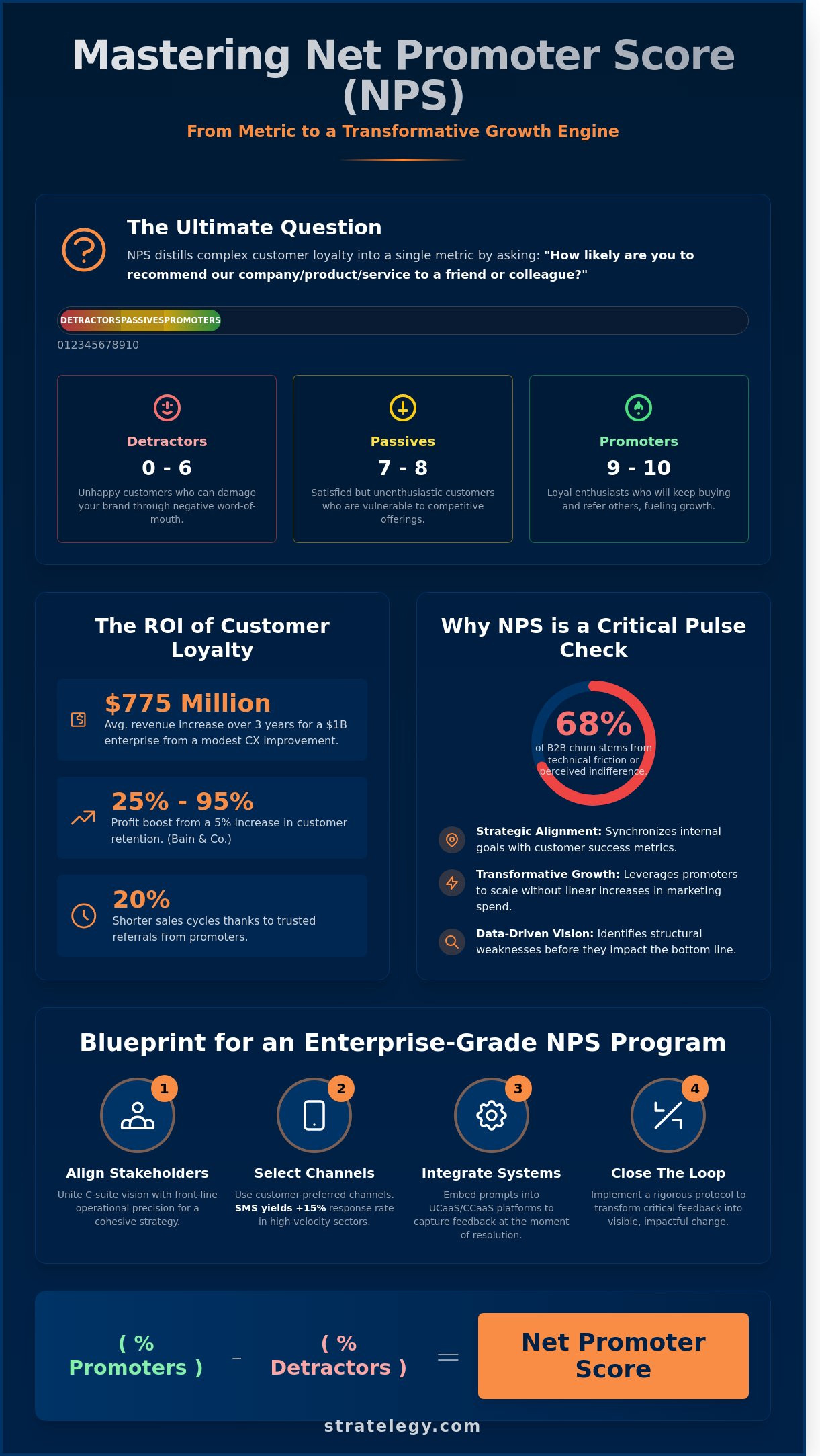
A 2023 analysis by the Temkin Group revealed that even a modest improvement in customer experience can generate an average of $775 million in additional revenue over three years for a $1 billion enterprise. You likely recognize that the net promoter score is far more than a simple metric; it’s the definitive pulse check on your brand’s future health and market resilience. However, the inherent elegance of this methodology is often compromised when data remains trapped in isolated silos, leaving leadership unable to translate a single digit into a transformative growth strategy.
We’ll provide you with a sophisticated framework to master these complexities, turning raw feedback into a precise engine for strategic alignment and communication excellence. This guide explores how to bridge the gap between your existing technology and proactive client engagement. You’ll learn to harmonize your communication platforms with customer satisfaction metrics to ensure every interaction contributes to a culture of sustained loyalty and structural harmony. It’s time to move beyond passive data collection and embrace a model where feedback drives refined, intentional business evolution.
Key Takeaways
- Understand how the net promoter score serves as a strategic cornerstone for enterprise loyalty, evolving beyond a simple metric into a sophisticated engine for brand health.
- Master the foundational methodology required to design an enterprise-grade program that achieves seamless cross-departmental alignment and strategic growth.
- Implement a rigorous “Close the Loop” protocol to transform critical feedback into visible change and strengthen long-term customer retention.
- Explore how integrated communication infrastructures like UCaaS and CCaaS remove the technical friction that often undermines the customer experience.
The Strategic Significance of Net Promoter Score in 2026
In the architecture of modern enterprise, loyalty isn’t a nebulous sentiment; it’s a measurable asset. The Net Promoter Score serves as the definitive index for this asset, distilling complex customer interactions into a single, actionable metric of brand health. Since its inception by Fred Reichheld in 2003, the framework has transitioned from a simple survey tool into a strategic cornerstone for unified communication. In 2026, the “Ultimate Question” – whether a client would recommend a service to a peer – remains the highest expression of professional trust. It represents a willingness to stake one’s own reputation on another’s performance. However, elite organizations distinguish between the “score,” which is a diagnostic snapshot, and the “system,” which is a comprehensive framework designed for transformative growth.
Why NPS is the Pulse of Modern Enterprise Communication
Seamless connectivity drives high promoter scores. In B2B environments, communication friction creates detractors instantly. A 2024 industry report indicated that 68% of B2B churn stems from perceived indifference or technical friction during critical interactions. Reliable infrastructure isn’t just a utility; it’s the foundation of the passive to promoter pipeline. When a system functions with invisible precision, it allows the relationship to flourish. When it fails, it converts potential advocates into vocal critics. High-performing enterprises use these insights to align their communication strategies with client expectations, ensuring that every touchpoint reinforces the value proposition rather than eroding it.
The ROI of Loyalty: Beyond the Integer
High scores correlate directly with reduced customer acquisition costs (CAC). Promoters act as an unpaid, high-authority sales force, shortening sales cycles by 20% through trusted referrals. Research from Bain & Company demonstrates that a 5% increase in customer retention can boost profits by 25% to 95%. These advocates provide a buffer against market volatility, offering a stable foundation for long-term planning. Within the telecommunications sector, the net promoter score acts as a primary predictor of sustainable revenue growth by quantifying the stability of the recurring contract base.
- Strategic Alignment: Synchronizing internal goals with customer success metrics.
- Transformative Growth: Leveraging promoters to scale without linear increases in marketing spend.
- Data-Driven Vision: Using the net promoter score to identify structural weaknesses before they impact the bottom line.
The transition from measuring a number to managing a system requires a shift in perspective. It’s about moving from passive observation to active orchestration of the customer experience. By 2026, the most successful enterprises won’t just track their score; they’ll use it as a compass to navigate the complexities of global commerce with confidence and clarity.
Designing an Effective NPS Program: A Methodological How-To
Launching an enterprise-grade net promoter score initiative requires a meticulous architecture where data meets strategy. It’s not a mere collection of numbers; it’s a commitment to organizational clarity. This process begins with a deliberate coalition of stakeholders, uniting the C-suite’s vision with the operational precision of front-line managers. When these departments align, the resulting insights foster a culture of continuous refinement rather than reactive crisis management.
Modern delivery channels must reflect the customer’s preferred environment to ensure high participation. While traditional email provides space for reflection, 2024 industry benchmarks indicate that SMS-based prompts yield a 15% higher response rate in high-velocity sectors. Integrating prompts directly into CCaaS platforms captures sentiment at the precise moment of resolution, ensuring the data remains untainted by the passage of time. The goal is to create a frictionless feedback loop that feels like a natural extension of the service experience.
The methodology finds its roots in the 2003 Harvard Business Review classic, The One Number You Need to Grow. Reichheld’s foundational work proved that this specific metric correlates more closely with profitable growth than any other satisfaction index. By focusing on this single lever, organizations can convert abstract loyalty into a measurable engine for expansion. To prevent survey fatigue, enterprises must balance the need for fresh data with respect for the customer’s attention. Relational checks are most effective on a 90 day cycle, while transactional surveys demand immediate execution, ideally within 24 hours of a service interaction.
Segmenting Your Audience: Promoters, Passives, and Detractors
Promoters (9-10) are your strategic partners. They provide 2.6 times the lifetime value of an average customer and act as a shield against market volatility. Passives (7-8) represent the vulnerable middle, presenting a 20% churn risk if a competitor offers a lower price. Detractors (0-6) are the primary source of brand erosion. They require a tailored framework for recovery to prevent negative sentiment from scaling across social and professional networks.
Crafting the Survey: Precision and Timing
Enterprise survey design thrives on a “less is more” philosophy. A single scale followed by an open-ended “Why?” captures the nuance of the experience without inducing fatigue. This qualitative data is where the real transformation happens, as it reveals the drivers behind the digits. Timing is equally critical. A relational check-in every quarter provides a macro view of the partnership, while transactional prompts offer the granular detail needed for immediate operational excellence.
Calculating and Benchmarking for Strategic Alignment
The net promoter score serves as the mathematical heartbeat of customer centricity. Calculating this metric requires a precise subtraction: the percentage of Detractors from the percentage of Promoters. This calculation yields a whole number ranging from -100 to +100. It’s an index rather than a percentage, which explains why a score of 50 is significantly more difficult to achieve than a 50% satisfaction rating. This specific range allows for a clear visualization of brand health, where anything below zero indicates a structural deficit in customer trust.
Context defines the value of the result. A score of 40 might signal dominance in the telecommunications sector, where the 2023 industry average sat at 31, yet that same 40 would represent underperformance in specialty retail. Enterprises often fall into the trap of obsessing over external benchmarks. While industry data provides a baseline, your internal trend line remains the most critical diagnostic tool. A score that climbs from 20 to 35 over 18 months demonstrates more strategic vitality than a static 50 that’s remained unchanged for three years.
Interpreting the Data: Moving from Metrics to Insights
Interpreting the net promoter score requires a nuanced understanding of the three tiers of performance. A score between 0 and 30 is generally considered good, suggesting more advocates than critics. Reaching the 70+ threshold places an organization in the world class category, a space occupied by elite brands that have mastered the art of consistent delivery.
- The Passive Warning: A high percentage of Passives, even with a positive NPS, indicates a vulnerable market position. These customers are satisfied but not loyal; they’ll migrate to a competitor for a 10% price reduction.
- B2B Volatility: In enterprise environments with small sample sizes, such as 25 key accounts, a single Detractor can swing the score by 15 points. This volatility necessitates a focus on individual account health rather than aggregate averages.
Relational vs. Transactional NPS: Which One to Prioritize?
Strategic alignment requires a balance between the macro and micro views of the customer experience. Relational NPS measures the long-term health of the partnership. It’s typically conducted twice a year to gauge overall brand sentiment and executive-level alignment. It’s the “soul” of the relationship.
Transactional NPS, or tNPS, functions as the “pulse” of the machine. It triggers immediately after specific touchpoints, such as a software implementation or a support ticket resolution. To create a 360-degree view, use tNPS to identify immediate friction points and relational NPS to validate that your overarching value proposition remains intact. Leaders don’t choose one over the other; they use tNPS to fix the process and relational NPS to build the vision.
Turning Feedback into Action: The Art of Closing the Loop
Measurement without movement is a wasted investment. To extract the full potential of your net promoter score, the organization must adopt a dual-layered response system that transforms raw data into strategic intelligence. A rigorous “Close the Loop” process ensures that feedback doesn’t languish in a database but instead serves as a catalyst for visible, structural change.
The Inner Loop facilitates immediate recovery at the individual level. When a Detractor signals dissatisfaction, a 24 to 48-hour response window is non-negotiable. This swift intervention converts volatility into stability, often turning a frustrated client into a loyal advocate through the sheer power of being heard. This isn’t just customer service; it’s a strategic intervention to prevent churn, which typically costs five times more than retention efforts.
The Outer Loop focuses on systemic evolution. It analyzes aggregate data to identify recurring friction points across the enterprise. If 22% of neutral respondents mention delivery delays, the Outer Loop triggers a supply chain audit. This approach ensures that the organization isn’t just treating symptoms but is actively curing the underlying operational diseases that stifle growth.
Leveraging AI for Real-Time Sentiment Analysis
By 2026, sophisticated AI tools will analyze CCaaS transcripts in real-time to detect frustration long before a survey is even dispatched. Natural Language Processing (NLP) identifies the “why” behind the “what,” extracting nuance from open-ended comments that traditional metrics often miss. Predictive NPS uses communication metadata to forecast loyalty by analyzing the cadence and sentiment of every digital touchpoint. Deploying agent assist technology within your contact center can further accelerate this process by surfacing real-time insights that empower front-line teams to resolve issues before they escalate into detractor responses.
Empowering Front-Line Teams with NPS Data
True transformation happens when front-line teams have total visibility. Integrating net promoter score results directly into CRM and UCaaS dashboards ensures that every interaction is informed by the customer’s emotional history. This alignment is bolstered by Employee NPS (eNPS), as internal engagement is the essential precursor to external loyalty. High eNPS environments see a 12% boost in productivity compared to disengaged counterparts. Sustaining these results over time requires a deliberate workforce engagement management strategy that treats employee experience as a core architectural discipline rather than a secondary concern. To capitalize on success, organizations should invite Promoters into formal referral programs or case study collaborations, turning satisfied clients into an extension of the sales force.
Discover how to align your operational goals with customer expectations through our tailored frameworks for enterprise growth.
Optimizing CX Through Integrated Communication Infrastructure
A high net promoter score isn’t merely the result of a good product; it’s the byproduct of a frictionless interaction ecosystem. When communication channels fail, Detractors are born. Technical friction, such as dropped calls or fragmented customer data, accounts for a significant portion of consumer dissatisfaction. Research from Salesforce indicates that 76% of customers expect consistent interactions across departments, yet many enterprises still struggle with siloed legacy systems. High-quality communication tools serve as the structural foundation for loyalty. By integrating UCaaS and CCaaS platforms, organizations remove the barriers that frustrate users. Reliability remains the most critical pillar of trust. Transitioning from aging copper lines to LTE POTS replacement ensures that even emergency systems and critical feedback loops remain operational. Stratelegy focuses on building these resilient, elegant frameworks where technology and strategy exist in perfect harmony.
How Unified Communications Drive Higher Promoter Scores
Wait times and inconsistent messaging are the primary drivers of low scores. When a customer moves from a chat window to a phone call, they shouldn’t have to repeat their story. Unified communications eliminate this redundancy. Stratelegy’s philosophy emphasizes sophisticated alignment, ensuring that every touchpoint reflects the brand’s premium standards. Implementing advanced UCaaS solutions allows teams to respond with precision and speed. Data from the Aberdeen Group shows that companies with strong omnichannel engagement retain 89% of their customers. This seamless flow of information transforms passive users into active Promoters by demonstrating respect for their time and effort. For a deeper understanding of how these platforms work together, exploring what is unified communications and its role in modern enterprise connectivity provides the strategic context needed to make informed infrastructure decisions. When it comes to selecting the right partners for this transformation, evaluating unified communications providers against a rigorous 2026 enterprise checklist ensures your organization avoids the legacy pitfalls that silently erode customer loyalty.
Building a Resilient Feedback Ecosystem with Stratelegy
Modernizing legacy infrastructure is a strategic necessity, not a luxury. Service failures caused by outdated POTS lines can tank a net promoter score overnight during a critical outage. Leaders must view their technology stack as a primary driver of customer loyalty rather than a back-office expense. A resilient ecosystem prevents the technical lapses that lead to negative sentiment. By replacing fragile connections with robust, modern alternatives, enterprises create a stable environment for growth. Stratelegy helps organizations transform chaos into order through meticulously designed communication architectures. True business success requires a structure that is both efficient and aesthetically harmonious. Contact Stratelegy to align your communications with your CX goals and elevate your enterprise loyalty strategy.
Mastering the Architecture of Enterprise Loyalty
Mastering the net promoter score in 2026 requires more than a simple survey; it demands a sophisticated architecture of listening and response. Organizations that achieve the 70+ point benchmark for excellence don’t just collect data. They integrate feedback into a continuous loop of improvement. Success hinges on two specific pillars: the methodological precision of your program design and the reliability of the communication infrastructure supporting it. When your enterprise aligns its technical framework with its customer-centric vision, you create a foundation for transformative growth. It’s about turning fragmented data into a cohesive strategy that resonates across every touchpoint in the 2026 business environment.
Stratelegy bridges the gap between raw feedback and operational elegance. We specialize in high-reliability LTE POTS replacement alongside enterprise-grade UCaaS and CCaaS solutions designed for 99.999% uptime. Our firm was founded on the principles of strategic alignment to ensure your communication channels remain resilient and effective. We help you navigate the transition from legacy systems to modern, cloud-based frameworks that drive measurable results. Elevate your enterprise communication strategy with Stratelegy.
Your journey toward a more harmonious and profitable enterprise starts with a commitment to structural excellence. We’re ready to help you build that future today.
Frequently Asked Questions
What is a good Net Promoter Score for a B2B company?
A score above 30 is considered solid for B2B organizations, though world-class leaders frequently target 50 or higher. Retently’s 2024 industry benchmarks indicate the B2B average sits at 35. This metric serves as a baseline for strategic alignment. Companies shouldn’t just chase numbers; they must build tailored frameworks that prioritize customer loyalty over vanity metrics.
How often should an enterprise conduct NPS surveys?
Enterprises should conduct surveys every 90 days to maintain a consistent pulse on customer sentiment. Gartner research indicates that 70% of top-performing firms utilize quarterly touchpoints. This cadence ensures your net promoter score data remains fresh and actionable. It prevents the stagnation that occurs with annual reviews. High-frequency data allows for a more agile, transformative growth strategy.
Can NPS accurately predict customer churn in the telecommunications industry?
A 10-point decline in a telecom company’s score directly correlates with a 3% rise in immediate churn. Bain & Company research confirms that detractors are 4 times more likely to abandon their service provider than promoters. This predictive power makes the metric essential for risk mitigation. Telecommunications leaders use these insights to deploy targeted retention campaigns before the contract expires.
What is the difference between NPS and CSAT (Customer Satisfaction Score)?
NPS evaluates long-term brand loyalty while CSAT measures short-term satisfaction with a specific interaction. CSAT uses a 1-5 scale to capture immediate sentiment after a support call or purchase. In contrast, the net promoter score asks a single question about future advocacy. One focuses on the transaction; the other focuses on the relationship’s enduring health.
How do I handle a low NPS score without demoralizing my team?
Presenting a low score as a blueprint for operational refinement prevents team burnout and fosters a culture of accountability. Data from the 2023 Customer Experience Index shows that teams who view feedback as a growth tool improve scores 15% faster. Avoid blame. Instead, use the data to create a more harmonious and well-designed customer journey.
Is it better to use email or SMS for NPS surveys in 2026?
SMS surveys are the superior choice for 2026 because they yield response rates of 45% while email fluctuates around 8%. Mobile-first communication isn’t optional; it’s the primary channel for 80% of enterprise customers. Shifting to SMS ensures your data collection is both efficient and representative of your entire user base. It’s about meeting the client where they’re most comfortable.
How can AI improve the accuracy of my Net Promoter Score data?
AI enhances accuracy by using Natural Language Processing to categorize thousands of open-ended responses without human subjectivity. Research from MIT suggests that AI identifies 25% more actionable themes than manual analysis. This technology transforms chaotic data into a structured vision. It allows executives to make decisions based on precise, unbiased evidence rather than intuition.
Why is the ‘Why’ question more important than the numerical score itself?
The qualitative “why” response provides the strategic context that a numerical value lacks. Industry studies show that 85% of successful product pivots originate from verbatim customer comments rather than the score itself. A number tells you where you stand, but the words tell you where to go next. These insights are the foundation of a sophisticated, future-proof business strategy.