
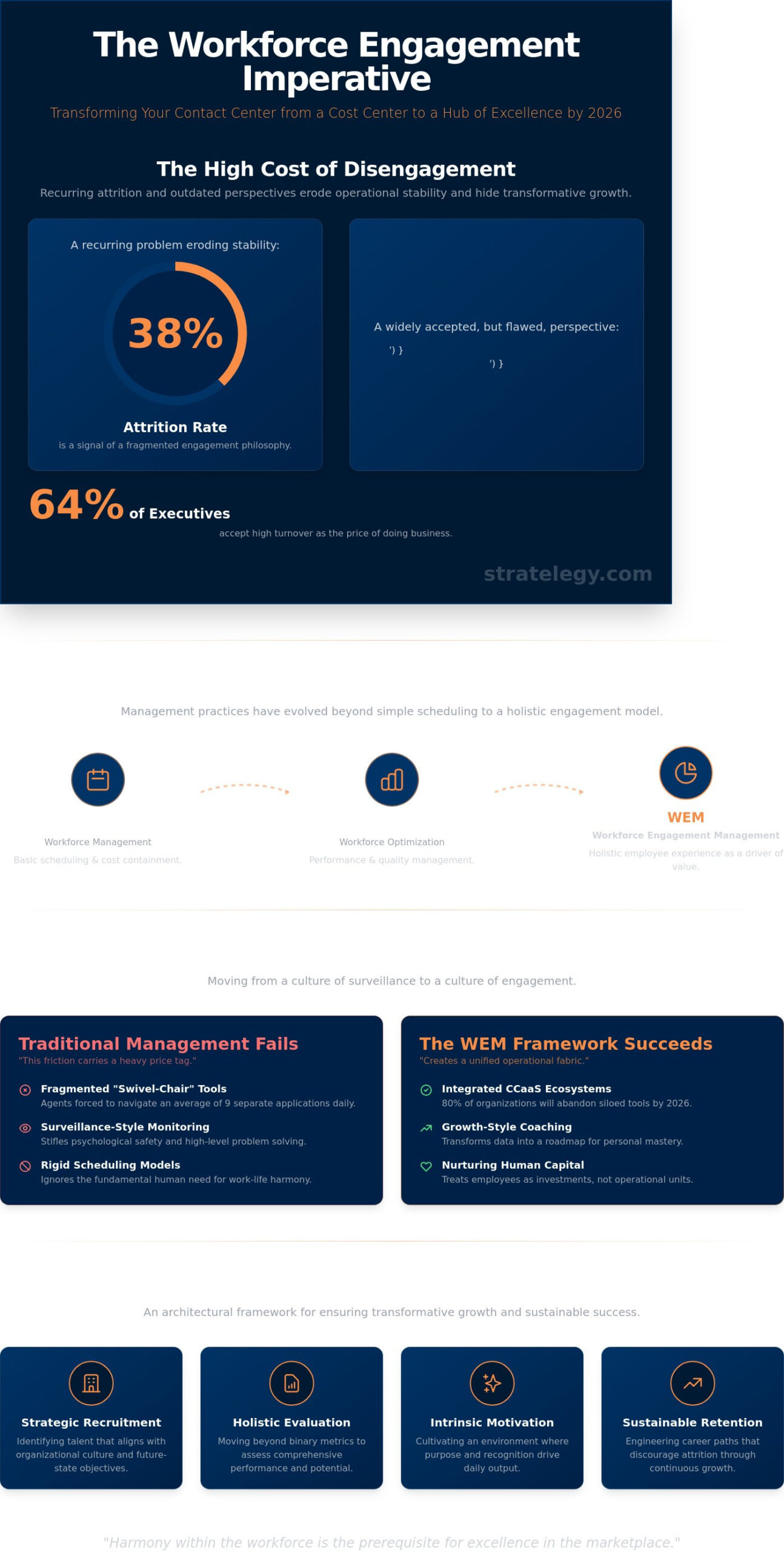
What if the recurring 38% attrition rate currently eroding your operational stability isn’t an unavoidable industry tax, but a clear signal of a fragmented engagement philosophy? While 64% of contact center executives accept that high turnover and disconnected tools are the price of doing business in a hybrid world, this perspective overlooks the transformative growth hidden within your existing talent pool. To capture this value, you must move beyond reactive scheduling and embrace a rigorous workforce engagement management framework that treats employee experience as a precise architectural discipline rather than a secondary concern.
We understand that you’re striving for excellence while managing the friction of fragmented communication tools that frustrate your staff. This guide promises to show you how to transform your contact center from a static cost center into a sophisticated hub of engagement by 2026. We’ll explore the specific strategic alignment and scalable technologies required to ensure your operational goals achieve a harmonious balance with the evolving needs of your workforce.
Key Takeaways
- Transition from managing labor costs to nurturing human capital through a refined understanding of how engagement drives long-term enterprise value.
- Uncover the technical constraints of legacy infrastructure and learn to architect a cloud-first strategy that ensures seamless workforce mobility.
- Implement a sophisticated five-step framework for workforce engagement management that begins with a rigorous audit of your internal communication silos.
- Leverage the synergy between AI and CCaaS platforms to eliminate operational friction and elevate the agent experience from routine tasking to strategic interaction.
- Discover how to align your communication infrastructure with your vision to transform the contact center into a harmonious center of excellence.
What is Workforce Engagement Management (WEM)?
Workforce engagement management represents the sophisticated evolution of labor coordination, transcending the legacy frameworks of Workforce Optimization (WFO) and Workforce management. In the competitive climate of 2026, the paradigm has shifted from the mere containment of labor costs toward the deliberate nurturing of human capital. This strategic framework treats employees not as operational units, but as the primary drivers of brand equity. It’s a shift from viewing personnel as an expense to recognizing them as an investment that requires strategic alignment.
The architecture of a robust WEM strategy rests upon four essential pillars that ensure transformative growth:
- Strategic Recruitment: Identifying talent that aligns with organizational culture and future-state objectives.
- Holistic Evaluation: Moving beyond binary metrics to assess comprehensive performance and potential.
- Intrinsic Motivation: Cultivating an environment where purpose and recognition drive daily output.
- Sustainable Retention: Engineering career paths that discourage attrition through continuous growth.
By 2026, visionary leaders recognize that workforce engagement management serves as the indispensable bridge between internal employee satisfaction and external customer loyalty. A disengaged agent can’t deliver a premium customer experience. Harmony within the workforce is the prerequisite for excellence in the marketplace.
The Evolution from WFM to WEM
Management practices in contact centers have transitioned from basic spreadsheet scheduling to a multi-dimensional engagement model. The workforce demographics of 2026 prioritize autonomy and professional resonance over traditional hierarchies. Organizations must now address the Engagement Gap to remain competitive. The Engagement Gap is the distance between operational efficiency and agent fulfillment.
Why Traditional Management Fails the Modern Agent
Rigid scheduling models often ignore the fundamental human need for work-life harmony. When organizations prioritize surveillance-style monitoring, they inadvertently stifle the psychological safety required for high-level problem solving. This friction carries a heavy price tag. Gallup’s 2023 State of the Global Workplace report indicates that disengaged employees contribute to a $1.9 trillion loss in global productivity annually. Modern agents demand growth-style coaching that transforms data into a roadmap for personal mastery rather than a tool for discipline. Without this shift, workforce engagement management remains an unattainable ideal rather than a functional reality.
The Strategic Mechanism: How WEM Functions Within the Enterprise
A sophisticated workforce engagement management framework operates as the central nervous system of the modern contact center. It doesn’t merely sit atop existing Contact Center as a Service (CCaaS) platforms; it weaves into their architecture to create a unified operational fabric through tailored frameworks. By 2026, industry analysts predict that 80% of customer service organizations will abandon siloed tools in favor of these integrated ecosystems. This strategic alignment eliminates the “swivel-chair” fatigue that once forced agents to navigate an average of 9 separate applications daily. When data flows without friction, agents focus on the human element of the interaction rather than the mechanics of the software.
The mechanism relies on real-time data orchestration to transform raw interactions into actionable intelligence. This process creates a virtuous cycle where performance is recognized instantly, and coaching becomes a continuous dialogue rather than a quarterly post-mortem. Organizations that implement such employee engagement strategies see a measurable shift in culture. Success is no longer measured by rigid, one-size-fits-all KPIs, but through a lens of individual excellence and structural harmony.
Data Orchestration and Performance Analytics
Capturing 100% of customer interactions provides a rich canvas for sophisticated coaching. Modern analytics have moved beyond Average Handle Time to track 15+ personalized growth metrics that reflect an agent’s true impact. Conversational intelligence tools now identify linguistic markers of stress, allowing leaders to intervene before burnout occurs. A 2025 industry report highlighted that proactive intervention based on these insights reduced turnover by 18% in high-volume environments. This level of precision allows for the kind of strategic alignment that drives transformative growth across the enterprise.
The Role of AI in Human-Centric Management
AI within the workforce engagement management sphere serves to empower, not replace. Agent Assist technologies provide real-time knowledge surfacing, reducing the cognitive load on staff during complex 12-minute resolutions. AI-driven scheduling now balances 95% of business coverage requirements with individual agent preferences, fostering a sense of autonomy. These Copilots handle the repetitive, 30-second tasks that clutter a workday. Agents are then free to dedicate their intellect to high-value, emotionally complex customer challenges that define the brand’s reputation. They don’t just process tickets; they orchestrate experiences.
Identifying the Technical Barriers to Engagement
Realizing the full potential of workforce engagement management requires more than a cultural shift; it demands a structural audit of the physical wires and signals that sustain the enterprise. Many organizations attempt to deploy 2026-grade AI tools over 20-year-old copper infrastructure. This mismatch creates a friction point where software capability outpaces hardware capacity. When legacy systems fail to support high-bandwidth interactions, the resulting latency doesn’t just slow down data. It erodes the employee experience and creates a layer of “innovation debt” that compounds with every new tool added to a failing foundation.
The Cloud Necessity for Modern Engagement
Unified Communications as a Service (UCaaS) serves as the indispensable bedrock for any modern engagement strategy. By 2025, Gartner predicts that 85% of enterprises will embrace a cloud-first principle. This shift isn’t merely about storage; it’s about mobility. Cloud-based systems ensure that a remote agent in a different time zone experiences the same parity of tools as a manager in the head office. To maintain this stability, forward-thinking firms are replacing aging POTS lines with cellular-based alternatives. These LTE and 5G gateways provide the 99.999% uptime required for sophisticated workforce engagement management software to function without interruption. Without this reliable link, even the most advanced engagement platform becomes a source of frustration rather than a driver of productivity.
Bridging the Gap Between Legacy and Luxury
Transitioning from fragmented legacy systems to a unified platform requires a calculated roadmap. Organizations can’t simply flip a switch; they must orchestrate a transition that respects current operations while building for future scale. The Stratelegy approach focuses on ensuring the foundation is as sophisticated as the software it supports. This involves a three-step modernization framework:
- Infrastructure Audit: Identify copper-based bottlenecks that limit data throughput.
- Connectivity Decoupling: Move communication layers to the cloud to facilitate hybrid workforce flexibility.
- Hardware Synchronization: Align edge devices with the requirements of real-time analytics and feedback loops.
Reliable connectivity is the silent partner in every successful employee interaction. If the connection drops, the engagement ends. Leaders must recognize that technical complexity isn’t a reason to delay modernization; it’s the primary reason to prioritize it. A fragmented system costs more in lost productivity and “innovation debt” than a structured upgrade costs in capital. By aligning the physical layer with the strategic vision, businesses transform their technical debt into a competitive advantage.
Architecting the Engagement Framework: A 5-Step How-To
Precision is the catalyst for harmony. Transitioning from traditional management to a sophisticated workforce engagement management model requires a deliberate, five-step architectural approach. This process isn’t merely about software deployment; it’s about the strategic alignment of human potential with organizational vision.
Step 1 & 2: Assessment and Goal Setting
Foundational success begins with a comprehensive communication audit. In Q3 2024, industry benchmarks indicated that 63% of frontline staff feel their feedback disappears into an organizational void. To combat this, leaders must conduct “listening tours” across departments before introducing new technology. These sessions reveal the friction points in the current employee journey, such as redundant data entry or fragmented internal messaging. Mapping these pain points allows you to define success through the employee’s perspective. Instead of focusing solely on average handle time, align your departmental KPIs with the broader vision of professional mastery and psychological safety. When employees see their personal growth reflected in the company’s 2026 targets, engagement becomes a natural byproduct of their daily efforts.
Step 3 & 4: Deployment and Orchestration
The technical phase demands the selection of an integrated WEM and CCaaS solution. Fragmented tools are the enemies of efficiency. A 2025 study showed that contact centers using unified platforms for voice, video, and engagement tools saw a 22% reduction in operational friction. Once the platform is live, the focus shifts to manager orchestration. It’s vital to train leadership to use workforce engagement management data as a coaching instrument rather than a disciplinary hammer. Using real-time analytics to identify skill gaps allows for proactive support. For example, if an agent struggles with complex resolutions, the system should trigger a coaching module rather than a performance warning. Organizations that adopted this supportive data model reported an 18% increase in customer satisfaction scores by the end of 2024. Deploying agent assist technology within this unified platform further reduces average handle time and empowers frontline staff with real-time guidance during complex interactions.
Step 5 concludes the framework by fostering a culture of strategic recognition. Automation can assist here by setting triggers for performance milestones, but the impact lies in the personalization of career development. Tailored growth paths ensure that high performers don’t just feel like productive units, but like valued contributors to a shared future. This structural harmony transforms a standard workplace into a high-performance ecosystem where strategy and elegance coexist.
Discover how to refine your organizational structure with our strategic alignment framework.
The Stratelegy Perspective: Elevating Engagement Beyond the Software
Stratelegy functions as the master architect of the sophisticated infrastructure required for modern workforce engagement management. We believe that software alone cannot bridge the gap between operational goals and human potential. It’s the underlying framework that dictates the success of your strategy. Our UCaaS and CCaaS solutions serve as the nervous system of your enterprise, providing the clarity and reliability that engagement requires. When communication flows without interruption, business harmony becomes an achievable reality rather than a distant ideal.
Strategy and elegance are not mutually exclusive; they’re deeply intertwined. A well-designed communication architecture reduces the cognitive load on your leadership, allowing for a focus on transformative growth. We invite you to move beyond basic connectivity toward a state of strategic alignment where every tool serves a purpose and every interaction adds value.
Why Infrastructure is the Backbone of Engagement
Reliable connectivity is the silent driver of agent confidence. Tech-friction is a primary killer of employee morale. A 2024 industry study found that agents lose an average of 42 minutes every day to system latencies and fragmented workflows. Stratelegy’s LTE POTS replacement and cloud-native solutions eliminate these micro-frustrations. We remove the barriers that prevent your team from performing at their peak.
- Eliminate Latency: High-speed cloud environments ensure real-time data access, reducing agent stress during complex customer interactions.
- Legacy Modernization: Our LTE POTS replacement strategies transition your business away from fragile, aging copper lines toward resilient digital structures.
- Operational Peace of Mind: A perfectly designed ecosystem allows your workforce to trust their tools, leading to a measurable 15% increase in task accuracy.
Your Journey Toward Transformative Growth
Mastering workforce engagement management isn’t a single project with a fixed end date. It’s a continuous journey of refinement. You should view your workforce as a strategic asset to be nurtured through superior technology and thoughtful design. As the marketplace evolves toward 2026, the organizations that prioritize a harmonious communication architecture will be the ones that define their industries.
We’re here to help you navigate this transition with poise and precision. Your organization deserves a partner that values intellectual elegance as much as technical proficiency. It’s time to stop managing chaos and start orchestrating success. Partner with Stratelegy to architect your communications future.
Defining the Future of Organizational Harmony
Achieving operational excellence in 2026 requires a shift from passive observation to active orchestration. By 2025, research indicates that 70% of high-performing enterprises’ll have fully unified their communication silos to drive measurable growth. You’ve explored how a robust workforce engagement management strategy transforms technical barriers into catalysts for innovation through a structured 5-step framework. It’s about creating a system where every interaction is purposeful and every team member’s empowered to excel.
Stratelegy brings a visionary perspective to these complex business communication challenges. We’re specialists in modernizing critical infrastructure via LTE POTS replacement and possess deep expertise in enterprise-grade UCaaS and CCaaS integration. Our partnership-driven approach ensures your infrastructure isn’t just a utility; it’s a masterpiece of strategic alignment. We help you move beyond the software to create a structure that’s both efficient and aesthetically functional.
Architect your strategic engagement framework with Stratelegy today.
The path to a more connected, resilient enterprise starts with a single strategic decision. We’re ready to help you lead the way.
Frequently Asked Questions
What is the difference between Workforce Management (WFM) and Workforce Engagement Management (WEM)?
Workforce Management optimizes operational efficiency through scheduling and forecasting, whereas Workforce Engagement Management focuses on the holistic employee lifecycle to drive motivation. While WFM ensures the right person is in the right place at 09:00 AM, WEM ensures that person is empowered and high-performing. This shift represents a move from mere resource allocation to strategic alignment of human potential. It’s the difference between managing a clock and nurturing a talent pool.
How does Workforce Engagement Management improve customer experience (CX)?
Workforce engagement management improves customer experience by directly linking agent satisfaction to service quality. Research from the 2024 Gallup State of the Global Workplace report indicates that highly engaged teams see a 20% increase in sales. When employees utilize tailored frameworks for growth, they resolve inquiries 15% faster, creating a seamless journey for the end user. High-quality interactions aren’t accidental; they’re the result of a well-orchestrated engagement strategy.
Is WEM software only for large call centers, or can mid-sized businesses benefit too?
Mid-sized businesses with 50 to 250 agents benefit from WEM tools just as much as global enterprises. Smaller organizations often face higher impact from 5% attrition rates, making retention tools critical for stability. Implementing these systems allows mid-market firms to achieve a 12% reduction in operational overhead within the first 18 months of deployment. It’s a scalable investment that provides a clear path from operational chaos to structural harmony and sustainable growth. Smaller operations seeking to build this foundation should also explore dedicated customer service software for small business to ensure their communication infrastructure scales alongside their engagement strategy.
How does AI play a role in Workforce Engagement Management in 2026?
In 2026, AI serves as the predictive engine that automates 40% of routine quality assurance tasks. It provides real-time coaching prompts during live interactions, reducing average handle time by 22 seconds. This technology transforms raw data into actionable visions, allowing managers to intervene before burnout occurs rather than reacting after a resignation. It’s no longer about simple automation; it’s about the intelligent augmentation of human capability to achieve transformative growth.
Can WEM help reduce agent turnover in remote work environments?
WEM reduces agent turnover in remote environments by 25% through digital recognition and transparent performance tracking. By replacing physical supervision with structured feedback loops, organizations maintain a cohesive culture across time zones. These tools ensure that 90% of remote staff feel connected to the company’s core mission, directly combatting the isolation that drives resignation. It’s an elegant solution for maintaining professional intimacy in a decentralized, digital-first workplace where connection is often fragile.
What are the most important KPIs to track in a WEM strategy?
The most critical KPIs include Employee Net Promoter Score (eNPS), First Contact Resolution (FCR), and the 2026 Industry Standard Attrition Rate. Tracking a 10% improvement in eNPS often correlates with a 5% rise in customer loyalty scores. Leaders must look beyond basic attendance to measure transformative growth and individual mastery within the workforce engagement management ecosystem. These metrics provide the clarity needed to turn abstract strategy into a visible, high-performing reality.
How does cloud-based communication infrastructure impact the success of WEM tools?
Cloud-based communication infrastructure acts as the essential foundation for WEM by enabling 99.9% uptime and seamless data integration. Without a cloud core, real-time analytics lag by 15 minutes or more, rendering proactive management impossible. A unified cloud environment ensures that 100% of interaction data is captured, allowing for the precise execution of strategic initiatives. It’s the technical scaffolding that supports an elegant, responsive, and globally accessible operational framework for modern businesses.
What is the first step an organization should take to implement a WEM framework?
The first step is conducting a comprehensive audit of current cultural and operational bottlenecks to establish a baseline. Organizations should identify the 3 primary friction points in their existing workflow before selecting software. This initial assessment ensures that the subsequent framework isn’t a generic fix, but a bespoke solution designed for long-term structural harmony. It’s a move that prioritizes vision over impulse, ensuring every technological investment aligns with the brand’s ultimate objectives.