

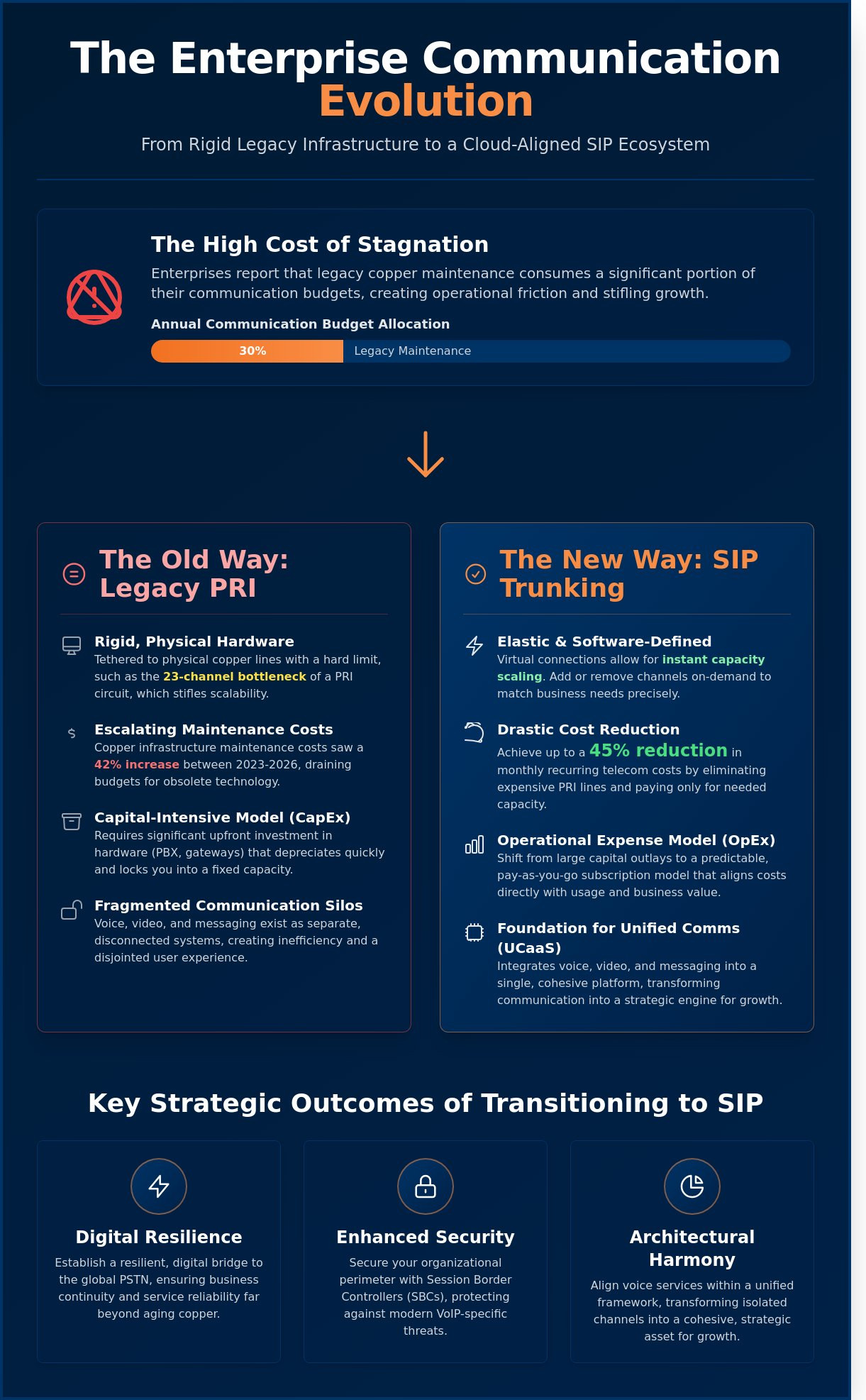
What if the very infrastructure connecting your global enterprise is actually the silent architect of its operational stagnation? In an era where 72% of IT directors report that legacy copper maintenance consumes nearly 30% of their annual communication budget, the transition to sip trunking is no longer a mere technical upgrade; it’s a fundamental act of strategic alignment. You’ve likely felt the friction of fragmented communication silos and the frustration of paying premium prices for rigid, outdated hardware that fails during peak business periods. We understand that managing this complexity requires more than a quick fix; it demands a vision for transformative growth.
This guide provides the technical clarity and the tailored framework you need to orchestrate a seamless transition from legacy systems to a sophisticated, cloud-aligned ecosystem. You’ll gain a clear roadmap to navigate the legacy-to-cloud journey while securing a 45% reduction in monthly recurring telecom costs. We’ll explore the architecture of modern voice systems, the logic of scalable multimedia integration, and the specific steps to forge a unified platform that reflects the elegance of your business operations.
Key Takeaways
- Navigate the inevitable sunsetting of legacy copper infrastructure by establishing a resilient, digital bridge to the global PSTN.
- Secure your organizational perimeter through a sophisticated understanding of Session Border Controllers and modern protocol architecture.
- Leverage sip trunking to transition from capital-intensive hardware to an elastic, cloud-aligned model that harmonizes capacity with real-time demand.
- Execute a precise implementation strategy by auditing network readiness and hardware compatibility to ensure total architectural harmony.
- Align your voice services within a unified UCaaS framework to transform isolated communication channels into a strategic engine for growth.
The Evolution of Enterprise Connectivity: Beyond Legacy Infrastructure
Modern enterprise architecture requires a fundamental shift in how we perceive connectivity. By 2026, the global telecommunications landscape has moved past the era of physical copper, reaching a point where digital agility is the only currency that matters. SIP trunking acts as the sophisticated digital bridge between your internal network and the global Public Switched Telephone Network (PSTN). It transforms communication from a rigid hardware dependency into a fluid, software-defined asset. This virtualization allows organizations to scale voice capacity instantly, replacing physical wires with logical sessions that adapt to real-time demand.
The transition from physical trunks to virtualized paths isn’t merely a change in medium. It’s a move toward a more harmonious business operation. SIP provides the necessary foundation for Unified Communications as a Service (UCaaS), ensuring that voice doesn’t exist in a silo. By 2026, the strategic alignment of communication protocols with cloud-native environments has become the standard for any organization seeking transformative growth. Legacy systems can’t compete with the precision and resilience of a well-architected SIP environment.
The Decline of PRI and Analog Landlines
The final sunsetting of ISDN services in late 2025 marked a definitive end for the Primary Rate Interface (PRI). Legacy hardware has become a massive liability; maintenance costs for copper infrastructure rose by 42% between 2023 and 2026. Organizations still tethered to PRI face a 23-channel bottleneck that stifles scalability and hampers rapid expansion. This rigidity prevents the strategic alignment required for modern, agile operations. Transitioning to virtualized sip trunking isn’t just a technical upgrade. It’s a strategic necessity to avoid the escalating risks of obsolete hardware and the inevitable service outages associated with aging PSTN lines.
SIP vs. VoIP: Clarifying the Terminology
Clarifying these terms is essential for architectural precision. VoIP represents the broad category of voice transmission over internet protocols, while SIP is the specific protocol used to initiate it. SIP is the signaling language that orchestrates multimedia sessions. While VoIP carries the data, SIP manages the initiation, modification, and termination of the call. This protocol enables more than just voice. It integrates video, instant messaging, and rich data into a single, cohesive stream. It’s the prerequisite for any robust UCaaS framework, ensuring that communication remains an elegant, unified experience across the entire enterprise. Without SIP, the modern vision of a truly integrated enterprise VoIP and cloud communications framework simply doesn’t function.
Demystifying SIP Trunking: Technical Architecture and Protocols
The architecture of modern enterprise voice relies on the seamless integration of internal infrastructure and external carrier services. At its core, sip trunking serves as the digital bridge, replacing physical wires with virtual connections. This transformation requires a precise orchestration between the on-premise or cloud-based IP-PBX and the Internet Telephony Service Provider (ITSP). It’s a sophisticated alignment where software defines the reach of your global communication. Success depends on how well these components communicate across the network perimeter.
Private vs. Public Domains in Communication
The private domain consists of the internal LAN where the IP-PBX resides. This environment allows the enterprise to retain total control over call routing and internal user experience. In contrast, the public domain represents the vast network of the PSTN and the ITSP’s infrastructure. The SIP trunk functions as the authenticated gateway between these two worlds. It ensures that every packet of data maintains its integrity as it crosses from the controlled internal environment into the open internet.
Securing this intersection requires a Session Border Controller (SBC). This device acts as a specialized firewall for voice traffic, handling NAT traversal and protecting against Distributed Denial of Service (DDoS) attacks. In 2024, security breaches in unmanaged VoIP systems cost global businesses over $12 billion, making the SBC a non-negotiable component of a strategically aligned voice framework.
The Mechanics of Session Initiation
SIP operates through a series of structured requests and responses. When a user initiates a call, the system sends an INVITE request to the recipient. The Session Description Protocol (SDP) then negotiates the media parameters, determining which codecs will handle the audio or video data. This handshake is essential for ensuring that both endpoints can interpret the data stream correctly, whether they’re using basic voice or high-definition video conferencing.
- G.711 Codec: Provides high-fidelity audio but requires approximately 87.2 Kbps of bandwidth per call.
- G.729 Codec: Compresses voice data to roughly 31.2 Kbps, ideal for sites with limited bandwidth.
- Media Negotiation: SDP ensures both devices agree on the highest quality codec supported by the network.
Maintaining audio clarity requires strict network topology management. To achieve a Mean Opinion Score (MOS) of 4.0 or higher, latency must stay below 150ms and jitter must remain under 30ms. Strategic bandwidth allocation ensures that sip trunking traffic receives priority over standard data, preventing packet loss during peak usage periods. This technical discipline transforms a simple connection into a robust platform for enterprise growth.
Strategic Advantages: Why Modern Organizations Prioritize SIP
The evolution of enterprise communication represents more than a technical upgrade; it’s a fundamental pivot in fiscal philosophy. Organizations are abandoning the rigid, CAPEX-intensive architecture of on-premise hardware for the fluid, OPEX-driven efficiency of cloud-based models. This shift allows leaders to redirect capital from depreciating physical assets toward strategic innovation and core business drivers. The elasticity factor remains the most compelling argument for this transition. A retail giant facing a 400% surge in call volume during the November holiday window can scale capacity instantly, then retract it in January without paying for idle resources. This precision ensures that infrastructure costs remain perfectly aligned with actual utilization.
Centralization serves as the second pillar of this modern architecture. Managing communication across 50 national branches no longer requires 50 separate maintenance contracts or local technicians. Instead, a single administrative interface provides a holistic view of the entire network. This unified visibility allows for the strategic orchestration of resources, ensuring that every location operates under a standardized, high-performance framework regardless of its geographical footprint.
Cost Optimization and Transformative Growth
Traditional telephony relies on rigid PRI line rentals that often cost between $250 and $400 per month per circuit, regardless of actual usage. By adopting sip trunking, enterprises eliminate these redundant fixed costs and bypass the exorbitant long-distance charges associated with legacy carriers. Consolidation is the cornerstone of this financial strategy. Merging voice and data onto a single, unified network reduces administrative overhead by an estimated 35%, as IT teams no longer manage disparate cabling and vendor contracts. This streamlined approach facilitates rapid expansion; a firm can establish a virtual presence in a new international market within 48 hours, bypassing the typical 6-week delay for physical circuit installation.
Enhanced Reliability and Business Resilience
Operational continuity is no longer a luxury but a baseline requirement for the modern enterprise. Modern providers utilize geo-redundancy, distributing traffic across multiple data centers located in distinct seismic zones to ensure 99.999% availability. Dynamic routing protocols serve as an invisible safety net, automatically redirecting inbound traffic to secondary offices or mobile devices if a local network failure occurs. This intelligence transforms how we view disaster recovery. By distributing traffic across a decentralized cloud architecture, sip trunking mitigates the risk of a single point of failure that historically paralyzed entire corporate headquarters during local outages.
Navigating the Transition: Implementation and Quality Assurance
Transitioning to sip trunking requires more than a simple technical switch; it demands a meticulous architectural audit of your current infrastructure. Recent industry data shows that 82% of enterprises still maintain legacy PBX hardware that lacks native IP capabilities. You must determine if a full hardware refresh is required or if a Media Gateway can effectively bridge the gap between TDM and IP protocols. This decision dictates your long-term scalability and the elegance of your voice ecosystem.
Network integrity serves as the foundation of voice fidelity. A successful deployment targets latency below 150ms and jitter under 30ms to ensure crystal-clear communication. You’ll need to design for Quality of Service (QoS) at the router level, prioritizing voice packets over standard data traffic. Without this strategic alignment, even the most robust bandwidth will succumb to congestion during peak usage periods. It’s about creating a harmonious flow where data and voice coexist without friction. For hybrid workforces operating across modern LEED-certified buildings where cellular signals are frequently blocked, complementing your SIP infrastructure with an enterprise wifi calling strategy ensures seamless voice continuity across every corner of your facilities.
Selecting a partner is a choice that transcends mere connectivity. You aren’t just buying a service; you’re choosing a collaborator to support your transformative growth. A true strategic partner offers deep-tier peering and geographic redundancy that ensures 99.999% availability. They should provide a tailored framework that matches your specific enterprise requirements, moving beyond the one-size-fits-all approach common in the lower-tier market.
The Migration Roadmap
Phase 1 begins with a discovery audit of your call volumes. Focus on the 95th percentile of peak usage to determine your required concurrent call paths. Phase 2 implements a hybrid model where SIP trunks run parallel to existing PRI lines for a 14-day pilot. This ensures a zero-downtime transition. Phase 3 concludes with the full cutover and the decommissioning of legacy copper infrastructure, finally shedding the costs of outdated maintenance contracts.
Ensuring Security and Voice Fidelity
Security isn’t a secondary concern. Implementing SIP TLS (Transport Layer Security) is essential to encrypt signaling and prevent unauthorized interception. You must configure Session Border Controllers (SBCs) to act as a specialized firewall, mitigating the risk of toll fraud, which cost global businesses over $25 billion in 2023. Real-time monitoring tools provide the analytics needed to maintain voice clarity, allowing your team to visualize packet health and resolve issues before they reach the end user.
Strategic Alignment: Elevating Your Communication Ecosystem
Communication infrastructure in 2026 demands a departure from the fragmented architectures of the past. It’s no longer sufficient to treat voice as a utility; it must function as a strategic asset. We bridge the gap between the 99.999% reliability of legacy systems and the rapid agility of the cloud. By positioning sip trunking as the primary gateway to a broader UCaaS and CCaaS integration, we transform a simple connection into a powerful engine for organizational growth. This alignment ensures that every byte of voice data contributes to a larger, more intelligent business narrative.
Integrating Voice into the Broader Strategy
Siloed communication tools are the silent killers of enterprise efficiency. Data from 2024 indicates that fragmented systems cost mid-market firms roughly $12,500 per employee annually in lost productivity. Stratelegy eliminates these frictions by weaving sip trunking directly into your CRM and collaboration platforms. This integration creates a 360-degree view of the customer journey, allowing for real-time data synchronization that empowers your front-line teams. We don’t just install technology; we craft bespoke communication frameworks that reflect your specific operational DNA. Our role is to act as the architect of your digital transformation, ensuring your voice strategy supports your long-term vision.
Beyond SIP: A Holistic Approach to Connectivity
True enterprise resilience requires a vision that extends beyond the dial tone. While voice traffic moves to the cloud, critical systems often remain tethered to failing copper infrastructure. We solve this by orchestrating a synergy between modern voice protocols and LTE POTS replacement for fire, elevator, and life safety systems. This holistic approach ensures your organization remains compliant with NFPA 72 standards while shedding the costs of obsolete analog lines.
- We replace the chaos of disparate vendors with the clarity of a single national partner.
- Our frameworks prioritize structural harmony, balancing legacy requirements with future-ready scalability.
- We turn technical debt into a competitive advantage through precise, rhythmic execution of your connectivity roadmap.
The transition to a modern ecosystem shouldn’t feel like a disruption. It’s an evolution toward a more elegant, controlled, and profitable way of doing business. We provide the expertise to navigate these complexities, ensuring that your infrastructure is as sophisticated as the strategy it supports. Discover how Stratelegy aligns your communications with your growth strategy.
Architecting the Future of Enterprise Voice
As 2026 approaches, the transition from fragmented legacy systems to a unified architecture is no longer an option; it’s a strategic imperative. Modern organizations are moving beyond basic connectivity to embrace sip trunking as the core of their digital identity. By integrating enterprise-grade UCaaS and CCaaS protocols, businesses can achieve 99.999% reliability while eliminating the maintenance burdens of aging infrastructure. This evolution requires more than technical implementation. It demands a vision where communication becomes a distinct competitive advantage. Success isn’t just about making calls; it’s about building a resilient ecosystem that aligns with your long-term objectives.
Whether you’re navigating the final phase of FCC-mandated POTS replacement or scaling operations across national borders, the path forward relies on precision. Stratelegy offers specialized expertise in critical LTE POTS replacement and national-scale solutions designed for total strategic alignment. A well-designed communication framework doesn’t just function. It harmonizes strategy with execution to create a scalable foundation for transformative growth. It’s time to move toward a more sophisticated, well-designed future.
Partner with Stratelegy to modernize your communication architecture.
Your journey toward a more elegant and efficient enterprise voice architecture starts today.
Frequently Asked Questions
What is the difference between SIP and VoIP?
VoIP represents the broad category of voice transmission over the internet, while SIP is the specific signaling protocol that initiates and manages those sessions. In 2025, SIP governs approximately 92% of all enterprise VoIP deployments because it handles more than just voice. It manages video, instant messaging, and multimedia conferencing with superior precision, offering a more robust framework for unified communications than traditional alternatives.
Can I keep my existing phone numbers when switching to SIP trunking?
You’ll maintain full ownership of your existing numbers through the standard process of Local Number Portability. Federal regulations require providers to release numbers within 24 to 48 hours for standard requests, ensuring a seamless transition without service interruptions. This strategic alignment ensures your brand identity remains intact while you transition to a more flexible architecture that supports your long-term growth objectives.
How many SIP trunks does my business actually need?
Your requirement depends on concurrent call volume rather than your total headcount. Most enterprises utilize a 1:3 ratio, meaning one path for every three employees. If your firm has 300 staff members, 100 channels typically suffice to maintain 99.9% call completion rates during peak hours. This calculated approach prevents over-provisioning and ensures your infrastructure remains both lean and highly effective for your specific operational needs.
Is SIP trunking secure enough for enterprise use?
Modern sip trunking provides enterprise grade security through Transport Layer Security and Secure Real-time Transport Protocol. Implementing AES-256 encryption effectively mitigates eavesdropping risks and unauthorized access. Recent data from 2024 shows that properly configured SIP systems experience 65% fewer security incidents compared to unencrypted legacy circuits. This creates a fortified communication environment that protects your intellectual property and sensitive client data with absolute certainty.
What happens to my phone service if the internet goes down?
Your communications remain resilient through automated failover protocols that redirect traffic to secondary data lines or mobile devices. Using an SD-WAN configuration provides 99.999% availability by switching paths in less than 50 milliseconds. This ensures your operational continuity doesn’t falter during local network outages. This sophisticated safety net maintains your professional presence regardless of external infrastructure challenges or unexpected regional connectivity issues.
Does SIP trunking support emergency 911 services?
Enhanced 911 services are fully integrated into modern SIP architectures to comply with Kari’s Law and the RAY BAUM’S Act. These regulations ensure that emergency responders receive precise location data, including floor and room numbers, which is vital for large corporate campuses. Your system will automatically transmit this granular information to the nearest Public Safety Answering Point, guaranteeing that your safety protocols meet the highest legal and ethical standards.
Do I need to replace my entire phone system to use SIP?
You don’t need to discard your existing legacy hardware if you utilize an ATA or a VoIP gateway. These devices bridge the gap between analog PBX systems and digital networks for a fraction of the cost of a full replacement. A standard 4-port gateway costs approximately $200, allowing for a phased and graceful digital transformation. This method preserves your previous capital investments while unlocking the advanced features of a modern cloud-based voice architecture.
How much can a business typically save by switching to SIP?
Enterprises typically realize a 40% to 60% reduction in monthly telecommunications expenditure after the initial migration. Gartner reports indicate that consolidating multiple PRI lines into a single sip trunking solution saves the average mid-sized firm $12,000 annually. These savings stem from the elimination of physical hardware maintenance and significantly lower long-distance tariffs. This represents a transformative shift that reallocates capital from maintenance to strategic innovation and business expansion. For a deeper exploration of how modern enterprise VoIP strategies drive cloud communication savings, our comprehensive guide outlines the full financial and operational case for transitioning in 2026.