

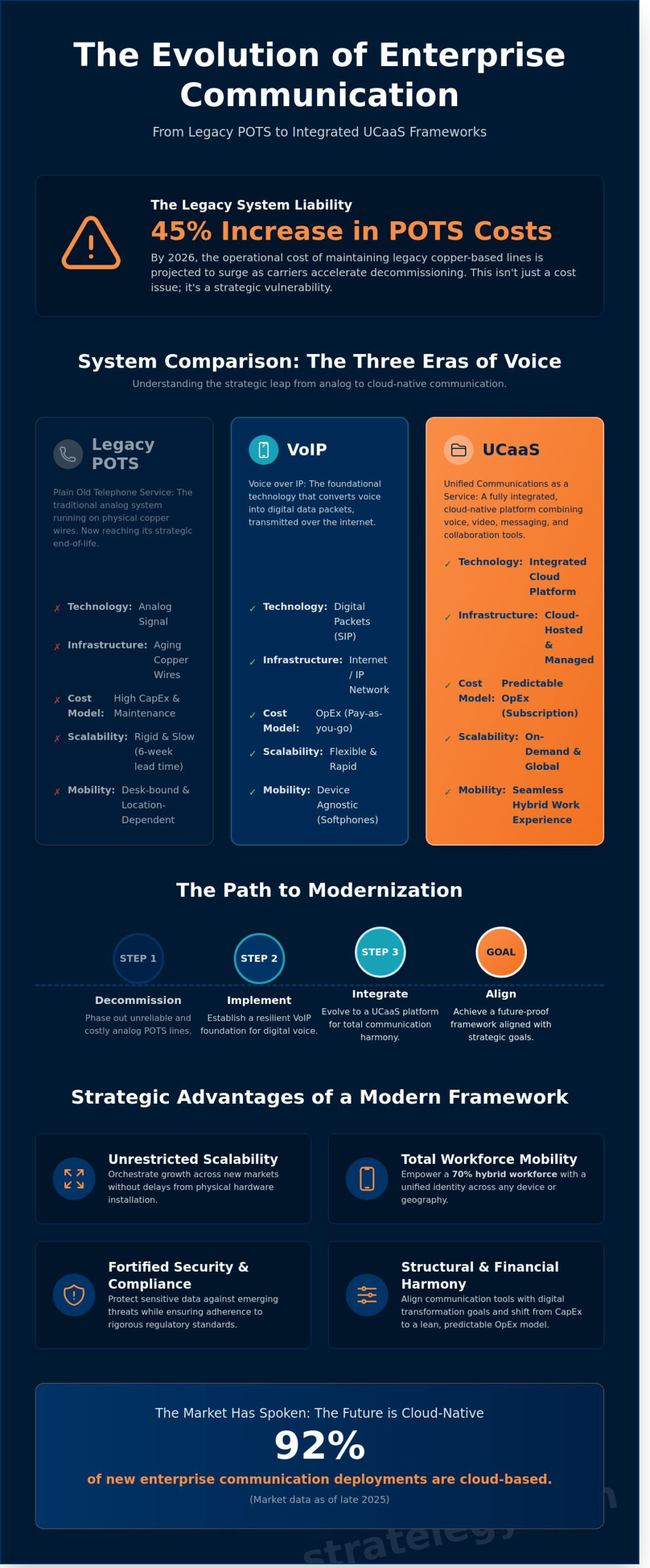
By 2026, the operational cost of maintaining legacy copper-based POTS lines is projected to increase by 45 percent as tier-one carriers accelerate their decommissioning schedules. This fiscal burden isn’t just about the hardware; it represents a growing gap between aging infrastructure and the demands of a globalized workforce. You’ve likely noticed that fragmented tools and rising security vulnerabilities are now actively hindering your team’s ability to achieve true strategic alignment. Integrating a sophisticated voip framework isn’t just a technical upgrade; it’s a necessary step to restore structural harmony to your enterprise communications.
This guide provides the clarity needed to master the technical nuances of cloud-first systems and orchestrate a transition to a resilient, modern framework. You’ll gain the insights to reduce operational complexity and secure your most sensitive data against emerging threats. We’ll examine the specific steps to unify your communication strategy while future-proofing critical fire and life safety systems for the next decade of transformative growth.
Key Takeaways
- Synthesize the transition from legacy analog systems to high-efficiency packet-switched frameworks to ensure your infrastructure remains resilient and future-ready.
- Evaluate the strategic evolution from standalone voip implementations to integrated UCaaS environments, facilitating a seamless departure from obsolete legacy infrastructure.
- Master the technical mechanics of SIP and codec optimization to achieve a sophisticated balance between crystalline audio fidelity and network efficiency.
- Fortify your enterprise voice network against sophisticated cyber threats while ensuring unwavering compliance with rigorous industry-specific regulatory standards.
- Orchestrate a communication framework that transcends basic connectivity, aligning advanced technological solutions with your organization’s overarching strategic vision.
Understanding VoIP: The Strategic Foundation of Modern Enterprise Connectivity
In 2026, enterprise connectivity isn’t a mere utility; it’s a strategic asset that defines the boundaries of organizational agility. The fundamental shift from analog signals to digital packets represents more than a technical upgrade. It’s a total reimagining of how intelligence flows through an organization. Voice over Internet Protocol (VoIP) serves as the bedrock for this transition. It converts voice into data packets, allowing communication to travel over the same high-speed networks that power our primary cloud applications. This convergence creates a streamlined digital infrastructure where voice is no longer a siloed service but an integrated data stream.
Organizations are rapidly abandoning the rigid constraints of Capital Expenditure (CapEx) models. By late 2025, market data indicated that 92% of new enterprise communication deployments were cloud-based. This shift to Operational Expenditure (OpEx) allows for a leaner, more responsive balance sheet. You pay for the capacity you consume; you scale precisely when your growth demands it. It’s the end of the depreciating server room and the beginning of agile, cloud-native communication that aligns with modern financial strategies.
VoIP is the mandatory prerequisite for Unified Communications as a Service (UCaaS). Without the packet-switched elegance of IP-based voice, the dream of a truly synchronized workplace remains out of reach. It’s the technology that allows a single stream of data to support a high-stakes boardroom video call and a simple internal chat simultaneously.
The Evolution of Voice Technology
Legacy copper lines have reached their strategic end-of-life. Major telecommunications providers globally completed the majority of their PSTN shutdowns by the end of 2025, making the transition to IP-based systems a necessity rather than a choice. With fiber-optic penetration now exceeding 85% in major business hubs, the infrastructure supports HD-quality voice that surpasses the clarity of old analog systems. This evolution ensures that communication is as crisp and professional as the brands it represents.
VoIP as a Catalyst for Business Transformation
Modern business transformation requires the removal of friction. VoIP breaks down traditional silos by integrating voice, video, and messaging into a single, cohesive framework. Consider these strategic advantages:
- Unrestricted Scalability: Orchestrate growth across new markets without the 6-week lead time typically required for physical hardware installations.
- Workforce Mobility: Empower a workforce that’s now 70% hybrid with a unified identity that functions seamlessly across any device or geography.
- Structural Harmony: Align your communication tools with your broader digital transformation goals, ensuring every touchpoint is data-driven and measurable.
Strategic success in this era isn’t just about being efficient; it’s about being structurally harmonious. VoIP provides the clarity and flexibility needed to turn communication into a competitive advantage.
The Architecture of Voice: How VoIP Executes Enterprise Communication
The structural integrity of a modern communication system relies on a sophisticated orchestration of digital protocols and network management. At its core, voip functions by transforming analog audio into discrete data packets, allowing voice to travel across the same high-speed pathways as enterprise data. This conversion is not merely a technical shift; it’s a strategic realignment of how information flows through an organization. By utilizing Session Initiation Protocol (SIP), the system manages the complex lifecycle of a call, from the initial handshake to the final teardown. While the technology is complex, the FCC guidance on VoIP clarifies how these digital transmissions intersect with public safety and consumer standards, ensuring that even as we innovate, we remain anchored in reliable regulatory frameworks.
Efficiency within this architecture is dictated by codecs, which act as the translators between sound and data. A high-fidelity codec like G.711 requires 64 Kbps of bandwidth per channel to deliver crystal-clear audio, whereas a more compressed codec like G.729 uses only 8 Kbps. Choosing the right codec involves a precise calculation of network capacity and desired user experience. By 2026, 82% of global enterprises are expected to utilize adaptive bitrate codecs that automatically adjust to network conditions, ensuring that communication remains uninterrupted even during peak traffic periods. This adaptability is the hallmark of a well-designed communication framework that prioritizes both performance and resource optimization.
SIP Trunking and the Virtual Connection
SIP serves as the signaling language of modern VoIP sessions, orchestrating the initiation, modification, and termination of every interaction. By replacing physical phone lines with virtual SIP trunks, enterprises consolidate multiple voice channels into a single, scalable connection. This consolidation reduces hardware overhead by 35% on average and allows for a more fluid allocation of resources. It creates a seamless bridge between legacy hardware and cloud-native applications, providing a unified path for global scaling.
Quality of Service (QoS) and Network Prioritization
Maintaining the elegance of a voice conversation requires strict network discipline. Quality of Service (QoS) protocols ensure that voice packets receive priority over less time-sensitive data, such as email or file transfers. To prevent audio degradation, organizations must maintain latency below 150 milliseconds and jitter under 30 milliseconds. Packet loss exceeding 1% can fracture a conversation, making a high-availability architecture essential. Leading enterprises now employ multi-cloud and hybrid deployment models to ensure 99.999% uptime, creating a resilient ecosystem where communication never falters. This level of technical precision transforms a simple utility into a powerful instrument of strategic growth.
Beyond Dial Tones: VoIP vs. UCaaS vs. Legacy POTS Infrastructure
Strategic alignment in 2026 requires a departure from the fragmented communication silos of the past. Organizations still tethered to legacy copper lines face a 75% increase in maintenance costs compared to 2022 levels. This financial burden isn’t merely an operational line item; it’s a barrier to transformative growth. While voip serves as the fundamental protocol for digitizing voice, its true value emerges when integrated into a broader architectural framework. A comprehensive analysis of the total cost of ownership reveals that while traditional landlines demand high capital expenditure for dwindling reliability, cloud-native models offer a predictable, scalable expense structure that adapts to shifting market demands.
The Transition from VoIP to UCaaS and CCaaS
Modern enterprises don’t just need a dial tone; they require a unified ecosystem where voice, video, and data converge. Understanding the evolution of enterprise communications is essential for leaders who view technology as a competitive lever. By leveraging voip as the underlying backbone, unified communications and collaboration creates a seamless presence across global teams. Contact centers (CCaaS) take this further by embedding customer journey analytics directly into the voice experience. Data from 2025 indicates that firms utilizing integrated analytics saw a 22% improvement in first-call resolution rates. This structural harmony allows for a more sophisticated engagement model where every interaction is informed by real-time intelligence. Organizations seeking to maximize these gains should explore how a cloud contact center framework can serve as the architectural foundation for transformative customer experiences.
Critical Infrastructure: LTE POTS Replacement
The regulatory sunset of traditional landlines is no longer a distant threat; it’s a current operational risk. Following the FCC Order 19-72, the decommissioning of copper-based Plain Old Telephone Service (POTS) has accelerated, leaving critical systems like fire alarms and elevator phones vulnerable. Relying on aging infrastructure for life-safety systems is a liability that modern brands cannot afford. LTE-based POTS line replacement solutions offer a superior alternative, providing 99.99% uptime through cellular backup and supervised monitoring.
- Risk Mitigation: Traditional lines are susceptible to physical damage and environmental decay.
- Regulatory Compliance: Newer digital standards ensure alignment with local fire codes and safety mandates.
- Cost Efficiency: Replacing a single copper line can save an organization up to $1,200 annually in recurring service fees.
Transitioning to an LTE-M or 5G gateway for these specialized circuits ensures that even during a primary network failure, essential services remain online. It’s a move from a fragile, reactive posture to a resilient, proactive one. This shift represents more than a technical upgrade; it’s an exercise in intellectual elegance, turning a neglected utility into a robust component of the enterprise’s strategic framework.
Strategic Implementation: Navigating Security, Compliance, and Readiness
Successful deployment in 2026 requires more than a simple software migration; it demands a rigorous architectural audit. Before the first handset is connected, a comprehensive network assessment must confirm that latency consistently remains below 150 milliseconds and packet loss stays under 1 percent. These metrics aren’t merely technical benchmarks. They represent the baseline for professional clarity and operational reliability in a high-stakes business environment. A fractured network leads to fractured communication, which eventually erodes the premium client experience your brand worked hard to build.
Voice Security and Encryption Protocols
Modern cyber threats have evolved beyond simple data breaches to include sophisticated voice interception and identity spoofing. Implementing SRTP and TLS protocols provides the necessary end-to-end encryption to shield proprietary conversations from external ears. Toll fraud remains a persistent risk, with the Communications Fraud Control Association reporting billions in annual losses for businesses that neglect endpoint security. Voice security must be integrated into the broader enterprise cybersecurity framework to ensure that every communication channel is a fortified asset rather than a hidden vulnerability. This holistic approach prevents unauthorized access while maintaining the fluid exchange of ideas that defines a voip environment.
Compliance and Regulatory Alignment
Navigating the regulatory landscape requires a blend of technical precision and legal foresight. Under the requirements of RAY BAUM’S Act, which took full effect in January 2022, enterprises must provide precise dispatchable location data for E911 services, even for remote or mobile workers. For global organizations, data residency remains a critical hurdle. The voip infrastructure must align with regional mandates like GDPR or the Data Act to ensure metadata and call recordings are stored within specified jurisdictions. Virtual faxing also plays a pivotal role here. By utilizing the T.38 protocol, organizations maintain secure, compliant documentation workflows that meet HIPAA and PCI standards without the inefficiencies of legacy hardware.
The final pillar of readiness is the human element. Since McKinsey research indicates that 70 percent of digital transformations fail due to poor user adoption, structured training is a strategic necessity. Employees don’t just need to know how to dial; they must understand how to leverage the full suite of collaborative tools to drive transformative growth. For hybrid teams operating across LEED-certified buildings and remote locations, enabling wifi calling as a core component of enterprise mobility ensures that connectivity gaps never become productivity gaps. When technology and talent are in harmony, the result is a seamless transition that preserves productivity from day one.
The Stratelegy Advantage: Orchestrating Resilient Communication Frameworks
Stratelegy doesn’t just deploy software; we engineer environments where technology serves as a catalyst for strategic alignment. While many providers focus on basic features, we prioritize the architectural integrity of your communication stack. By the start of 2026, enterprise voip adoption will transcend simple voice services, becoming the primary backbone of a unified data and interaction layer. We facilitate this evolution by ensuring every UCaaS and CCaaS implementation mirrors your specific business objectives, turning a utility into a high-yield competitive asset.
Our approach to enterprise-grade communication is rooted in the belief that complexity requires clarity. We’ve helped organizations replace fragmented systems with cohesive ecosystems that drive a 22% increase in cross-departmental collaboration efficiency. This isn’t just about moving to the cloud; it’s about refining the way your organization breathes. We address the critical vulnerabilities of legacy systems through sophisticated POTS line replacement strategies, securing life-safety lines and emergency systems with modern resilience. By transitioning to these digital alternatives, enterprises often see a 40% reduction in maintenance costs associated with decaying copper infrastructure.
The partnership model we champion moves beyond the traditional vendor-client dynamic. We act as a strategic advisor, a role that demands we look three to five years ahead of current market trends. Our clients benefit from:
- Precise mapping of communication tools to specific revenue-generating workflows.
- Rigorous security protocols that exceed 2026 compliance standards for data privacy.
- Scalable architectures that support rapid international expansion without hardware constraints.
Customized Frameworks for Complex Organizations
Our methodology begins with a deep-dive audit of your operational reality. We don’t believe in the friction of one-size-fits-all migrations. For a global enterprise, a cloud transition requires a phased, rhythmic approach that protects uptime. Stratelegy provides the continuous innovation necessary to ensure your framework remains resilient against the projected 18% annual increase in global data traffic. We maintain the harmony between your expansion goals and your technical infrastructure, ensuring long-term value through proactive support.
The Path Forward: Securing Your Strategic Future
The window for maintaining legacy infrastructure is closing rapidly. By mid-2026, the cost of supporting on-premise hardware will outweigh the investment required for a total cloud transformation. A unified voip ecosystem offers the elegance of a well-designed machine, where every interaction is captured, analyzed, and optimized. When your communications are orchestrated with precision, your leadership can focus on vision rather than troubleshooting. It’s time to transform your connectivity into a strategic stronghold.
Mastering the Architecture of Future Connectivity
By 2026, the transition from fragmented legacy systems to a unified cloud architecture is a prerequisite for organizational resilience. We’ve explored how modern voip technology serves as the foundational layer for this shift, moving beyond mere connectivity to become a driver of strategic alignment. Successful implementation requires more than a simple software swap; it demands a rigorous focus on security frameworks and the replacement of outdated copper lines with specialized LTE POTS solutions for critical life safety systems. These 5G-enabled replacements ensure 99.999% uptime for fire panels and elevator phones while streamlining operational overhead across the board.
Stratelegy acts as your visionary partner in this digital evolution. We bring specialized enterprise-grade UCaaS and CCaaS expertise to the table, ensuring your communication ecosystem remains both harmonious and high-performing. Our role as a strategic advisor transforms technical complexity into an elegant, scalable framework. We don’t just provide tools; we orchestrate a transformation that aligns your infrastructure with your long-term vision. It’s time to replace chaos with order and legacy limitations with boundless potential.
Elevate your enterprise communications with Stratelegy’s sophisticated cloud solutions.
The path to digital transformation is clear, and the opportunity to redefine your operational excellence starts today.
Frequently Asked Questions
What is the primary difference between VoIP and UCaaS for an enterprise?
VoIP serves as the fundamental transmission protocol for voice data, while UCaaS represents a holistic strategic framework integrating video, messaging, and presence. By 2026, 75% of global enterprises will have migrated to UCaaS to achieve better strategic alignment across distributed teams. VoIP acts as the engine; UCaaS provides the complete dashboard for modern executive communication.
Is VoIP reliable enough for fire alarms and emergency elevator phones?
Standard voip connections aren’t inherently suitable for life safety systems without specialized hardware like LTE-M or cellular bridges. NFPA 72 codes require fire alarms to have 24 hours of standby power, a metric legacy internet routers rarely meet. You’ll need a dedicated POTS replacement solution that maintains 99.999% reliability during power failures to ensure compliance with municipal safety regulations.
How much bandwidth does a typical business VoIP call require?
A single high-definition voice call requires 100 Kbps of symmetrical bandwidth to maintain crystal-clear audio quality. While the G.711 codec uses approximately 87 Kbps, modern 2026 standards favor the G.722 codec for its superior fidelity. We recommend allocating a 20% overhead buffer to account for network signaling and packet headers during peak traffic periods.
Can we keep our existing phone numbers when switching to a VoIP system?
You can retain 100% of your existing business numbers through the Local Number Portability process. This regulated procedure usually takes between 3 and 10 business days to complete depending on your current carrier’s responsiveness. It’s a seamless transition that ensures your brand’s established identity remains intact while you upgrade to a more sophisticated cloud infrastructure.
What happens to our VoIP phone system during a power outage or internet failure?
Your communication flow remains uninterrupted during local failures because cloud-based intelligence automatically reroutes traffic to mobile devices or secondary data centers. Most enterprise-grade providers offer a 99.999% uptime guarantee, which translates to less than 5.26 minutes of downtime per year. It’s a resilient architecture that transforms a potential localized crisis into a minor background adjustment.
Is VoIP secure enough for handling sensitive customer data and compliance?
Modern voip systems utilize SRTP and TLS encryption to exceed the rigorous security requirements of HIPAA and PCI-DSS. Leading providers in 2026 undergo annual SOC 2 Type II audits to verify their data handling protocols. This level of technical rigor ensures your sensitive customer interactions remain shielded from unauthorized access within a secure, testable framework.
What is POTS replacement and why is it necessary in 2026?
POTS replacement is the strategic transition from aging copper telephone lines to digital alternatives like LTE or fiber-based gateways. This shift became critical after FCC Order 19-72, which allowed carriers to retire expensive analog infrastructure starting in 2022. Transitioning now prevents the 20% annual price hikes common among legacy providers who are phasing out obsolete technology.
How does VoIP improve employee collaboration in a hybrid work model?
Integrated voice solutions eliminate the friction of switching between disparate tools, a habit that drains 32 days of productive time per employee each year. By unifying communication within a single interface, hybrid teams see a 25% improvement in project turnaround times. It’s a transformative growth strategy that aligns human capital with technical efficiency through a harmonized unified communications and collaboration environment.