
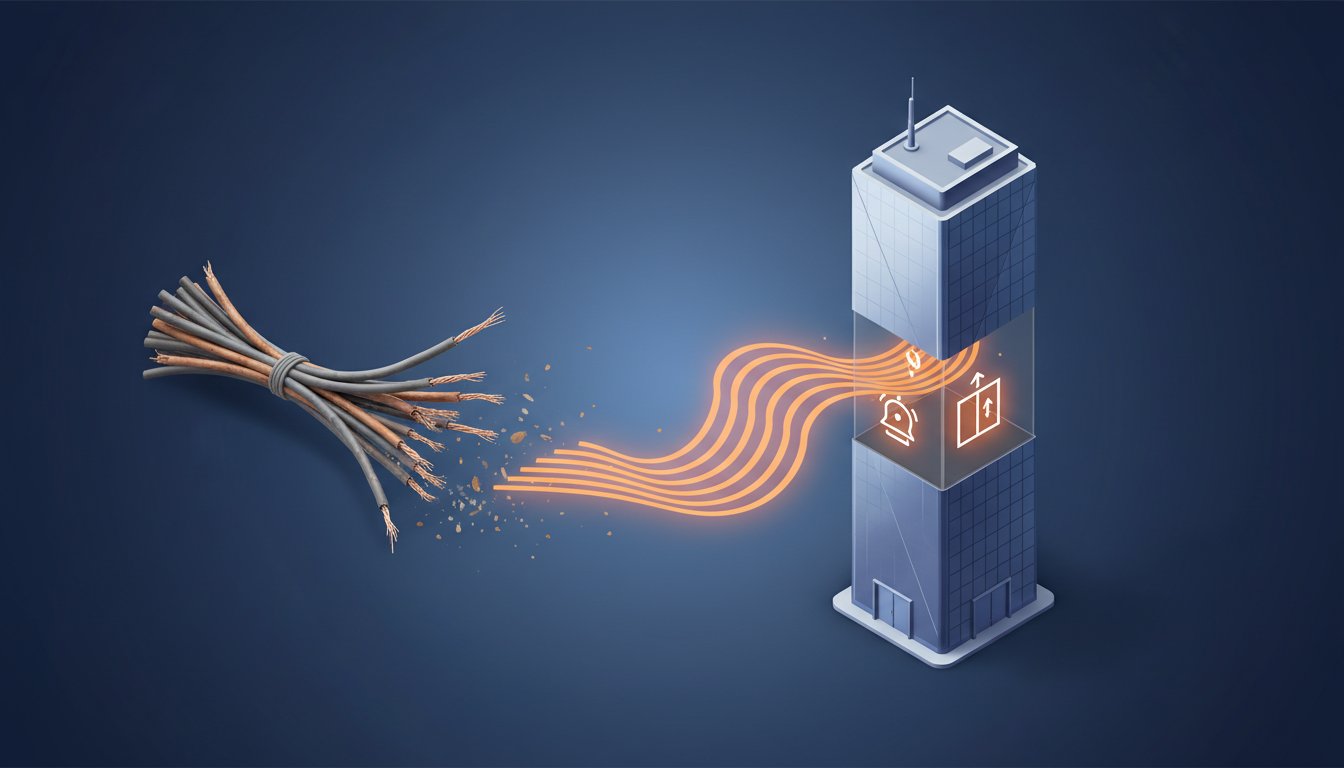
While many view the copper sunset as a mere technical phase-out, the reality is a strategic ultimatum: by 2026, the cost of maintaining a single legacy analog circuit has escalated by over 450% compared to 2019 levels. You’ve likely noticed your monthly recurring charges climbing while the pool of technicians capable of repairing these decades-old systems vanishes. It’s a precarious position, especially when your NFPA 72 compliance for fire alarms and elevator safety hangs on a thread of oxidizing copper. We understand the anxiety that comes with dismantling a system that’s been the bedrock of your life-safety infrastructure for forty years. This guide ensures your pots line replacement isn’t just a reactive fix, but a deliberate move toward a resilient, digital future.
You’ll learn to navigate the complexities of modernizing your communication stack while securing a 30% reduction in operational overhead. We’ll bridge the gap between legacy reliability and digital agility, providing a clear framework for a seamless, compliant transition that protects both your budget and your people.
Key Takeaways
- Navigate the complexities of the “Copper Sunset” by understanding how FCC Order 19-72 and escalating costs necessitate a shift toward modern digital infrastructure.
- Evaluate the technical superiority of cellular-redundant hardware over standard VoIP to ensure your pots line replacement maintains unwavering operational continuity.
- Master the critical life-safety requirements of NFPA 72 to guarantee that fire alarms and elevator systems remain fully compliant during the digital transition.
- Implement a rigorous five-step framework designed to identify hidden legacy lines and execute a seamless migration across expansive enterprise footprints.
- Discover how to transform a technical necessity into a strategic advantage by aligning resilient communication hardware with a unified, future-ready infrastructure.
The Economics of the Copper Sunset: Why POTS Line Replacement is Essential in 2026
The “Copper Sunset” represents the systematic decommissioning of the Public Switched Telephone Network (PSTN), a transition that has moved from a gradual phase-out to an urgent strategic shift. By 2026, the structural obsolescence of analog infrastructure is no longer a peripheral concern for IT leaders; it’s a central risk to operational stability. We’ve reached a point where the physical medium of copper is failing. Maintaining these legacy systems isn’t just inefficient; it’s a fiscal drain that hampers transformative growth.
FCC Order 19-72, issued in August 2019, acted as the primary catalyst for this shift. This regulatory pivot granted carriers relief from the requirement to offer analog voice services at regulated, cost-based rates. It effectively signaled the end of the copper era by removing the “unbundled network element” obligations. Today, carriers are incentivized to let legacy networks deteriorate while aggressively raising prices to force a migration. Attempting a pots line replacement strategy is the only way to escape this cycle of escalating costs and diminishing returns.
The Regulatory Shift and Pricing Volatility
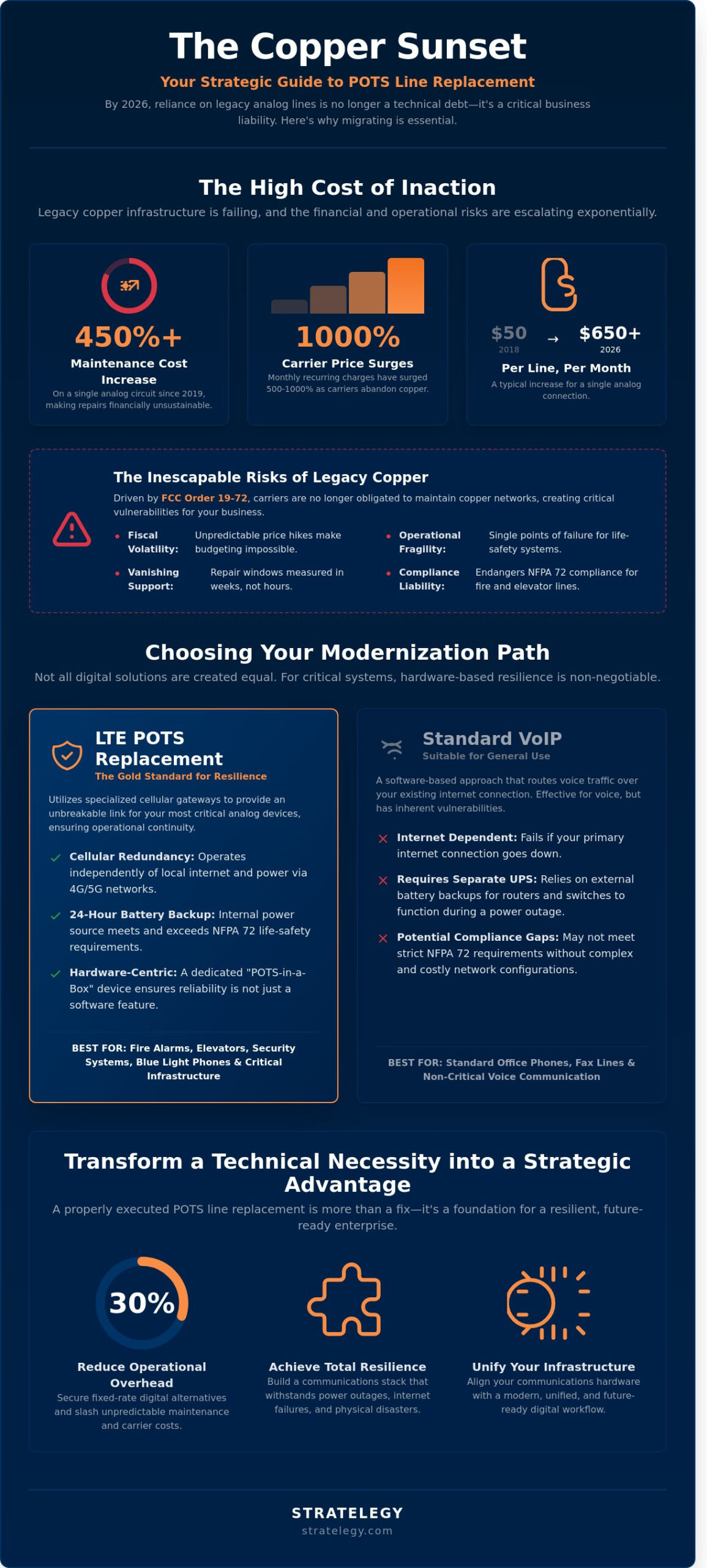
Carriers have transitioned from regulated utilities to market-based providers for analog services. This shift has triggered price volatility that is difficult to budget for. Since 2019, enterprise customers have documented price surges ranging from 500% to 1000% per line. A single analog connection that cost $50 a month in 2018 often exceeds $650 in 2026. Because carriers are no longer legally obligated to maintain copper quality, they’ve initiated a “service sunset” where technical support for these lines is virtually non-existent. When a line fails, the repair window is often measured in weeks, not hours.
Risk Mitigation in a Post-Analog World
Analog lines are inherently fragile and susceptible to environmental factors that modern fiber and wireless networks ignore. Moisture ingress, physical decay of lead-sheathed cables, and the simple lack of replacement parts make copper a liability. In contrast, modern digital frameworks offer self-healing architectures and multi-path redundancy. Relying on 40-year-old wiring for critical fire alarms or elevator communications creates significant insurance liability. Organizations must recognize that: “In 2026, the greatest risk to business continuity is not the adoption of new technology, but the continued reliance on unmaintained legacy copper.” This risk is compounded by the fact that AT&T plans to discontinue traditional landline phone service by 2029, accelerating the timeline for enterprises that have yet to begin their migration planning.
- Fiscal Volatility: Unpredictable price hikes make long-term financial planning impossible.
- Operational Fragility: Lack of redundant paths leads to single points of failure for life-safety systems.
- Strategic Alignment: A timely pots line replacement ensures that communications infrastructure supports, rather than hinders, modern digital workflows.
The decision to modernize is no longer about seeking a “significant improvement” in call quality. It’s about protecting the enterprise from the inevitable collapse of a network that the providers themselves have abandoned. Organizations that act now can secure fixed-rate digital alternatives, while those who wait will find themselves at the mercy of a market that has already moved on.
Evaluating Modern Alternatives: LTE POTS Replacement vs. VoIP
Choosing the right path for pots line replacement isn’t merely a technical upgrade; it’s a deliberate recalibration of your organization’s operational backbone. Decision-makers must distinguish between pure software-based voice solutions and hardware-centric cellular gateways. While both paths move traffic away from aging copper, their architectural integrity varies significantly under stress. True success lies in matching the replacement technology to the specific demands of the end-point device, ensuring that modernization doesn’t compromise reliability.
LTE-Based POTS Replacement (The Gold Standard)
This solution utilizes specialized cellular gateways, frequently categorized as “POTS-in-a-Box”, to bridge the gap between analog heritage and digital future. These devices convert analog signals from legacy hardware into digital packets for transmission over 4G LTE or 5G networks. For critical life-safety systems, the hardware must include internal battery backups capable of sustaining operation for 24 hours during a total power failure, adhering to NFPA 72 standards. This isn’t just a backup; it’s a bespoke safety net for your most vital assets.
Strategic resilience emerges from dual-SIM configurations. By utilizing both AT&T and Verizon networks simultaneously, enterprises can achieve a 99.99% uptime rating. This redundancy ensures that a local carrier outage doesn’t paralyze your fire panels, security alarms, or elevator phones. It’s a sophisticated framework for leaders who prioritize continuity over simple connectivity. For those seeking to align their infrastructure with long-term business goals, this hardware-first approach provides the most stable foundation for non-voice applications.
VoIP and SIP Trunking for Voice-Centric Lines
For standard administrative office phones, migrating to Voice over IP (VoIP) or SIP trunking remains the most cost-effective trajectory. Since the FCC Order 19-72 finalized in 2019, approximately 68% of enterprise-level firms have transitioned their primary voice traffic to UCaaS platforms. These cloud-based environments offer scalability and lower monthly overhead, turning a rigid utility into a flexible, data-rich asset that integrates with modern workflows. Organizations looking to maximize the value of this transition should explore how unified communications and collaboration platforms can unify voice, messaging, and data into a single cohesive framework.
Pure VoIP faces distinct limitations. High-latency environments, where jitter exceeds 30ms or packet loss climbs above 1%, can disrupt sensitive modem signals. Fire alarms and security systems often fail to “handshake” over standard internet connections because they lack the physical dial tone stability that specialized cellular hardware provides. A comprehensive pots line replacement strategy acknowledges that while voice traffic belongs in the cloud, critical signals require the dedicated path of a cellular-redundant gateway. Organizations shouldn’t force a one-size-fits-all solution when the requirements for a desk phone and a fire panel are fundamentally different.
Life Safety Compliance: Fire Alarms, Elevators, and Security
The most persistent obstacle to a comprehensive pots line replacement strategy is the perceived risk to life safety systems. Decision-makers often ask if cellular or IP-based signaling is legally compliant for fire and elevator monitoring. The answer is a definitive yes, provided the architecture adheres to specific regulatory benchmarks. Modernizing these critical paths isn’t merely a cost-saving measure; it’s a transition toward superior reliability and real-time visibility that legacy copper can’t provide.
National standards have evolved to embrace this shift. The NFPA 72 (National Fire Alarm and Signaling Code) 2022 edition provides clear frameworks for Managed Facilities-Based Voice Network (MFVN) solutions. For an enterprise to remain compliant, the replacement hardware must be UL 864 listed for fire signaling. This certification ensures the equipment can withstand the rigors of emergency environments while maintaining seamless communication with central monitoring stations. Using non-certified equipment can void insurance policies or lead to failed inspections by the Authority Having Jurisdiction (AHJ). Facility managers navigating these requirements will find detailed guidance in our LTE POTS replacement for fire alarms strategic guide, which covers how to harmonize NFPA 72 and UL 864 compliance while reducing monthly recurring costs.
Fire Alarm Signaling and Monitoring
Digital migration replaces dual copper paths with high-availability dual-path cellular or IP connections. These modern systems utilize a persistent “heartbeat” connection to monitor link integrity. If the polling interval fails for even 200 seconds, the system triggers an immediate supervisory alert at the central station. To satisfy life safety mandates, these gateways include integrated 24-hour battery backups. This ensures 100% uptime during local power failures, surpassing the performance of aging copper lines that are increasingly prone to environmental degradation and service outages.
Elevator and Emergency Phone Requirements
Specialized gateways solve the unique physical hurdles of elevator shafts, such as signal attenuation through reinforced concrete and steel. ASME A17.1 safety codes require that emergency communication maintains crystal-clear two-way voice clarity and transmits precise location data to dispatchers. A POTS in a Box solution for elevator and emergency phone compliance provides the necessary 48V loop current to power existing analog handsets without requiring a total hardware overhaul. It preserves the architectural integrity of the building while upgrading the underlying transport layer. This approach is essential for the estimated 900,000 elevators in the United States that require a stable, code-compliant alternative as traditional carriers abandon analog maintenance.
Strategic alignment with these codes isn’t just about avoiding fines. It’s about building a resilient infrastructure. By integrating pots line replacement into the broader enterprise security framework, organizations gain centralized management over systems that were previously siloed and unmonitored. This shift converts a legacy liability into a modern, managed asset.
The Enterprise Migration Roadmap: Executing a Seamless Transition
Transitioning away from legacy copper isn’t just a technical upgrade. It’s a strategic realignment of your operational architecture. To achieve a seamless pots line replacement across a national footprint, organizations must follow a disciplined five-step framework: forensic discovery, pilot validation, hardware curation, professional deployment, and managed cutover. This sequence ensures that the migration moves from chaos to structural harmony, protecting the continuity of critical business functions.
The Discovery and Audit Phase
A successful pots line replacement project begins not with a purchase order, but with a forensic audit of the existing environment. Many enterprises find that 22% of their monthly carrier spend is wasted on “ghost lines” that serve no active purpose. By reconciling carrier billing records with physical line traces, organizations can eliminate these inefficiencies before the migration begins. This phase requires a meticulous inventory of every connected device. Use this checklist to identify often-overlooked endpoints:
- Legacy fax machines and point-of-sale terminals.
- Fire and life-safety alarm panels.
- Elevator emergency phones and call boxes.
- Utility meters and irrigation controllers.
- External gate entry and security systems.
Hardware Selection and Installation Logistics
The architectural integrity of the new system rests upon the selection of enterprise-grade LTE or 5G gateways rather than consumer-tier alternatives. Enterprise units offer dual-SIM redundancy and centralized management, allowing IT teams to monitor signal strength and device health across thousands of locations from a single dashboard. Data from 2024 deployments shows that professional installation reduces post-migration failure rates by 40% compared to self-install models. Certified technicians verify signal penetration and ensure compliance with local fire codes, which is essential for life-safety systems.
Managing the final cutover requires a “parallel run” strategy to ensure zero downtime. By keeping the legacy copper active until the new digital path is fully validated, you create a fail-safe environment. In 2026, the cost of a single hour of downtime for critical systems can exceed $100,000 for large retailers. A phased rollout, starting with a pilot at 5% of your total sites, allows your team to refine the configuration before the mass deployment begins. This measured approach transforms a complex technical hurdle into a predictable, value-driven evolution.
Stratelegy LTE POTS Replacement: Engineered for Strategic Resilience
Modernizing enterprise infrastructure requires more than a simple hardware swap; it demands a vision where reliability meets innovation. Stratelegy positions itself at this intersection, acting as the architect for organizations facing the sunset of copper-based networks. We view pots line replacement not as a reactive necessity, but as a deliberate move toward strategic elegance. By unifying your communication stack, we bridge the gap between legacy requirements and a future-defined ecosystem.
Our managed service model removes the friction of technical transitions. We orchestrate the entire lifecycle, beginning with a forensic audit of your current environment, followed by hardware selection and carrier negotiations. This comprehensive approach ensures that your transition is seamless. You’re not just buying a device; you’re securing a managed framework that handles every variable of the migration process. We transform your legacy liabilities into high-performing digital assets that support long-term scalability.
Beyond Hardware: A Partnership for Growth
Stratelegy’s consultative methodology ensures your infrastructure aligns with broader business objectives. We’ve seen that 65% of enterprises struggle with fragmented communication silos during modernization. Our framework solves this by ensuring that your pots line replacement strategy serves as a foundation for advanced UCaaS and CCaaS adoption. When your life-safety systems and fax lines move to LTE, they join a unified environment that’s easier to manage and far more resilient than traditional copper. Understanding the full scope of unified communications and collaboration strategies can help your organization maximize the long-term value of this infrastructure investment.
We provide the peace of mind that comes from 24/7 proactive monitoring. Our team doesn’t wait for a failure to occur; we identify and resolve anomalies before they impact your operations. This level of oversight ensures 99.99% uptime for critical paths, allowing your internal IT resources to focus on high-value initiatives rather than troubleshooting antiquated wiring. It’s a shift from maintenance-heavy operations to a streamlined, aesthetic flow of data and voice.
Next Steps for Your Organization
The window for cost-effective migration is narrowing as carrier maintenance fees for copper increase by 20% to 30% annually. Organizations that act before the 2026 infrastructure shift will capture the highest ROI by eliminating these compounding recurring costs immediately. We invite you to move beyond the limitations of the past and embrace a framework designed for the next decade of connectivity.
A strategic consultation allows us to map your current copper exposure and design a transition path that minimizes risk while maximizing performance. Let’s turn your infrastructure into a competitive advantage. You can schedule a strategic audit of your legacy infrastructure with Stratelegy to begin your journey toward a more resilient, unified future.
Securing Your Infrastructure Legacy Through 2026
The total sunset of copper infrastructure represents a definitive 2026 operational milestone that demands immediate strategic alignment. Transitioning away from legacy systems ensures your critical fire alarms and elevator circuits remain fully compliant with UL-listed safety standards. A successful pots line replacement isn’t merely a technical necessity; it’s a catalyst for transformative growth and structural harmony. By integrating UCaaS and LTE solutions, you replace fragile wires with a resilient framework designed for the modern era. Stratelegy provides the national deployment capabilities required to execute this transition across your entire enterprise footprint without disruption. We specialize in converting technical complexity into a refined, manageable roadmap that prioritizes both safety and efficiency. Don’t allow expiring hardware to compromise your organization’s vision or safety protocols. It’s time to embrace a sophisticated connectivity model that’s engineered for lasting excellence.
Contact Stratelegy for a Comprehensive POTS Replacement Audit
Your journey toward a more resilient and elegant infrastructure starts with a single, well-planned step today.
Frequently Asked Questions
What is the average cost savings when switching from POTS to LTE?
Enterprises typically realize cost savings between 40% and 60% when transitioning from legacy copper to LTE. Since the FCC Order 19-72 in 2019, major carriers have increased copper rates by as much as 450% in certain regions. This strategic shift eliminates these volatile maintenance fees. It replaces unpredictable billing with a fixed, scalable model that aligns with long term fiscal objectives.
Will my fire alarm still be code-compliant if I remove the copper lines?
Your fire alarm systems remain fully code compliant if the replacement hardware meets NFPA 72 standards and carries a UL 864 listing. These modern gateways provide the dual path communication required by life safety regulations. By integrating M2M cellular technology, you ensure that emergency signals reach monitoring stations with 99.9% reliability. This transition secures your infrastructure while maintaining strict adherence to local fire marshal mandates.
How long does the battery backup last on an LTE POTS replacement gateway?
Enterprise grade LTE gateways typically provide 24 hours of standby power to meet NFPA 72 requirements for life safety systems. High capacity internal batteries ensure uninterrupted operation during local power failures. If your facility requires extended uptime, external battery packs can expand this window to 48 or 72 hours. This hardware redundancy is a critical component of a resilient pots line replacement strategy.
Can I keep my existing phone numbers when I replace my POTS lines?
You can retain 100% of your existing phone numbers through the standard Local Number Portability process. This transition is seamless and prevents any disruption to established business identities or emergency contact protocols. Our team manages the porting schedule to ensure that the cutover occurs within a specific 15 minute window. This precision minimizes downtime and maintains the continuity of your enterprise communication framework.
Do I need a separate internet connection for a POTS-in-a-box solution?
A POTS-in-a-box solution doesn’t require your existing building internet because it utilizes an internal, dedicated LTE or 5G cellular module. This architectural independence creates a “clean” network path that’s physically separate from your primary data traffic. It eliminates bandwidth competition and prevents localized network outages from impacting your critical voice or alarm lines. We design these systems to function as autonomous pillars of your infrastructure.
What happens to my fax machine during a POTS line replacement?
Your existing fax machines connect directly to the replacement gateway using standard RJ-11 interfaces, requiring no changes to your hardware. The gateway converts analog signals into digital packets using the T.38 protocol to ensure 100% transmission accuracy. This bridge between legacy hardware and modern networks preserves your operational workflows. It allows for a sophisticated pots line replacement without the capital expense of upgrading every peripheral device.
How does LTE signal strength impact the reliability of emergency phones?
Reliable emergency phone operation requires an LTE signal strength of at least -90 dBm RSRP at the gateway location. If internal signal levels fall below this threshold, we deploy high gain external antennas to capture a stable connection. Modern 4G and 5G networks provide 99.99% uptime, which exceeds the reliability of aging copper wires. This robust connectivity ensures that elevator and emergency phones remain functional during critical moments.
Is professional installation required for POTS replacement hardware?
Professional installation is essential for enterprise environments to guarantee that every connection adheres to BICSI standards and local building codes. Certified technicians perform site surveys to identify optimal signal placement and manage the complex cross-wiring of legacy punch-down blocks. This meticulous approach prevents configuration errors that could jeopardize life safety systems. A managed deployment transforms a technical necessity into a refined, high performance infrastructure upgrade.