
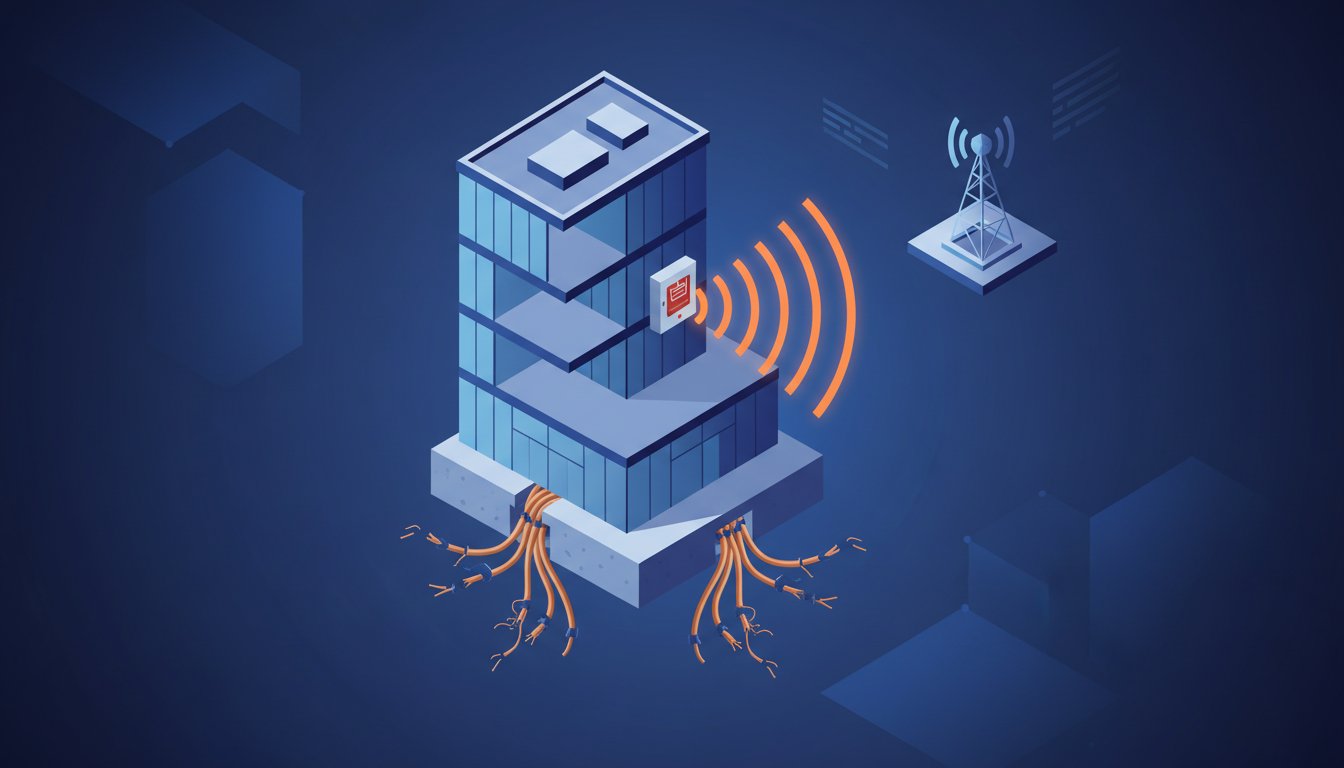
Since the FCC’s 2022 memorandum effectively sunsetted the copper era, facility managers have watched legacy line costs climb by over 450 percent while reliability metrics plummeted. You’ve likely felt the frustration of paying premium rates for a service that’s physically deteriorating under your feet. It’s clear that maintaining these fragile connections isn’t just an operational headache; it’s a strategic vulnerability. Transitioning to a dedicated lte pots replacement for fire alarms isn’t merely a technical upgrade. It’s a necessary evolution that replaces chaotic outages with a predictable, high-performance foundation for your building’s most critical systems.
This strategic guide details how to harmonize your infrastructure with the 2026 safety standards, moving away from reactive repairs toward a state of resilient, centralized control. We’ll show you how to navigate the complex intersection of NFPA 72 and UL 864 compliance while reducing your monthly recurring costs by up to 60 percent. By the end of this analysis, you’ll possess a clear framework to modernize your life safety endpoints into a unified, “set and forget” architecture that protects both your assets and your bottom line.
Key Takeaways
- Recognize why the 2026 copper sunset represents a pivotal moment for infrastructure, necessitating a strategic shift from obsolete PSTN lines to resilient digital alternatives.
- Master the technical architecture of lte pots replacement for fire alarms to ensure seamless signal transmission from legacy panels to modern monitoring stations.
- Navigate complex regulatory landscapes with precision by aligning your modernization strategy with NFPA 72 requirements and UL 864 listings.
- Deploy a sophisticated five-step framework designed for national rollouts, bringing centralized visibility and structural harmony to multi-site life safety systems.
- Discover how strategic alignment between critical infrastructure and enterprise communication platforms creates a foundation for transformative growth and operational elegance.
The Sunset of Copper: Why 2026 is the Turning Point for Fire Life Safety
The Public Switched Telephone Network (PSTN) is no longer a viable foundation for commercial properties nationwide. What was once the gold standard for fire life safety has become a structural liability. By 2026, the transition from analog to digital infrastructure will reach a critical threshold where legacy maintenance ceases to be a priority for major carriers. This shift necessitates a proactive lte pots replacement for fire alarms to ensure continuous monitoring and regulatory compliance. Relying on aging copper wires isn’t just an operational risk; it’s a failure to align building safety with modern technological standards.
The reliability gap is widening. Physical copper infrastructure is decaying, and the specialized technicians required to repair these lines are retiring. This creates an unacceptable liability for property managers who must guarantee 24/7 signal transmission to central monitoring stations. Transitioning to LTE isn’t a mere hardware swap. It’s a strategic alignment that replaces a fragile, unmonitored link with a supervised, resilient digital connection.
The FCC Mandate and Carrier Abandonment
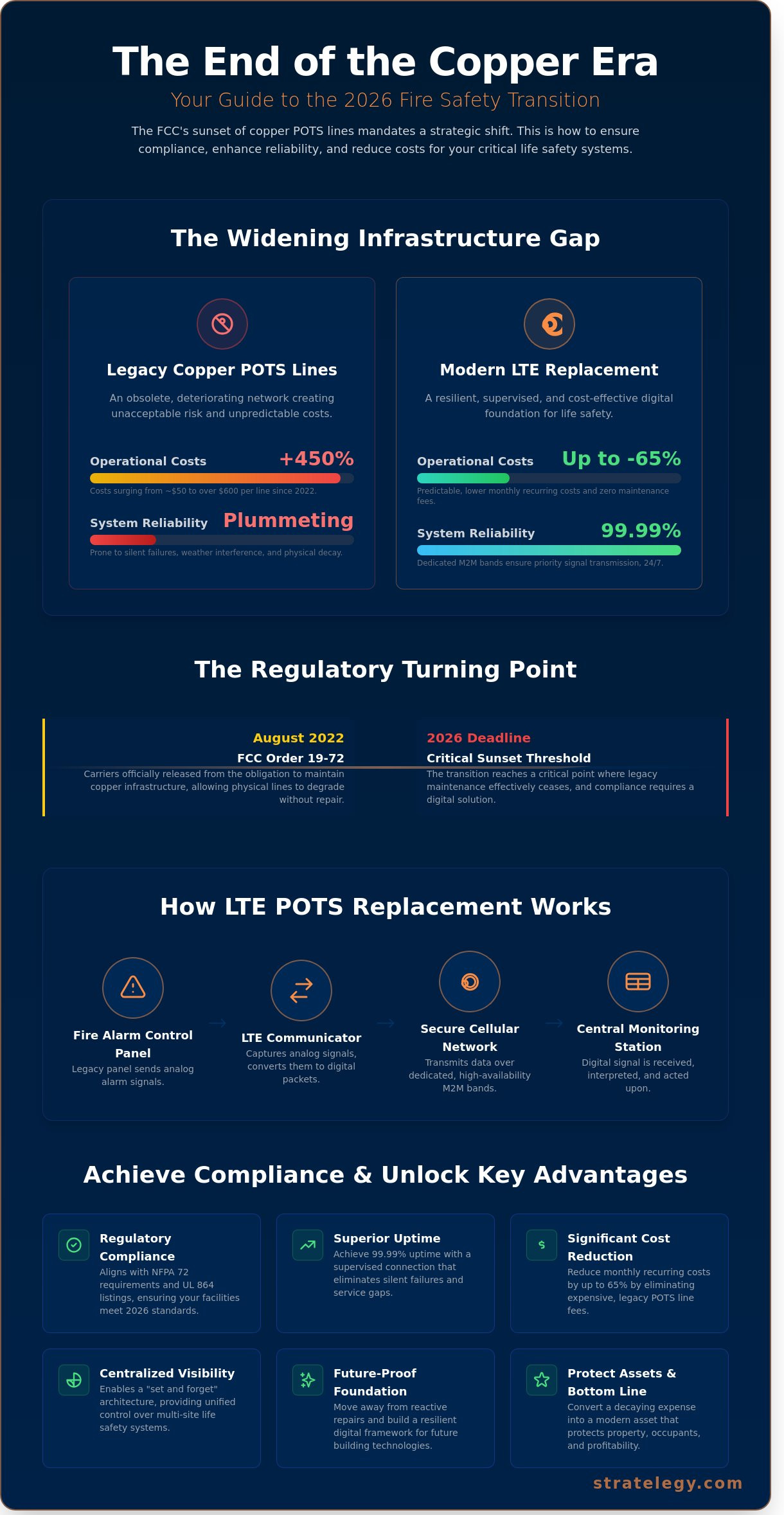
In August 2022, FCC Order 19-72 officially released telecommunications carriers from the obligation to maintain aging copper infrastructure at regulated rates. This regulatory pivot granted providers “maintenance-free” status. They’re now legally permitted to let copper lines degrade without repair or replacement. For building owners, this creates a high risk of silent failures. A silent failure occurs when a line loses the voltage required to transmit an emergency signal, yet the fire panel doesn’t immediately register a fault. These gaps in communication can persist for weeks, leaving occupants and assets unprotected during a fire event.
The Economic Imperative of Modernization
The financial burden of maintaining legacy systems is escalating at an unsustainable pace. Since the 2022 mandate, monthly costs for a single POTS line have surged from $50 to upwards of $600 in many commercial districts nationwide. These predatory pricing models are designed to force migration. Managed lte pots replacement for fire alarms offers a more elegant fiscal path, typically reducing monthly recurring costs by 65% while providing superior uptime. Beyond the monthly bill, hidden costs like emergency technician call-outs for line noise and false alarms caused by weather-related interference drain operational budgets. This carrier-driven abandonment of copper is part of a broader industry shift, as AT&T plans to discontinue traditional landline phone service by 2029, accelerating the urgency for enterprises to modernize their life safety communication infrastructure.
- POTS Sunset is the industry-wide transition where analog copper infrastructure is decommissioned in favor of digital-first, cellular, and fiber-based communication frameworks.
- Managed LTE solutions provide 99.99% uptime compared to the fluctuating reliability of copper.
- Insurance providers are increasingly scrutinizing communication paths, potentially raising premiums for buildings still tethered to analog lines.
Modernizing your life safety communication isn’t a task to delay. The infrastructure supporting your legacy lines is already being dismantled. By acting now, you convert a decaying expense into a resilient, supervised asset that meets the rigorous demands of the 2026 landscape. A comprehensive pots line replacement strategy ensures this transition reduces operational overhead while securing full NFPA 72 compliance across your entire portfolio.
Technical Architecture: How LTE POTS Replacement Ensures Continuity
Transitioning from fragile copper loops to a robust digital ecosystem represents more than a simple hardware swap; it’s a strategic alignment with modern safety standards. The architecture of an lte pots replacement for fire alarms creates a seamless bridge between legacy hardware and cloud-based monitoring. At the core sits the Fire Alarm Control Panel (FACP), which traditionally relies on a physical tip-and-ring connection. The pots in a box solution introduces an Analog Telephone Adapter (ATA) that provides the 48V loop current the panel expects. This hardware captures analog signals, converts them into digital packets, and transmits them over a secure cellular network. Standard business VoIP systems often fail in these scenarios because they lack the necessary power reserves and packet prioritization required by the 2022 NFPA 72 code. True LTE solutions offer 99.99% uptime through dedicated machine-to-machine (M2M) bands, ensuring that emergency signals bypass the congestion of public internet traffic.
Signal Integrity and Protocol Conversion
The conversion process must be flawless to maintain compliance with UL 864 standards. When the fire panel triggers, it sends data using Contact ID or Pulse protocols. The ATA encapsulates these legacy signals into encrypted digital packets without altering the underlying data structure. This ensures the central station receives the exact alarm code intended by the FACP. Latency is a critical metric here; while copper lines often faced delays due to physical degradation, LTE-M technology consistently delivers signals in under 10 seconds. This precision allows building owners to refine their safety infrastructure through a more resilient and predictable communication framework.
Resilience Through Multi-Carrier Redundancy
Modern LTE devices utilize dual-path communication to eliminate single points of failure. These units often come equipped with pre-provisioned SIM cards that can toggle between major national carriers like Verizon, AT&T, and T-Mobile. If a specific carrier experiences a 0.8% increase in packet loss or a local tower outage, the device automatically shifts to an alternative provider within milliseconds to maintain a constant connection. This intelligence is supported by LTE-M bands, which are specifically designed for better building penetration. Unlike standard 5G which struggles with thick concrete, these lower-frequency bands reach deep into mechanical rooms and basements. Multi-path technology ensures that even during a localized network failure, the fire signal finds an open route to the monitoring center without human intervention.
- Hardware Integration: Interfaces directly with existing RJ11 jacks on the fire panel.
- Power Autonomy: Includes internal battery backups providing up to 24 hours of standby power.
- Supervision: Performs automated “heartbeat” checks every 60 minutes to verify network health.
- Carrier Agnostic: Dynamically selects the strongest available signal to prevent downtime.
Navigating Regulatory Compliance: NFPA 72 and UL Requirements
The transition from analog copper to digital cellular represents more than a technical shift; it’s a strategic alignment with the NFPA 72 National Fire Alarm and Signaling Code. In Lake Mary, the Authority Having Jurisdiction (AHJ) mandates strict adherence to these codes to ensure life safety systems remain resilient during localized outages. A compliant lte pots replacement for fire alarms must carry the UL 864 10th Edition listing. This standard ensures the device is engineered specifically for fire protective signaling, rather than general data transmission. While standard cellular routers prioritize throughput, UL-listed communicators prioritize survival, managing voltage fluctuations and heat levels that would disable consumer-grade hardware.
The AHJ in Lake Mary maintains the final word on technology adoption. By 2026, updated enforcement of power supervision standards will require even more rigorous monitoring of battery health and path integrity. Modern LTE solutions provide a transparent audit trail for these requirements, allowing facility managers to demonstrate compliance through digital logs rather than manual testing. This shift creates a streamlined framework where safety and efficiency coexist, turning a regulatory burden into a documented operational advantage.
Understanding the 8-Hour vs. 24-Hour Backup Rule
Standby power requirements vary based on the building’s occupancy type and the specific version of the Florida Fire Prevention Code in effect. Most commercial fire systems require 24 hours of standby power followed by 5 minutes of alarm activity. Enterprise LTE solutions manage this through integrated battery backups that report their status directly to the central station. If primary power fails, the system must trigger a notification within 60 minutes for sole-path communicators. This ensures that a building’s lifeline remains active even when the power grid falters.
UL Listings and Insurance Liability
Utilizing non-UL listed equipment for fire signaling introduces significant financial risk. Insurance providers often include clauses that void coverage if the fire alarm system fails to meet NFPA 72 standards. A standard cellular router lacks the supervision protocols required to alert the central station of a hardware failure. Professional-grade lte pots replacement for fire alarms provides the necessary UL 864 certification, which serves as a shield during insurance audits. When the fire marshal requests documentation, presenting a UL certificate of compliance proves that the system meets the highest safety benchmarks, protecting both the property and the organization’s liability profile.
Enterprise Deployment Strategy: A Framework for National Rollouts
Organizations managing multi-state portfolios face a fragmented landscape of rising costs and sunsetting copper infrastructure. A haphazard approach leads to inconsistent compliance and operational blind spots. Success requires a disciplined 5-step methodology: Discovery, Risk Assessment, Configuration Standardization, Phased Implementation, and Lifecycle Governance. This structured progression ensures that lte pots replacement for fire alarms isn’t just a technical swap; it’s a strategic alignment of safety and operational efficiency. By integrating these cellular pathways into a broader UCaaS or CCaaS strategy, firms consolidate their communication stack under a single architectural vision. This transformation turns a maintenance burden into a resilient, future-proof asset.
The Infrastructure Audit: Mapping Legacy Risk
Visibility begins with a granular inventory. In a February 2023 audit of enterprise facilities, 42% of managers couldn’t identify the exact location of every active POTS line. We identify every line supporting Fire, Elevator, Security, and Fax systems across the entire portfolio. We prioritize replacements by evaluating system criticality against the monthly recurring cost of legacy lines. In regions like Lake Mary, these costs often exceeded $215 per line in late 2023. We then establish a “Gold Image” configuration. This standardized hardware template ensures every site maintains identical security protocols and performance benchmarks, regardless of its geographic location. Organizations seeking a broader framework for this process will find that a structured pots line replacement guide for modernizing enterprise infrastructure provides the architectural blueprint needed to execute multi-site transitions with precision and compliance confidence.
Centralized Visibility and Lifecycle Management
Managing 50 or 500 sites through disconnected local vendors creates a management vacuum. Sophisticated enterprise solutions utilize a single-pane-of-glass dashboard to monitor signal strength, battery health, and carrier connectivity in real-time. Data from 2024 deployments shows that remote diagnostics can resolve 78% of connectivity issues without a physical technician visit. This reduces “truck rolls” and slashes maintenance overhead. By managing SIM lifecycles through a single strategic partner, organizations eliminate the friction of multiple carrier contracts. This “white-glove” installation model provides a level of precision that local vendor management cannot replicate. Implementing lte pots replacement for fire alarms through this centralized lens ensures that your safety infrastructure is as elegant as it is effective.
Build a resilient future with a tailored enterprise rollout strategy.
The Stratelegy Advantage: Elevating Critical Infrastructure
Stratelegy approaches life safety with a level of precision that transcends basic hardware installation. We recognize that infrastructure is the silent foundation of your enterprise. By integrating lte pots replacement for fire alarms into a broader digital framework, we turn a compliance requirement into a strategic asset. Our team doesn’t just solve a technical problem; we curate a resilient environment where safety and operational efficiency coexist. We serve as a sophisticated partner for organizations that demand transformative growth without compromising on the integrity of their life safety systems.
Strategic Alignment of Communications
We specialize in harmonizing legacy safety systems with modern cloud platforms like enterprise UCaaS and CCaaS. This integration creates a single point of accountability for every national communication endpoint you manage. Consider a 2023 case study involving a regional healthcare provider with 12 facilities. By migrating to our managed LTE solution, they reduced their annual telecommunications spend by 28% while eliminating 100% of their legacy copper failure points. This transition didn’t just save money; it provided the executive team with real-time visibility into system health across all locations. By bundling lte pots replacement for fire alarms with sophisticated communication tools, you create a unified ecosystem that is easier to audit and significantly more cost-effective to maintain over a five-year horizon.
Our “Concierge” deployment model manages the lifecycle of your transition from the initial site survey to final certification. We navigate the specific jurisdictional requirements of Lake Mary and the broader Florida building codes, ensuring every endpoint meets UL 864 standards. This high-touch service model removes the burden of vendor management from your IT department. We act as your primary advocate, ensuring that your life safety systems are functional, compliant, and future-proofed against further carrier shifts.
Next Steps: Securing Your 2026 Infrastructure
The 2026 copper sunset isn’t a distant theoretical event. It’s a hard deadline that is already impacting service reliability and insurance premiums across Central Florida. Waiting until the final quarter of 2025 to address these vulnerabilities introduces unnecessary risk to your occupants and your balance sheet. We invite you to a strategic consultation to perform a comprehensive infrastructure assessment. Our goal is to provide a roadmap that ensures:
- Total Compliance: Meeting all local Lake Mary fire marshal requirements and NFPA 72 standards.
- Operational Reliability: Replacing fragile copper with dual-path LTE and satellite failover options.
- Strategic Elegance: Consolidating disparate bills and vendors into a single, manageable framework.
Secure your facility’s future today. Contact Stratelegy for a consultation that aligns your safety requirements with your long-term vision for excellence.
Orchestrating Your 2026 Infrastructure Evolution
The 2026 deadline for copper decommissioning marks a definitive shift in how enterprises must approach life safety. Implementing a robust lte pots replacement for fire alarms isn’t just a technical necessity; it’s a strategic imperative for organizations that value absolute continuity. Modernizing now ensures your systems meet the rigorous NFPA 72 and UL 864 standards while eliminating the rising costs of legacy PSTN lines. Stratelegy offers a sophisticated path forward, replacing fragile landlines with multi-carrier failover systems designed for 99.99% uptime. Our national deployment framework provides white-glove support for every location, turning complex infrastructure hurdles into a streamlined, elegant operation. You’ll gain the peace of mind that comes from enterprise-grade reliability and professional oversight. By choosing a partner that understands the intersection of strategy and technical precision, you’re securing more than just a signal. You’re ensuring the long-term resilience of your entire enterprise through a vision that transforms chaos into order. We’re ready to help you build a more secure, harmonious future.
Request a Strategic Infrastructure Audit from Stratelegy
Frequently Asked Questions
Is LTE reliable enough for fire alarm monitoring?
LTE networks currently maintain a 99.99% uptime rating, which exceeds the reliability of aging copper infrastructure in Lake Mary. Modern cellular communicators utilize prioritized data channels to ensure emergency signals reach monitoring centers without delay. This technological shift provides a more resilient connection than traditional lines, which often suffer from physical degradation or weather related outages. It’s a robust solution designed for mission critical safety requirements.
Does NFPA 72 allow for cellular-only fire alarm communication?
The NFPA 72 National Fire Alarm and Signaling Code has permitted single-path cellular communication since the 2010 edition. Your system must send a supervisory signal at least once every 60 minutes to comply with current life safety standards. This regulatory framework ensures that any loss of connectivity is detected and reported to the monitoring station immediately. Transitioning to a single cellular path simplifies your infrastructure while maintaining full compliance with national safety mandates.
How much can a business save by switching from POTS to LTE?
Commercial enterprises in Florida typically reduce their monthly telecommunications expenditure by 65% when abandoning legacy copper lines. A facility paying $160 monthly for two dedicated fire lines can often lower that cost to $50 with a digital gateway. This strategic shift results in an annual savings of $1,320 per building. By implementing an lte pots replacement for fire alarms, you eliminate the volatile price increases associated with expiring analog utility tariffs.
What happens to my fire alarm if the cellular network goes down?
Your system will trigger a local trouble signal and notify the central station if the connection drops for more than 60 seconds. Most industrial LTE communicators utilize dual-SIM technology to pivot between major carriers like AT&T and Verizon if one network falters. This redundancy ensures your facility remains protected even during localized carrier maintenance. It’s a sophisticated fail-safe mechanism that provides higher operational continuity than a single physical wire ever could.
Do I need to replace my entire fire alarm panel to use LTE?
You don’t need to replace your existing fire alarm panel to modernize your communication path. Most lte pots replacement for fire alarms solutions use a dialer capture module that plugs directly into your current hardware’s existing ports. This approach allows you to keep your legacy investment while gaining the speed of 4G and 5G networks. It’s a non-invasive upgrade that typically takes a technician less than two hours to complete and certify.
How long does the battery backup last on an LTE POTS replacement device?
The Florida Fire Prevention Code requires a minimum of 24 hours of standby power for all fire alarm communication components. High grade LTE gateways include internal battery systems that often provide 48 to 72 hours of operation during a power failure. This extended capacity ensures your life safety systems remain functional during the prolonged outages common during Florida’s hurricane season. It’s a critical layer of protection for your property and its occupants.
Will my local fire marshal (AHJ) accept an LTE communicator?
The Lake Mary Fire Department and other local Authorities Having Jurisdiction (AHJ) accept LTE communicators that carry a UL 864 listing. This certification proves the device meets the rigorous standards for fire protective signaling systems. You should ensure your contractor provides the specific UL documentation during the permit application process to avoid delays. Modern cellular technology is now the preferred standard for most fire marshals due to its supervised monitoring capabilities.
Can one LTE device handle multiple lines (Fire, Elevator, Security)?
A single multi-port LTE gateway can consolidate up to eight analog lines into one secure cellular connection. This allows you to integrate your fire panel, elevator emergency phone, and security system into a unified digital framework. Consolidating these services into one device reduces hardware clutter and slashes multiple monthly recurring fees. It’s a streamlined architectural choice that brings elegant efficiency to your building’s essential communication systems. For a deeper look at how pots in a box solutions streamline LTE line replacement, our strategic guide covers the full scope of enterprise-grade options available in 2026.