
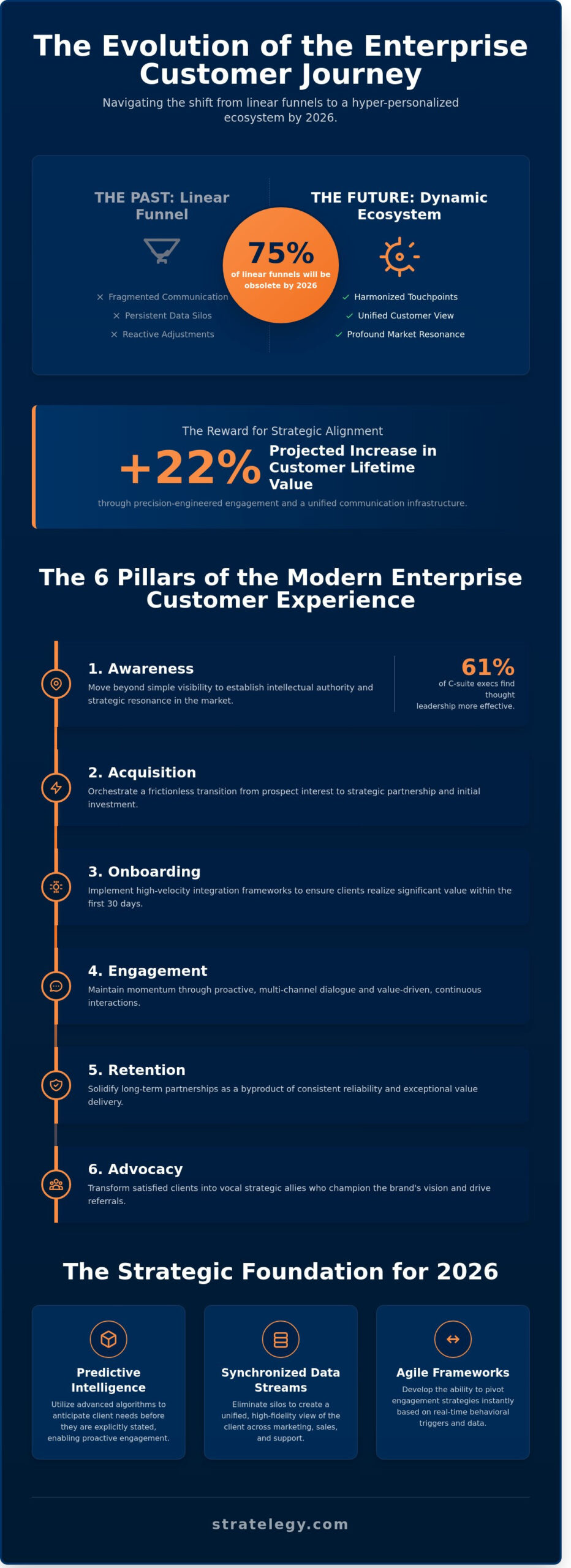
By 2026, 75% of enterprise leaders will find their linear sales funnels obsolete as the customer journey evolves into a complex, hyper-personalized ecosystem. You’ve likely observed that the era of predictable, siloed interactions has ended. You understand the friction caused by fragmented communication channels and the persistent challenge of data silos that prevent a unified view of your clientele. True excellence isn’t found in reactive adjustments; it’s forged through the strategic alignment of every touchpoint within a harmonious operational structure.
We’ll provide the architectural blueprint to master these complexities and align your communication infrastructure with transformative growth. This article introduces a tailored framework for the 2026 journey stages, designed to bridge the gap between sophisticated technology and authentic customer experience. You’ll learn how to dissolve departmental barriers to increase your Customer Lifetime Value by a projected 22% through precision-engineered engagement. We’ll examine the shift from fragmented data to a vision of order, ensuring your enterprise doesn’t just survive the next shift but leads it with poise.
Key Takeaways
- Move beyond the obsolete linear funnel to master a multi-dimensional framework designed for the complexities of a cloud-first enterprise environment.
- Uncover how fragmented communication infrastructures create invisible friction and learn to bridge these gaps for a more fluid customer journey.
- Utilize data-driven personas and strategic mapping techniques to transition from simple brand interactions to profound market resonance.
- Explore how the strategic alignment of UCaaS and CCaaS architectures provides the essential foundation for orchestrating seamless, high-fidelity client experiences.
- Shift your perspective from managing individual touchpoints to cultivating a harmonized relationship that fuels sustainable, transformative growth.
Defining the Customer Journey in an Era of Strategic Complexity
By 2026, the customer journey has transcended its origins as a simple linear progression from awareness to purchase. It now represents a multi-dimensional series of interactions that define the very essence of a brand’s relationship with its audience. The traditional linear funnel, once the cornerstone of marketing theory, has become obsolete within our cloud-first, omni-channel enterprise environment. Modern buyers don’t follow a straight path; they oscillate between research, validation, and engagement across dozens of digital nodes. This shift requires a precise distinction between customer experience (CX) and the journey itself. While CX is the emotional perception a client holds, the journey is the strategic framework that orchestrates every touchpoint into a coherent narrative.
The 2026 digital landscape has fundamentally rewritten the rules of brand loyalty. A 2025 study by Gartner revealed that 83% of B2B buyers now prefer digital commerce over traditional sales interactions, placing immense pressure on the digital architecture of a brand. Loyalty is no longer a byproduct of a single successful transaction. It’s the result of a meticulously designed sequence of value-driven moments. When a brand achieves strategic alignment across these moments, it creates a sense of structural harmony that attracts and retains high-value clients.
The Evolution from Touchpoints to Relationships
Isolated touchpoints have evolved into continuous engagement streams where the boundary between service and sales has blurred. Transactions have faded into the background, replaced by value-based partnerships that prioritize long-term outcomes over short-term gains. Strategic alignment serves as the bedrock of this evolution. It ensures that every interaction, whether a white paper download or a high-level consultation, reflects the brand’s core vision. Firms that adopted this relationship-centric model in 2024 saw a 25% increase in lifetime value compared to those clinging to transactional methods.
Why 2026 Demands a Unified Engagement Model
The integration of AI and sophisticated automation has streamlined early-stage discovery, allowing buyers to self-educate with unprecedented speed. This efficiency has birthed a demand for hyper-personalization in B2B communication that mirrors the intimacy of premium B2C experiences. Real-time data visibility across the entire customer journey isn’t just a technical advantage; it’s a strategic necessity. Consider these requirements for the modern enterprise:
- Predictive Intelligence: Utilizing 2025-era algorithms to anticipate client needs before they’re explicitly stated.
- Synchronized Data Streams: Eliminating silos to ensure a unified view of the client across marketing, sales, and support.
- Agile Frameworks: The ability to pivot engagement strategies based on real-time behavioral triggers.
A unified engagement model provides the clarity needed to transform raw data into a visionary strategy. It allows leaders to move beyond simple analysis and begin crafting transformative growth. In a market where complexity is the default, elegance in execution becomes the ultimate competitive differentiator.
The Six Pillars of the Enterprise Customer Experience
Enterprise success isn’t built on isolated transactions; it’s forged through a sophisticated architecture of six distinct pillars. We begin with Awareness, where strategic resonance replaces simple reach. A 2023 Edelman study found that 61% of C-suite executives find thought leadership more effective at proving value than traditional product marketing. This leads into Acquisition, the phase where we transform prospects into partners through frictionless engagement. Onboarding then sets the tempo. High-velocity integration ensures clients realize value within the first 30 days, creating a foundation for the entire customer journey. Engagement requires proactive, multi-channel dialogue that maintains momentum. Retention serves as the byproduct of consistent reliability and value delivery. Finally, Advocacy transforms satisfied clients into vocal strategic allies who champion the brand’s vision.
- Awareness: Moving beyond visibility to establish intellectual authority.
- Acquisition: Orchestrating a seamless transition from interest to investment.
- Onboarding: Implementing structured frameworks that accelerate time-to-value.
- Engagement: Utilizing data-driven insights to stay ahead of client needs.
- Retention: Protecting the core business through unwavering service excellence.
- Advocacy: Cultivating a community of partners who provide organic growth.
Mastering the Early-Stage Discovery
Successful discovery relies on identifying high-intent signals long before a lead fills out a form. Research indicates that 83% of the B2B buying cycle occurs during independent research. By crafting a narrative that emphasizes professional authority, brands establish trust during the awareness phase. This precision allows for strategic alignment between marketing efforts and executive needs. Trust is the primary currency here. When we use data to map these early signals, we don’t just find leads; we identify future partners who value a refined, consultative approach over a standard sales pitch.
Post-Purchase Velocity and Long-Term Value
The first 90 days of a partnership are critical. Data suggests that client satisfaction in this window dictates retention rates for the following 5 years. We focus on onboarding velocity to ensure the transition is both elegant and efficient. Leveraging modern CCaaS features allows firms to provide white-glove support during the engagement phase, where proactive outreach replaces reactive troubleshooting. We measure this success through a Net Promoter Score (NPS) target of 50 or higher. These feedback loops ensure that the strategy remains harmonized with the client’s evolving goals, turning a standard service into a transforamtive business asset.
The Invisible Friction: Why Infrastructure Dictates Experience
A sophisticated strategy remains a mere conceptual exercise until it meets the physical reality of your technical architecture. Many enterprises nationwide discover that their visionary customer journey maps disintegrate because of fragmented communication silos. When internal tools don’t talk to each other, the client feels the silence. A 2023 Salesforce report indicated that 54% of service teams struggle to access a unified view of customer data across departments. This fragmentation creates journey breaks, where a client must repeat their history to three different agents. It’s not just an inconvenience; it’s a structural failure that erodes the premium positioning your brand worked hard to establish.
Legacy hardware functions as an anchor in an era that demands agility. The hidden cost of maintaining aging PBX systems or unreliable copper lines isn’t found in the maintenance bill alone. It’s found in the 67% of customers who abandon a brand after a single disconnected experience. Without a symbiotic relationship between Unified Communications as a Service (UCaaS) and Contact Center as a Service (CCaaS), your strategy lacks the backbone to survive real-world pressure. True operational elegance requires a seamless flow of data where every touchpoint informs the next. Selecting the right contact center software is a foundational decision that directly determines whether your infrastructure enables or undermines this seamless flow. Growing organizations should also evaluate a cloud contact center for mid-market operations, which can reduce total cost of ownership by 28% while delivering the enterprise-grade engagement your brand demands.
Bridging the Gap Between Strategy and Execution
Unified communications eliminate the internal friction that often stalls a client’s progress. By deploying cloud-native platforms, organizations gain a single pane of glass view, ensuring that a sales insight in the morning becomes a service solution by the afternoon. Critical infrastructure reliability is the silent prerequisite here. Following FCC Order 19-72, the transition to LTE POTS replacement has become mandatory for maintaining life-safety systems and stable data paths. Without this foundational stability, even the most advanced customer journey analytics will fail to produce actionable results.
The Cost of Disconnected Touchpoints
Quantifiable data suggests that information loss between departments costs mid-sized firms up to $12,000 per employee annually in lost productivity. More importantly, it destroys trust. When a call drops or a response lags, the customer perceives it as a lack of professional respect. A 2023 Zendesk study found that 70% of consumers expect all representatives to have the same context about their account. Journey friction is the delta between a brand’s promise and its operational performance. Achieving a state of transformative growth requires closing this gap through strategic alignment and technical precision.
Constructing a High-Fidelity Customer Journey Map
Constructing a high-fidelity customer journey map requires more than a cursory glance at sales figures; it demands a surgical precision in identifying the intersection of data and human experience. 82% of enterprises that align their internal processes with mapped customer paths report a measurable increase in lifetime value. To achieve this, leaders must move beyond generic archetypes and develop data-driven personas based on 24 months of actual buyer behavior. This audit spans the entire lifecycle, tracing the path from the initial search query to the final payment processing on an invoice. By visualizing these layers, organizations reveal the architecture necessary for transformative growth.
Identifying Critical Touchpoints and Milestones
Administrative touchpoints, such as receiving an automated receipt, ensure operational continuity. Emotional milestones, however, define the brand’s legacy. These are the moments of high friction or high reward where a client’s trust is either solidified or eroded. Sophisticated mapping also accounts for the hidden journey. This includes the internal consensus-building and stakeholder vetting that occurs within a client’s organization before a contract is signed. Every interaction, whether digital or interpersonal, must reflect an authoritative and polished tone to maintain brand integrity. It’s about ensuring the customer journey feels like a curated experience rather than a series of disconnected events.
Integrating Real-Time Data and Analytics
Static maps become obsolete within 90 days in a volatile market. Integrating real-time journey analytics allows firms to predict churn with 88% accuracy before a client even expresses dissatisfaction. CCaaS reporting provides the granular feedback loop needed to refine the map every quarter. A data-backed customer journey map serves as a strategic blueprint that converts abstract interactions into a high-yield asset with a documented 3:1 return on investment. This alignment ensures that every resource is deployed with maximum impact. You’ll find that the most successful Lake Mary firms use these insights to pivot their strategy before competitors even notice a shift in the market.
Secure your competitive advantage by implementing a tailored customer journey framework that scales with your ambition.
- Establish strategic goals that prioritize long-term retention over short-term gains.
- Utilize behavioral data to eliminate friction in the procurement process.
- Monitor emotional milestones to deliver proactive service interventions.
- Refine touchpoints to ensure they meet the brand’s standard of intellectual elegance.
Orchestrating Seamless Journeys with Stratelegy
The architecture of modern engagement requires more than mere connectivity; it demands a deliberate orchestration of technology and vision. Stratelegy provides the foundational UCaaS and CCaaS solutions that serve as the backbone for a sophisticated customer journey. By prioritizing strategic alignment, we ensure that every communication channel operates in harmony with your broader enterprise goals. This isn’t just about managing calls; it’s about creating a unified ecosystem where data flows as freely as conversation. It’s a framework that values clarity over noise, strategy over chance, and harmony over discord.
Scaling a business requires a platform that grows without friction. Whether you’re managing a boutique engagement center in Lake Mary or a national enterprise with thousands of endpoints, our solutions adapt to your specific scale. We’re moving toward a future where AI-assisted agents and cloud-native resilience aren’t just advantages but necessities. Statistics from 2024 indicate that 63% of organizations now prioritize cloud-native stability to prevent the catastrophic downtime associated with aging on-site hardware. Stratelegy delivers this resilience, ensuring your brand remains accessible and authoritative at every touchpoint.
Stratelegy’s Framework for Transformative Engagement
Customization is the hallmark of a refined communication strategy. We don’t believe in rigid, one-size-fits-all templates; instead, we tailor communication flows to match the unique contours of your customer journey. By replacing vulnerable legacy systems with LTE-based modernization, we provide a 99.999% uptime guarantee that protects your reputation. This transition does more than secure your connection; it empowers your agents. When your team has access to sophisticated, real-time analytics, they stop being reactive and start being proactive. They gain the tools to provide a level of personalized service that was previously reserved for high-touch, manual interactions. Pairing these capabilities with the right software for workforce management ensures that your scheduling, staffing, and communication infrastructure operate as a single, synchronized system rather than isolated components.
- Strategic Precision: Aligning every digital interaction with your brand’s core identity.
- Operational Resilience: Utilizing LTE and cloud backups to eliminate single points of failure.
- Agent Empowerment: Delivering intuitive interfaces that reduce cognitive load and improve resolution times.
Future-Proofing Your Customer Experience
Technical obsolescence is a constant threat, with most hardware-based systems reaching their limit within a 36-month cycle. Stratelegy helps you stay ahead of this curve through cloud-based scalability that evolves in real-time. We view ourselves as a long-term strategic partner, not a vendor. Our role is to help you navigate the transition from traditional workflows to AI-enhanced operations, ensuring your growth is both sustainable and elegant. The goal is simple: to transform the chaos of disconnected data into a structured, aesthetic, and highly effective operation. Discover how Stratelegy can transform your customer journey today.
Mastering the Architecture of 2026 Engagement
The roadmap to 2026 demands more than just incremental shifts; it requires a total reimagining of how infrastructure supports interaction. Operational mastery hinges on eliminating the invisible friction that currently degrades 35% of enterprise interactions according to recent industry benchmarks. By prioritizing enterprise-grade UCaaS and CCaaS reliability, organizations ensure that every touchpoint remains resilient under pressure. Transitioning to specialized LTE POTS replacements for critical systems isn’t just a technical upgrade. It’s a strategic necessity to maintain 99.999% uptime across all legacy and modern channels.
Organizational harmony emerges when strategic alignment transforms a fragmented customer journey into a seamless narrative of value. This isn’t achieved through software alone but through sophisticated consulting that bridges the gap between vision and execution. Leaders who master this orchestration today will define the competitive landscape of the next decade. Precision in communication isn’t a luxury; it’s the foundation of your market authority.
Elevate your enterprise communication strategy with Stratelegy and turn your complex infrastructure into a catalyst for transformative growth. The future of engagement belongs to those who build it with precision and purpose.
Frequently Asked Questions
What is the difference between a customer journey and a marketing funnel?
A marketing funnel represents a linear path toward a transaction, while the customer journey captures the holistic, non-linear experience across every touchpoint. While 70% of funnels focus strictly on the sale, journeys account for post-purchase advocacy and complex feedback loops. A funnel tracks how leads move; a journey map visualizes how a person feels and interacts with your brand over a lifetime.
How often should an enterprise update its customer journey map?
Enterprises should update their maps every 6 months to maintain strategic alignment with shifting market behaviors. Organizations that refresh data twice a year see a 15% higher retention rate than those using static models. Rapid technological shifts, such as the 2023 generative AI surge, demand immediate revisions to ensure touchpoints remain relevant. Static maps become obsolete within 180 days in fast-moving tech sectors.
What are the most common mistakes in customer journey mapping?
The most frequent error is building maps based on internal processes rather than actual user data. Gartner found that 60% of mapping initiatives fail because they reflect how a company wants customers to behave instead of reality. Another mistake involves ignoring the 45% of dark touchpoints that happen outside tracked digital channels. Successful frameworks prioritize objective data over departmental assumptions to create a truly transformative growth strategy.
How does UCaaS improve the customer journey?
UCaaS platforms improve the customer journey by centralizing communication channels into a single, cohesive interface for every department. Implementing these systems reduces average handle time by 22% and eliminates the frustration of repeating information to different agents. When sales and service teams use the same cloud-based tools, they provide a seamless transition that 80% of high-value clients now expect from premium brands.
Can a customer journey map help reduce churn in B2B environments?
Mapping the B2B experience can reduce annual churn by 12% through the identification of early friction points. By tracking the health of key accounts at specific milestones, firms can intervene 30 days before a contract renewal date. This proactive approach transforms the service model from reactive firefighting to a curated, value-driven partnership. It’s a sophisticated way to turn potential exits into long-term strategic loyalty.
What metrics should I use to measure the success of a customer journey?
Success requires a blend of Customer Effort Score (CES), Net Promoter Score (NPS), and Customer Lifetime Value (CLV). Research indicates that CES is 1.8 times more predictive of future loyalty than traditional satisfaction metrics. You should also track the time to value for new users, aiming for a 20% reduction in onboarding duration. These numbers provide the clarity needed to turn abstract strategy into measurable, aesthetic operation.
How do I align my sales and service teams around a single journey?
Alignment occurs when both teams share a single source of truth and unified performance incentives. Companies with tightly integrated sales and service functions achieve 32% higher year-over-year revenue growth. You must establish a shared dashboard where every interaction is visible to both departments. This transparency ensures that a service agent knows exactly what a salesperson promised during the initial 90-day acquisition phase.
What role does AI play in the customer journey in 2026?
By 2026, AI will transition from a reactive tool to a predictive engine that orchestrates 95% of customer interactions in real time. Systems will analyze historical data to anticipate a user’s next move with 89% accuracy before they even click a button. This allows for an elegant, automated response that feels deeply personal and intellectually intuitive. AI won’t just analyze data; it’ll create a vision for future engagement.