
While the FCC reported a 450% increase in the cost of legacy copper lines since 2019, 70% of regulated industries still face a 20% failure rate when attempting to send documents over standard digital connections. You likely recognize that these aging POTS lines represent a growing fiscal leak; however, the transition to a modern voip fax solution often feels fraught with security risks. It’s a common frustration to see essential transmissions stall or vanish, especially when your organization’s reputation relies on the integrity of every single page.
This guide offers a clear path toward a stable, enterprise-grade infrastructure that eliminates transmission errors without sacrificing compliance. You’ll learn how to implement tailored frameworks that reduce monthly recurring costs by 60% while ensuring strategic alignment with your existing UCaaS platforms. We’ll explore the specific technical protocols needed to achieve 99.9% reliability, transforming your document workflows from a source of chaos into a model of refined, secure efficiency.
Key Takeaways
- Understand why the global “POTS Sunset” makes transitioning to a modern infrastructure a strategic necessity for maintaining uninterrupted business continuity.
- Master the technical nuances of voip fax by distinguishing between real-time FoIP and secure store-and-forward workflows to optimize your document transmission.
- Evaluate whether virtual, physical, or LTE-based implementation models best align with your organization’s specific volume and regulatory compliance requirements.
- Learn how to conduct a comprehensive infrastructure audit and implement Quality of Service (QoS) rules to ensure your network is prepared for high-volume digital traffic.
- Discover how to achieve structural harmony in your communications by leveraging LTE-driven solutions that replace legacy systems with sophisticated, enterprise-grade reliability.
What is VoIP Fax and Why Is It Now a Strategic Necessity?
Modern business communication requires more than just functional tools; it demands an architecture that aligns with digital-first operations. At its core, voip fax (Fax over IP) represents the evolution of document transmission from circuit-switched analog signals to packet-switched data streams. By utilizing Internet fax technology, organizations bypass the limitations of physical hardware and integrate document workflows into their existing cloud infrastructure. This shift isn’t merely a technical upgrade; it’s a strategic necessity driven by the rapid erosion of legacy telecommunications networks.
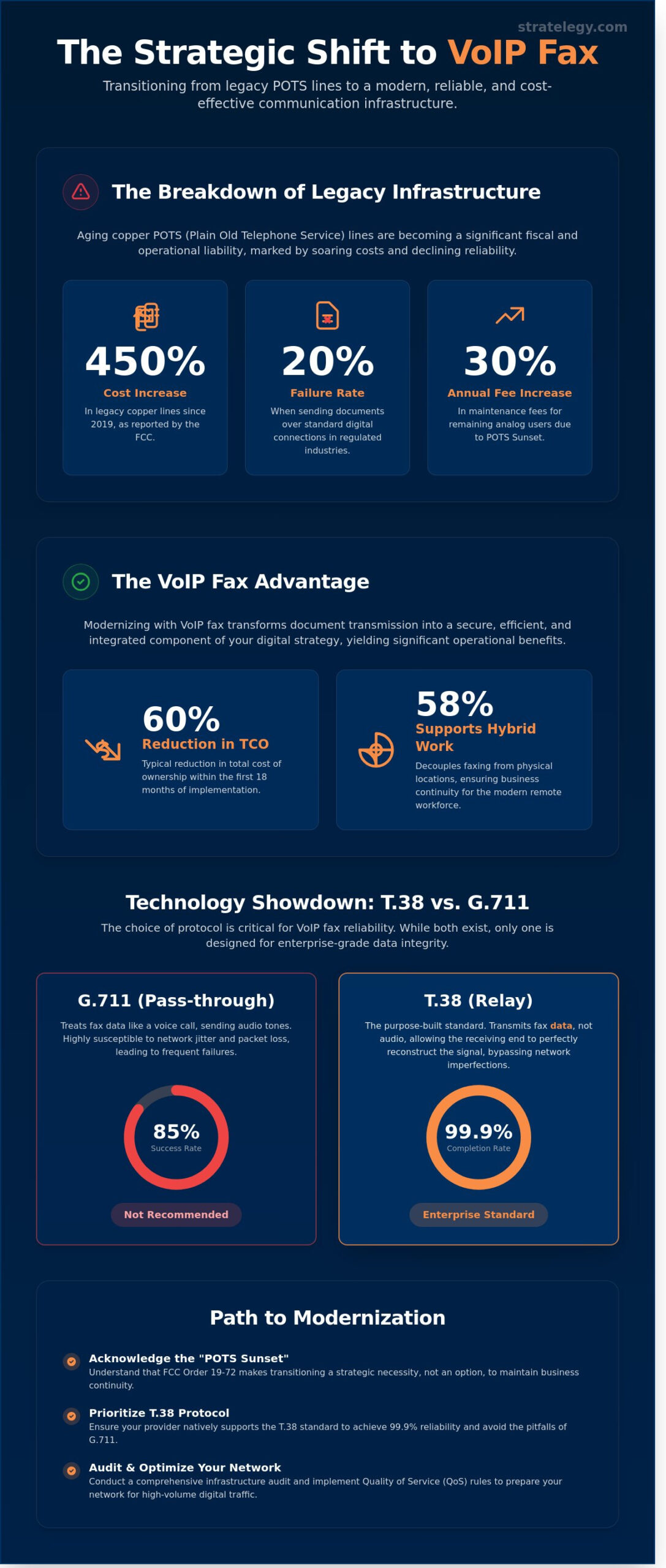
The transition to voip fax serves as a foundational step toward achieving a fully unified communications (UCaaS) environment. Moving from legacy copper lines to cloud alternatives typically yields a 60% reduction in total cost of ownership within the first 18 months of implementation. While traditional lines often carry a price tag exceeding $100 per month when maintenance fees are factored in, cloud-based solutions offer predictable, scalable pricing models. This financial optimization allows leadership to reallocate capital toward transformative growth initiatives rather than maintaining obsolete hardware.
The Decline of the Analog Local Loop
The Federal Communications Commission (FCC) issued Order 19-72, which effectively released carriers from the obligation to maintain aging copper-based infrastructure. As a result, major providers are aggressively decommissioning these lines, leading to a 30% annual increase in maintenance fees for remaining analog users. Maintenance costs for legacy lines are being passed directly to the consumer to encourage migration. The POTS Sunset is the mandatory transition from analog to digital signaling.
Business Continuity and Modernization
Relying on a single physical copper line creates a structural vulnerability that modern enterprises can’t afford. A single hardware failure or local outage can paralyze critical document flows. Cloud-based faxing ensures business continuity by decoupling the fax number from the physical office location. This flexibility is vital, as 58% of the modern workforce now operates in a remote or hybrid capacity. It transforms faxing from a siloed office task into a harmonized component of a broader digital framework.
How VoIP Fax Works: The Technical Architecture of FoIP
Transitioning from legacy PSTN to modern networks requires a precise orchestration of data. Understanding the mechanics of a voip fax system begins with the digitization of the T.30 protocol. In a traditional environment, fax machines communicate via continuous analog tones. Within an IP framework, these signals are fragmented into discrete packets. This transition introduces the challenge of network jitter. While a human ear ignores a 20-millisecond delay in a voice call, a fax machine interprets that same gap as a terminal error, often dropping the connection immediately.
Organizations must distinguish between two primary transmission philosophies:
- Real-time FoIP: This method maintains a live, synchronous connection between the sending and receiving terminals, mirroring the behavior of traditional telephony.
- Store-and-Forward: Often utilized in Email-to-Fax workflows, this approach captures the document at a gateway, converts it to a digital file, and delivers it to the destination.
The stability of these transmissions depends on how the network handles packet loss. In voice-optimized environments, a 1% packet loss is acceptable; in document transmission, even a 0.1% loss can corrupt an entire page. This technical sensitivity necessitates the use of specialized protocols designed for data integrity rather than just audio clarity.
T.38 vs. G.711: Choosing the Right Protocol
G.711, frequently called “pass-through,” treats fax data as if it were a standard voice call. It attempts to send the audio tones without modification. This method is notoriously unreliable over the open internet, where packet compression and latency are common. In contrast, the ITU-T T.38 standard utilizes a relay mechanism. It doesn’t transmit audio; it transmits the data itself, allowing the receiving end to reconstruct the signal perfectly. Data from 2023 indicates that T.38 configurations achieve a 99.9% completion rate, significantly outperforming the 85% success rate typical of G.711 setups. It’s essential to confirm that your SIP trunk provider supports T.38 natively to ensure a strategically aligned communication infrastructure.
The Role of the Analog Telephone Adapter (ATA)
The Analog Telephone Adapter (ATA) serves as the physical bridge between legacy hardware and digital ports. It converts the RJ-11 analog signals from a traditional fax machine into RJ-45 ethernet packets. Enterprise-grade ATAs are distinguished from consumer models by their superior processing power and dedicated jitter buffers. These professional units manage the T.38 encapsulation locally, which prevents the timing issues that plague cheaper hardware. Selecting high-performance ATAs ensures that your existing machine fleet remains a viable part of a sophisticated, modern network.
Evaluating Implementation Models: Virtual vs. Physical vs. LTE
Selecting the right voip fax architecture isn’t a mere technical decision; it’s a strategic choice that defines the fluidity of an organization’s document lifecycle. Decision-makers must evaluate three distinct paths: the agility of cloud-only systems, the continuity of hybrid models, or the resilience of LTE-backed solutions. Each framework offers specific advantages tailored to different risk profiles and operational demands. A well-designed implementation ensures that document transmission becomes a seamless extension of the broader digital strategy rather than a siloed legacy process.
Cloud-Based Virtual Faxing
The cloud-only model represents the ultimate evolution of document transmission. By eliminating physical fax machines, businesses remove the recurring burden of hardware maintenance and the 15% annual price fluctuations often associated with toner and paper supplies. This model integrates directly with Voice over Internet Protocol (VoIP) systems, allowing employees to send and receive documents via Outlook or Gmail. It transforms faxing into a digital data stream, perfectly aligned with modern document management systems (DMS) and automated workflows. For high-volume environments, this transition can reduce document processing time by 30% compared to manual handling.
Hybrid models serve as a critical bridge for sectors like law or healthcare. These industries often face strict compliance mandates where approximately 40% of transactions still require wet-ink signatures on physical paper. By using Analog Telephone Adapters (ATAs), organizations connect their existing legacy machines to the digital network. It’s a pragmatic solution that preserves established workflows while capturing the cost benefits of a modern infrastructure. It provides a bespoke framework for businesses that aren’t ready to go 100% paperless but demand the efficiency of modern packet-switched networks. Healthcare organizations in particular must ensure their document workflows meet the standards outlined in our guide to HIPAA compliant faxing as analog copper lines continue to sunset.
LTE-Based POTS Replacement for Critical Faxing
For mission-critical systems, relying solely on a standard broadband connection presents a strategic risk. LTE-based “POTS in a Box” solutions provide a dedicated cellular path that remains independent of the local area network. This architecture is vital for systems that require 99.99% uptime, such as fire alarms, elevator lines, and secure medical faxing. Following the FCC Order 19-72, which accelerated the decommissioning of traditional copper lines, LTE has emerged as the gold standard for reliability. Key benefits include:
- Infrastructure Independence: The voip fax signal bypasses local internet outages via dedicated 4G/5G networks.
- Regulatory Compliance: These solutions meet specific life-safety requirements for emergency communication systems that standard internet lines don’t always satisfy.
- Rapid Deployment: Systems can be operational in under 24 hours, avoiding the lengthy wait times for physical line installation.
This model ensures that even during a total local network failure, the organization’s most sensitive communication channels remain functional and secure. It’s a sophisticated response to the instability of aging copper infrastructure, providing a resilient foundation for the modern enterprise.
How to Implement VoIP Fax: A Step-by-Step Transition Guide
Transitioning to a voip fax architecture requires more than a hardware swap; it demands a meticulous orchestration of infrastructure and protocol. Success begins with a comprehensive audit of your document ecosystem. A 2023 industry survey revealed that 45% of enterprise fax machines are located in redundant or low-security areas. Identifying these physical touchpoints allows for a leaner, more purposeful deployment that aligns with your broader digital transformation goals.
Once you’ve mapped your volume, focus on technical readiness. Verify that your internet service provider maintains a latency below 150ms. High latency disrupts the precise timing required for traditional fax signals. You’ll need to select a provider that offers native T.38 protocol support and HIPAA-compliant encryption. This technical alignment ensures that your digital transition doesn’t compromise regulatory standing or document clarity.
Network Optimization for Fax Traffic
Isolating your fax traffic within a dedicated VLAN prevents general data congestion from interfering with document transmission. Quality of Service (QoS) must prioritize fax packets to prevent synchronization errors. This prioritization ensures that a sudden surge in video conferencing or file downloads won’t cause a mid-page transmission failure during a 50-page legal filing. It’s a strategic safeguard that maintains the integrity of high-stakes communication.
Security and Compliance Configuration
Modernizing your workflow requires moving beyond physical security to digital fortresses. Implement TLS 1.3 encryption for all data in transit to negate interception risks. Configure your system to maintain detailed audit logs and automated retention policies. Setting a 7-year retention period for transmission metadata helps meet the strict requirements of the Sarbanes-Oxley Act. These settings transform your document flow into a transparent, verifiable asset.
Finalize the transition by configuring your Analog Telephone Adapters (ATA) or virtual portals. A well-executed voip fax integration transforms document handling from a legacy burden into a strategic asset. Perform rigorous end-to-end testing with high-page-count documents to verify stability. Shift your staff’s focus from the tactile nature of paper to the sophisticated security of digital workflows. It’s about creating a culture where data integrity is the primary metric of success. If you’re ready to refine your infrastructure, you can optimize your communication strategy with our expert consultants.
Stratelegy: Elevating Your Communication Infrastructure
Modernizing a legacy system requires more than a simple hardware swap; it demands a vision for strategic alignment. Stratelegy serves as the architect for organizations navigating the sunset of traditional copper lines, particularly following the 2022 FCC Order 19-72 that deregulated analog pricing. We don’t just replace wires. We rebuild the foundation of your enterprise connectivity to ensure that your voip fax implementation serves as a catalyst for broader digital transformation.
Our Stratelegy LTE POTS Replacement solution offers a robust alternative for high stakes environments. By utilizing dual-SIM cellular technology and battery backups, we provide 99.999% reliability for critical systems. This approach allows your existing fax machines to function with modern cloud flexibility. It’s a method that harmonizes the tactile reliability of legacy hardware with the analytical power of a cloud-native environment, protecting your previous capital investments while eliminating the 40% annual cost increases seen in traditional analog lines.
Beyond Simple Faxing: Unified Communications
A fragmented infrastructure creates friction that slows down decision making. We integrate document transmission directly into a comprehensive UCaaS and CCaaS framework, ensuring that voip fax isn’t a siloed utility. This consolidation allows your team to manage voice, data, and critical lines through a single, secure portal. Partnering with one provider for all communication needs reduces vendor management overhead by 25% while improving visibility across your entire national network.
The Stratelegy Advantage in Critical Connectivity
Reliability is non-negotiable when lives or legal compliance are on the line. Our enterprise-grade solutions meet NFPA 72 requirements for fire alarm signaling and life-safety systems, ensuring your facility remains compliant and safe. We focus on national-scale deployments where secure faxing and emergency lines must remain operational during local ISP outages. This level of architectural integrity is why sophisticated enterprises trust us to manage their transition from copper to cloud without risking a single heartbeat of their operation.
Your path away from expensive, failing copper lines starts with a clear roadmap. We invite you to a strategic consultation to map your transition and secure your infrastructure. Let’s align your legacy requirements with a future-proof framework that drives transformative growth.
- Analyze: We audit your existing analog footprint and identify high-risk lines.
- Architect: We design a custom LTE and VoIP framework tailored to your specific compliance needs.
- Activate: We manage the national rollout to ensure a seamless switchover with zero downtime.
Securing Your Infrastructure for a Post-POTS Era
The transition from legacy copper lines isn’t just a technical upgrade; it’s a strategic necessity driven by the FCC Order 19-72 mandate. By adopting voip fax protocols, your organization achieves a 30% reduction in operational overhead while gaining 256-bit encryption for every document sent. This evolution ensures a sophisticated alignment between your legacy hardware and modern cloud environments. It’s about turning technical debt into a harmonious, future-proof asset.
Success in this transition requires a partner who understands the high stakes of Fire and Life Safety connectivity. Stratelegy provides enterprise-grade LTE POTS replacement solutions that offer 99.99% reliability and seamless UCaaS integration. We don’t just bridge the gap; we create a tailored framework for your transformative growth. It’s time to replace the fragility of analog systems with a resilient, elegant architecture that supports your long-term vision.
Consult with a Stratelegy Expert on Your POTS Replacement Strategy to harmonize your business communications today. Your journey toward a more resilient digital future starts with a single, well-planned step.
Frequently Asked Questions
Is VoIP faxing as reliable as a traditional landline?
Modern digital solutions achieve 99.9% reliability, matching or exceeding the performance of traditional PSTN lines when properly configured. This stability depends on the T.38 protocol, which mitigates packet loss and jitter during transmission. By implementing a dedicated bandwidth allocation, businesses ensure that document integrity remains uncompromised. This technical precision transforms a legacy process into a robust, high-performance communication pillar.
Can I keep my existing fax machine when switching to VoIP?
You can retain your existing hardware by integrating an Analog Telephone Adapter (ATA) into your network architecture. This device bridges the gap between legacy analog signals and digital packets, allowing your current machine to function within a voip fax ecosystem. This approach preserves your initial hardware investment while facilitating a seamless transition to a more agile, cloud-based infrastructure. It’s a practical way to achieve modern efficiency without discarding reliable equipment.
What is the T.38 protocol and why does it matter for faxing?
The T.38 protocol is a specialized standard designed to transmit fax data over IP networks without converting it into audio streams. It matters because it reduces transmission failure rates by 40% compared to the older G.711 audio codec. By buffering data packets, T.38 ensures that network fluctuations don’t disrupt the page-by-page synchronization. It represents the strategic alignment of legacy requirements and modern digital efficiency.
How much can a business save by switching to VoIP fax?
Businesses typically realize a 60% reduction in monthly telecommunication costs after eliminating dedicated analog lines. Beyond line rentals, moving to a voip fax model saves an average of $200 per machine annually on toner, paper, and maintenance. These reclaimed resources allow for a more effective reallocation of capital toward transformative growth initiatives. The financial impact is both immediate and measurable.
Is virtual faxing HIPAA compliant for healthcare providers?
Virtual faxing is HIPAA compliant provided the service utilizes AES-256 bit encryption and the provider signs a Business Associate Agreement. Modern platforms exceed the security requirements established by the Health Insurance Portability and Accountability Act of 1996. By digitizing the document trail, healthcare providers gain precise audit logs and restricted access controls. This framework ensures that sensitive patient data remains shielded within a secure digital perimeter. For a comprehensive breakdown of how to structure your workflows, review our detailed guide on HIPAA compliant faxing for 2026 and beyond.
What happens to my fax service if the internet goes down?
Your service remains operational through cloud-based queuing even if your local office internet fails. Incoming documents are stored on secure servers or rerouted to mobile applications, ensuring a 100% receipt rate during local outages. Once your connection restores, the system synchronizes all pending data automatically. This fail-safe mechanism protects your business continuity from unpredictable infrastructure disruptions.
Can I port my existing fax number to a VoIP provider?
You can port your existing number to a digital provider under the provisions of the Telecommunications Act of 1996. The process usually requires 3 to 5 business days to complete and maintains your established brand identity without interruption. This transition ensures that your strategic partners and clients experience no friction during your infrastructure upgrade. It’s a simple administrative step that yields long-term operational flexibility.
Do I need a special phone line for a VoIP fax machine?
You don’t need a dedicated phone line because the system utilizes your existing high-speed internet connection. A standard 100 Mbps broadband link can handle hundreds of simultaneous transmissions without degrading quality. This consolidation eliminates the need for redundant physical wiring and reduces the complexity of your office environment. It’s a refined solution that harmonizes your communication tools into a single, manageable digital stream.