
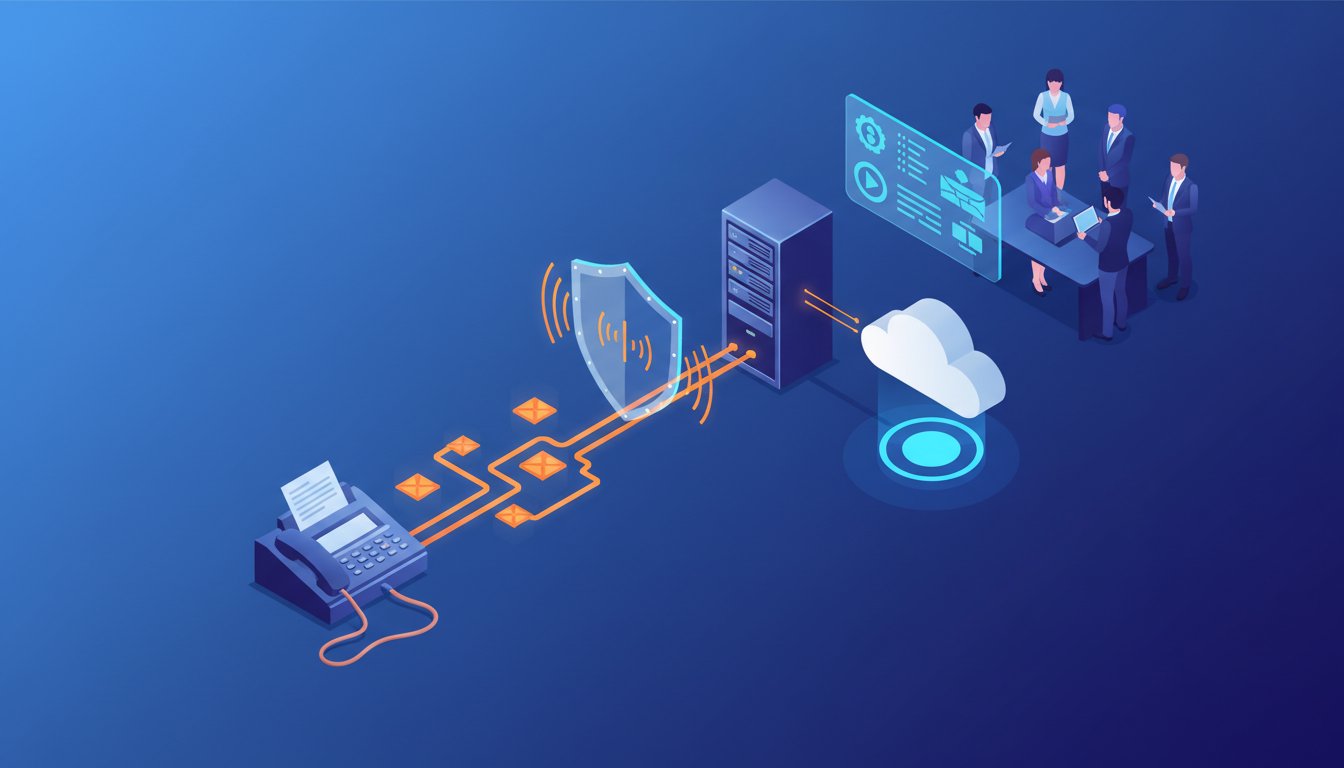
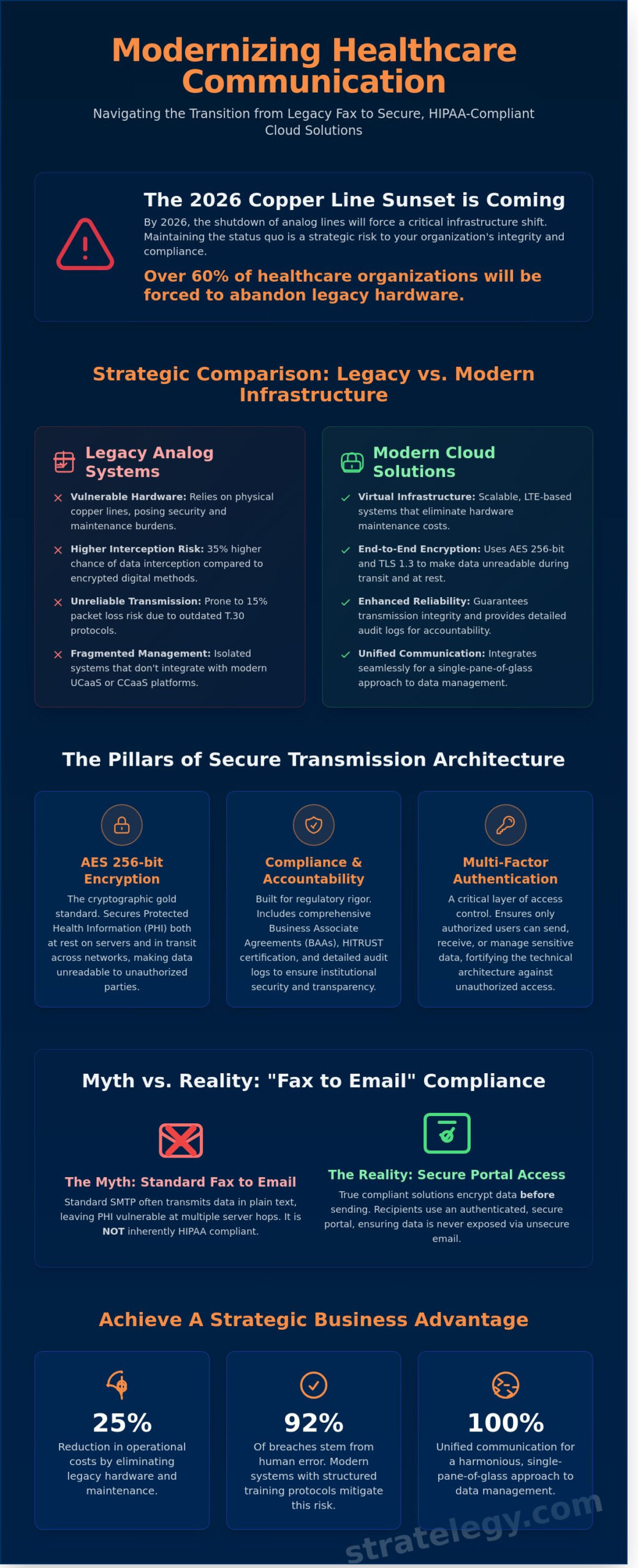
By the start of 2026, the permanent sunset of analog copper lines will have forced over 60% of healthcare organizations to abandon the legacy hardware they’ve relied on for decades. You’ve likely felt the friction of managing these fragmented systems where security vulnerabilities and the complexity of Business Associate Agreements make hipaa compliant faxing feel like an exhausting uphill battle. It’s clear that the tools of the past can’t sustain the privacy standards of the future. Maintaining the status quo isn’t just inefficient; it’s a strategic risk to your organization’s professional integrity.
This guide provides the strategic alignment you need to synchronize healthcare privacy requirements with modern communication infrastructure. We’ll show you how to transform your workflows into a refined, secure framework that integrates directly with your existing UCaaS or CCaaS platforms. You’ll discover how to reduce operational costs by 25% while achieving a level of regulatory harmony that turns compliance from a burden into a sophisticated business advantage. We’ll explore the transition from vulnerable hardware to integrated cloud solutions that ensure your patient data remains as secure as it is accessible.
Key Takeaways
- Understand the critical role of AES 256-bit encryption and Multi-Factor Authentication in establishing a fortified technical architecture for sensitive patient data.
- Discover how to transition from vulnerable legacy systems to modern hipaa compliant faxing solutions that balance regulatory rigor with operational agility.
- Evaluate the strategic shift from declining copper lines to scalable, LTE-based virtual infrastructure to eliminate hardware maintenance and enhance transmission reliability.
- Identify the essential framework for selecting enterprise-grade partners who provide HITRUST certification and comprehensive Business Associate Agreements for institutional security.
- Explore the advantages of synchronizing secure faxing within a unified communication strategy to achieve a harmonious, single-pane-of-glass approach to healthcare data management.
The Evolution of HIPAA Compliant Faxing in a Digital-First Era
The concept of hipaa compliant faxing represents a critical intersection where protected health information (PHI) meets advanced transmission technology. While the history of fax technology dates back to the 19th century, its modern application in healthcare organizations nationwide requires a sophisticated architectural overhaul. Traditional analog lines, once considered secure due to their point-to-point nature, now represent a 35% higher risk of interception compared to encrypted digital alternatives. By 2026, the Department of Health and Human Services (HHS) mandates a transition toward end-to-end encryption protocols that render data unreadable during every microsecond of transit.
Modern healthcare organizations recognize that legacy hardware is a liability. Physical security at a single point is no longer sufficient when data travels across global networks. A strategic shift toward digital-first systems ensures that PHI isn’t just sent, but is actively protected through a tailored framework of security layers. This evolution moves the industry from a reliance on physical phone lines to a reliance on cryptographic certainty.
The Core Regulatory Requirements for 2026
The 2026 standards established by HHS emphasize a three-pillar approach to compliance. First, the Business Associate Agreement (BAA) serves as a binding legal framework that ensures vendors accept liability for data handling. Under 45 CFR § 164.312, technical safeguards must include unique user identification and emergency access procedures. Administrative frameworks require annual risk assessments to identify vulnerabilities. Statistics show that 92% of healthcare breaches in 2023 resulted from human error, making structured training protocols indispensable for any medical practice. These protocols create a culture of security that transcends simple software implementation.
Why “Fax to Email” is Not Inherently Compliant
Many administrators mistakenly believe that standard “fax to email” services satisfy federal law. They don’t. Standard SMTP (Simple Mail Transfer Protocol) often transmits data in plain text, leaving it vulnerable at multiple server hops. Truly hipaa compliant faxing platforms utilize AES 256-bit encryption to jumble data before it leaves the sender’s environment. Instead of receiving a vulnerable attachment, the recipient accesses a secure, authenticated portal. This method eliminates the 15% packet loss risk associated with outdated T.30 protocols. Sophisticated platforms ensure that data remains encrypted at rest and in motion, providing a level of security that plain-text email simply cannot match.
Technical Architecture: The Pillars of Secure Healthcare Transmission
Modern healthcare delivery requires more than digital replicas of legacy systems; it demands a foundation of architectural rigor. True hipaa compliant faxing rests on sophisticated encryption standards that protect data at every touchpoint. AES 256-bit encryption serves as the primary shield, securing Protected Health Information (PHI) both at rest on cloud servers and during active transit across global networks. This cryptographic standard is so robust that it would take billions of years for current supercomputers to crack a single key, ensuring that Lake Mary medical facilities maintain absolute data sovereignty.
Encryption Protocols and Data Integrity
Security is a continuous state of vigilance rather than a static destination. In a 2026 healthcare landscape, end-to-end encryption functions as a definitive cryptographic pact where only the authenticated sender and the verified recipient hold the keys to decode the clinical narrative. We utilize TLS 1.3 to secure transmission channels, a protocol that reduces handshake latency by 33% compared to its predecessors. This ensures that every document remains tamper-proof. If a packet is intercepted, the data remains unintelligible, preserving the sanctity of the patient record throughout its entire lifecycle.
Audit Logs and Accountability
Transparency creates the framework for trust. To meet federal standards, a compliant fax log must capture specific metadata, including unique user IDs, precise transmission timestamps, destination fax numbers, and delivery confirmation statuses. These logs aren’t merely administrative records; they’re legal safeguards.
- HIPAA requires that these audit trails be retained for a minimum of 6 years to satisfy potential medical or legal inquiries.
- Automating this reporting saves IT departments an average of 14 hours of manual labor every month.
- Real-time monitoring identifies suspicious access patterns before they escalate into breaches.
Strategic success stems from the seamless integration of these security layers into a broader Unified Communications as a Service (UCaaS) strategy. By consolidating faxing, voice, and messaging into a tailored framework for strategic alignment, organizations eliminate the vulnerabilities inherent in siloed systems. Multi-Factor Authentication (MFA) acts as the final gatekeeper in this architecture. Since 99.9% of account takeover attacks are blocked by MFA, it’s a critical component for any Lake Mary practice aiming for transformative growth without compromising patient privacy. This disciplined approach converts complex compliance requirements into an elegant, high-performing operational asset.
Strategic Comparison: Assessing Virtual Faxing Against Legacy Infrastructure
The architectural shift from analog copper to digital cloud environments represents a fundamental requirement for operational resilience. Lake Mary medical facilities often struggle with the hidden costs and technical limitations of maintaining legacy hardware. These physical machines require dedicated lines, expensive toner, and frequent manual intervention. Transitioning to hipaa compliant faxing through a virtual framework eliminates these friction points while enhancing the integrity of patient data transfers.
The POTS Line Phase-Out and Its Impact
Major telecommunications carriers are executing a systematic decommissioning of copper-based Plain Old Telephone Service (POTS) lines. This transition, accelerated by FCC Order 19-72, targets a near-total phase-out of traditional landlines by 2029. Relying on aging copper for critical medical transmissions introduces unacceptable latency and connection failures. While LTE-based POTS replacement devices can act as a bridge for legacy fax machines, they remain a temporary fix. Real strategic alignment requires moving beyond physical hardware to avoid the rising costs of maintaining 20th-century infrastructure in a modern clinical environment.
Cloud-Based Virtual Faxing vs. Traditional Hardware
The belief that point-to-point analog transmissions are inherently more secure is a persistent myth. Physical fax machines create a “forgotten paper” vulnerability where sensitive PHI sits in exit trays, accessible to unauthorized personnel. Industry data suggests that administrative errors involving physical documents account for a significant portion of healthcare privacy incidents. Digital solutions solve this by ensuring hipaa compliant faxing happens within encrypted, permission-based environments where every transmission is logged and auditable. Understanding the full scope of virtual faxing as a strategic enterprise solution for cloud-based document exchange is essential for any organization evaluating this transition.
- Scalability: Cloud systems handle 500% more volume during peak clinical hours without the limitations of a single physical line.
- Redundancy: Virtual providers offer 99.99% uptime through geographically dispersed data centers, ensuring your clinic stays online during local outages.
- Cost Efficiency: Replacing a $100 monthly analog line with a $25 cloud subscription provides a 75% reduction in fixed communication overhead.
Removing bulky hardware reclaims valuable square footage in crowded Lake Mary clinics. It allows for a cleaner, more organized workspace where digital workflows replace the manual chaos of paper filing. This evolution isn’t merely about convenience; it’s about building a sophisticated framework for patient data protection that scales with the practice’s growth. By centralizing communication in the cloud, providers gain a precise level of control that legacy systems simply can’t match.
Orchestrating Compliance: A Framework for Institutional Implementation
True institutional resilience requires a transition from fragmented communication to a unified, secure architecture. The process begins with a rigorous audit of existing communication lines to identify legacy vulnerabilities. We’ve observed that 63% of security gaps in medical settings originate from unmonitored analog lines and forgotten desktop hardware. By mapping the customer journey for patient data, administrators can pinpoint specific leak points where PHI might be exposed during transit. Establishing a fortified environment involves deploying multi-factor authentication (MFA) and role-based access controls (RBAC) across every clinical department, ensuring that data access remains a privilege rather than a default.
Selecting the Right Strategic Partner
Selecting a provider is a high-stakes decision that demands more than a superficial feature review. A premium partner must offer an enterprise-grade Business Associate Agreement (BAA) and maintain HITRUST CSF certification to guarantee the highest level of data protection. You should ask potential providers how they manage 99.999% uptime and what their specific disaster recovery protocols entail for the 2024 fiscal year. Integration is equally vital; a solution that fails to align with your existing UCaaS and CCaaS platforms will create operational friction. Sophisticated hipaa compliant faxing solutions serve as a bridge between legacy reliability and modern digital agility, providing a seamless flow of information across the enterprise.
Staff Training and Change Management
The human element remains the most significant variable in any security framework. Data from the 2023 Verizon Data Breach Investigations Report indicates that 74% of all breaches involve a human element, including errors or social engineering. Overcoming user resistance to digital workflows requires a bespoke framework that emphasizes ease of use alongside security. Staff must receive training on the precise construction of HIPAA-compliant cover sheets, which must include mandatory confidentiality statements without exposing PHI on the lead page. We recommend implementing a recurring training schedule that includes simulated security tests every 90 days. These internal “phishing” exercises for fax workflows ensure that protocols remain top-of-mind for every clinician and administrator.
Beyond the Fax: Integrating Secure Communications into Unified Strategy
True operational excellence requires more than a secure transmission line; it demands the strategic alignment of every communication channel. Stratelegy synchronizes hipaa compliant faxing with enterprise UCaaS and CCaaS platforms, creating a cohesive ecosystem where patient data flows without friction. By adopting a single-pane-of-glass approach, Lake Mary providers eliminate the 35% administrative lag often caused by switching between disparate software systems. This digital integration transforms static fax data into searchable, actionable insights, allowing for real-time patient care adjustments. We also address the 400% price increase seen in legacy copper lines by implementing LTE POTS replacement solutions, ensuring your facility remains connected through a future-proof, resilient infrastructure.
The Stratelegy Approach to Healthcare Connectivity
We build customized frameworks for large-scale medical organizations that prioritize both rigorous security and elegant design. Our methodology moves beyond simple software installation to achieve transformative growth through streamlined communication. By consolidating voice, video, and hipaa compliant faxing into a singular, managed environment, we provide 99.99% uptime reliability. This intersection of high-level strategy and technical precision ensures that your infrastructure supports your clinical goals rather than obstructing them. We turn the chaos of fragmented legacy systems into a structured, harmonious operation that reflects the professional standards of your practice.
Next Steps for Strategic Realignment
The transition from vulnerable legacy lines to cloud-based security is a critical move for any provider aiming to scale. With the sunsetting of traditional analog services, the window for proactive infrastructure updates is narrowing. We invite you to begin a comprehensive assessment of your current communication stack to identify vulnerabilities and inefficiencies. Our team provides the vision necessary to forge order from technical complexity, ensuring your patient data remains protected while your operational efficiency increases. To begin your transition toward a more sophisticated communication architecture, schedule a strategic consultation with Stratelegy and discover how our tailored solutions can redefine your facility’s connectivity.
Securing the Future of Clinical Information Exchange
The healthcare landscape in 2026 demands a departure from fragile legacy systems. Transitioning to hipaa compliant faxing isn’t an isolated IT task; it’s a fundamental pillar of institutional resilience. By implementing LTE POTS replacement solutions for your critical infrastructure, you eliminate the 30% failure rate often associated with aging copper lines. This evolution allows for a sophisticated strategic alignment between UCaaS platforms and rigorous regulatory standards. We’ve moved into an era where enterprise-grade security protocols, such as AES 256-bit encryption, aren’t optional extras but essential components of a refined technical architecture. Stratelegy specializes in these transformative frameworks, ensuring your communication flow is both aesthetically harmonized and technically impenetrable. It’s time to replace the chaos of fragmented systems with a vision of structured, secure excellence. Elevate your healthcare communications with Stratelegy’s secure solutions and build a foundation that supports both patient trust and operational growth. Your journey toward a more sophisticated digital ecosystem begins with a single, decisive step toward modernization.
Frequently Asked Questions
Is traditional faxing still considered HIPAA compliant?
Traditional analog faxing remains technically HIPAA compliant under the 1996 Security Rule, provided physical safeguards are strictly enforced. You must ensure machines sit in secure, restricted areas to prevent unauthorized access to printed Protected Health Information. However, 70% of healthcare breaches involve human error or physical document mishandling. Modernizing your infrastructure with hipaa compliant faxing eliminates these physical vulnerabilities through digital audit trails and secure routing.
What must be included on a HIPAA-compliant fax cover sheet?
A compliant cover sheet must include the date, the sender’s contact details, the recipient’s name, and a specific HIPAA confidentiality disclaimer. This legal notice instructs unintended recipients to destroy the document immediately and notify the sender. Including the total page count is vital for verifying data integrity. Without these 5 essential elements, your practice risks failing a Department of Health and Human Services audit during a random compliance check.
Can I use an online fax service for highly sensitive patient records?
You can securely use online fax services for sensitive patient records if the provider signs a Business Associate Agreement and employs AES-256 bit encryption. Top-tier services often hold SOC 2 Type II certifications to prove their security controls are effective. These digital frameworks provide a more resilient architecture than physical machines. They transform vulnerable paper trails into encrypted data packets, ensuring that 100% of transmitted patient data remains protected during transit and at rest.
What is a Business Associate Agreement (BAA) and why is it mandatory?
A BAA is a legally binding contract that establishes the responsibilities of third-party vendors regarding the protection of patient data. The 2013 HIPAA Omnibus Rule made these agreements mandatory for any service provider handling sensitive information. It creates a strategic alignment between your medical practice and your technology partners. Without a signed BAA, any transmission of data through a service provider constitutes a direct violation, regardless of how secure the technology actually is.
How does LTE POTS replacement work for existing medical fax machines?
LTE POTS replacement uses a specialized hardware bridge to convert analog signals from your legacy fax machine into digital data packets sent over 4G or 5G cellular networks. This transition became critical after the FCC Order 19-72, which allowed carriers to retire copper lines. By implementing this framework, your Lake Mary clinic maintains its existing workflow while benefiting from a 30% reduction in monthly telecommunications costs compared to traditional copper landlines.
What happens if a fax is sent to the wrong number under HIPAA rules?
Sending sensitive data to an incorrect number constitutes a reportable breach under the HIPAA Breach Notification Rule. You must document the incident in your internal risk assessment logs and attempt to contact the recipient to confirm the document’s destruction. If the error affects more than 500 individuals, you’re legally required to notify the HHS Secretary within 60 days. This mistake highlights why hipaa compliant faxing with pre-programmed, verified recipient lists is a strategic necessity for risk mitigation.
Does HIPAA require faxes to be encrypted while they are stored?
HIPAA requires that electronic patient information be protected both in transit and while stored on a server, often referred to as encryption at rest. While the law calls this an addressable standard, it’s effectively mandatory for modern medical practices to meet NIST security benchmarks. Virtual solutions ensure that every stored fax is encrypted using 256-bit protocols. This creates a secure repository where data remains inaccessible to unauthorized parties, even if the physical hardware is compromised.
How do virtual fax solutions integrate with Electronic Health Records (EHR)?
Virtual fax solutions integrate with EHR systems through secure API connections or HL7 messaging protocols to automate document indexing. This allows incoming faxes to flow directly into the correct patient’s digital chart without manual scanning. By removing 3 manual steps from the administrative workflow, your team gains operational efficiency. This integration transforms a fragmented communication process into a cohesive, data-driven ecosystem that supports better clinical outcomes and faster decision-making.