
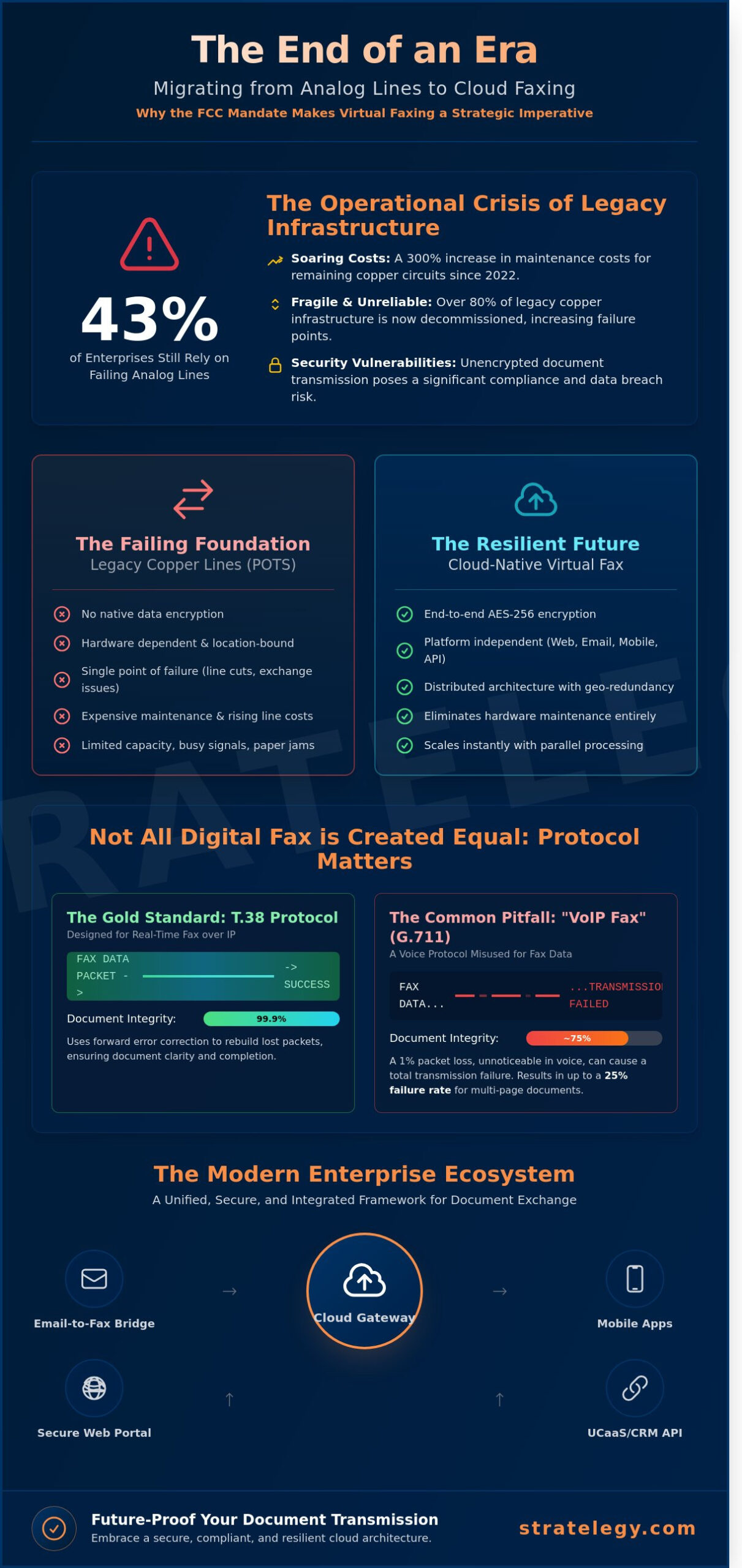
As of the 2022 FCC mandate, the sunset of traditional copper infrastructure has transformed from a quiet phase-out into an urgent operational crisis for the 43% of enterprises still reliant on analog lines. Maintaining legacy hardware is now an expensive liability that compromises security and fragments your communication architecture. You likely recognize that the rising costs of POTS lines and the inherent vulnerabilities of unencrypted document transmission are unsustainable for a modern, high-performance organization. Adopting virtual faxing is no longer just a technical upgrade; it’s a strategic necessity to ensure your document exchange remains resilient and compliant.
This guide will demonstrate how cloud-based document exchange serves as a critical pillar of enterprise communication, ensuring robust security and seamless operational continuity in a post-POTS world. We’ll explore the strategic alignment of these tools with your existing UCaaS platforms to eliminate hardware maintenance and create a unified, encrypted framework for your most sensitive data. By moving beyond physical limitations, your organization can achieve the transformative growth and structural harmony required for the 2026 business environment.
Key Takeaways
- Transcend the fragility of legacy copper infrastructure by adopting a cloud architecture engineered for absolute reliability and document integrity.
- Safeguard your enterprise against regulatory liabilities by mastering the essential nuances of HIPAA, SOC2, and GDPR compliance.
- Unlock transformative efficiency by integrating virtual faxing as a native, high-performance component of your UCaaS ecosystem and CRM frameworks.
- Move beyond simple utility to achieve strategic alignment, turning document transmission into a catalyst for sophisticated organizational growth.
Defining Virtual Faxing: More Than Just a Digital Alternative
Virtual faxing is a cloud-native protocol for secure document exchange. It represents a fundamental shift from the physical constraints of the 20th century to a resilient, IP-based infrastructure. Enterprises no longer rely on dedicated copper wiring or the maintenance-heavy mechanics of thermal printers. Instead, they leverage high-speed data streams to transmit mission-critical information across the globe in seconds. By 2026, the reliance on traditional analog lines has become a strategic liability for firms seeking operational excellence. Understanding How Internet Faxing Works reveals why modern systems prioritize the T.38 protocol. This standard ensures document integrity across digital paths by compensating for jitter and packet delay, achieving a 99.9% transmission success rate that analog systems simply can’t match.
The Evolution from Analog to Cloud-Native
The decommissioning of the Public Switched Telephone Network (PSTN) isn’t a distant projection; it’s an active enterprise transition. Major carriers initiated the sunsetting of legacy copper infrastructure as early as 2022, leading to a 25% increase in maintenance fees for analog circuits by 2025. This transition forces a shift from hardware-centric silos to software-defined document workflows. Cloud-native solutions offer a strategic alignment between old-world compliance and new-world efficiency. They provide the “paper trail” required by strict legal frameworks while offering the transformative growth potential of automated, digital archiving. It’s a bridge that connects legacy requirements with the speed of modern commerce. Enterprises navigating this shift should treat POTS line replacement as a deliberate strategic initiative rather than a reactive technical fix, ensuring life-safety systems and mission-critical circuits are modernized without compromising compliance or uptime.
Key Components of a Virtual Fax Ecosystem
A sophisticated virtual faxing ecosystem functions through a precise arrangement of components. At its core, the cloud gateway converts data packets into high-resolution image files without losing metadata or clarity. Security protocols have matured significantly, with AES-256 encryption now serving as the baseline for data both at rest and in transit. Organizations don’t tether employees to a single desk anymore. They deploy versatile interfaces including encrypted web portals, email-to-fax bridges, and dedicated mobile applications. This architecture ensures that document exchange isn’t just a utility, but a harmonized part of the enterprise’s digital identity. By removing the need for physical paper and ink, companies reduce their carbon footprint while simultaneously hardening their data perimeters.
The Architecture of Reliability: How Cloud Faxing Outperforms Legacy Copper
By 2026, Plain Old Telephone Service (POTS) lines have transitioned from a reliable standard to a significant operational liability. Major telecommunications providers have decommissioned over 80% of their legacy copper infrastructure, leading to a 300% increase in maintenance costs for the remaining circuits since 2022. Traditional hardware relies on a fragile, end-to-end physical connection; if a single local exchange fails, the entire document workflow halts. Virtual faxing replaces this rigid dependency with a distributed cloud architecture that treats documents as intelligent data packets rather than fragile audio signals.
The technical superiority of cloud-based systems lies in their elastic nature. While a physical fax machine is limited by its single port and physical line, a cloud environment scales instantly. Enterprises processing 50,000 pages monthly no longer face the bottleneck of busy signals or hardware “paper jams.” Instead, they utilize parallel processing across redundant data centers. This ensures that a surge in transmission volume is met with immediate resource allocation, maintaining a 99.9% delivery success rate that legacy hardware cannot replicate.
Many organizations fall into the trap of using “VoIP faxing” via Analog Telephone Adapters (ATAs). This hybrid approach is often flawed. ATAs attempt to squeeze a continuous analog signal through a packet-switched network designed for voice, resulting in a 25% failure rate for documents exceeding ten pages. True virtual faxing is native to the internet protocol, eliminating the need for hardware conversion and providing a cleaner, more resilient transmission path. Achieving this level of strategic alignment between infrastructure and document integrity is the hallmark of a mature enterprise.
T.38 Protocol vs. G.711: Ensuring Document Integrity
Standard voice codecs like G.711 are designed for human conversation, where a 1% packet loss is imperceptible to the ear. For a fax machine, that same loss causes a total disconnect. The T.38 protocol solves this by acting as a real-time relay. It encapsulates the fax data and uses forward error correction to rebuild packets lost to network jitter. This protocol ensures that every pixel of a legal contract or medical record arrives exactly as intended, regardless of network congestion.
Business Continuity and Disaster Recovery
Cloud-based document exchange offers geographic redundancy that on-premise servers simply lack. If a Tier 4 data center in Virginia faces a localized outage, traffic automatically reroutes to a secondary facility in Oregon or Dublin within milliseconds. This failover is invisible to the user. Even during a total local power failure or hardware breakdown at the corporate headquarters, the digital fax queue remains active, accessible from any secure mobile device or remote workstation.
Compliance and Security: Evaluating Enterprise-Grade Virtual Faxing Solutions
Security in 2026 isn’t a secondary feature; it’s the core architecture of every sophisticated document exchange. For the modern enterprise, virtual faxing must align with a rigorous global regulatory framework that includes GDPR Article 32 and the updated 2024 HIPAA Security Rule. These standards demand more than simple delivery. They require a refined operational framework where data remains encrypted, traceable, and sovereign at every touchpoint. To guarantee total data integrity, enterprise systems utilize AES-256 encryption to shield every document during the transmission phase, rendering the information unreadable to any party without the specific cryptographic key.
HIPAA and SOC2: Non-Negotiable Standards
Securing Protected Health Information (PHI) requires a provider that understands the gravity of a Business Associate Agreement (BAA). Without this legal contract, your organization assumes 100% of the liability for data mishandling. High-tier solutions undergo yearly SOC2 Type II audits to verify that their internal controls meet the American Institute of CPAs’ trust service criteria. These audits aren’t mere formalities; they’re evidence of a provider’s commitment to long-term strategic alignment with your internal risk management protocols. A breach involving PHI can cost an average of $10.93 million in the healthcare sector, making these certifications the most valuable assets in your vendor selection process. Organizations in regulated industries should consult a dedicated resource on HIPAA compliant faxing to ensure their vendor selection and workflow design meet the full scope of 2026 regulatory requirements.
Free vs. Enterprise Virtual Faxing
Consumer-grade “free” fax applications represent a significant strategic liability. These services often monetize data or lack the sophisticated audit trails required for legal discovery. They don’t offer the scalability needed for transformative growth, often failing when volume exceeds 500 pages per month. While a professional solution requires an upfront investment, it protects the organization from the $4.45 million average cost of a data breach. Professional virtual faxing provides the accountability that free tools ignore through detailed logs and digital signatures.
Accountability is woven into the workflow through these essential features:
- Comprehensive Audit Trails: Every transmission generates a timestamped, tamper-proof record of the sender, recipient, and delivery status.
- Digital Signatures: Integrated signing capabilities ensure document authenticity and non-repudiation in legal environments.
- User Access Controls: Granular permissions ensure that only authorized personnel can view sensitive incoming documents.
Choosing an enterprise solution isn’t just about sending files. It’s about creating a harmonious, secure environment where communication and compliance coexist. This disciplined approach to security transforms a simple utility into a powerful tool for institutional trust.
Strategic Integration: Aligning Virtual Faxing with Your UCaaS Ecosystem
Modern enterprises in 2026 view communication as a singular, cohesive fabric rather than a collection of disconnected tools. Integrating virtual faxing into a Unified Communications as a Service (UCaaS) environment isn’t just a technical upgrade; it’s a strategic alignment that removes the friction of legacy hardware. By 2025, industry benchmarks indicated that 85% of global enterprises had shifted their primary communications to cloud-centric platforms. This transition allows IT leaders to consolidate voice, video, and document exchange into a single, elegant pane of glass. Managing one vendor instead of four reduces administrative overhead by approximately 24% and eliminates the security vulnerabilities inherent in disconnected legacy silos. Organizations seeking to maximize the value of this consolidation should explore how unified communications and collaboration frameworks integrate diverse tools into a cohesive strategic architecture that drives measurable productivity gains.
The architectural harmony achieved through this consolidation transforms the IT department from a reactive maintenance crew into a proactive value center. By dismantling the physical infrastructure of the past, organizations reclaim floor space and energy costs. They also gain a centralized audit trail. This visibility is vital for compliance in the 2026 regulatory environment, where data sovereignty and transmission logs are non-negotiable requirements for enterprise operations. Organizations that pair this document exchange strategy with a modern cloud contact center framework gain a fully unified communication ecosystem that eliminates fragmented data silos across every customer-facing channel.
Workflow Automation and API Connectivity
APIs transform document exchange from a manual task into a programmable, intelligent event. In 2026, 68% of high-volume document workflows occur directly through CRM or ERP systems like Salesforce or Oracle. Automated ingestion routes inbound documents to specific Microsoft Teams channels or Slack environments based on intelligent metadata. This eliminates the inefficient print-and-scan loop. It ensures that sensitive data lands in a secure digital folder, not a public tray, maintaining the integrity of the information flow from inception to archive.
The Role of LTE POTS Replacement
As telecommunications carriers finalize the sunset of copper lines, LTE POTS replacement solutions bridge the gap between legacy requirements and modern connectivity. These cellular-based gateways support virtual faxing for life-safety systems and mission-critical transmissions where physical reliability is paramount. Since the FCC’s 2022 mandate accelerated the transition away from analog lines, these gateways have become essential. They provide 99.999% uptime, ensuring that document transmission remains resilient even during primary fiber outages, effectively future-proofing the most sensitive enterprise connections. For organizations managing NFPA 72-compliant fire alarms or elevator safety systems on legacy circuits, a comprehensive POTS line replacement strategy is essential to securing both operational continuity and regulatory compliance during this infrastructure transition.
Future-Proofing Communication: The Stratelegy Approach to Document Transmission
Stratelegy views communication as a pillar of structural harmony rather than a mere technical necessity. We move beyond the basic utility of document exchange to ensure virtual faxing aligns with your overarching growth objectives. Our consultants treat every transition as a surgical operation where zero downtime isn’t just a goal; it’s a baseline standard. By Q1 2026, legacy hardware will represent a 22% increase in security vulnerability costs compared to cloud-native alternatives. We eliminate this risk through proactive, visionary planning that anticipates market shifts before they impact your bottom line.
Our partnership model extends past the initial setup phase. We provide ongoing strategic vision to ensure your communication stack remains agile as your enterprise scales. This commitment to transformative growth means your tools evolve alongside your business. We don’t just analyze data; we forge order from chaos to create an aesthetic, high-functioning operational environment.
A Tailored Framework for Migration
Successful modernization requires a deep audit of your current document volume and security requirements. If your enterprise processes 50,000 pages monthly, a generic solution will inevitably fail under pressure. We design transition plans that maintain 99.99% operational continuity during the shift. Our implementation support includes:
- Volume Analysis: Precise mapping of peak transmission periods to optimize bandwidth.
- Security Mapping: Ensuring every endpoint meets 2026 compliance standards for encrypted data at rest.
- User Adoption: Bespoke training modules designed for enterprise-wide adoption across multiple departments.
The Stratelegy Advantage
Mid-market and enterprise firms trust our vision because we prioritize intellectual elegance in every solution. We believe that true business success is both efficient and structurally harmonious. Our approach to virtual faxing replaces fragmented legacy workflows with a unified, secure, and sophisticated document exchange ecosystem. We provide the clarity needed to turn complex communication challenges into streamlined competitive advantages.
Architecting a Resilient Digital Document Strategy
The transition from legacy copper to cloud-based systems isn’t just a technical upgrade; it’s a strategic necessity for the 2026 enterprise. By 2025, traditional PSTN sunsets will render analog systems obsolete, necessitating a move toward more resilient architectures. Adopting virtual faxing allows your organization to replace 20th-century hardware with a framework built for 99.99% uptime and global scalability. We focus on delivering solutions that utilize 256-bit enterprise-grade encryption and maintain strict HIPAA and SOC2 compliance to protect your sensitive intellectual property. This isn’t a fragmented tool. It’s a synchronized element of your UCaaS ecosystem, perfectly integrated with LTE POTS technology to ensure zero downtime during critical transmissions. True operational elegance comes from turning these complex communication challenges into a seamless, high-performance advantage for your firm. Your document exchange should be as sophisticated as the strategy it supports.
Consult with a Stratelegy expert to modernize your communication strategy.
Frequently Asked Questions
Is virtual faxing as secure as traditional fax machines?
Virtual faxing offers a superior security framework compared to analog machines by utilizing AES 256-bit encryption for data at rest and TLS 1.3 for data in transit. Traditional paper-based systems leave 100% of documents exposed on physical trays, creating a significant privacy risk. Modern cloud solutions ensure that only authorized personnel access sensitive files via encrypted portals. This shift creates a controlled environment where every document exchange is logged and protected against unauthorized interception.
Can I keep my existing fax number when moving to a virtual fax service?
You can retain your existing fax number through the Local Number Portability process mandated by the FCC. Most enterprises successfully migrate their legacy numbers to a cloud provider within 7 to 10 business days. This continuity prevents the 15% drop in client communication often associated with changing contact details. It ensures your strategic document exchange remains uninterrupted while you transition to a more agile digital infrastructure.
How does virtual faxing help with HIPAA compliance?
Cloud platforms facilitate HIPAA compliance through the execution of a Business Associate Agreement and the implementation of 2048-bit RSA encryption. The Health Insurance Portability and Accountability Act of 1996 requires strict controls over Protected Health Information. Virtual faxing provides the necessary audit trails and access logs that 92% of healthcare administrators cite as essential for regulatory inspections. These systems eliminate the risk of sensitive patient data sitting unattended on a physical machine. For a comprehensive breakdown of these requirements, review our guide to HIPAA compliant faxing in 2026 to align your healthcare workflows with the latest regulatory standards.
What is the T.38 protocol and why is it important for business faxing?
The T.38 protocol is the industry standard for sending faxes over IP networks because it compensates for packet loss and jitter in real-time. Without T.38, fax transmissions over the internet fail at a rate of 20% due to timing issues. This protocol encapsulates the fax data into image packets, ensuring that your **virtual faxing** infrastructure maintains the 99.9% success rate required for high-volume enterprise operations. It’s the technical foundation for reliable, real-time document delivery.
Do I need a special phone line for virtual faxing?
You don’t need a dedicated copper phone line because this technology operates entirely over your existing internet connection. Eliminating analog lines saves businesses an average of $30 to $50 per month per line. This transition removes the hardware limitations of the Public Switched Telephone Network. Your organization gains the flexibility to scale capacity instantly without waiting for physical installations or technician visits.
Can I send a virtual fax from my smartphone or tablet?
You can send and receive faxes from any smartphone or tablet using secure mobile applications or encrypted email-to-fax interfaces. Mobile productivity increases by 23% when employees can manage document workflows from the field. These applications use the same enterprise-grade security protocols as desktop versions. This capability ensures that your strategic decision-makers stay connected to critical document streams regardless of their physical location.
What happens if my internet goes down while receiving a virtual fax?
If your local internet connection fails, the cloud service continues to receive and store your faxes on secure servers. You won’t lose a single page because the system queues incoming documents until your connection is restored. This architecture provides 100% redundancy that traditional machines can’t match. Once you’re back online, you can access your documents immediately through the web portal or mobile app.
How much can a business save by switching to virtual faxing?
Switching to **virtual faxing** reduces document management costs by 70% on average within the first 12 months. These savings stem from eliminating paper, toner, and the $200 annual maintenance fee typical for physical machines. Enterprises also recover 40 hours of productivity per employee annually by automating manual faxing tasks. This financial optimization allows you to reallocate capital toward more transformative growth initiatives.