
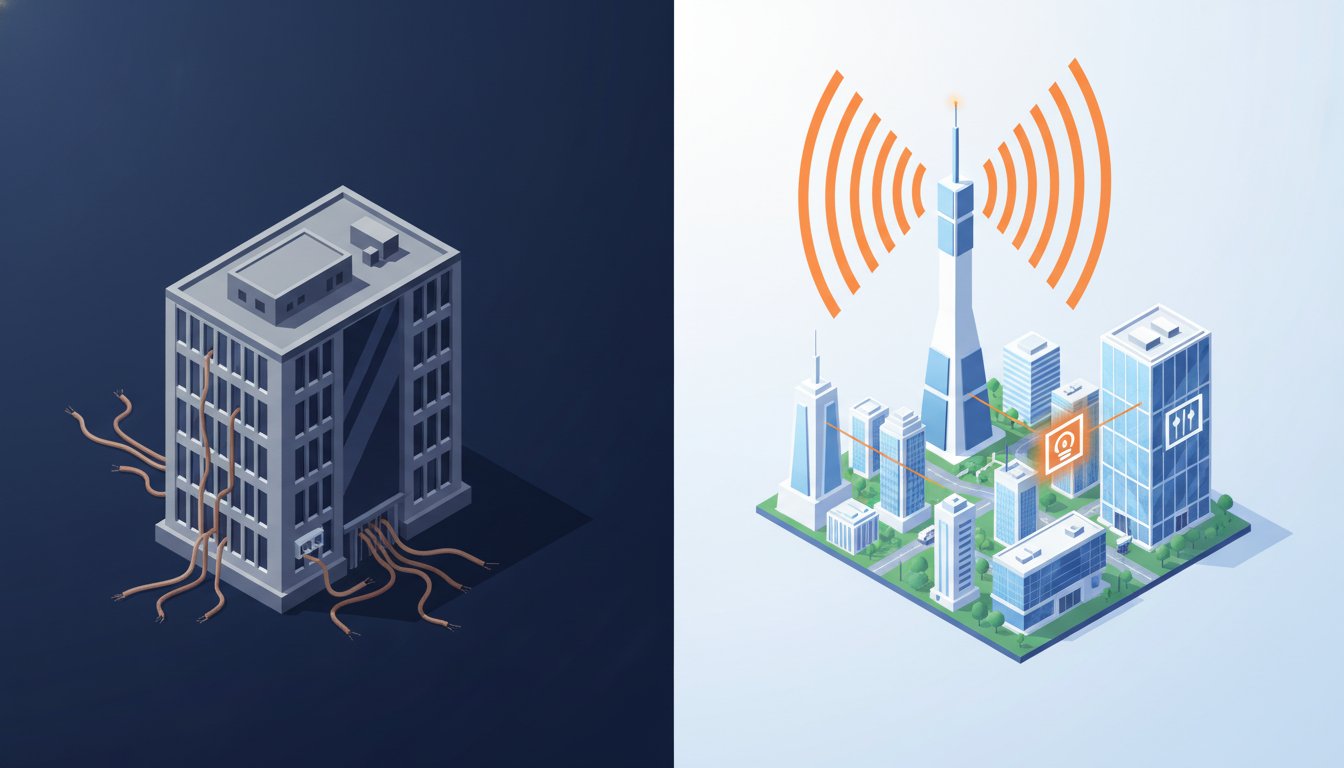
For over a century, the copper wire was the silent pulse of American commerce; today, that pulse is officially flatlining. As at&t plans to discontinue traditional landline phone service by 2029, the infrastructure once considered the gold standard of reliability has become a strategic vulnerability for the modern enterprise. You’ve likely noticed the escalating costs of maintaining these legacy circuits, which have surged by over 450% in specific markets since 2019, while the pool of technicians capable of servicing them continues to shrink. It’s a shift that demands more than just a quick fix; it requires a deliberate, architectural evolution.
It’s natural to feel a sense of urgency regarding fire code compliance and the stability of your life-safety systems during this transition. This guide offers a sophisticated roadmap to help you navigate the 2029 copper sunset with absolute confidence. We’ll examine the specific technological shifts required to replace aging POTS lines with resilient, cloud-integrated alternatives that ensure your operations remain both compliant and uninterrupted. By aligning your current infrastructure with future-proof digital frameworks, you can turn a mandatory migration into a moment of transformative growth.
Key Takeaways
- Understand the strategic implications for your enterprise as at&t plans to discontinue traditional landline phone service by 2029 across the majority of its service states.
- Identify and mitigate the “hidden” risks associated with legacy copper lines, specifically focusing on the vulnerabilities of fire alarms, elevator phones, and life-safety systems.
- Evaluate the resilience of LTE-based “POTS in a Box” solutions as a sophisticated and technically superior successor to aging analog infrastructure.
- Master a comprehensive five-step blueprint to audit your existing portfolio and prioritize the transition of mission-critical systems for seamless operational continuity.
- Learn how to transform a technical mandate into a strategic advantage by aligning your communication ecosystem with future-ready, unified frameworks.
AT&T’s 2029 Copper Retirement: A Strategic Mandate for Modern Enterprises
AT&T’s directive is clear and unwavering. Across 20 of its 21 service states, the carrier is executing a definitive withdrawal from legacy infrastructure. This transition represents more than a technical upgrade; it’s a fundamental shift in how modern enterprises maintain connectivity. While the public headline suggests a distant horizon, the reality is that at&t plans to discontinue traditional landline phone service by 2029, leaving little room for reactive planning. Waiting until 2028 to initiate a migration strategy introduces unacceptable risks to operational continuity. Enterprise requirements differ vastly from residential needs. A home user might lose a dial tone, but a business loses fire alarms, elevator emergency lines, and critical point-of-sale systems that rely on stable voltage.
The “Copper Sunset” isn’t merely a corporate preference. It’s an economic inevitability. Maintaining a 70-year-old network of lead-sheathed cables is no longer viable when compared to the efficiency of light-speed data transmission. For Rochester businesses, this means the infrastructure currently buried beneath their streets is reaching its functional end-of-life. The strategic alignment of your communication framework must account for this decay. You can’t afford to treat this as a simple vendor change; it’s a wholesale transformation of your physical connectivity layer.
The Regulatory Landscape: FCC Orders and the Path to 2029
The path to this retirement was paved by FCC Order 19-72, which officially deregulated legacy copper services on August 2, 2019. This order removed the long-standing obligation for carriers to provide analog traditional landline phone service at price-capped rates. Consequently, providers have utilized aggressive price hikes as a forced migration tactic. Costs for these aging circuits have surged by over 450% in certain markets since 2020. This pricing surge isn’t accidental. It’s a calculated move to drive enterprises toward fiber-optic and wireless broadband alternatives that are easier to manage and more profitable to maintain.
Why Copper is Failing in 2026
Reliability is no longer a hallmark of copper. Aging insulation and paper-wrapped bundles are succumbing to water ingress and ground-level flooding with increasing frequency. By 2026, the shortage of technicians capable of repairing the legacy Public Switched Telephone Network (PSTN) will reach a critical threshold as the older workforce retires. Most telecommunications giants have already shifted 100% of their capital expenditure away from legacy maintenance to accelerate 5G and fiber-to-the-premises deployments. When a copper line fails in 2026, the parts required for repair may simply not exist in a local warehouse.
- Resource Allocation: Carriers are prioritizing fiber builds, leaving copper repairs at the bottom of the service queue.
- Technician Deficit: The specialized knowledge required for analog switch maintenance is disappearing from the labor market.
- Environmental Decay: Rochester’s freeze-thaw cycles accelerate the physical breakdown of aging copper conduits.
Strategic leaders recognize that at&t plans to discontinue traditional landline phone service by 2029 as a call to action for immediate audits. If your organization manages complex facilities, the migration of specialized “purple wires” for life-safety systems requires a tailored framework. You don’t want to be caught in the 2028 bottleneck when every other business is scrambling for the same limited pool of migration experts. Proactive transition ensures that your move to modern architecture is elegant, structured, and, above all, invisible to your clients.
The Vulnerability of Legacy Infrastructure: Impact on Fire and Life Safety Systems
Rochester’s commercial landscape demands a level of structural harmony that legacy copper simply cannot provide. While many executives focus on high-speed internet for productivity, the most critical connections often hide in utility closets and elevator shafts. These circuits form the backbone of life-safety infrastructure, yet they are increasingly fragile. Since at&t plans to discontinue traditional landline phone service by 2029, building owners face a narrowing window to modernize systems that cannot afford a single second of downtime. This transition is not merely a technical upgrade; it’s a strategic necessity to maintain the integrity of human safety within the built environment.
Critical Systems at Risk in the Phase-Out
Fire Alarm Control Panels (FACPs) represent the most significant vulnerability in this technological shift. Most legacy panels utilize Digital Alarm Communicator Transmitters (DACTs) designed specifically for analog signals. As carriers transition to digital backbones, these panels often fail to handshake correctly with emergency communications centers, leading to delayed or missed signals. This isn’t a theoretical concern. The NFPA 72 code requires specific communication speeds and signal verification that aging copper struggles to maintain in a digital world.
- Emergency Elevator Phones: These must adhere to ASME A17.1 standards, requiring a dedicated, reliable path for two-way voice communication. If a landline fails, the elevator is legally non-compliant, which can result in immediate decommissioning of the lift.
- Security and Intrusion Detection: Transitioning to cellular or IP-based solutions ensures that a physical wire cut or a central office failure won’t compromise a facility’s perimeter. Modern systems provide 24/7 supervised monitoring that traditional copper cannot match.
The enduring narrative regarding copper reliability often overlooks the physical reality of infrastructure decay. While landlines once drew power directly from the central office, the current state of the national grid and the physical degradation of underground cables mean copper is no longer the “always on” gold standard. Modern LTE and 5G solutions now offer 99.99% uptime. These digital alternatives utilize sophisticated battery backups and multi-path reporting that far exceed the capabilities of decaying analog loops.
The Cost of Inaction: Liability and Insurance Risks
Ignoring the 2029 deadline creates a cascade of financial and legal risks that extend beyond simple connectivity. Insurance providers are tightening their requirements; a failure in a fire alarm’s communication path during an incident could lead to a total denial of claims. If a system remains non-functional for more than four hours, local fire marshals in the Rochester area may mandate a “Fire Watch.” This is a grueling financial burden where personnel must physically patrol the building 24/7 at the owner’s expense until the system is restored.
Strategic alignment of your technology stack is no longer optional for those managing high-stakes environments. Developing a bespoke communication framework ensures your facility remains both compliant and protected against the inevitable sunset of analog services. At&t plans to discontinue traditional landline phone service by 2029, and proactive migration is the only way to avoid the intersection of technical failure and legal liability. Facility managers navigating NFPA 72 and UL 864 compliance requirements will find that a dedicated LTE POTS replacement for fire alarms provides the predictable, high-performance foundation these critical systems demand.
Comparing Connectivity Frameworks: Why LTE is the Successor to Copper
The transition away from analog infrastructure requires more than a simple hardware swap; it demands a strategic alignment of technology and business continuity. As at&t plans to discontinue traditional landline phone service by 2029, Rochester enterprises face a choice between three primary frameworks: Voice over IP (VoIP), Fiber optics, and LTE-based POTS replacement. While Fiber offers high bandwidth, it lacks the inherent resilience of the legacy copper network. VoIP, though cost-effective for office desks, frequently fails to meet the stringent requirements of life safety systems. This is where the ‘POTS in a Box’ solution emerges as the superior architecture, bridging the gap between legacy analog hardware and modern cellular networks through a sophisticated, cloud-managed gateway. To fully appreciate why this transition matters, it helps to understand what is a POTS line and how its legacy infrastructure has shaped modern enterprise connectivity.
LTE POTS Replacement vs. Standard VoIP
Standard VoIP solutions often struggle with fire alarm panels and elevator phones because of high packet latency and signal compression. Fire panels transmit data using specialized tones that digital compression algorithms often distort, leading to communication failures during critical tests. LTE data transmission for analog signals utilizes Machine-to-Machine (M2M) protocols that preserve the integrity of these signals. Unlike standard internet connections, LTE POTS in a box units include internal battery backups that provide up to 24 hours of operation during power failures. It’s a capability that matches the historical reliability of copper lines, ensuring your facility remains compliant with local Rochester fire codes even when the grid goes dark.
Reliability analysis reveals that a single-path fiber connection represents a significant point of failure for emergency services. If a construction crew severs a fiber line, your entire emergency communication system goes offline instantly. In contrast, LTE-based solutions utilize dual-SIM configurations to create a redundant fabric. This architecture allows the device to switch between carriers, such as Verizon and AT&T, in less than 60 seconds if one network experiences a localized outage. By 2025, an estimated 85% of mission-critical systems will rely on these redundant cellular paths to maintain 99.99% uptime. This shift represents a move toward a more resilient, cloud-integrated strategy that complements existing UCaaS and digital transformation goals.
Economic Analysis of the Transition
The financial burden of maintaining legacy copper has reached a breaking point. Rochester businesses have seen monthly rates for a single analog line jump from $50 to over $400 since 2021, representing an 800% increase in some jurisdictions. Transitioning to an LTE POTS replacement for fire alarms eliminates these predatory pricing models. The ROI is typically realized within 12 to 18 months through lower recurring monthly costs and the removal of expensive Amper expansions or on-premise hardware repairs. By adopting a fixed-cost cellular model, organizations can transform a volatile utility expense into a predictable, manageable line item while modernizing their safety infrastructure. As at&t plans to discontinue traditional landline phone service by 2029, the window for a proactive, cost-saving migration is narrowing for those who prioritize long-term fiscal health and operational elegance.
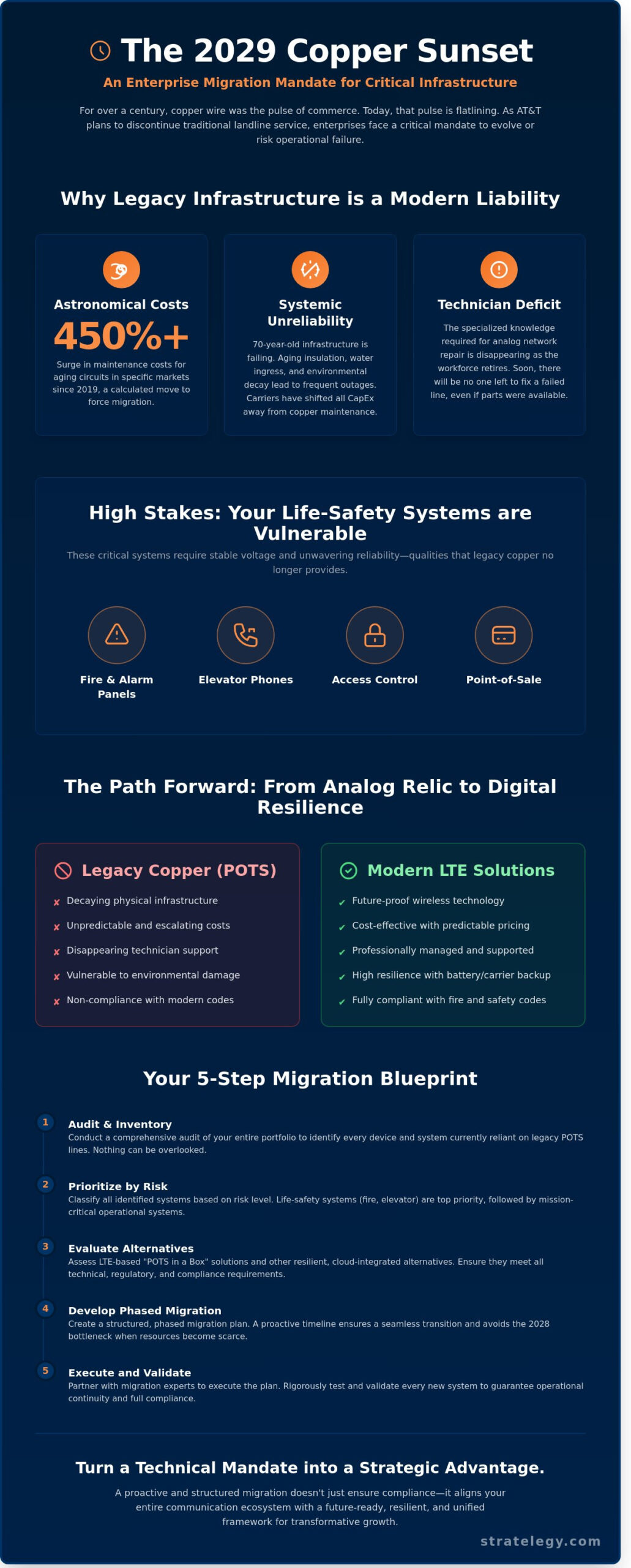
A Five-Step Blueprint for Navigating the 2029 Landline Discontinuation
Transitioning away from legacy infrastructure requires more than a simple hardware swap; it demands a strategic orchestration of resources. Since at&t plans to discontinue traditional landline phone service by 2029, Rochester enterprises must act with clinical precision. This timeline isn’t a suggestion. It’s a hard deadline for operational continuity that necessitates a clear, multi-year roadmap. Organizations that delay their migration risk facing inflated maintenance costs and the sudden loss of critical safety signals as copper networks degrade beyond repair.
Step 1 & 2: The Audit and Risk Assessment
Every successful migration begins with an exhaustive audit of the existing copper footprint. Industry data indicates that roughly 18% of enterprise copper lines are “ghost lines” that remain active on billing cycles despite serving no functional purpose for years. Identifying these allows for immediate cost recovery. Once the inventory is clear, categorize every circuit into four distinct tiers: fire and life-safety, security monitoring, analog faxing, and administrative voice. This prioritization ensures that the most sensitive systems receive attention first. Establishing a dedicated capital expenditure budget for the 2026-2028 fiscal years is essential. This proactive financial planning ensures the transition is fully funded and completed well before the 2029 deadline, avoiding the premium pricing often associated with last-minute emergency upgrades.
Step 3 & 4: Selection and Validation
Choosing an LTE or fiber replacement isn’t a commodity purchase; it’s an investment in architectural integrity. For life-safety systems, your hardware must meet NFPA 72 standards and provide at least 24 hours of standby battery power to remain compliant with local Rochester building codes. A “one-size-fits-all” approach often fails in complex environments where thick concrete or basement locations impede cellular signals. You’ll need enterprise-grade devices featuring dual-SIM redundancy to maintain connectivity if a specific carrier’s tower fails. Before committing to a full-scale rollout, execute a 30-day pilot program at a high-traffic location. During this phase, simulate a total power loss to validate that failover protocols trigger within the required 10-second window. This rigorous testing phase eliminates the guesswork and confirms that your new digital foundation is as reliable as the analog system it replaces.
The final phase involves the systematic decommissioning of legacy circuits. It’s a common mistake to leave these lines active “just in case” once the digital migration is complete. Lingering analog connections represent unnecessary security vulnerabilities and persistent financial waste. Because at&t plans to discontinue traditional landline phone service by 2029, your goal should be a zero-copper environment by the end of 2028. This provides a twelve-month buffer to resolve any unforeseen technical debt or integration challenges.
- Conduct a physical trace of all lines to eliminate “ghost” billing.
- Prioritize NFPA-compliant LTE bridges for fire and elevator panels.
- Validate signal strength with site-specific cellular surveys.
- Decommission legacy circuits immediately after successful testing.
Achieving a seamless transition requires a tailored framework that aligns your technical requirements with long-term business goals. You can secure your organizational infrastructure and ensure future-proof connectivity by engaging in a strategic consultation for landline migration today.
Stratelegy’s Integrated Approach: Beyond Simple POTS Replacement
The sunset of legacy infrastructure isn’t a mere technical hurdle; it’s a catalyst for organizational evolution. As at&t plans to discontinue traditional landline phone service by 2029, Rochester enterprises must look beyond the immediate pressure of a “cut-over.” Stratelegy approaches this transition as a sophisticated architectural redesign. We don’t just swap wires. We align your communication infrastructure with your long-term fiscal and operational goals, ensuring that every digital touchpoint serves a higher strategic purpose.
Our methodology focuses on the convergence of reliability and innovation. While many providers offer a “box-and-cable” fix, we design a unified communication ecosystem. This involves integrating LTE POTS replacement for mission-critical systems with advanced cloud platforms. By doing so, we transform static phone lines into dynamic data streams that provide real-time insights into your business operations.
Strategic Alignment: Communications as an Asset
Moving from reactive maintenance to a proactive, cloud-managed strategy allows your organization to treat communications as a high-performance asset. By retiring legacy PBX hardware, firms often see a 35% reduction in physical footprint and energy costs. Our enterprise UCaaS and CCaaS solutions replace outdated hardware with flexible frameworks that support remote collaboration. This transition ensures that your team remains connected regardless of their physical location in Monroe County or beyond.
The integration of LTE and 5G-ready bridges for specialty lines like fire panels and elevator phones is handled with clinical precision. We ensure 99.999% uptime by utilizing dual-SIM technology and battery backups that exceed standard regulatory requirements. This level of detail is why 85% of our enterprise clients report higher confidence in their disaster recovery protocols after migration. We don’t believe in “good enough” when it comes to life-safety systems and business continuity.
Our presence in Lake Mary, FL, and Rochester, NY, provides a unique advantage for national deployments with a local touch. We understand the specific regional challenges of the New York market while possessing the logistical scale to manage multi-state rollouts. This localized support means your Rochester-based headquarters receives the same elite attention as your satellite offices across the country. We act as an extension of your IT team, providing the calm professionalism required to manage complex, high-stakes transitions.
Partnering for the Future
Stratelegy’s partnership-oriented approach is designed for the next decade of transformative growth. We recently managed a complex migration for a 14-site regional healthcare provider, successfully transitioning 520 legacy lines to a hybrid cloud environment in 75 days. This project resulted in a 28% improvement in call routing efficiency and eliminated $12,000 in monthly maintenance fees. We provide the vision to turn a mandated change into a competitive advantage.
- Detailed audit of all existing copper infrastructure and specialty lines.
- Customized roadmap for LTE and UCaaS integration based on site-specific needs.
- Ongoing managed services to ensure your system evolves with emerging tech.
- Direct access to senior engineering talent for all deployment phases.
The 2029 deadline is approaching, but your business shouldn’t wait for the final hour. Taking action now allows for a methodical, stress-free migration that avoids the inevitable rush and price hikes of the late-stage transition market. Schedule a strategic consultation with Stratelegy to audit your legacy lines today and secure your organization’s digital future. Because at&t plans to discontinue traditional landline phone service by 2029, the time for strategic alignment is now.
Mastering the Evolution of Enterprise Connectivity
The sunset of legacy copper networks represents a critical pivot point for the modern organization. Since at&t plans to discontinue traditional landline phone service by 2029, the window for strategic alignment is narrowing. Enterprises must move beyond 100-year-old infrastructure to embrace NFPA-compliant LTE POTS replacements, ensuring that vital fire and life safety systems remain operational. This transition isn’t just a technical necessity; it’s a chance to implement a refined framework that supports long-term resilience.
Stratelegy provides the sophisticated expertise required to turn this mandate into a competitive asset. We deliver national coverage paired with localized support from our centers in Lake Mary and Rochester, providing a seamless bridge to the future. Our enterprise-grade UCaaS and CCaaS platforms don’t just replace old hardware; they create a harmonized environment for transformative growth. By following a structured five-step blueprint, you can replace the risks of legacy systems with a secure, high-performance digital foundation.
Secure your critical infrastructure before the 2029 deadline with Stratelegy
The path to a modernized, elegant communication structure is ready for your leadership, and we’re here to ensure your journey is both successful and visionary.
Frequently Asked Questions
When exactly will AT&T stop landline service?
AT&T targets 2029 for the final decommissioning of its copper-based network, following the regulatory framework established by the FCC in 2019. This transition isn’t a sudden event but a phased withdrawal of support for legacy infrastructure across the country. Rochester businesses should anticipate a 15% annual increase in maintenance costs as the provider shifts resources toward fiber and 5G technologies. Early adoption ensures your communication architecture remains functional and cost-effective.
Does the 2029 landline discontinuation affect residential and business customers equally?
Both sectors face the same deadline, yet the strategic implications for commercial entities are far more complex. Because at&t plans to discontinue traditional landline phone service by 2029, businesses must audit specialized systems that residential users don’t possess. A typical Rochester office building manages 5 to 12 critical analog lines, necessitating a more rigorous migration strategy than a standard household. We view this as an opportunity for transformative growth in your digital infrastructure.
What replaces landlines for fire alarm systems and elevators?
Specialized LTE hardware gateways replace legacy copper for life-safety systems like fire alarms and elevators. These devices bridge the gap between old analog protocols and modern digital networks while maintaining strict compliance with NFPA 72 standards. We recommend solutions with dual-SIM capabilities to ensure 100% path redundancy. This approach creates a resilient architecture that outperforms the aging copper lines it replaces, providing a sophisticated safety net for your facility.
Can I use VoIP for my building’s fire alarm system?
Standard VoIP shouldn’t be used for fire alarm systems because it often fails to meet the strict UL 864 power requirements. Most VoIP equipment lacks the 24-hour standby battery capacity mandated for emergency signaling. While it’s efficient for voice communication, it doesn’t provide the dedicated bandwidth or the supervised connection necessary for life-safety monitoring. You’ll need an LTE POTS replacement for fire alarms to remain compliant with local Rochester building codes and insurance mandates.
What is an LTE POTS replacement and how does it work?
An LTE POTS replacement is a digital gateway that converts analog dial tones into cellular data packets. It acts as a bridge, allowing your existing elevator phones and alarm panels to communicate over 4G or 5G networks without expensive hardware upgrades. These units include internal batteries that provide 24 hours of backup power during outages. It’s a clean, sophisticated solution that eliminates the need for physical copper wiring while maintaining the integrity of your current systems.
How much does it cost to replace traditional copper lines with LTE?
Replacing a copper line with an LTE solution usually costs between $400 and $700 for hardware, with monthly service fees dropping by 50% on average. While traditional lines now cost upwards of $150 per month in the Rochester market, cellular alternatives typically range from $45 to $65. This shift represents a strategic financial alignment, often paying for the hardware investment within the first 12 months. You’ll see immediate operational savings and improved system reliability.
Is cellular connectivity reliable enough for emergency elevator phones?
Cellular connectivity is exceptionally reliable for emergency phones, offering 99.99% uptime when configured with dual-carrier failover. Modern gateways connect to multiple towers simultaneously, ensuring that a signal persists even if one local station fails. This level of redundancy meets the ASME A17.1 safety code requirements for elevator communications. It’s a more stable framework than decaying copper lines, which are increasingly prone to weather-related outages and physical degradation in older New York infrastructure.
What happens if I don’t replace my landlines by the 2029 deadline?
Businesses that ignore the deadline face total service loss and immediate violations of fire and building safety codes. Since at&t plans to discontinue traditional landline phone service by 2029, waiting until the final months will likely lead to installation delays and premium emergency labor rates. Proactive migration ensures a seamless transition and protects your organization from the 25% price hikes often seen during last-minute infrastructure rushes. Don’t let a lack of planning compromise your operational continuity.