
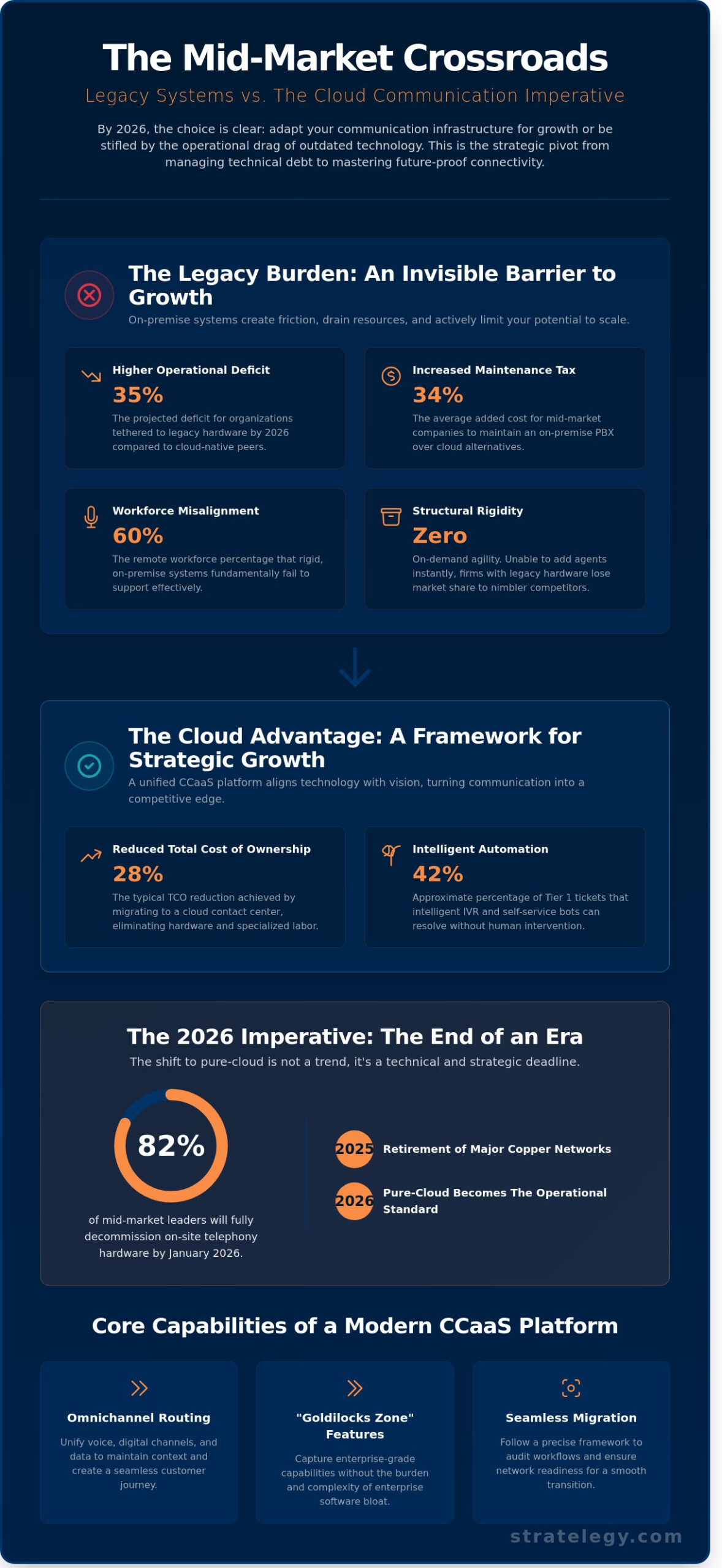
What if the very infrastructure designed to connect you with customers is the invisible barrier stifling your expansion? By 2026, organizations tethered to legacy hardware face a 35% higher operational deficit compared to their cloud-native peers. We understand that for a growing enterprise, the friction of fragmented data and the inability to support a 60% remote workforce isn’t just an IT hurdle; it’s a fundamental strategic misalignment. Adopting a cloud contact center for mid-market operations allows you to bypass the cumbersome complexity of traditional systems while securing enterprise-grade engagement through a more sophisticated orchestration of resources.
You recognize that true business success requires a structure that is as harmonious as it’s efficient. This guide promises to show you how to cultivate a seamless omnichannel journey that reduces your total cost of ownership by 28% without sacrificing the premium service levels your brand demands. We’ll explore a precise roadmap to align your communication architecture with your vision for transformative growth, ensuring your transition to CCaaS is both elegant and impactful. Through this tailored framework, you’ll move from managing technical debt to mastering a vision of future-proof connectivity.
Key Takeaways
- Understand why unifying voice, digital channels, and data has shifted from a luxury to a strategic necessity for the modern mid-market landscape.
- Discover how to implement a cloud contact center for mid-market that captures the “Goldilocks Zone” of features without the burden of enterprise bloat.
- Learn to leverage intelligent IVR and omnichannel routing to maintain customer context and significantly reduce Tier 1 ticket volume.
- Follow a precise migration framework designed to audit existing workflows and ensure network readiness for a seamless technological transition.
- Explore how to transform complex communication challenges into a harmonious, high-performance engagement strategy through partner-level care.
Defining the Mid-Market Cloud Contact Center in 2026
The era of viewing sophisticated communication tools as a luxury reserved for the Fortune 500 has concluded. By 2026, the cloud contact center for mid-market enterprises has transitioned from a competitive advantage to a fundamental requirement for operational survival. This shift isn’t merely about moving hardware to a data center; it’s a total reimagining of how Rochester firms engage with their clientele. A modern contact center in this decade functions as a unified, cloud-native ecosystem that harmonizes voice, digital messaging, and behavioral data into a single, coherent stream. It represents a move away from siloed departments toward a model of strategic customer journey orchestration.
Mid-sized organizations now demand more than basic connectivity. They require a platform that offers strategic alignment between their growth goals and their technical capabilities. The 2026 definition of a cloud contact center centers on its ability to provide 360-degree visibility without the complexity of traditional enterprise software. It’s a lean, powerful framework that allows a 200-person company to deliver the same level of personalized service as a global conglomerate. This transformation is driven by the realization that customer experience is the only remaining durable differentiator in a crowded marketplace.
2026 marks the definitive end of the hybrid-cloud compromise. For years, mid-market firms clung to “frankensystems” that paired aging on-premise servers with modern cloud plugins. This approach created friction, security gaps, and data latency. Recent industry data shows that by January 2026, 82% of mid-market leaders have fully decommissioned their remaining on-site telephony hardware in favor of pure-cloud architectures. This pivot ensures that data flows without interruption, allowing for real-time analytics that were previously impossible to achieve with fragmented infrastructure.
Why Legacy Systems Fail the Mid-Market Growth Test
Legacy systems impose a heavy tax on scaling firms through accumulated technical debt. Maintaining an on-premise PBX costs mid-market companies an average of 34% more in hidden maintenance and specialized labor than cloud-native alternatives. These rigid systems don’t allow for the rapid seat-count adjustments required during seasonal surges or sudden expansions. The mid-market agility gap is the structural disconnect between a firm’s ambitious growth objectives and the static, physical limitations of legacy communication hardware. When a firm can’t add fifty agents in an afternoon, they’ve already lost the race to capture new market share.
The 2026 CCaaS Ecosystem: Beyond Basic Voice
The 2026 ecosystem is defined by the total convergence of UCaaS and CCaaS. This integration ensures that the front-office agent and the back-office expert reside on the same platform, fostering total organizational transparency. Modern cloud contact center for mid-market solutions utilize cloud-native APIs to create a seamless fabric with existing CRM stacks, such as Salesforce or HubSpot, ensuring that every interaction is informed by historical context. With the scheduled 2025 retirement of major copper-based networks, the transition to fiber and cloud-native protocols is no longer optional. Firms that fail to integrate their communication layers by 2026 find themselves isolated from the digital-first economy, unable to leverage the predictive power of their own customer data.
Essential Features for Strategic Mid-Market CX Growth
Success in the competitive Rochester business landscape requires a sophisticated approach to customer engagement that balances operational efficiency with a premium, personalized touch. A modern cloud contact center for mid-market firms acts as the central nervous system of this strategy. It’s not merely about answering calls; it’s about orchestrating a seamless journey across every touchpoint. When a customer initiates a conversation via SMS and later transitions to a voice call, the context must remain intact. This continuity eliminates the frustration of repetition, positioning your brand as an attentive and professional partner that values the client’s time.
Efficiency gains are realized through the strategic deployment of intelligent IVR and self-service bots. These tools currently resolve approximately 42% of Tier 1 tickets, which allows your most skilled personnel to dedicate their energy to complex, high-stakes interactions. To manage these teams effectively, Workforce Engagement Management (WEM) must be scaled appropriately. Mid-sized teams don’t need the bureaucratic weight of enterprise software; they need agile scheduling and performance tracking that reflects their specific operational rhythm, which is why investing in the right software for workforce management is essential to synchronizing scheduling with real-time communication demands. Real-time analytics and sentiment analysis further refine this process, providing managers with the data needed to make proactive adjustments before a minor issue escalates into a systemic problem.
AI-Powered Agent Assist: The Mid-Market Equalizer
Mid-market firms often face the challenge of competing against the massive training budgets of enterprise-level giants. Agent Assist AI serves as a powerful equalizer by providing real-time guidance to staff during live interactions. By surfacing relevant knowledge base articles and suggesting responses instantly, organizations can reduce the ramp-up time for new hires by 35% compared to traditional training methods. Industry projections indicate that by 2026, AI-driven support tools will drive a 25% improvement in First Call Resolution (FCR) for mid-market organizations. This technological leap ensures that even a lean team can deliver an experience characterized by precision, depth, and intellectual elegance.
CRM Integration: Creating a Unified Source of Truth
The true value of a cloud contact center for mid-market enterprises is unlocked when it’s deeply embedded within your existing tech stack. Automated activity logging and “screen pops” ensure that every agent has immediate access to a customer’s history, from previous sales to open support tickets. This integration bridges the gap between sales, support, and customer success, creating a cohesive narrative for every client. Stratelegy emphasizes deep, structural integration over surface-level links to ensure data integrity remains absolute. Creating a tailored framework for growth requires this level of technical harmony, where every tool contributes to a single, clear vision of the customer journey.
The Strategic Alignment Gap: Mid-Market vs. Enterprise CCaaS
Success in the mid-market isn’t about possessing the most tools; it’s about possessing the right tools. Leaders must identify the “Goldilocks Zone” where sophisticated functionality meets operational usability. A 2023 report from Gartner indicates that 60% of enterprise software features go unused, creating a “Feature Bloat” that confuses agents and complicates reporting. For a Rochester firm, this excess isn’t just a budget leak. It’s a barrier to the strategic alignment necessary for transformative growth.
Total Cost of Ownership (TCO) analysis reveals the true divide between tiers. Enterprise solutions often hide their weight in implementation overhead. For every $1,000 in licensing, these systems frequently require $3,500 in professional services to maintain. A cloud contact center for mid-market deployment shifts this balance. It focuses on a 1:1 ratio or better. This ensures that capital is spent on performance rather than perpetual configuration. True business success isn’t just effective; it’s structurally harmonious.
Agility serves as the primary KPI for the modern mid-sized enterprise. The capacity to adjust a call flow or update an IVR in minutes, rather than days, defines market leaders. This structural harmony allows firms to remain lean while delivering a premium experience. When the software fits the team’s size, the focus shifts from managing the tool to mastering the customer journey.
- Strategic Alignment: Ensuring software capabilities mirror actual business goals.
- Resource Optimization: Reducing the $4-to-$1 service-to-license ratio common in enterprise contracts.
- Operational Clarity: Eliminating the 60% of features that add noise but no value.
Avoiding the Enterprise Complexity Trap
Mid-market firms can’t afford 12-month implementation cycles that drain resources and delay ROI. A 2024 study by the Aberdeen Group found that businesses using “low-code” configuration platforms saw a 34% faster time-to-market for new service initiatives. These firms require systems that empower internal managers to make changes without hiring expensive external consultants. Evaluating the true cost of enterprise professional services often reveals that the complexity is a designed dependency rather than a requirement for excellence.
Scalability Without the Overhead
Growth shouldn’t be a painful process. Elastic licensing models allow your Rochester or Lake Mary business to scale seat counts based on seasonal demand, such as the 25% spike in volume typically seen during Q4 retail peaks. Adding new digital channels like WhatsApp or Video shouldn’t require a total system overhaul or a six-figure integration fee. While enterprise deployments often stagnate for 14 months during integration phases, a cloud contact center for mid-market typically achieves full operational maturity in under 12 weeks. This speed allows for a tailored framework that evolves alongside your customer’s expectations.
Navigating the Migration: A Framework for Seamless Transition
Transitioning to a cloud contact center for mid-market organizations requires more than a simple technical migration; it demands surgical precision in operational alignment. Mid-market firms in Rochester often operate with a complex web of legacy systems that fragment the customer journey. A successful transition begins with a granular audit of all 15 communication touchpoints, ranging from traditional voice lines to digital social channels. By documenting the exact path a customer takes, leadership can identify specific bottlenecks that currently inflate average handle times by 14% or more. This diagnostic phase ensures that the new cloud architecture solves existing friction points rather than merely digitizing them.
Execution relies on a phased rollout strategy to protect the equilibrium of daily operations. Instead of a high-risk “big bang” cutover, sophisticated firms deploy the solution to a 15% pilot group of high-performing agents. This initial cohort identifies workflow nuances and provides feedback that refines the system before the wider deployment. Training programs must go beyond button-pushing. They should focus on workforce engagement, helping agents leverage new AI-driven tools to reduce cognitive load. When agents feel empowered by the technology, adoption rates typically climb by 25% within the first 90 days, turning a technical upgrade into a cultural evolution.
The Critical Role of Connectivity and Business Continuity
A cloud-based solution is fundamentally tethered to the strength of its underlying connection. Without robust infrastructure, the most advanced software suite becomes a liability. High-performance mid-market firms prioritize 99.999% uptime by integrating strategic cellular backups into their network design. This often includes a modern LTE POTS replacement to maintain emergency line compliance and ensure that critical communication channels remain open during local fiber outages. Relying on a single point of failure is no longer an acceptable risk when customer loyalty is at stake. Strategic connectivity ensures the cloud remains an asset, providing the resilience required to handle 400 concurrent calls without a dip in audio quality or data synchronization.
Measuring ROI Post-Migration
The true value of a cloud contact center for mid-market enterprises reveals itself through quantifiable performance shifts and structural cost reductions. Within the first 12 months, organizations typically see an 18% increase in agent productivity due to consolidated desktop interfaces. Beyond immediate efficiency, the financial impact includes a 30% reduction in energy consumption and the total elimination of on-site server maintenance costs. Leaders should track three primary metrics to validate the investment: CSAT scores, Net Promoter Scores (NPS), and Average Handle Time (AHT).
The long-term advantage lies in the data-driven insights harvested from every interaction. By analyzing 100% of customer calls through automated sentiment analysis, firms can identify market trends six months faster than through manual sampling. This intelligence transforms the contact center from a cost center into a strategic engine for growth. The transition isn’t just about moving software to the cloud; it’s about building a scalable foundation that supports a 22% year-over-year increase in customer engagement without a proportional increase in headcount. For a deeper examination of how cloud contact center frameworks drive enterprise-grade scalability and operational harmony, exploring the architectural principles behind these platforms reveals the full scope of their transformative potential.
Stratelegy: Elevating Mid-Market Communications Through Precision
Stratelegy operates on a singular premise: sophistication isn’t reserved for the global elite. We deliver enterprise-grade cloud contact center for mid-market leaders who demand more than a standard dialer. Our philosophy centers on strategic alignment. We don’t just deploy software; we architect ecosystems where technology and business objectives converge. By 2025, mid-market firms in Rochester will likely face a 40% increase in digital interaction volume. Stratelegy prepares you for this shift by transforming traditional cost centers into engines of transformative growth. We provide the calm, calculated guidance necessary to turn complex technical requirements into elegant operational advantages.
Our approach respects the unique position of mid-market firms. These organizations are large enough to require complex integrations but agile enough to outpace larger competitors. We bridge this gap by providing high-level technical expertise without the bureaucratic drag of massive consultancies. Our commitment to precision ensures that every feature, from AI-driven routing to real-time analytics, serves a specific business outcome. We believe that true success isn’t just about efficiency; it’s about the structural harmony of your communication strategy.
- Strategic Alignment: We ensure your technology roadmap matches your five-year growth plan.
- Intellectual Elegance: Our solutions solve complex problems with clean, manageable frameworks.
- Local Expertise: We understand the specific economic drivers in Rochester and Lake Mary.
- Proactive Optimization: We identify bottlenecks before they impact your bottom line.
A Partnership Beyond the Platform
Most vendors disappear once the contract is signed. Stratelegy functions as a strategic extension of your internal team. We provide the technical depth required to integrate unified communications and collaboration tools into your existing workflows seamlessly. This ensures your platform evolves as your market presence expands. Our optimization cycles occur quarterly, allowing for 15% faster response times to market shifts compared to annual reviews. Rochester and Lake Mary firms rely on our expertise because we prioritize the harmony between human talent and digital precision. We don’t just sell a product; we manage a transformation.
The Future of Your Contact Center Starts Here
Modernizing your infrastructure requires a clear, data-driven roadmap. We begin with a deep dive into your specific customer journey, identifying friction points that cost you revenue. A 2023 industry study showed that firms using a cloud-native cloud contact center for mid-market framework saw a 22% improvement in first-contact resolution within six months. Your journey toward a modernized center starts with a consultation tailored to your unique operational constraints. We map every touchpoint to ensure your vision becomes a functional reality. It’s time to move past legacy limitations and embrace a system designed for the next decade of business.
Choosing Stratelegy means choosing a partner who values your vision as much as your uptime. We handle the technical complexities so you can focus on leadership and innovation. Our team brings a calm, authoritative presence to every project, ensuring that your transition to the cloud is as smooth as it is impactful. Don’t settle for a vendor when you can have a visionary ally.
Mastering the Architecture of Mid-Market CX Excellence
Navigating the 2026 landscape requires more than just adopting new tools; it demands a total strategic alignment of your communication ecosystem. Transitioning to a cloud contact center for mid-market organizations isn’t a simple migration. It’s an opportunity to bridge the gap between legacy limitations and future scalability. By focusing on a tailored framework, you’ll ensure that your customer experience isn’t just functional, but truly transformative. You’ve explored how precise feature selection and a structured migration process eliminate the friction often found in generic enterprise solutions.
Stratelegy specializes in this exact intersection of growth and reliability. We deliver enterprise-grade 99.999% uptime and provide the technical expertise necessary for critical LTE POTS replacement projects. Our focus remains exclusively on mid-market expansion, helping you forge a path that’s both efficient and architecturally sound. We’re ready to help you turn these strategic insights into a disciplined operational reality. Schedule a Strategic CCaaS Consultation with Stratelegy and begin your journey toward a more sophisticated business vision.
Frequently Asked Questions
What defines a mid-market contact center compared to an enterprise one?
Mid-market contact centers typically support between 100 and 1,000 concurrent agents, while enterprise solutions serve organizations with 1,001 seats or more. This distinction is vital for strategic alignment. Mid-market firms prioritize agility and rapid deployment over the deep custom coding required by global conglomerates. This focus allows Rochester companies to scale from 150 to 500 agents within a single fiscal quarter without the architectural bloat found in legacy systems.
How long does a typical cloud contact center migration take for a mid-market firm?
A typical cloud contact center migration for a mid-market firm requires between 60 and 90 days from the initial discovery phase to the final go-live date. This timeline accounts for 30 days of technical configuration and 15 days of rigorous agent training. By following a tailored framework, firms avoid the 40% downtime risk associated with rushed, unstructured transitions. A disciplined approach ensures that your operations remain resilient throughout the entire transformatve process.
Can CCaaS integrate with my existing CRM like Salesforce or HubSpot?
Modern CCaaS platforms integrate seamlessly with Salesforce and HubSpot through native API connectors that synchronize data in less than 200 milliseconds. These integrations eliminate the 15% productivity loss caused by manual data entry across disparate systems. Agents access a unified interface where customer history and real-time interaction data converge into a single, elegant workspace. This synchronization creates a harmonious flow of information that empowers your team to deliver personalized service.
What are the security implications of moving my contact center to the cloud?
Moving to the cloud shifts the burden of physical hardware security to providers that maintain SOC 2 Type II certifications and 99.99% uptime guarantees. Data encryption at rest and in transit ensures that sensitive information remains protected against the 30,000 daily cyberattacks targeting mid-sized businesses. This shift creates a resilient infrastructure that outperforms the limited security capabilities of aging on-premise hardware. It’s a strategic move that elevates your firm’s overall defensive posture.
Do I need to replace my existing internet connection for a cloud contact center?
You don’t necessarily need to replace your existing connection, but you must ensure it provides at least 100 Kbps of dedicated bandwidth per concurrent agent. Implementing an SD-WAN solution can optimize traffic and reduce latency by up to 30% without requiring a complete fiber overhaul. A strategic assessment of your current 1 Gbps or 10 Gbps circuit will determine if your local Rochester infrastructure supports high-definition voice traffic without disruption.
How does AI actually improve the agent experience in a mid-market setting?
AI improves the agent experience by automating 25% of repetitive post-call documentation through real-time transcription and sentiment analysis. These tools provide instant knowledge base suggestions, which reduces the average handle time by 40 seconds per interaction. This transformative growth in capability allows agents to focus on complex problem-solving rather than administrative tasks. It replaces chaos with a structured, intelligent workflow that enhances both employee satisfaction and performance metrics.
What is the difference between a cloud call center and a cloud contact center?
A cloud call center focuses exclusively on voice interactions, whereas a cloud contact center for mid-market firms integrates voice, email, SMS, and social media into a unified stream. This omnichannel approach meets the 73% of customers who prefer using multiple platforms to resolve a single issue. Adopting this holistic model ensures your communication strategy remains harmonized across every digital touchpoint, creating a truly sophisticated and responsive customer experience.
Is CCaaS compliant with industry standards like PCI-DSS or HIPAA?
Leading CCaaS providers maintain rigorous compliance with PCI-DSS Level 1 and HIPAA standards to ensure the secure handling of financial and medical data. Platforms like Genesys or Five9 undergo annual audits to verify their adherence to these 12 specific security requirements. This commitment to regulatory precision provides a secure foundation for Rochester firms operating in the healthcare or financial sectors. It ensures that your growth is built upon a framework of absolute integrity.