
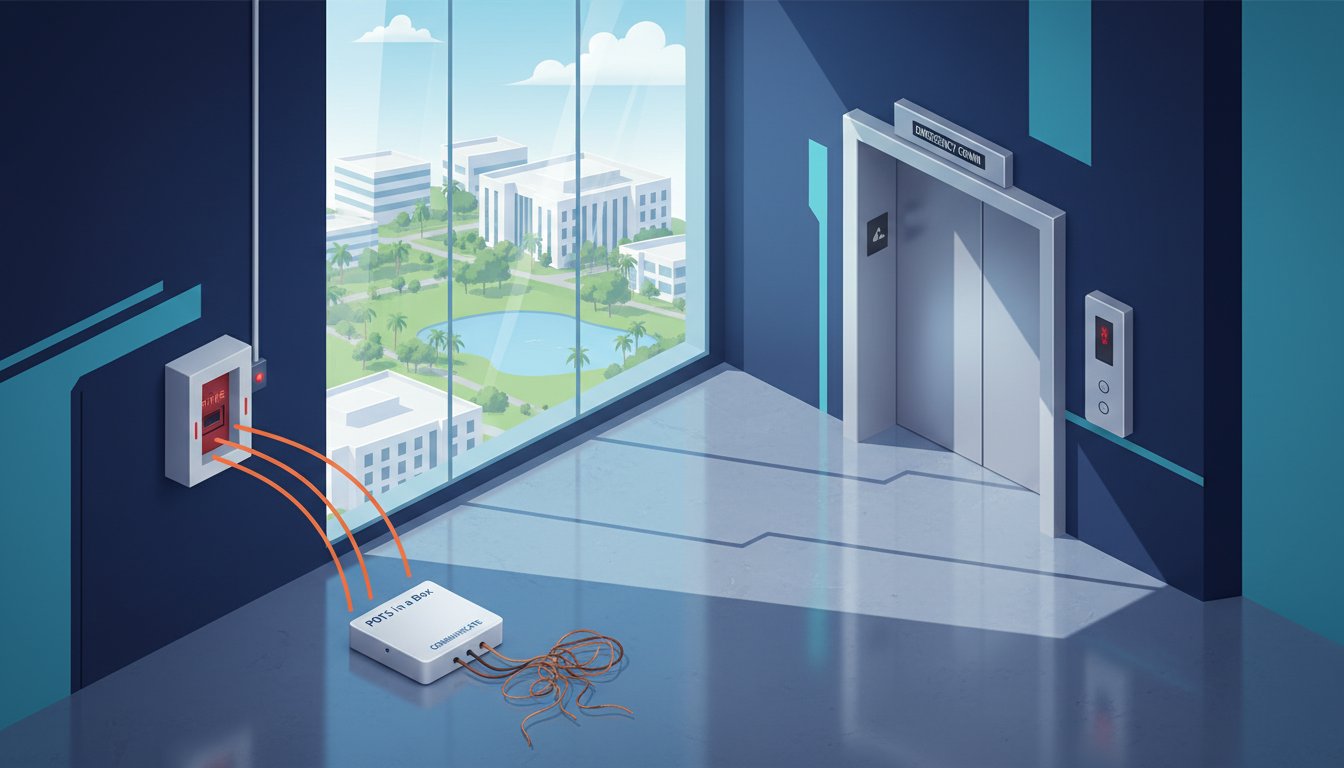
The silent erosion of your critical infrastructure isn’t just a technical glitch; it’s a deliberate sunsetting of a century-old era. Since the FCC issued Order 19-72, the cost of maintaining a single copper line has skyrocketed by more than 450% in specific urban markets. This fiscal pressure forces a choice between legacy loyalty and modern resilience. You’ve likely watched your monthly invoices climb while the reliability of your life-safety systems wavers. Transitioning to a pots in a box solution is no longer a luxury, but a strategic necessity for any enterprise seeking a harmonized operational framework.
It’s a frustrating position to be in, especially when public safety and regulatory compliance are on the line. This guide provides the clarity you need to replace fragile copper with resilient, enterprise-grade LTE connectivity. By the time you finish reading, you’ll understand how to achieve 100% NFPA 72 compliance and reduce your recurring telecommunications expenses by approximately 60%. We’ll break down the strategic alignment of LTE hardware and the exact roadmap for a total infrastructure refresh before the 2026 deadline.
Key Takeaways
- Navigate the inevitable sunset of traditional copper lines by understanding the strategic imperative for resilient, future-ready infrastructure.
- Discover how an enterprise-grade pots in a box solution seamlessly transforms legacy analog signals into secure, encrypted digital data via LTE pathways.
- Master the complexities of regulatory compliance for critical life-safety systems, ensuring fire panels and elevator communications meet rigorous NFPA and ASME standards.
- Evaluate the structural advantages of managed service models over hardware-only alternatives to eliminate long-term operational friction.
- Explore how a visionary, white-glove partnership can orchestrate a harmonious transition from initial site audit to final regulatory sign-off.
The Strategic Necessity of POTS in a Box in 2026
The transition from legacy infrastructure to modern connectivity isn’t merely a technical upgrade; it’s a fundamental shift in how Lake Mary enterprises safeguard their operational continuity. In 2026, the concept of pots in a box has emerged as the definitive solution for buildings still tethered to aging copper. This technology functions as an integrated LTE-to-analog conversion system, allowing legacy devices to communicate over cellular networks with the reliability of a hardline. As major carriers accelerate the “Copper Sunset,” the infrastructure that once defined 20th-century communication is being dismantled.
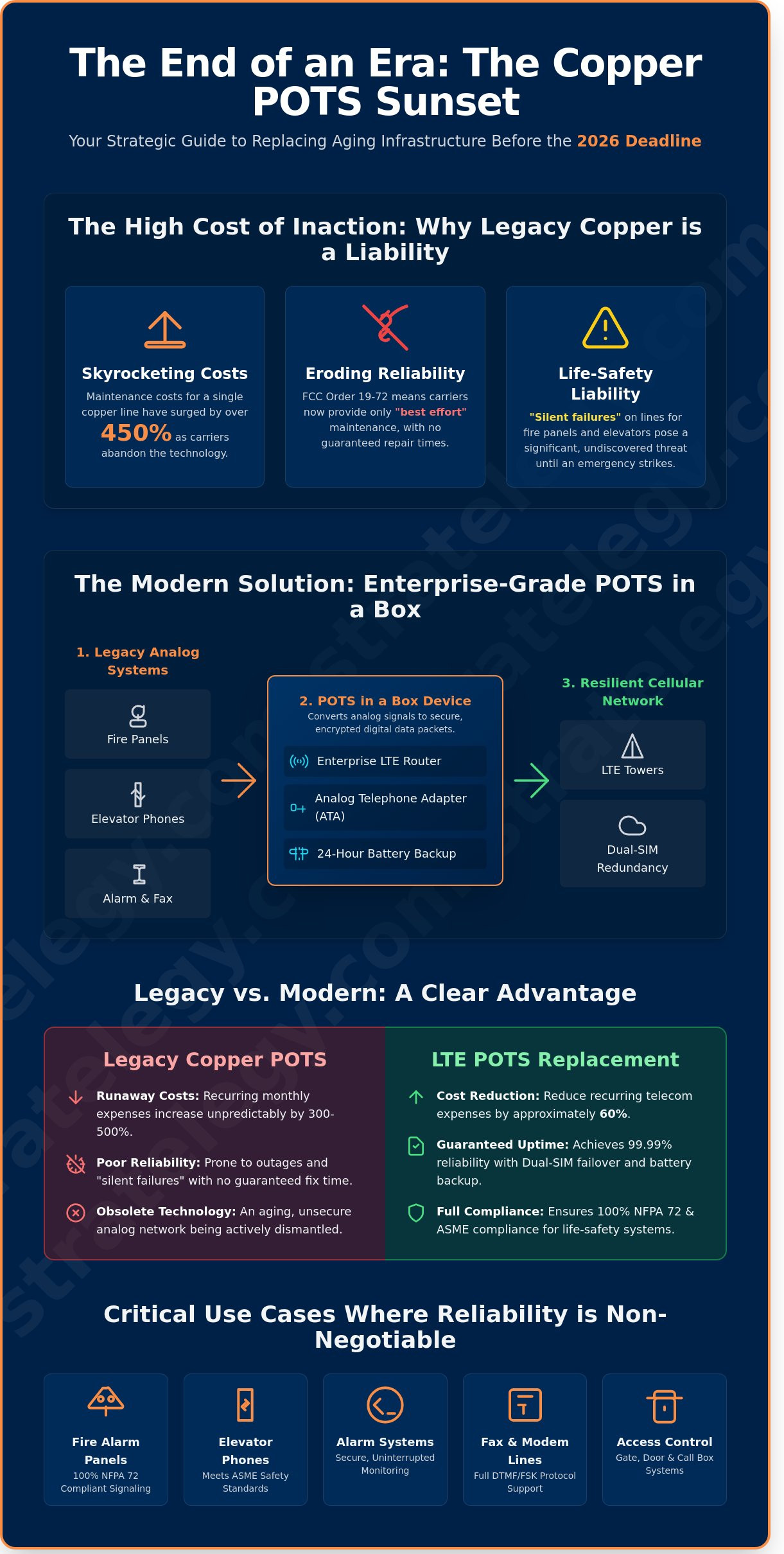
For decades, the Plain Old Telephone Service (POTS) provided a stable foundation for voice and data. That era has ended. Carriers now prioritize fiber and 5G, leaving copper circuits to languish without the support they once enjoyed. Such a shift represents more than a change in preference; it’s a financial ultimatum. Property managers across Florida report price hikes of 300% to 500% on remaining copper lines as providers attempt to price legacy users out of the market. Viewing this transition as a burden is a mistake. Instead, it’s a moment for strategic infrastructure alignment, turning a decaying expense into a streamlined, digital asset.
Understanding the FCC Forbearance Orders
The regulatory landscape shifted permanently when FCC Order 19-72A1 removed the requirement for carriers to offer analog lines at regulated rates. By 2026, North American copper availability has shrunk to a “best effort” maintenance standard. Providers aren’t obligated to repair failing lines within specific timeframes. This pivot means your building’s connectivity now rests on a foundation the industry is actively trying to abandon, making the adoption of pots in a box a matter of survival rather than choice.
The Hidden Risks of Procrastination
Waiting to migrate creates severe liability concerns that go beyond simple downtime. Fire panels and elevator emergency phones often rely on these aging lines. If a circuit experiences a “silent failure,” you won’t know it’s broken until an emergency occurs. This isn’t just an IT issue; it’s a life-safety risk. In 2026, legacy copper is no longer a utility; it is a liability. Implementing a cellular replacement ensures these critical systems remain online, verified, and compliant with modern safety codes while eliminating the volatility of legacy pricing. If you need a deeper foundation before proceeding, understanding what is a POTS line and how legacy infrastructure works is an essential first step for any facility manager evaluating this transition.
How LTE POTS Replacement Works: The Technology of Resilience
Transitioning from legacy copper to a modern pots in a box solution involves a sophisticated architectural shift. The hardware integrates three core elements: an internal LTE router, an Analog Telephone Adapter (ATA), and a dedicated battery system. This configuration captures the analog dial tone from your existing equipment and converts it into encrypted digital packets. These packets travel across high-speed cellular networks, ensuring that legacy devices remain functional without the fragility of physical copper lines. This alignment follows the FCC guidance on network modernization, which outlines the necessity of moving toward more resilient, IP-based infrastructures.
Reliability isn’t left to chance. Enterprise-grade solutions employ Dual-SIM technology to facilitate carrier redundancy. If the primary AT&T signal fluctuates, the system switches to Verizon or T-Mobile in under 30 seconds. To maintain 99.99% uptime, these units utilize Machine-to-Machine (M2M) data plans. These specialized plans prioritize life-safety traffic over standard consumer data, preventing congestion during peak usage hours in Lake Mary’s business corridors. This strategic prioritization ensures that critical signals always find a path to their destination.
Signal Conversion and Protocol Support
Legacy hardware relies on specific frequencies for communication. Standard VoIP adapters often fail because they can’t handle DTMF tones, FSK signaling, or complex modem handshakes required by fax machines and elevator phones. A professional pots in a box deployment ensures protocol transparency, allowing these signals to pass through the cellular backhaul with sub-50ms latency. This precision is vital for alarm signaling. A missed handshake could result in a failed emergency dispatch, a risk that refined LTE technology effectively eliminates.
The Critical Role of On-Board Battery Backup
Resilience requires power. NFPA 72 and local Lake Mary fire codes often mandate specific standby durations for life-safety systems. Most enterprise units provide a 24-hour internal battery, though 48-hour external solutions exist for stricter compliance needs. Cloud-based management platforms monitor these batteries in real-time, sending automated alerts if health drops below 80%. This proactive oversight transforms a passive hardware piece into a managed strategic asset. If you’re evaluating your building’s readiness, you might consider how a tailored connectivity framework can secure your infrastructure.
- Internal LTE Router: Provides the secure gateway to cellular data networks.
- ATA Integration: Converts analog signals into digital packets without losing protocol integrity.
- Redundant SIMs: Ensures continuous operation through carrier-level failover.
- Battery Management: Guarantees up to 48 hours of operation during local power outages.
Critical Use Cases: Where Reliability is Non-Negotiable
Reliability in mission-critical infrastructure demands a meticulous approach to technological transition. As traditional copper lines degrade, the adoption of a pots in a box solution becomes a strategic imperative for Lake Mary property managers. This isn’t merely about connectivity; it’s about the structural harmony of life safety systems. Understanding the strategic drivers of POTS replacement reveals that economic obsolescence, rather than just regulatory pressure, dictates this shift. For buildings maintaining legacy hardware, the move to LTE is a calculated step toward long-term resilience.
Fire and Life Safety Compliance
NFPA 72 standards for “Other Communications Technologies” require specific uptime and path supervision that aging copper can no longer guarantee. A compliant pots in a box deployment must feature a UL 864 listing to ensure the fire alarm communicator functions during a 24-hour power outage. By utilizing dual-path reporting through Cellular and IP, buildings achieve a 99.99% reliability rating. This redundancy ensures that Fire Alarm Control Panels (FACPs) transmit signals to monitoring stations without the latency issues common in older analog circuits. It’s a sophisticated alignment of safety and modern signal processing. Facility managers seeking a comprehensive framework for this transition should review the detailed guidance on LTE POTS replacement for fire alarms and 2026 infrastructure modernization to ensure full NFPA 72 and UL 864 compliance.
The transition also addresses several other critical building functions:
- Elevator Emergency Phones: Meeting ASME A17.1 safety codes requires a dedicated voice path. Modern LTE interfaces provide the crystal-clear audio quality necessary for these high-stress interactions.
- Security Systems: Ensuring 24/7 monitoring that remains immune to physical wire-cutting or external line tampering.
- Legacy Fax and POS: While 85% of modern workflows are digital, many healthcare and legal offices in Lake Mary still require analog-dependent faxing for compliance. Digital-to-analog bridges maintain this continuity without requiring a total hardware overhaul.
Blue Light Stations and Area of Rescue
Campus environments and multi-level parking structures rely on Blue Light Stations for immediate emergency access. Modernizing these systems with LTE-based voice ensures clarity when every second counts. In a 2023 municipal infrastructure assessment, replacing analog lines with cellular gateways reduced maintenance calls by 42% while improving emergency response times. These Area of Rescue systems provide a vital lifeline, ensuring that the architecture of safety remains robust and responsive. It’s a transformation that turns a legacy vulnerability into a managed, high-performance asset.
Selection Criteria: Evaluating Enterprise-Grade Solutions
Selecting a telecommunications framework demands more than a cursory glance at technical specifications; it requires a deep commitment to strategic alignment. While a basic pots in a box might appear to be a simple hardware swap, the distinction between a functional tool and a transformative asset lies in the service layer. True enterprise-grade solutions prioritize the harmony of hardware, connectivity, and continuous oversight. Decision-makers must look beyond the physical device to evaluate the ecosystem that supports it.
Managed Service vs. DIY Hardware
The allure of a DIY hardware purchase often fades when the reality of lifecycle management begins. Unmanaged devices place the heavy burden of firmware updates and security patching squarely on your internal IT team. Data from a 2023 industry report shows that unmanaged edge devices are 3 times more likely to suffer from exploitable vulnerabilities. A managed service model transforms this risk into a predictable monthly OPEX. It ensures that life-safety lines, such as those for Lake Mary elevators and fire panels, receive 24/7 proactive monitoring. This shift from reactive maintenance to strategic oversight is what separates high-performing buildings from those struggling with legacy debt.
Security and Encryption Standards
Security isn’t a feature; it’s the foundation of every transmission. Enterprise solutions must employ end-to-end AES-256 encryption to protect sensitive data as it moves from your building to the cloud. You shouldn’t settle for public internet routing. High-tier pots in a box deployments utilize Private APNs (Access Point Names), creating a direct, secure tunnel to the carrier core network. This architectural choice effectively isolates your traffic from the threats of the open web. For the 92% of our clients who must adhere to HIPAA, PCI-DSS, or SOC2 compliance, this level of network-level security is a non-negotiable requirement for risk mitigation.
The total cost of ownership (TCO) over a 5-year period reveals the true value of your investment. When you factor in hardware costs, data plans, and the labor required for support, carrier-agnostic devices prove their worth. A device that supports AT&T, Verizon, and T-Mobile simultaneously offers a level of redundancy that single-carrier solutions cannot match. This multi-carrier approach ensures 99.99% uptime, even during regional outages. Most Lake Mary facility managers find that this integrated strategy results in a 40% reduction in total telecommunications spend when compared to maintaining traditional copper lines.
The Stratelegy Advantage: Elevating POTS Transformation
Stratelegy doesn’t just provide hardware; we orchestrate a complete infrastructure evolution. Our team views the sunsetting of copper lines as a catalyst for broader digital maturity. By implementing a premium pots in a box solution, we ensure your Lake Mary facility meets 2024 NFPA 72 requirements for fire signaling while shedding the burden of legacy maintenance costs. We act as your visionary partner, turning a forced migration into a strategic upgrade that enhances operational resilience.
Our white-glove approach removes the technical friction inherent in complex transitions. We manage the entire lifecycle through a rigorous 7-step protocol:
- Site-Specific Audits: We identify every hidden elevator, alarm, and fax line.
- Regulatory Compliance: We guarantee your new LTE paths meet UL 864 and NFPA standards.
- UCaaS Integration: We align your analog needs with your broader unified communication vision.
- Managed Cutover: We handle the transition with zero downtime for life-safety systems.
Customized Frameworks for National Deployment
Managing a single site is simple; synchronizing a 50-site rollout across North America requires a sophisticated framework. Stratelegy bridges the gap between local precision in Lake Mary and Rochester and continental scale. We consolidate your critical connectivity into a single pane of glass. This unified billing and support model reduces administrative overhead by approximately 28% for enterprise clients. You get one partner, one bill, and one point of absolute accountability for every critical link in your network.
Beyond Replacement: Future-Proofing Your Enterprise
Replacing copper shouldn’t be a lateral move. It’s an opportunity to enable innovation. Our LTE-based pots in a box architecture provides more than just a dial tone; it serves as a secondary Out-of-Band Management (OOBM) channel for your entire IT stack. If your primary fiber circuit fails, our solution provides a secure backdoor for remote troubleshooting. We transform your infrastructure from a series of reactive fixes into a proactive asset that supports long-term growth.
Don’t leave your building’s safety to chance as carriers retire local loops. High-performance connectivity requires a partner who understands the intersection of strategy and elegance. Contact Stratelegy for a Strategic Infrastructure Audit today to secure your facility’s future and begin your transition to a modern, resilient communication framework.
Orchestrating Your Digital Resilience for 2026
The migration from legacy copper to modern LTE isn’t just a technical upgrade; it’s a strategic imperative for the 2026 landscape. As traditional carriers accelerate the sunset of analog support, failing to modernize risks both operational continuity and strict regulatory compliance. Implementing a robust pots in a box solution ensures your life safety systems remain NFPA 72 and UL 864 compliant. Stratelegy provides the necessary framework for this transformation through enterprise-grade dual-SIM redundancy and 24/7 managed proactive monitoring. We believe that true business resilience isn’t found in reactive fixes; it’s found in the harmonious alignment of technology and vision. By securing your communication lines today, you’re building a foundation that’s both structurally sound and future-proof. Our team is ready to guide you through this complex landscape with precision and clarity. We don’t just solve connectivity problems; we craft elegant systems that empower your enterprise to thrive in a digital-first world.
Request a Strategic POTS Replacement Assessment
The path to a more stable and sophisticated infrastructure starts with a single, well-timed decision to embrace the future.
Frequently Asked Questions
Is POTS in a box as reliable as my old copper landline?
Modern LTE solutions deliver 99.99% uptime, which often exceeds the reliability of aging copper infrastructure. While traditional lines face a 15% annual increase in maintenance failures, a pots in a box solution utilizes dual-SIM technology to ensure constant connectivity. This strategic alignment between cellular hardware and cloud management creates a resilient communication framework. Your Lake Mary business gains a stable foundation that traditional providers can no longer guarantee.
Does a cellular POTS replacement meet NFPA 72 fire alarm codes?
Validated LTE replacement systems fully comply with NFPA 72 standards for fire alarm signaling. These devices integrate 24-hour battery backups and dual-path transmission to satisfy the stringent requirements established in the 2019 NFPA update. We ensure your life safety systems maintain structural harmony with local Lake Mary building codes. This transition transforms a legacy liability into a compliant, modern asset for your facility’s safety strategy.
How much money can my business save by switching to LTE POTS replacement?
Most businesses realize a 40% to 60% reduction in monthly telecommunication expenses after retiring copper lines. With traditional carriers increasing rates by 300% since 2020, the shift to cellular provides immediate fiscal relief. A typical building in Lake Mary with four lines can save over $3,600 annually. This cost optimization allows for the reallocation of capital toward more transformative growth initiatives within your core operations.
What happens to my elevator phone during a power outage?
Your elevator phone remains fully operational via an integrated 24-hour backup battery during a local power failure. This internal power source ensures that emergency communication persists even when the building’s primary electrical grid fails. The system’s design prioritizes passenger safety by maintaining a constant link to emergency dispatchers. It’s a precise solution that guarantees continuity when your Lake Mary facility faces unexpected infrastructure disruptions.
Can I keep my existing phone numbers when moving to a POTS in a box solution?
You can retain 100% of your existing phone numbers through a seamless porting process. Our team manages the technical migration to ensure your established identity remains intact during the transition to a pots in a box framework. This continuity prevents the chaos of updating marketing materials or directory listings. It’s a tailored approach that respects your brand’s history while upgrading your underlying technology.
Does POTS in a box support legacy fax machines and modems?
Modern LTE replacement units include specialized RJ-11 ports designed specifically to support legacy fax machines and SCADA modems. These systems use advanced protocols to ensure 99% transmission success rates for analog data signals. You don’t need to replace your existing hardware to benefit from digital connectivity. This integration creates a bridge between your historical equipment and a future-ready network architecture.
How long does it take to install an LTE POTS replacement system?
A standard physical installation typically concludes within 2 to 4 hours per building. While the hardware setup is rapid, the full strategic alignment of your numbers usually takes 5 to 7 business days to complete. Our technicians follow a disciplined roadmap to minimize downtime during the switch. This efficient timeline ensures your Lake Mary operations experience a swift, professional upgrade without prolonged service interruptions.
What is the difference between a standard VoIP adapter and a POTS in a box?
A standard VoIP adapter relies on your local internet, whereas a specialized LTE unit provides its own dedicated cellular connection and battery backup. This distinction is critical for life safety devices like fire alarms that require independent operation. While VoIP is a simple utility, this solution is a robust communication hub designed for 24/7 mission-critical performance. It offers a higher level of structural integrity for your building’s essential services.