

Would you pay $2,700 a month for a utility line that 97% of your competitors have already abandoned? With AT&T’s copper network shutdown beginning in June 2026, legacy users face soaring costs and immediate reliability risks. If you’re struggling with how to get budget for new phone system upgrades, you aren’t just asking for a software update. You’re presenting a plan to save your business from a looming infrastructure collapse.
We understand that the pressure to modernize often clashes with strict CapEx limitations. It’s frustrating to manage failing hardware while leadership views communication as a mere cost center. This guide provides a clear framework to transform your communication needs into a strategic investment that wins executive approval. You’ll learn how to leverage the 40% operational savings of UCaaS and CCaaS to build a future-proof infrastructure that never falls behind. We’ll break down the FCC’s March 2026 rulings and provide the ROI data you need to secure funding today.
Key Takeaways
- Reframe your communication system as foundational infrastructure rather than a simple utility to eliminate technical debt and improve stability.
- Learn how to get budget for new phone system projects by aligning technical requirements with 2026 business goals like hybrid work and customer experience.
- Quantify the escalating financial risks of the “copper sunset” to build a compelling case for migrating away from expensive legacy POTS lines.
- Shift from heavy upfront Capital Expenditure to a predictable Operating Expenditure model that stabilizes your monthly technology spend.
- Leverage a managed Device Lifecycle and Technology Refresh Policy to ensure your infrastructure stays current without the need for future emergency funding.
The Strategic Shift: Why Your Phone System is Infrastructure, Not a Utility
Phone systems aren’t just dial tones anymore. They’re the backbone of your digital environment. For decades, the business telephone system was treated as a utility, similar to water or electricity. You paid for the line, it worked, and you ignored it until it broke. That era officially ended when the FCC accelerated copper retirement in early 2026. Today, treating your communications as a utility is a strategic liability. It’s time to view it as critical infrastructure that demands engineering precision.
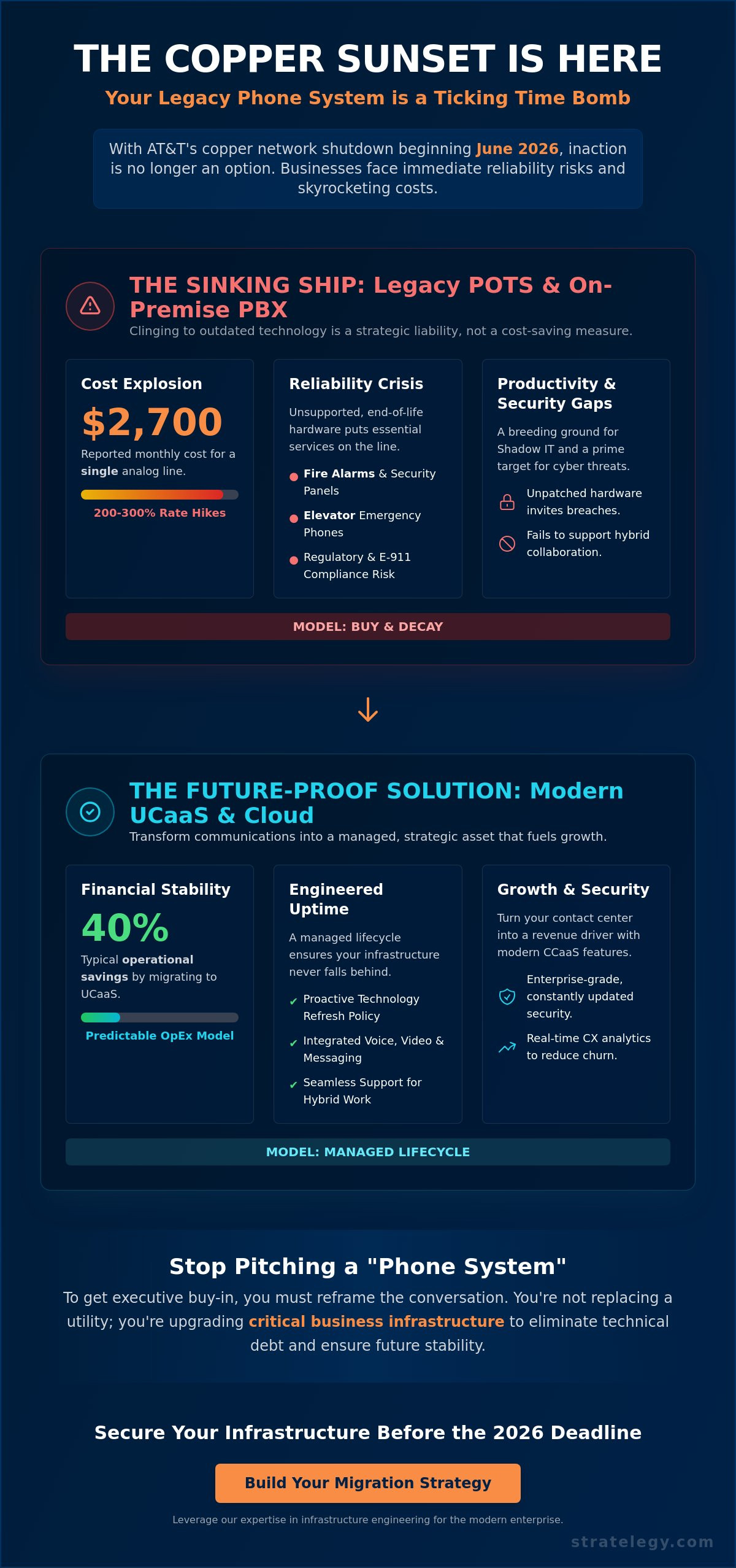
Understanding how to get budget for new phone system projects starts with reframing the conversation for your executive team. You aren’t asking for a new tool; you’re replacing a decaying asset with a managed framework. Legacy hardware follows a “buy-and-decay” cycle. You spend significant capital on a PBX, and it begins losing value and capability the moment it’s installed. Modern Unified Communications as a Service (UCaaS) flips this model. It’s a managed lifecycle where the technology stays current, ensuring your business never falls behind.
The High Cost of Maintaining Technical Debt
“Good enough” communication is a silent killer of enterprise productivity. In 2026, a majority of the workforce requires hybrid collaboration tools that legacy systems simply cannot provide. Aging copper lines and on-premise hardware create a gap that employees fill with “shadow IT.” When staff use unmanaged personal apps to bypass clunky office phones, you lose data governance and create silos. There’s also a massive security risk. Unpatched, end-of-life hardware is a prime target for modern cyber threats. Maintaining this technical debt isn’t just expensive; it’s a threat to your operational stability.
Unified Communications as a Growth Engine
Transitioning to UCaaS and Contact Center as a Service (CCaaS) turns your phone system into a revenue driver. By integrating voice, video, and messaging into one platform, you eliminate the friction that slows down your team. Advanced CCaaS features like real-time sentiment analysis allow you to identify customer frustration before it leads to churn. UCaaS is a strategic framework for organizational agility rather than just a software tool for making calls.
When you build your business case, focus on infrastructure stability. A predictable, managed environment eliminates the fear of falling behind. Knowing how to get budget for new phone system upgrades requires showing leadership that communications are the engine of your enterprise. It’s the difference between a system that barely functions and one that is built to stay current.
Identifying the Hidden Costs of Legacy POTS Lines
Legacy copper is no longer a stable foundation. It’s a liability. Major carriers like AT&T and Verizon are aggressively decommissioning their copper networks throughout 2026. This isn’t a slow phase out anymore. It’s an active shutdown. If you are wondering how to get budget for new phone system projects, start by auditing your current POTS bills. You’ll likely find that you’re paying a premium for a service that the provider no longer wants to support. This “copper sunset” is designed to make legacy lines financially unsustainable for the enterprise.
The Escalating Price of Inaction
POTS line rates have skyrocketed by 200% to 300% over the last three years. In some metropolitan areas, monthly costs for a single analog line have been reported to exceed $2,700. This is a deliberate strategy by carriers to force migration. Beyond the monthly invoice, the price of emergency repairs for unmanaged hardware is unsustainable. Most vendors stopped supporting legacy PBX hardware years ago. When a critical component fails, you’re forced to search for used parts or pay exorbitant fees for specialized technicians who still understand the tech. You can find more details on when to Upgrade Your Phone System in recent industry reports. Transitioning to a managed pots line replacement program eliminates these unpredictable financial spikes.
The risks aren’t just financial. Fire alarms, elevator emergency phones, and security panels often rely on these aging lines. If a legacy line fails during an emergency, the regulatory consequences are severe. Many insurance providers are now auditing building communications to ensure E-911 compliance and connectivity. A failed alarm panel on a discontinued copper line could invalidate your coverage or lead to massive fines from local fire marshals. This is where how to get budget for new phone system conversations shift from “nice to have” to “essential for compliance.”
LTE POTS Replacement: The Modern Alternative
Modern infrastructure engineering solves these problems through cellular based alternatives. These “POTS in a box” solutions provide the same analog handoff your fire panels and elevators require, but they run on secure, redundant LTE networks. This ensures your life safety systems remain operational even if the physical copper lines in the street are cut or decommissioned. These systems are built for predictability and compliance. They provide a stable bridge that keeps your facility safe while you modernize the rest of your enterprise. If you’re unsure about your current exposure to copper retirement, consult with an infrastructure engineer to audit your existing lines and identify failure points before they become emergencies.
Calculating ROI: Comparing Legacy vs. Cloud-Based Systems
Proving the value of a technology upgrade requires moving beyond simple monthly bill comparisons. To understand how to get budget for new phone system investments, you must present a financial model that accounts for the transition from heavy Capital Expenditure (CapEx) to predictable Operating Expenditure (OpEx). This shift mirrors how many enterprises manage other critical assets; for instance, companies often utilize Alliance Fleet Solutions to transition their commercial vehicles to leasing models that provide better cash flow predictability. In contrast, cloud-based phone models eliminate “lumpy” capital cycles by trading unpredictable repair bills for a flat, per-user monthly fee that includes continuous software updates and security patches.
Total Cost of Ownership (TCO) Framework
A true ROI analysis must include more than just the sticker price of the software. You need to calculate the Total Cost of Ownership (TCO), which includes hardware maintenance, licensing fees, power consumption, and administrative overhead. For companies looking to further optimize their power footprint, Ethernetics offers advanced energy-saving solutions for modern data centers. Legacy systems often involve multi-vendor sprawl, where you pay one vendor for the PBX, another for the lines, and a third for maintenance. Consolidating into a single unified provider reduces these fragmented costs and simplifies governance. Total Cost of Ownership is the only metric that matters for CFO approval because it reveals the true long-term drain of aging infrastructure. Beyond hard costs, consider the “soft cost” savings. Cloud systems significantly reduce internal IT tickets related to move-add-change requests, which typically consume 15% of an IT team’s weekly bandwidth in legacy environments.
The Value of Scalability
Efficiency is built into the cloud. In a legacy environment, companies often over-provision their capacity, paying for 20% more lines than they actually use just to handle seasonal peaks. Cloud systems allow for instant scaling. You pay only for what you use, when you use it. This agility extends to your customer engagement strategy. Integrating an omnichannel cloud contact center allows you to drive customer lifetime value through better sentiment analysis and faster resolution times. When you present your case for how to get budget for new phone system modernization, emphasize that you aren’t just buying a tool; you’re optimizing your operational efficiency for 2026 and beyond. This approach ensures your business never falls behind the competition while maintaining a predictable, manageable budget.
The 5-Step Internal Pitch for Your New Phone System
Winning executive approval requires more than a list of software features. It’s about engineering a business case that prioritizes stability, security, and financial predictability. Knowing how to get budget for new phone system projects requires a disciplined five-step approach that moves the conversation from “telecom” to “infrastructure.”
- Step 1: Audit your environment. Identify every failure point in your current setup, from aging copper lines to unpatched hardware. Document your total current spend, including those hidden maintenance fees and emergency repair costs.
- Step 2: Align with 2026 business goals. Show how a modernized system supports specific objectives like hybrid work flexibility or improved customer experience (CX) metrics.
- Step 3: Present a Risk vs. Reward analysis. Focus on the security and compliance risks of staying on legacy hardware. Use the March 2026 FCC rulings as evidence that the “do nothing” strategy is actually a high-risk gamble.
- Step 4: Propose a Device Lifecycle policy. Introduce a plan that ensures the system never becomes legacy again. This eliminates the need for future emergency budget requests.
- Step 5: Define the implementation roadmap. Provide a clear, phased timeline that mitigates fears of business disruption. Leadership needs to see that the transition will be controlled and predictable.
This is the most effective strategy for how to get budget for new phone system modernization in 2026. By following this framework, you position yourself as a strategic partner rather than just a department head asking for new tools.
Speaking the CFO’s Language
CFOs prioritize governance and predictability over novelty. Frame your project around “Zero CapEx” models to gain immediate approval without waiting for the next major budget cycle. By shifting to an OpEx model, you provide the business with a flat, manageable monthly expense that covers everything from security to hardware refreshes. This “built to stay current” philosophy ensures the organization never falls behind again. You aren’t just buying phones; you’re securing a managed service that eliminates technical debt and provides long-term financial stability.
For CFOs in the manufacturing sector looking for additional ways to drive efficiency, you can check out EnergoStrateg to optimize your utility costs using a similar SaaS-driven approach.
Demonstrating Operational Excellence
Modernizing your infrastructure frees up your internal IT team for higher-value projects. When you move to a managed unified communications as a service framework, you outsource the maintenance headache to specialized infrastructure engineers. This transition typically leads to a 40% reduction in operating costs while improving data security and regulatory compliance. It’s an investment in operational excellence that pays dividends in both uptime and employee productivity. If you’re ready to build your specific business case, contact our infrastructure engineers to start your environment audit today.
Stratelegy: Infrastructure Engineering for the Modern Enterprise
Stratelegy is more than a service provider. We are infrastructure engineers who prioritize the long-term health of your business communications. Most tech companies focus on the novelty of their software features. We focus on security, governance, and predictability. Our approach ensures that your communication stack remains a strategic asset rather than a decaying liability. When you partner with us, you gain access to a team that has already solved the problems you haven’t encountered yet. We operate with a disciplined focus on achieving true communications excellence through engineering rather than just sales. It’s built to stay current, so your business never falls behind.
The Stratelegy Refresh Policy
Our industry-first Device Lifecycle and Technology Refresh Policy is the cornerstone of our service. It eliminates technical debt by ensuring your hardware is always modern. This managed lifecycle provides the long-term financial predictability that CFOs demand. Instead of facing a massive capital request every five years, your infrastructure stays current through a steady, managed process. This is the ultimate answer to how to get budget for new phone system initiatives. You aren’t just asking for a one-time purchase. You’re proposing a sustainable model where your business never falls behind. Our UCaaS and CCaaS solutions are built on this foundation of engineering excellence, ensuring that your team always has the tools they need to perform. This model transforms communication from a cost center into a predictable, high-performance infrastructure pillar.
Securing Your Critical Infrastructure
We specialize in the high-stakes areas of enterprise communication. This includes LTE POTS replacement for fire panels, elevator phones, and security systems. These aren’t just phone lines; they’re life-safety requirements that demand 100% reliability. We prioritize E-911 certification and compliance to give you peace of mind. As of May 2026, our specialized engineering team has transitioned hundreds of facilities away from failing copper networks. Our proactive monitoring ensures 99.999% reliability for these critical systems. This level of oversight is essential for maintaining a secure and resilient digital environment.
If you’re struggling to articulate how to get budget for new phone system upgrades to your board, we can help. We provide the data and engineering expertise needed to build a comprehensive case for modernization. Our focus is on the long-term health of your business infrastructure. We provide the stability you need to grow without the fear of technology obsolescence. Contact Stratelegy to build your business case today and secure the future of your enterprise communications.
Secure Your Infrastructure and Lead the Transition
The 2026 copper network shutdown is a hard deadline for enterprise stability. Maintaining legacy POTS lines is a high-risk financial gamble that now costs up to 300% more than modern alternatives. You’ve learned how to get budget for new phone system upgrades by reframing the conversation around infrastructure reliability and 40% operational savings. Shifting from Capital Expenditure to a managed Operating Expenditure model ensures your technology never falls behind again.
Stratelegy is ready to act as your strategic engineer. We provide the industry-first Device Lifecycle and Technology Refresh Policy to eliminate technical debt for good. Whether you need specialized LTE POTS replacement for life-safety systems or enterprise-grade UCaaS and CCaaS infrastructure, we prioritize your long-term health. Our team focuses on achieving true communications excellence through disciplined engineering. Take the first step toward a predictable, future-proof environment today. Build your strategic communication business case with Stratelegy and gain the peace of mind that comes with a managed, modern infrastructure.
Frequently Asked Questions
How do I justify a new phone system if our current one still works?
Justification lies in risk management and the elimination of technical debt. While your current system might provide a dial tone, the underlying copper network is being decommissioned by carriers like AT&T as of June 2026. This creates a critical point of failure that your business cannot afford. Modernizing is a proactive shift from a buy and decay model to a managed lifecycle that avoids the $2,700 monthly rates legacy lines now command.
What is the difference between CapEx and OpEx for phone systems?
Capital Expenditure involves large upfront costs for hardware that loses value immediately. Operating Expenditure, the preferred model in 2026, utilizes a predictable per-user monthly fee. This model is essential for those learning how to get budget for new phone system upgrades because it moves the cost to a manageable line item. It ensures your infrastructure stays current without requiring massive budget cycles every five years for hardware refreshes.
Can I replace my fire alarm copper lines with a cellular solution?
Yes, LTE POTS replacement is the industry standard for fire alarms and life safety systems. These cellular solutions provide a secure, redundant handoff that meets E-911 and fire marshal requirements. Unlike copper lines, which face aggressive retirement throughout 2026, cellular “POTS in a box” units offer superior reliability. They protect your facility from service discontinuation while reducing monthly utility costs by up to 60% compared to legacy copper.
How long does it take to implement a new enterprise UCaaS platform?
A standard enterprise implementation typically takes between 30 and 90 days. This timeline includes the initial environment audit, network readiness testing, and comprehensive user training. Infrastructure engineers manage the migration in phases to ensure zero business disruption. By following a disciplined roadmap, you can transition from failing legacy hardware to a fully unified platform without impacting your daily operations or the customer experience you provide.
What are the risks of ignoring the POTS line sunset?
Ignoring the sunset leads to immediate financial and operational risks. Carriers are raising rates by 300% to discourage use, with some lines exceeding $2,700 per month. Beyond cost, you face the risk of sudden service loss as networks are decommissioned in 2026. This could invalidate insurance coverage or lead to regulatory fines if critical systems like elevators or fire panels lose connectivity during an emergency event.
How does a managed device lifecycle policy save money in the long run?
A managed device lifecycle policy eliminates the lumpy capital spikes associated with hardware refreshes. By including hardware updates in your monthly service, you ensure your technology never falls behind. This approach is a key component in how to get budget for new phone system projects because it stabilizes the long-term total cost of ownership. It removes the need for emergency capital requests when old desk phones or servers inevitably fail.
Is a cloud-based phone system secure for highly regulated industries?
Modern UCaaS platforms are built for highly regulated sectors like healthcare and finance. These systems offer end-to-end encryption, multi-factor authentication, and SOC 2 Type II compliance. Unlike on-premise hardware that often sits unpatched, cloud infrastructure receives real-time security updates. This proactive engineering approach ensures your data governance remains intact while meeting strict 2026 regulatory standards for privacy and security across all communication channels.
What happens to my existing phone numbers when I switch systems?
You keep all your existing phone numbers through a process called porting. This includes your main business lines, direct dials, and toll-free numbers. Infrastructure engineers handle the coordination with your current carrier to ensure a seamless transition. While carriers often charge a one-time fee of $20 to $50 per number, the process prevents any disruption to your established customer contact points and maintains your brand consistency.