
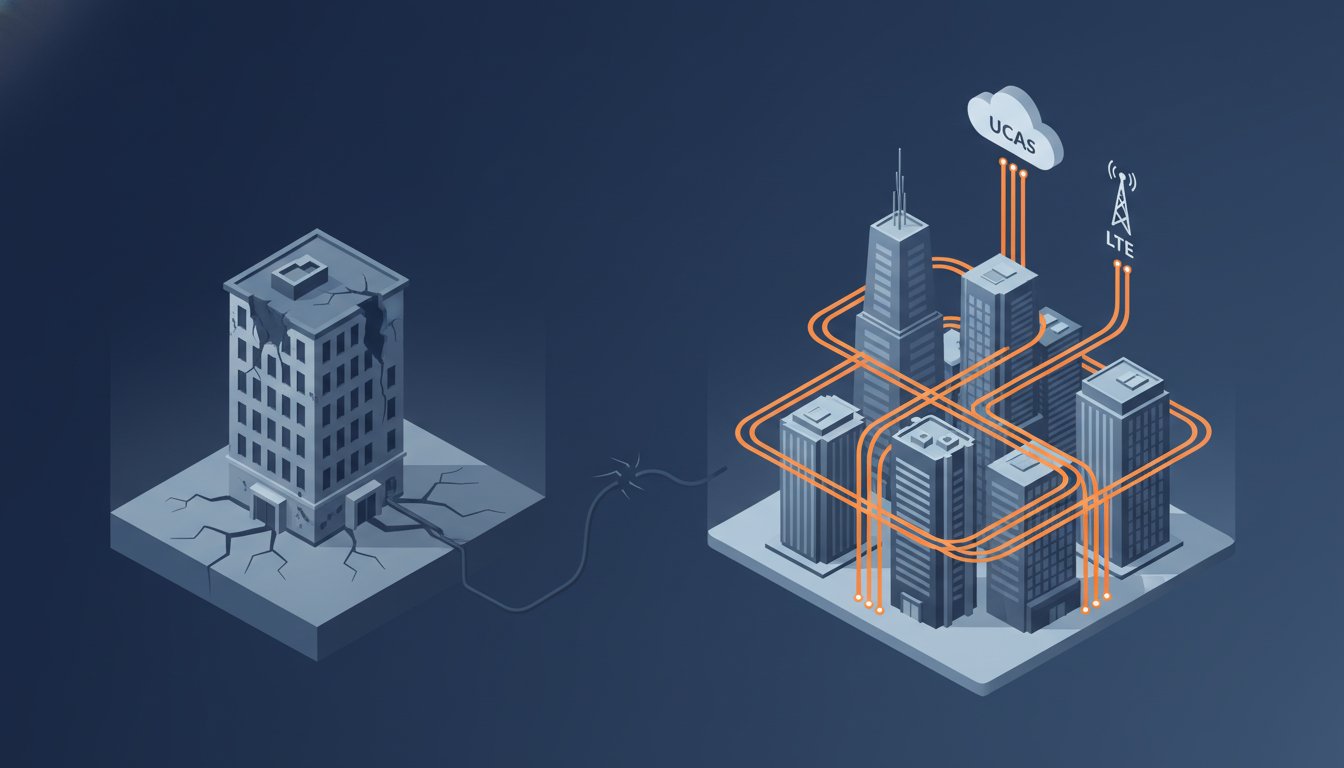
With the average cost of downtime for mid-sized businesses reaching $9,000 per minute in 2026, a single communication blackout can jeopardize your entire fiscal year. You likely recognize that your phone system is more than just a tool for sales; it’s the lifeline for your operations and your primary link to emergency services. Managing a remote workforce while staying compliant with fire and life-safety regulations often feels like an impossible balancing act during a crisis.
This strategic guide explains how to engineer a resilient disaster recovery plan for business phones that maintains uptime for both operations and critical life-safety systems. We’ll show you how to move beyond simple internet failover to a multi-layered cloud and cellular architecture. You’ll learn to implement zero-downtime voice infrastructure through UCaaS and LTE POTS replacement strategies. We will also cover the 3-2-1-1-0 backup rule and current regulatory shifts to ensure your business remains predictable, secure, and fully operational when the unexpected occurs.
Key Takeaways
- Modern communication standards have shifted from simple restoration to continuous availability frameworks that protect both operational voice and critical life-safety lines.
- Implementing a resilient disaster recovery plan for business phones involves leveraging geo-redundant UCaaS platforms to eliminate on-premise hardware as a single point of failure.
- Legacy copper infrastructure has become a primary vulnerability; transitioning to LTE POTS replacement is essential for maintaining compliant elevator and alarm connectivity.
- Building a reliable strategy starts with a thorough audit of all existing lines to ensure hidden connections are migrated to high-availability cloud architectures.
- True operational predictability is achieved through foundational engineering that prioritizes infrastructure stability and rigorous governance over superficial software features.
What is a Disaster Recovery Plan for Business Phones?
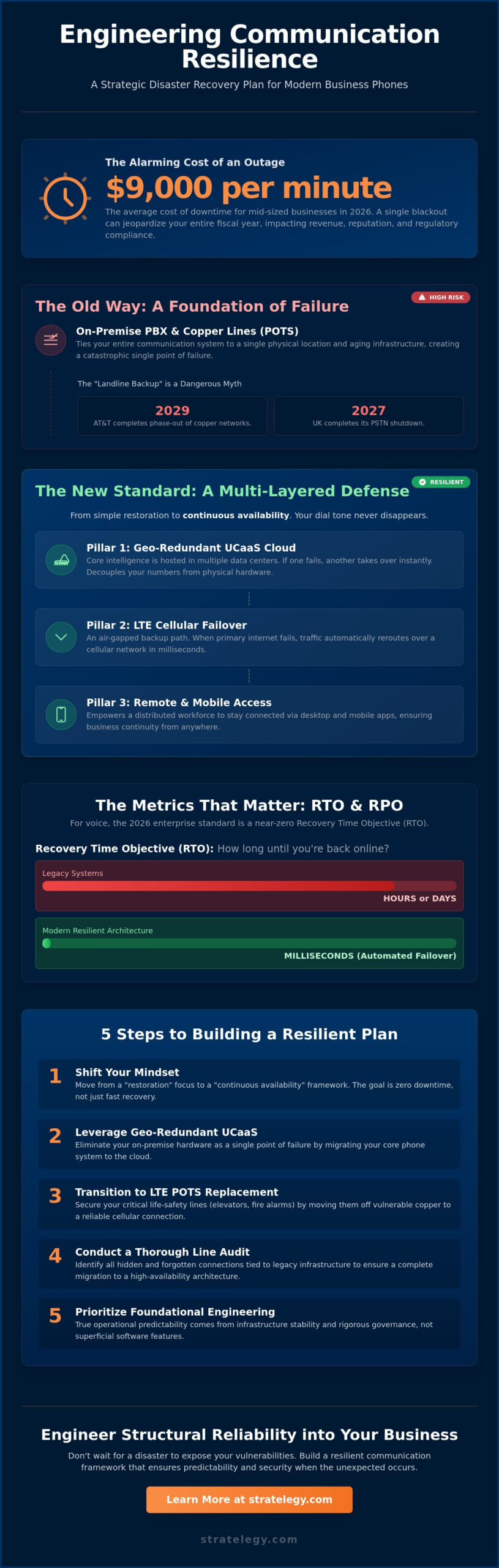
A disaster recovery plan for business phones is a strategic framework engineered to preserve voice, messaging, and emergency communication capabilities during a total infrastructure failure. While traditional disaster recovery planning often focuses on data restoration, a voice-centric plan prioritizes continuous availability. In 2026, enterprise standards have moved past the concept of “restoration.” Modern systems are built to remain functional through the crisis itself, ensuring that your organization never loses its dial tone or its connection to critical life-safety systems.
Relying on legacy Plain Old Telephone Service (POTS) is no longer a viable strategy. With major carriers like AT&T phasing out copper networks by 2029 and the UK completing its PSTN shutdown in early 2027, the “landline backup” is a dangerous myth. True resilience now rests on three foundational pillars:
- Cloud Redundancy: Using geo-redundant UCaaS platforms to decouple your phone numbers from physical hardware.
- Cellular Failover: Implementing LTE POTS replacement to provide an air-gapped path for emergency lines.
- Remote Mobility: Enabling a seamless transition to mobile and desktop applications for a distributed workforce.
The High Cost of Communication Downtime
Financial impact is immediate. With the average cost of downtime for mid-sized businesses reaching $9,000 per minute in 2026, every missed sales call represents a direct hit to the bottom line. Beyond lost revenue, the reputational damage of a customer reaching a “dead line” can take years to repair. There’s also the matter of legal liability. If an elevator phone or fire alarm fails during an outage because it lacked a modern disaster recovery plan for business phones, the resulting regulatory fines and litigation can be catastrophic.
RTO and RPO for Voice Services
In the context of voice, your Recovery Time Objective (RTO) is the duration of the outage before your phones are back online. Your Recovery Point Objective (RPO) refers to the potential loss of call logs, recordings, or voicemail data. For 2026 enterprise environments, a near-zero RTO is the expectation. You shouldn’t wait hours for a technician to arrive. Instead, your infrastructure should automatically reroute traffic to secondary cloud nodes or cellular pathways the moment a primary link fails.
Layering Redundancy: UCaaS and LTE Failover Mechanisms
Resilience isn’t accidental. It’s engineered. Traditional on-premise PBX systems create a dangerous single point of failure for your organization. If the local hardware malfunctions or a construction crew cuts the fiber line outside your building, your business goes dark. Transitioning to unified communications as a service removes this vulnerability by hosting the core intelligence of your phone system in the cloud. This shift is the foundational step in a modern disaster recovery plan for business phones.
When your primary internet connection fails, automated failover protocols must take over instantly. High-performance edge devices detect the loss of the primary signal and immediately reroute traffic to secondary cellular paths. This transition happens in milliseconds. Active calls stay connected; your staff remains productive. This level of predictability is essential in 2026, where the financial stakes of an outage are higher than ever. Engineering a truly resilient disaster recovery plan for business phones requires looking at these structural foundations to ensure long-term stability.
Geo-Redundancy and Cloud Architecture
Modern cloud systems utilize “Active-Active” server clusters distributed across multiple geographic zones. If a localized disaster impacts a data center in one region, a node in a separate zone immediately handles the load without manual intervention. For high-volume environments, cloud contact center platforms ensure that agents remain reachable regardless of regional connectivity issues. We prioritize carrier-grade infrastructure to guarantee that dial tone remains a constant, not a variable, for your enterprise.
LTE POTS Replacement for Critical Infrastructure
Most organizations overlook their most dangerous failure point: life-safety lines. Fire alarms, elevator phones, and security panels often still run on legacy copper that doesn’t support modern digital failover. We address this gap with LTE POTS replacement solutions, frequently referred to as “POTS in a Box.” These devices provide a dedicated, air-gapped cellular link equipped with integrated battery backups. This specialized hardware ensures your facility remains compliant with NFPA 72 codes and other life-safety requirements even when the primary power and wired internet are completely unavailable.
The Obsolescence Risk: Why Legacy Copper is Your Biggest Vulnerability
Copper isn’t a safety net; it’s a structural liability. Many business owners cling to the myth that analog landlines are indestructible because they “work when the power is out.” This is no longer true in 2026. Most modern copper lines are served by digital loop carriers or remote terminals that require local power to function. If the neighborhood grid fails, your legacy lines likely fail with it. Clinging to these aging circuits creates a massive blind spot in your disaster recovery plan for business phones.
Major carriers are aggressively decommissioning their analog footprints. AT&T is on track to phase out its traditional copper network by 2029, and the UK’s full PSTN shutdown is scheduled for January 2027. As these networks disappear, the remaining lines suffer from “vampire” maintenance costs. For instance, the federal Universal Service Fund (USF) contribution factor has reached 37% in the second quarter of 2026. These escalating fees, combined with the lack of carrier support, drain budgets that should be allocated toward resilient, modern infrastructure.
Legacy infrastructure is also prone to silent failures. During extreme weather events, moisture ingress in aging junction boxes frequently causes grounding issues that disable fire and elevator lines without triggering an immediate alarm. This lack of predictability is unacceptable for enterprise governance. A robust disaster recovery plan for business phones must replace these fragile analog loops with engineered solutions that offer real-time health monitoring and physical path diversity.
The Death of the Analog Loop
Carriers are no longer obligated to maintain copper lines under FCC Order 19-72. This regulatory shift has led to a rapid decline in repair quality and response times. Relying on a service that the provider is actively trying to abandon is a high-risk strategy. Implementing a comprehensive pots line replacement is now a prerequisite for any organization that prioritizes life-safety compliance and operational continuity. Moving to a digital foundation eliminates the physical decay associated with the analog loop.
Transitioning to Managed Cellular Solutions
Managed LTE and 5G solutions provide the distinct physical path required for true redundancy. Unlike copper or fiber, which often share the same underground conduits, cellular signals are air-gapped from local ground disruptions. These systems offer centralized governance, allowing your technical team to monitor signal strength and battery health across all locations from a single dashboard. This shift from reactive repair to proactive maintenance ensures your emergency communication remains functional, predictable, and fully compliant with modern safety codes.
5 Steps to Building a Resilient Phone DR Plan
Engineering a robust disaster recovery plan for business phones requires a disciplined, five-step technical execution. This process shifts your focus from reactive troubleshooting to proactive infrastructure management. By following this framework, you ensure that your communication remains predictable even when local utilities fail. A successful implementation relies on these core actions:
- Audit all existing lines: Catalog every connection, specifically identifying hidden life-safety lines in elevators, fire panels, and security systems.
- Transition to geo-redundant UCaaS: Move operational voice traffic to a cloud platform that utilizes active-active server clusters across multiple geographic zones.
- Deploy LTE POTS replacement hardware: Install specialized cellular gateways for systems that traditionally depend on analog copper to ensure an air-gapped path.
- Establish a “Crisis Mode” protocol: Configure automated routing that instantly pushes calls to mobile softphones and remote workstations during a facility outage.
- Schedule quarterly automated failover testing: Validate your technical readiness every 90 days to confirm that secondary pathways engage without manual intervention.
Auditing Your Communication Surface Area
You cannot protect what you haven’t documented. Identifying “ghost lines” is a critical component of a disaster recovery plan for business phones. These are often legacy circuits for fax machines or alarm panels that remain on copper, creating systemic vulnerabilities. We recommend mapping the physical infrastructure paths of your facility to identify single points of failure, such as shared conduits where a single accident could sever both your primary fiber and backup cable connections. Differentiating between standard operational voice and critical life-safety requirements allows for a more targeted and cost-effective redundancy strategy.
Testing and Maintenance Frameworks
A disaster recovery plan is dead on arrival without a proprietary maintenance framework to support it. Systematic hardware update policies ensure that your communication infrastructure remains resilient against both physical decay and digital obsolescence. Relying on technical partners for ongoing oversight and compliance monitoring prevents your DR strategy from becoming a static document. Instead, it becomes a living part of your business continuity management system, aligned with ISO 22301 standards. Secure your infrastructure by partnering with technical experts in LTE POTS replacement and UCaaS migration to maintain long-term operational health.
Engineering Structural Reliability with Stratelegy
Stratelegy operates as foundational engineers rather than simple service providers. We recognize that a disaster recovery plan for business phones is a structural necessity, not just a software configuration. Our methodology moves beyond the superficial features of modern telephony to prioritize infrastructure stability and long-term operational health. By focusing on the underlying architecture, we ensure that your communication remains functional when local systems fail.
Our approach to enterprise UCaaS and CCaaS integrates high-level security with rigorous governance. We design these platforms to provide predictability under pressure. For organizations managing complex call flows or large-scale contact centers, we implement redundant routing paths that maintain agent availability regardless of regional disruptions. This engineering-first mindset allows us to deliver a communication environment where uptime is a baseline expectation, not a variable.
The Stratelegy LTE POTS replacement solution addresses the most critical vulnerability in modern facilities: life-safety connectivity. We modernize elevator phones, fire panels, and security alarms by transitioning them to a dedicated cellular infrastructure. This specialized hardware provides an air-gapped path that remains independent of your building’s primary power or wired internet. We eliminate the fear of obsolescence by replacing fragile analog loops with engineered redundancy built for 2026 standards and beyond.
Proactive Partnership vs. Vendor Relationship
Technical expertise is most valuable when it’s proactive. We position ourselves as strategic specialists who anticipate systemic vulnerabilities before they lead to an outage. Our commitment to lifecycle management means we don’t just install a system and disappear; we provide ongoing oversight and systematic hardware update policies. This disciplined engineering approach helps your organization achieve excellence by ensuring your communication infrastructure remains secure, compliant, and ready for any crisis.
Get Started: Your Communication Resilience Audit
Your roadmap to a modernized environment begins with a comprehensive Stratelegy infrastructure assessment. During this audit, we identify every connection in your facility, from standard office extensions to hidden life-safety lines. We map your existing physical paths to uncover single points of failure that could jeopardize your disaster recovery plan for business phones. Following the audit, we provide a clear technical path for migrating to a geo-redundant architecture that protects your revenue and your personnel. Secure your critical infrastructure with Stratelegy today and ensure your business stays connected when it matters most.
Securing Your Operational Future
Predictability is the ultimate goal of modern communication infrastructure. You’ve seen that relying on legacy copper is a liability that your organization can no longer afford. By implementing a multi-layered cloud and cellular architecture, you ensure that your dial tone remains a constant even during regional disasters. A resilient disaster recovery plan for business phones isn’t just about software; it’s about engineering structural reliability into every layer of your communication stack.
Stratelegy brings specialized technical niche expertise to every engagement. We prioritize compliance-oriented engineering and utilize proprietary maintenance frameworks to keep your systems ahead of regulatory shifts and physical decay. This proactive approach eliminates the fear of obsolescence and secures your critical life-safety lines for the long term. We act as foundational engineers who anticipate systemic vulnerabilities before they impact your bottom line or your reputation.
Partner with Stratelegy to engineer your disaster recovery framework and gain the peace of mind that comes with a truly resilient infrastructure. Your business deserves a foundation that’s built for excellence and maintained with discipline.
Frequently Asked Questions
Does VoIP work during a power outage?
VoIP requires an active internet connection and local power to operate physical desk phones. However, a cloud-hosted UCaaS architecture ensures that your call processing continues in a geo-redundant data center even if your office is dark. To maintain local connectivity, you must implement battery backups for your network switches or utilize mobile applications that run on cellular data.
How does LTE failover work for business phones?
LTE failover utilizes a cellular gateway to provide an alternate data path when your primary fiber or cable connection fails. High-performance edge devices detect the loss of signal and automatically switch traffic to the cellular network in milliseconds. This mechanism ensures your disaster recovery plan for business phones maintains active voice sessions without manual intervention.
Is a cellular phone line as reliable as a traditional landline for fire alarms?
Managed LTE connections are now more reliable than traditional landlines because carriers have stopped maintaining the aging copper infrastructure. Specialized LTE POTS replacement devices include integrated battery backups and provide real-time health monitoring that analog lines lack. These systems eliminate the risk of “silent failures” caused by moisture or grounding issues in decaying copper loops.
What is POTS replacement and why is it necessary for disaster recovery?
POTS replacement is the transition of legacy analog lines to modern digital or cellular equivalents. This transition is essential because major carriers like AT&T are phasing out copper networks by 2029. Without modernizing these lines, your critical systems like elevators and fire panels will lose support and connectivity, creating a massive gap in your operational resilience.
Can my employees use their mobile phones as part of a disaster recovery plan?
Employees can maintain full business functionality through UCaaS mobile applications that mirror their office extensions. This allows for an immediate transition to remote work if your primary facility becomes inaccessible. Your team keeps access to corporate directories, call recording, and hunt groups without needing to be physically present at their desks.
How often should I test my business phone disaster recovery plan?
You should conduct automated failover testing at least quarterly to validate your technical readiness. These tests confirm that secondary cellular paths engage correctly and that cloud routing profiles are up to date. Regular testing is the only way to ensure your disaster recovery plan for business phones will perform as engineered during a real-world infrastructure failure.
What are the regulatory requirements for emergency elevator phones in 2026?
Regulatory standards require elevator phones to have a dedicated, supervised connection that remains functional for at least four hours during a power outage. In 2026, compliance typically involves moving to LTE solutions that meet ASME A17.1 and NFPA 72 codes. These systems must provide automated alerts if the communication path is compromised or if the battery health declines.
What happens to my inbound calls if my office building is inaccessible?
Inbound calls are instantly rerouted to secondary locations, remote workers, or automated attendants via your cloud-hosted platform. Because the intelligence of your UCaaS or CCaaS system resides in geo-redundant data centers, your business identity remains active. Clients will never receive a busy signal or a dead line, regardless of the physical status of your building.