
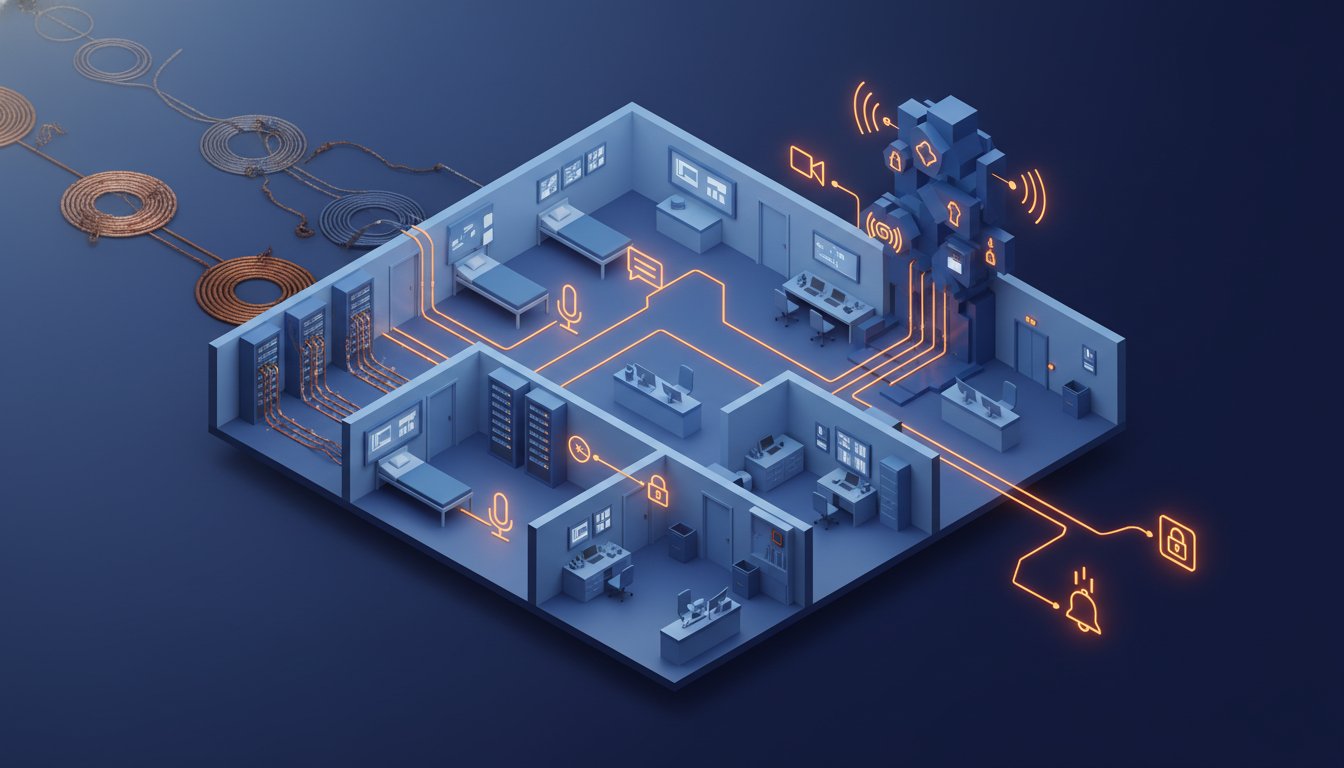
In 2026, deploying UCaaS for healthcare clinics is no longer a simple software upgrade; it’s a rigorous structural engineering project where a single security oversight can result in HIPAA fines of up to $50,000 per violation. You’re likely managing the daily friction of fragmented patient messages while maintaining aging copper POTS lines that grow more expensive and less reliable every month. It’s a stressful balance between preserving clinical continuity and avoiding the obsolescence of legacy hardware. We know that for a clinic director, reliability isn’t just a feature; it’s the foundation of patient safety and operational peace of mind.
This article provides a strategic framework to bridge the gap between your current systems and a modern, cloud-based patient engagement model. You’ll learn how to build a unified platform for voice, video, and medical messaging that prioritizes technical governance and long-term stability. We’ll examine the mandatory technical safeguards introduced in 2026, the regulatory requirements for 911 coordination during POTS replacement, and the specific steps to ensure your communication infrastructure remains predictable, secure, and fully compliant.
Key Takeaways
- Understand why modernizing with ucaas for healthcare clinics is essential to resolve the “POTS Gap” and secure clinical continuity in 2026.
- Identify the mandatory HIPAA technical safeguards and the non-negotiable requirement for Business Associate Agreements (BAAs) to protect patient data.
- Learn how to protect life-safety systems, such as fire alarms and elevator phones, that standard VoIP often fails to support during digital transitions.
- Follow a structured 5-step migration framework to audit existing infrastructure and ensure every endpoint meets current regulatory codes.
- Discover how foundational engineering and proactive maintenance frameworks transform communication from a service into a predictable business asset.
What is UCaaS for Healthcare Clinics and Why is it Essential in 2026?
Modern healthcare delivery requires more than just a functional phone line. It demands a resilient, integrated infrastructure that can handle the complexities of patient data and real-time clinical collaboration. UCaaS for healthcare clinics is the architectural solution to this demand. It moves communication from isolated hardware to a cloud-based environment where voice, video, and messaging function as a single, cohesive unit. This shift isn’t just about adding features; it’s about establishing a framework for structural reliability that supports every patient interaction.
The foundation of this technology lies in Unified Communications (UC), which eliminates the silos between different communication methods. In 2026, the necessity of this integration has reached a critical point. The Federal Communications Commission (FCC) released the Network and Services Modernization Order (FCC-26-19A1) in March 2026, which grants carriers blanket authority to grandfather legacy voice services. As copper lines become obsolete, clinics that rely on fragmented systems like separate fax machines, paging apps, and analog desk phones face significant clinical and operational risks. Moving to a unified platform isn’t just a software upgrade; it’s a strategic move to secure the long-term health of your business infrastructure.
The Core Components of a Clinical UCaaS Platform
A professional ucaas for healthcare clinics deployment focuses on three primary pillars of engagement. First, cloud-based voice systems utilize intelligent call routing to ensure patient inquiries reach the correct triage or scheduling desk without delay. This reduces administrative friction and improves the patient experience. Second, secure messaging modules provide a HIPAA-compliant space for clinicians to collaborate on patient care in real time. This is especially vital following the February 16, 2026, deadline for updating privacy practices regarding substance use disorder records. Finally, integrated video conferencing allows for seamless telehealth consultations, which accounted for 40% of the healthcare communication market share by 2025.
Addressing the Healthcare Communication Crisis
Legacy systems are currently failing to meet the expectations of modern patients who demand instant, secure responses. Many clinics are still burdened by the technical debt of aging on-premise PBX hardware, which requires expensive, specialized maintenance. These on-premise systems lack the scalability needed for 2026’s digital-first environment. Furthermore, clinics remain the primary targets for aggressive price hikes on remaining POTS lines as carriers seek to exit the analog market. By transitioning to a managed UCaaS model, clinics eliminate these unpredictable expenses and replace them with a governed, predictable infrastructure designed for the next decade of clinical excellence.
Security, Governance, and HIPAA Compliance in Healthcare UCaaS
Security is not a passive state; it is an engineered outcome. In 2026, the HIPAA Security Rule has eliminated the flexibility of “addressable” controls, making technical safeguards like multi-factor authentication (MFA) and encryption of data at rest and in transit mandatory for all entities. For ucaas for healthcare clinics, compliance begins with a non-negotiable Business Associate Agreement (BAA). This document is the legal bedrock of your partnership, ensuring the vendor accepts responsibility for protecting Protected Health Information (PHI). Without a signed BAA, any cloud communication tool is a systemic vulnerability that risks fines ranging from $100 to $50,000 per violation.
Data residency and role-based access control (RBAC) provide the next layer of governance. Modern clinics must ensure their data resides within sovereign cloud environments that meet strict regulatory standards. RBAC allows administrators to define exactly who can access, record, or share clinical data, preventing unauthorized exposure. This level of oversight is essential when managing substance use disorder (SUD) records, which now require updated Notice of Privacy Practices as of the February 16, 2026, deadline. A disciplined approach to communication infrastructure ensures that security remains a constant, rather than a variable.
Engineering Compliance into the Communication Layer
Modern unified communications and collaboration platforms automate the creation of comprehensive audit logs. These logs are vital for the annual penetration testing now required by law. There’s a significant distinction between consumer-grade messaging and healthcare-grade security. While consumer apps prioritize novelty, healthcare-grade systems focus on end-to-end encryption and data integrity. Proactive monitoring systems detect unusual traffic patterns or unauthorized access attempts in real time. This allows technical experts to neutralize threats before they impact clinical operations. If you’re unsure about your current security posture, a professional infrastructure assessment can reveal hidden vulnerabilities.
Interoperability with Clinical Workflows
True efficiency is found where communication meets clinical data. Integrating ucaas for healthcare clinics with Electronic Health Record (EHR) systems allows for immediate patient context during every interaction. SIP trunking serves as the bridge, connecting modern cloud-based applications to your existing clinical hardware. This preserves your current investments while enabling advanced features like intelligent call routing. Effective integration also addresses alert fatigue. By categorizing notifications, clinicians only receive urgent alerts, while routine administrative updates are handled through secondary channels. This methodical organization improves both provider focus and patient safety.
The POTS Gap: Securing Life-Safety Systems During UCaaS Migration
A successful transition to ucaas for healthcare clinics requires more than just migrating desk phones to the cloud. Many facilities overlook the “POTS Gap,” the critical vulnerability created when legacy copper lines are disconnected without a viable plan for life-safety systems. Fire alarms, elevator phones, and building security systems were engineered to run on analog copper infrastructure. Standard VoIP often fails to support these critical signals because digital compression can distort the specific analog tones required for emergency communication. Neglecting these lines during a migration isn’t just a technical oversight; it’s a significant regulatory and safety risk.
The FCC’s Network and Services Modernization Order (FCC-26-19A1) mandates specific 90-day coordination periods for 911-related service discontinuance. This underscores the government’s recognition that these lines are indispensable. To maintain 99.999% uptime, clinics must move away from the “dial tone” mentality and embrace cellular-based redundancy. We view LTE POTS replacement as a prerequisite for any comprehensive UCaaS strategy. It ensures that while your patient communications move to the cloud, your physical facility remains protected by a resilient, managed connection that operates independently of your local internet circuit.
LTE POTS Replacement for Healthcare Facilities
Modernizing fire alarm communicators and elevator phones doesn’t require a complete rewiring of your building. By utilizing POTS line replacement technology, clinics can convert analog signals into digital data packets transmitted over secure LTE or 5G networks. This approach meets all NFPA 72 and UL standards for emergency signaling. It also addresses the financial drain of legacy infrastructure. Carriers are aggressively raising rates on remaining copper lines to force migration, making the switch to LTE a strategic move that eliminates the highest recurring costs in your telecommunications budget.
Infrastructure Stability as a Clinical Asset
Engineering redundancy is the hallmark of a reliable healthcare environment. We implement dual-path connectivity for critical endpoints, ensuring that if one cellular carrier fails, another is immediately available. “POTS in a box” solutions provide a self-contained, managed gateway that bridges the gap between your legacy safety hardware and modern digital networks. This eliminates the fear of obsolescence for your existing equipment while providing the predictability of a monitored system. When ucaas for healthcare clinics is paired with a robust POTS replacement strategy, the result is a unified, hardened infrastructure that supports both digital patient engagement and physical life-safety protocols.
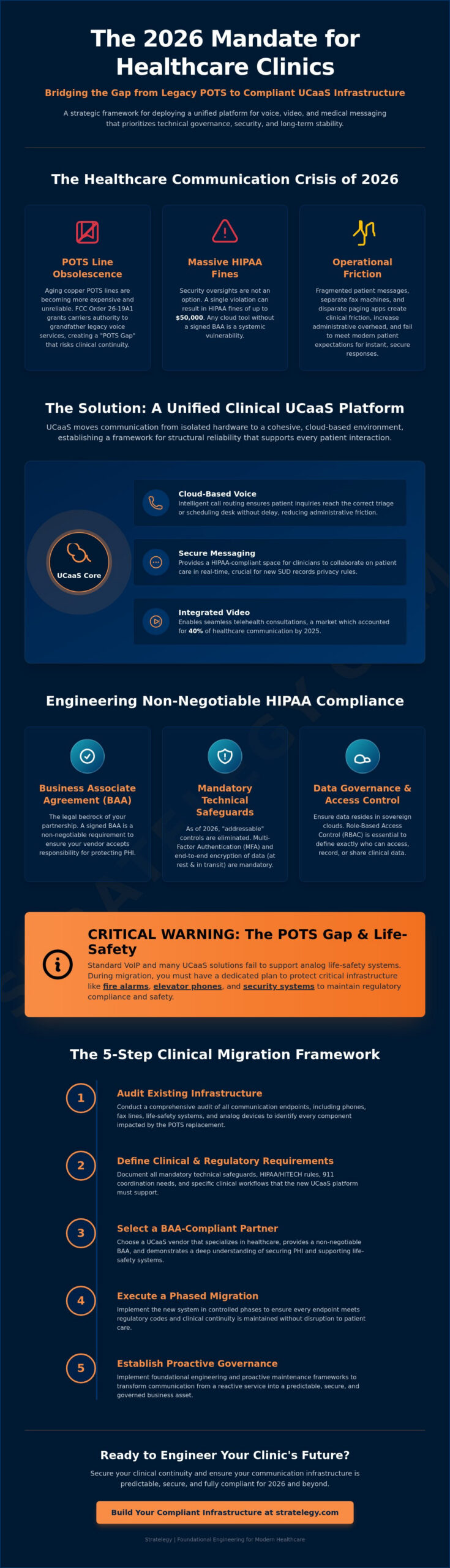
The Clinical Migration Framework: 5 Steps to a Unified Practice
Migrating to a unified communication model requires a disciplined roadmap to avoid operational gaps. A professional deployment of ucaas for healthcare clinics follows a systematic engineering framework rather than a simple software installation. This process ensures that every clinical workflow remains intact while your infrastructure modernizes. We focus on structural reliability to eliminate the risks associated with unmanaged transitions.
- Step 1: Infrastructure Audit. Identify every voice, data, and life-safety line within the facility. This includes the hidden analog connections for fire alarms and elevator phones that are often overlooked by general IT providers.
- Step 2: Regulatory Assessment. Verify that all endpoints comply with the 2026 HIPAA Security Rule. This involves ensuring mandatory multi-factor authentication and encryption protocols are active across all devices.
- Step 3: Partner Selection. Choose a strategic specialist who prioritizes technical governance over superficial features. A partner must sign a BAA and demonstrate deep knowledge of clinical compliance standards.
- Step 4: Phased Implementation. Deploy the system in controlled stages. This prevents disruption to patient care and allows staff to adjust to new digital workflows without the stress of a “big bang” cutover.
- Step 5: Lifecycle Management. Implement ongoing maintenance policies. Establishing a proprietary maintenance framework ensures your hardware and software remain secure and functional throughout their operational life.
Evaluating UCaaS Vendors for Healthcare ROI
ROI in healthcare communication isn’t just about the monthly subscription fee. It’s about the total cost of ownership (TCO). You must factor in the significant savings gained from LTE POTS replacement, which eliminates the high costs of maintaining aging copper lines. Look for vendors who offer proprietary maintenance frameworks and 24/7 technical support. In a mission-critical medical environment, a vendor should act as a foundational engineer, not just a service provider. If you’re ready to secure your clinic’s future, you can consult with our technical advisors today to build a predictable infrastructure.
Training and Adoption for Clinical Staff
A system is only as effective as the people who use it. Clinical staff need an intuitive interface that functions reliably during high-stress shifts. Standardizing communication protocols across multiple locations ensures a consistent experience for both providers and patients. Utilizing cloud contact center features can significantly improve patient intake efficiency by automating routine inquiries. This allows nurses and doctors to focus on clinical outcomes rather than navigating complex phone menus. High adoption rates are achieved when technology feels like a tool, not a hurdle.
Stratelegy: Foundational Engineering for Modern Healthcare
Effective communication in a clinical setting requires more than a software license. It demands a partnership rooted in technical authority and structural reliability. At Stratelegy, we move beyond the traditional service provider model to act as strategic specialists. We recognize that ucaas for healthcare clinics is a core component of your medical infrastructure. Our commitment is to provide security, governance, and a predictable framework that eliminates the operational friction common in unmanaged environments. We don’t just deliver a dial tone; we engineer a resilient platform designed for the specific rigors of 2026 healthcare regulations.
Our methodology bridges the gap between rapid software innovation and the need for long-term stability. While many providers focus solely on the latest features, we prioritize the health of the underlying architecture. This lifecycle management approach ensures that your communication tools evolve alongside your practice without compromising security or uptime. By anchoring digital tools in financial and regulatory business terminology, we provide a clear path toward operational excellence. We anticipate the hurdles your clinic hasn’t encountered yet, ensuring your systems remain modern and fully compliant.
Strategic Specialist vs. Service Vendor
Generic vendors often overlook the critical intersection of digital apps and physical safety. Stratelegy prioritizes infrastructure stability because we understand that a dropped call in a clinical environment is more than an inconvenience. We focus on specialized technical niches, such as LTE POTS replacement, to ensure that fire alarms and emergency lines remain functional during your cloud migration. Our proactive engineering approach identifies systemic vulnerabilities before they impact your workflow. We don’t wait for a failure to act; we build systems that are disciplined, modern, and inherently reliable.
Modernizing Your Practice with Confidence
Achieving excellence in healthcare communication requires engineering precision and a disciplined implementation strategy. We eliminate the fear of obsolescence through our systematic hardware update policies and proprietary maintenance frameworks. This ensures your clinic isn’t left behind as technology and regulations shift. Our goal is to provide business owners with total peace of mind, knowing their technical foundation is managed by experts who prioritize long-term viability over short-term sales. It’s time to shift your focus from software to structural reliability. Partner with Stratelegy for your healthcare UCaaS strategy and secure the future of your clinical communications.
Architecting a Resilient Future for Your Clinical Communications
Building a reliable communication framework requires a shift from reactive troubleshooting to proactive structural engineering. We’ve analyzed how the convergence of 2026 regulatory mandates and the obsolescence of copper lines makes ucaas for healthcare clinics a strategic necessity. By addressing the “POTS gap” and implementing a phased migration, your clinic can eliminate technical debt while enhancing patient engagement. Stability is achieved through disciplined governance and a commitment to long-term lifecycle management.
Stratelegy provides the technical expertise to bridge the gap between modern software innovation and foundational reliability. Our approach is grounded in HIPAA-compliant, enterprise-grade infrastructure and specialized LTE POTS replacement for critical life-safety systems. We utilize proprietary maintenance frameworks to ensure your systems remain predictable and secure against emerging threats. Don’t let your practice fall behind as legacy systems fade into history. Secure your clinic’s future with Stratelegy’s foundational UCaaS engineering. We are ready to help you transition to a modern, hardened infrastructure with total confidence.
Frequently Asked Questions
Is UCaaS HIPAA compliant for small healthcare clinics?
UCaaS is HIPAA compliant when the provider signs a Business Associate Agreement (BAA) and implements mandatory technical safeguards. In 2026, these safeguards include multi-factor authentication (MFA) and encryption for data at rest and in transit. For ucaas for healthcare clinics, compliance is a structural requirement that ensures protected health information (PHI) remains secure across all clinical endpoints.
What happens to my clinic’s fire alarm when I switch to UCaaS?
Switching to standard UCaaS can disable your fire alarm if it relies on analog copper lines. Fire alarms and elevator phones require a specialized LTE POTS replacement to maintain life-safety signals. We engineer these connections using cellular-based gateways that operate independently of your clinic’s primary internet circuit to ensure 99.999% uptime for emergency communications.
Can I use my existing medical office phones with a new UCaaS system?
You can often use existing hardware through SIP trunking or analog telephone adapters (ATA), but it’s rarely the most reliable path. Modern handsets are designed to integrate fully with the cloud-based features of ucaas for healthcare clinics. Transitioning to modern hardware eliminates the technical debt associated with maintaining legacy office phones and ensures access to all collaboration tools.
How does UCaaS improve the patient experience in a busy clinic?
UCaaS improves the patient experience by utilizing intelligent call routing to reduce hold times and administrative friction. Patients receive faster responses when their inquiries are automatically directed to the correct triage or scheduling desk. Unified messaging also allows staff to coordinate care more efficiently, which leads to more attentive and personalized patient interactions.
What is the cost difference between traditional POTS lines and UCaaS for healthcare?
Traditional POTS lines are becoming significantly more expensive as carriers discontinue copper infrastructure under the FCC-26-19A1 modernization order. UCaaS provides a predictable, managed cost structure that eliminates the variable maintenance fees of aging hardware. While you should evaluate the total cost of ownership, clinics typically see long-term financial benefits by removing legacy line expenses.
How long does it take to migrate a medical clinic to a unified communication platform?
A typical migration takes several weeks to a few months, depending on the complexity of your clinical infrastructure. The process begins with a comprehensive audit of all voice and life-safety lines, followed by a phased implementation. This methodical approach ensures that your clinical workflows remain operational and patient care is never disrupted during the transition.
Does UCaaS support telehealth and remote patient monitoring?
UCaaS provides the foundational infrastructure for telehealth through integrated, secure video conferencing and encrypted messaging. These tools allow clinicians to conduct remote consultations and monitor patient data within a single, governed platform. This integration simplifies the technology stack and ensures that remote care meets the same compliance standards as in-person visits.
What kind of internet connection does a clinic need for reliable UCaaS?
Reliable UCaaS requires a high-speed internet connection with low latency and sufficient bandwidth to handle concurrent voice and video streams. We recommend a dedicated fiber circuit paired with an LTE failover for redundancy. This dual-path connectivity ensures your communication remains stable even if your primary internet provider experiences a service interruption.