

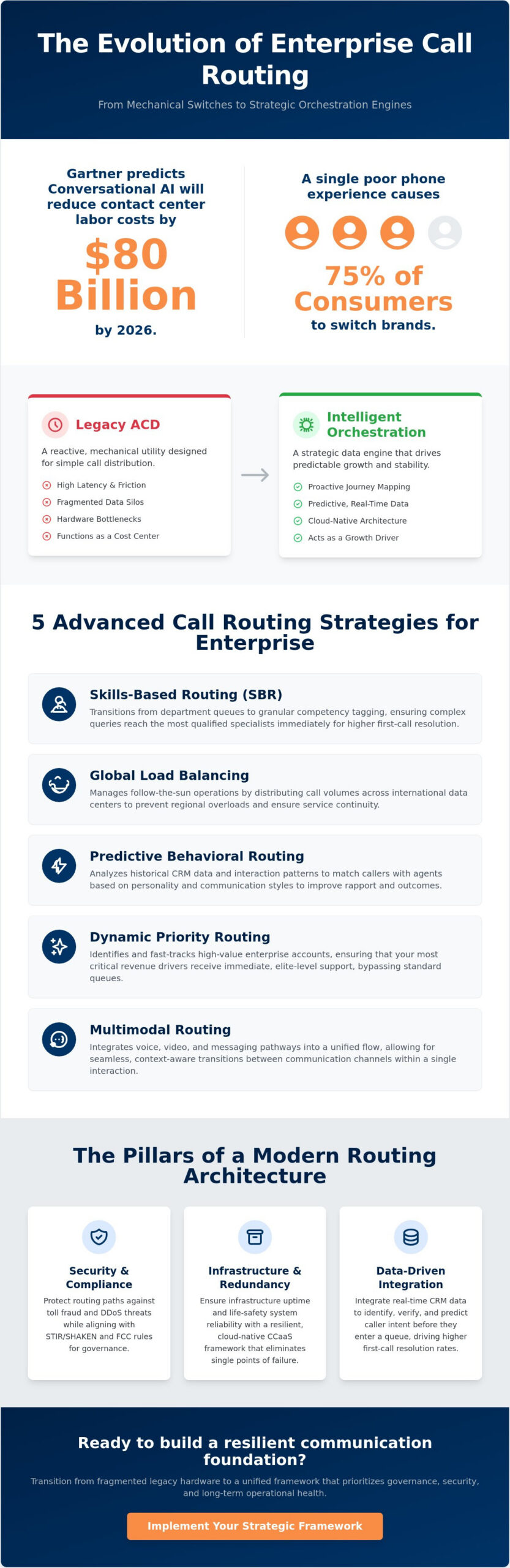
Gartner predicts conversational AI will reduce contact center labor costs by $80 billion in 2026. This isn’t just a trend; it’s a fundamental shift in how foundational engineers approach structural reliability. You’re likely dealing with the friction of legacy infrastructure, where high latency and fragmented data silos undermine your global reach. These inefficiencies are costly. Since 75% of consumers switch brands after a single poor phone experience, your call routing strategies for enterprise must function as a precision-engineered data engine rather than a simple mechanical switch.
We recognize that your priority is a stable, predictable communication environment. This article provides the technical blueprints to master sophisticated CCaaS and UCaaS frameworks that ensure global load balancing and infrastructure uptime. We’ll explore how to align your operations with the 2026 FCC proposed rules on offshore routing and the latest STIR/SHAKEN requirements. You’ll gain a clear strategy to reduce average handle time and achieve the first-call resolution rates your enterprise demands for long-term growth.
Key Takeaways
- Evolve your infrastructure from simple call distribution to strategic orchestration. Learn why modern organizations are moving beyond the ACD to treat communication paths as high-value assets.
- Implement sophisticated call routing strategies for enterprise that leverage global load balancing. These frameworks optimize agent utilization and ensure service continuity across multi-regional operations.
- Integrate real-time CRM data to identify and verify callers before they enter the queue. This predictive approach eliminates data silos and drives higher first-call resolution rates through informed engagement.
- Protect your communication lifecycle by securing routing paths against toll fraud and DDoS threats. Understand the engineering requirements for maintaining infrastructure redundancy and life-safety system reliability.
- Transition from fragmented legacy hardware to a unified CCaaS framework. Discover how to build a communication foundation that prioritizes governance, security, and long-term operational health.
Beyond the ACD: The Strategic Evolution of Enterprise Call Routing
Efficiency was once the only metric that mattered in communications. For decades, the Automatic Call Distributor (ACD) functioned as a mechanical utility, designed simply to move a caller from point A to point B based on agent availability. In 2026, this legacy approach is a liability for global organizations. Modern call routing strategies for enterprise have evolved into sophisticated orchestration engines. They no longer function as simple switches; they’re strategic assets that protect infrastructure stability and enhance the customer lifecycle.
The demands of a 2026 enterprise differ fundamentally from the legacy models used by smaller businesses. While an SMB might prioritize simple connectivity, an enterprise requires a framework that integrates UCaaS and CCaaS into a single, resilient ecosystem. This shift moves the conversation away from superficial features toward foundational engineering. It’s about building a system that can anticipate a customer’s needs while maintaining strict governance and regulatory compliance across multiple jurisdictions.
The Move to Intelligent Orchestration
Basic “fixed order” routing fails at the enterprise level because it ignores the complexity of the modern customer journey. Reactive transfers, where a caller is bounced between departments, create friction and drive up handle times. Transitioning to intelligent orchestration allows organizations to move toward proactive journey mapping. In this model, the system analyzes the caller’s intent before they ever reach an agent. Cloud-native architecture is essential here. It eliminates the geographic constraints and hardware bottlenecks that caused high latency in legacy systems, ensuring that global communications remain crisp and immediate.
Routing as a Business Intelligence Driver
Every inbound interaction is a rich source of metadata. By capturing this data at the point of entry, enterprises can feed downstream analytics engines to gain a clearer picture of operational health. This allows leadership to align routing logic directly with organizational KPIs and revenue targets. If a high-value account calls during a peak period, the system should recognize that priority and adjust the queue dynamically. Intelligent orchestration is the alignment of caller intent with the most qualified resource in real-time. This methodical approach ensures that your communication infrastructure acts as a driver of predictable growth rather than just a cost center. By treating routing as a data engine, you eliminate the fear of obsolescence and ensure your business remains grounded in technical excellence.
5 Advanced Call Routing Strategies for Global Enterprise Scale
Enterprise organizations cannot rely on the simplistic routing archetypes used by small businesses. When managing thousands of agents across multiple continents, your communication architecture must prioritize structural reliability and precision. Implementing sophisticated call routing strategies for enterprise ensures that every interaction is handled by the optimal resource without compromising infrastructure stability. These frameworks move beyond basic connectivity to provide a managed, predictable environment for global communications.
- Skills-Based Routing (SBR): This involves transitioning from department-level queues to granular competency tagging, ensuring complex queries reach the most qualified specialists immediately.
- Global Load Balancing: This strategy manages follow-the-sun operations, distributing call volumes across international data centers to prevent regional overloads.
- Predictive Behavioral Routing: By analyzing historical data, systems can match callers with agents based on personality traits and communication styles to improve rapport.
- Dynamic Priority Routing: This framework fast-tracks high-value enterprise accounts, ensuring that your most critical revenue drivers receive immediate, elite-level support.
- Multimodal Routing: Modern systems must integrate voice, video, and messaging pathways into a unified flow, allowing for seamless transitions between communication channels.
Achieving this level of orchestration requires a shift from fragmented legacy systems to a unified CCaaS environment. If you’re looking to eliminate technical debt, the experts at Stratelegy can help engineer a more resilient communication foundation.
Optimizing Global Load Balancing
Reducing latency in cross-continental call delivery is a matter of foundational engineering. For global enterprises, managing agent capacity across decentralized teams requires a real-time view of network health and regional traffic patterns. Implementing robust failover protocols is non-negotiable. If a regional outage occurs, your routing engine must automatically redirect traffic to secondary nodes without perceptible service interruption. This creates the peace of mind that comes from knowing your infrastructure is built for 100% uptime.
Refining Skills-Based Routing Frameworks
Traditional SBR often stops at language or product knowledge. Modern performance-based routing strategies utilize AI to update agent skill scores dynamically based on recent interaction outcomes. This ensures that the system doesn’t just look at a static resume, but at current proficiency. The goal is a disciplined balance between agent utilization and specialist availability. By utilizing granular tagging, you ensure that your most skilled engineers aren’t bogged down by tier-one requests, while still maintaining high first-call resolution rates across the board.
Data-Driven Routing: Integrating CRM and AI for Predictive Engagement
Data is the core engine of modern infrastructure. For global organizations, effective call routing strategies for enterprise now depend on the ability to query deep databases in milliseconds. It’s no longer enough to identify who is calling. You must understand why they’re calling before the interaction even begins. This shift from reactive connectivity to predictive engagement is what separates foundational engineering from superficial service provision.
A data-first approach prioritizes caller identification and verification at the network edge. By integrating your CCaaS platform with existing CRM systems, you create a seamless flow of information that informs every routing decision. This reduces customer effort and ensures that your internal resources are utilized with maximum efficiency.
CRM Integration and Identity Management
Real-time CRM lookups allow your system to perform instant database matching. When a call enters the environment, the system checks the caller’s identity against historical interaction data. This allows you to predict current needs based on open support tickets, recent orders, or account status. Automating the “VIP” experience through these lookups ensures that your most critical clients never wait in a generic queue. This methodical approach also prioritizes data privacy and compliance. By managing identity at the point of entry, you ensure that sensitive information is only accessible to authorized agents who have the specific regulatory certifications required for the task.
- Predictive Needs: Use historical data to anticipate the reason for the call.
- Database Matching: Route high-value accounts to dedicated teams instantly.
- Contextual Transfers: Pass all caller data to the agent to eliminate repetitive questioning.
AI-Intent and Sentiment Analysis
Natural Language Understanding (NLU) has fundamentally changed how enterprises manage inbound traffic. Instead of forcing customers through complex, multi-level IVR menus, NLU allows them to state their intent in plain language. AI-intent analysis reduces menu-traversal time by up to 40% in enterprise environments. This efficiency directly impacts your bottom line by reducing total handle time and improving the overall customer experience.
Sentiment analysis adds another layer of sophistication to your routing logic. By monitoring the caller’s tone and word choice in real-time, the system can detect frustration or urgency. If a caller is identified as “at-risk,” the routing engine can immediately divert them to specialized retention agents or senior supervisors. This proactive intervention protects the long-term health of your business and reinforces your identity as a technical expert who anticipates problems before they escalate.
Infrastructure Stability: Security and Redundancy in Routing Architecture
Resilient infrastructure is the bedrock of enterprise communication. Without stability, even the most advanced routing logic remains vulnerable to systemic failure. Strategic call routing strategies for enterprise must account for both the logical flow of data and the physical reliability of the network. This involves securing the routing path against external threats while ensuring that mission-critical services remain operational during regional outages. Foundational engineering prioritizes these structural elements to provide the peace of mind that comes with a predictable, managed environment.
Redundancy is not a luxury for the modern organization; it’s a requirement for lifecycle management. Mission-critical voice traffic requires multiple failover pathways to bypass localized network congestion or hardware failures. By implementing a unified framework that spans UCaaS and CCaaS, you eliminate the single points of failure common in legacy systems. This methodical approach to redundancy ensures that your communication engine continues to function regardless of external conditions.
Life-Safety and Emergency Routing
Emergency routing is a non-negotiable requirement for any global organization. Legacy copper lines represent a significant point of failure in modern frameworks because they lack the supervised monitoring and automatic failover capabilities of digital solutions. Integrating a modern pots line replacement solution ensures that 911 and fire-safety lines remain routable through cloud-native protocols. This transition eliminates the obsolescence of aging hardware. It replaces it with a supervised, LTE-backed foundation that guarantees uptime for life-safety systems, providing a secure path for critical alerts when they matter most.
Security and Governance Frameworks
Voice traffic is a high-value target for bad actors. Securing the routing path requires a disciplined approach to SIP security and ongoing monitoring for fraud patterns. Enterprises must implement strict governance frameworks to maintain HIPAA and PCI-DSS compliance within their automated routing flows. This isn’t just about encryption. It’s about systemic oversight of every node in the communication chain.
- SIP Security: Implement TLS and SRTP protocols to prevent eavesdropping and unauthorized access to voice streams.
- Fraud Monitoring: Utilize real-time analytics to detect and neutralize toll fraud or DDoS attacks before they disrupt global operations.
- Regulatory Compliance: Ensure that call routing logic respects data residency laws and industry-specific privacy mandates.
Building a secure environment requires a partner who understands the intersection of software and structural reliability. Secure your enterprise voice infrastructure with a managed framework designed for longevity and technical excellence.
Implementing a Strategic Routing Framework with Stratelegy
Engineering is the difference between a service that works and an infrastructure that endures. For global organizations, the transition from fragmented legacy systems to a unified framework is a matter of long-term operational health. Stratelegy views communication not as a utility, but as a foundational layer that requires proactive discipline and technical excellence. We prioritize structural reliability and predictable performance over superficial features, ensuring your business remains immune to the fear of obsolescence.
Our approach integrates CCaaS and UCaaS into a cohesive ecosystem designed for longevity. By implementing sophisticated call routing strategies for enterprise, we eliminate the systemic vulnerabilities that lead to high latency and agent underutilization. We don’t just provide software. We engineer a resilient communication engine that aligns with your financial goals and regulatory requirements.
The Stratelegy Engineering Advantage
We define ourselves as foundational engineers rather than just a service provider. This distinction shifts the focus from simple connectivity to total infrastructure stability. By integrating cloud contact center logic with physical network reliability, we ensure that your routing paths are supervised and redundant. This is especially critical when managing the intersection of customer engagement and life-safety systems.
Every enterprise has unique operational needs. We customize routing flows to meet specific governance mandates, whether you’re navigating new FCC rules on offshore routing or managing complex PCI-DSS requirements. Our proprietary maintenance frameworks provide ongoing oversight, anticipating potential bottlenecks before they impact your customer experience. This methodical oversight ensures your communication lifecycle is managed with precision.
Audit and Implementation Roadmap
Transitioning to a modern routing framework doesn’t have to mean operational downtime. We utilize phased migration strategies that protect your current traffic while building the foundation for future scale. This disciplined roadmap allows you to measure ROI through tangible metrics like reduced average handle time and higher first-call resolution. You’ll see the impact of seamless global load balancing and predictable infrastructure uptime in your bottom line.
- System Audit: Identify technical debt and legacy vulnerabilities in your current routing logic.
- Strategic Alignment: Map communication pathways to organizational KPIs and revenue drivers.
- Phased Deployment: Implement CCaaS and UCaaS pillars with zero-interruption failover protocols.
- Ongoing Maintenance: Utilize systematic update policies to ensure your hardware and software remain cutting-edge.
Your communication infrastructure is too important to leave to chance. Contact our technical specialists for a strategic enterprise communications audit to secure your organization’s digital future.
Future-Proofing Your Communication Infrastructure
Precision engineering is the only way to eliminate the risk of obsolescence in an increasingly complex global market. You’ve seen how sophisticated orchestration and real-time CRM integration transform communication from a simple utility into a high-performance strategic asset. Implementing modern call routing strategies for enterprise ensures your organization maintains peak efficiency while adhering to strict regulatory frameworks. This methodical approach to lifecycle management protects your infrastructure from the systemic vulnerabilities of legacy debt.
Stratelegy provides the technical expertise required to manage this transition with absolute confidence. We offer enterprise-grade UCaaS and CCaaS uptime guarantees and proactive, engineering-led maintenance frameworks that safeguard your global operations. Our LTE-based POTS replacement solutions further ensure that your life-safety systems remain reliable and routable during localized network outages. We prioritize structural reliability. This focus gives you the peace of mind that your business is built on a stable foundation. Take the first step toward a more resilient and predictable communication environment today.
Schedule a Strategic Enterprise Communications Audit to optimize your global reach and secure your digital legacy.
Frequently Asked Questions
What is the difference between skills-based routing and standard ACD?
Skills-based routing (SBR) prioritizes agent competency over simple availability. While a standard Automatic Call Distributor (ACD) focuses on moving calls to the next idle person, SBR uses granular metadata to match specific issues with the most qualified specialists. This transition is essential for complex call routing strategies for enterprise where first-call resolution is a primary KPI. It ensures that high-value interactions aren’t stalled by generalist queues.
How does AI-driven intent routing improve the customer experience?
AI-driven intent routing improves the customer experience by analyzing language and sentiment to predict caller needs. Instead of forcing a user through rigid menus, the system identifies the “why” behind the call in real-time. This allows for immediate diversion to specialized retention teams or senior supervisors if the system detects urgency. It creates a proactive engagement model that reduces friction and builds long-term trust in your brand’s technical prowess.
Can advanced call routing strategies work with legacy hardware?
Advanced call routing can integrate with legacy hardware through a cloud-native overlay, but full functionality usually requires a transition to CCaaS. Legacy on-premise systems often lack the API hooks needed for real-time CRM lookups or NLU processing. Organizations often face significant technical debt when trying to force modern orchestration onto aging copper-based infrastructure. A unified framework is the most reliable way to ensure structural stability and lifecycle management.
How do enterprise routing strategies handle global load balancing?
Enterprise routing strategies manage global load balancing by distributing traffic across decentralized international data centers. This “follow-the-sun” model prevents regional overloads by shifting volume to available nodes in different time zones. If a specific region experiences a network outage, the routing engine automatically triggers failover protocols to maintain service continuity. This methodical approach ensures that global communications remain crisp and immediate regardless of local infrastructure challenges.
What are the security risks associated with cloud-based call routing?
Security risks in cloud-based routing include toll fraud, DDoS attacks, and potential data residency violations. Protecting the routing path requires disciplined SIP security protocols and constant monitoring of interaction logs for systemic vulnerabilities. Enterprises must also ensure that their automated flows remain compliant with HIPAA and PCI-DSS mandates. Foundational engineering prioritizes these governance frameworks to provide a secure environment that eliminates the fear of unauthorized data access.
Why is POTS replacement critical for enterprise call routing reliability?
POTS replacement is critical because legacy copper lines lack the supervised monitoring required for mission-critical reliability. Modern call routing strategies for enterprise depend on digital pathways that can trigger automatic failovers during outages. LTE-backed solutions provide a stable foundation for life-safety systems, ensuring that emergency lines remain routable even when the primary network fails. This modernization is a key component of proactive lifecycle management and infrastructure health.
How does CRM integration impact call routing efficiency?
CRM integration dramatically increases efficiency by identifying and verifying callers at the network edge. When the system performs an instant database lookup, it can bypass the IVR and route high-value accounts directly to dedicated teams. This context-aware transfer passes all relevant historical data to the agent, eliminating the need for repetitive questioning. It transforms your communication infrastructure into a business intelligence driver that directly supports revenue goals.
What is the role of NLU in modern enterprise IVR systems?
Natural Language Understanding (NLU) allows callers to state their intent in plain language rather than navigating complex touch-tone menus. In a modern enterprise IVR, NLU handles the heavy lifting of caller categorization, which significantly reduces total handle time. This technology enables more precise orchestration by aligning caller intent with the most qualified resource in real-time. It’s a cornerstone of any disciplined strategy aimed at reducing customer effort and optimizing agent utilization.