
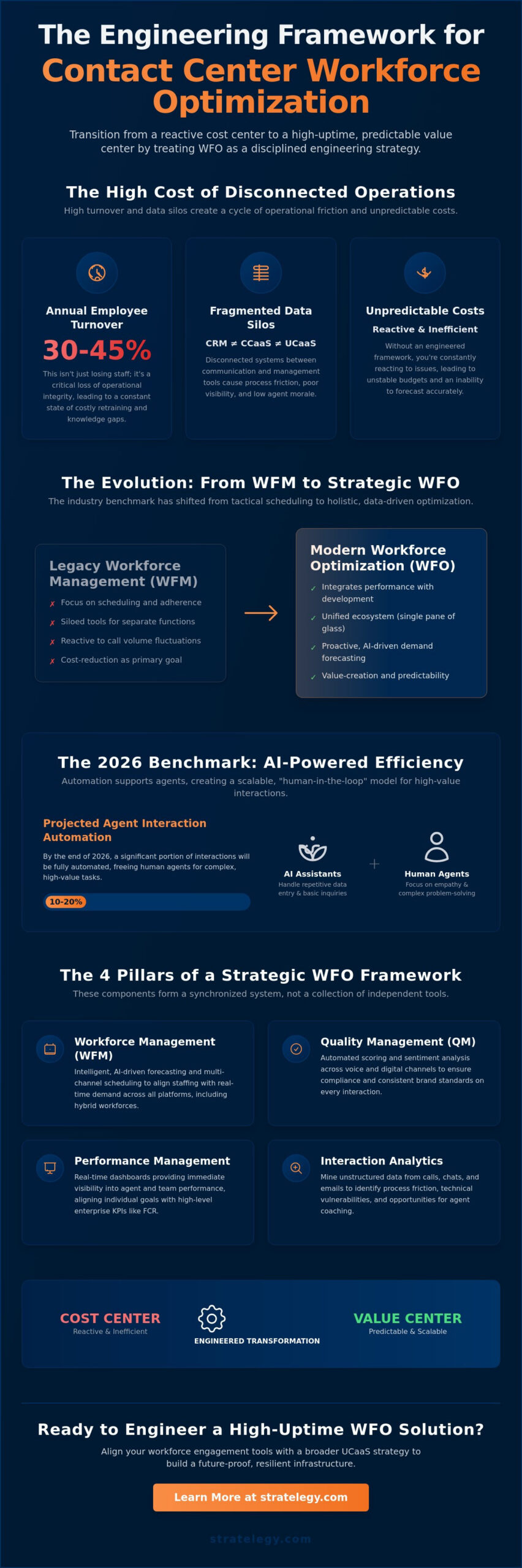
If your annual employee turnover is still hovering between 30% and 45%, you aren’t just losing staff; you’re losing the structural integrity of your operation. High turnover and fragmented data silos create a cycle of unpredictable costs that even the most advanced tools can’t fix on their own. Achieving excellence in contact center workforce optimization requires moving past basic management tactics and toward a disciplined engineering framework. It’s about building a foundation where technology and human talent work in a synchronized, predictable rhythm.
You already know that disconnected systems between your communication tools and management software lead to operational friction and low morale. We’ll help you master the framework for maximizing agent performance and infrastructure reliability through integrated workforce optimization. This guide breaks down the transition from legacy cost centers to scalable value centers. You’ll learn how to leverage CCaaS and UCaaS to improve key metrics like First Call Resolution and Average Handle Time while securing a future-proof infrastructure for your hybrid workforce.
Key Takeaways
- Transition from reactive scheduling to proactive, AI-driven demand forecasting by treating contact center workforce optimization as a disciplined engineering strategy.
- Integrate automated sentiment analysis and intelligent multi-channel scheduling to maintain high-performance quality management across all digital touchpoints.
- Audit existing data silos between your CRM and CCaaS platforms to establish precise baselines for agent occupancy and customer satisfaction.
- Leverage a phased implementation approach to ensure your infrastructure remains scalable and resilient in an evolving hybrid work environment.
- Align your workforce engagement tools with a broader UCaaS strategy to transform your operation from a cost center into a high-uptime value center.
What is Contact Center Workforce Optimization in 2026?
Modern contact center workforce optimization is no longer a collection of disparate software modules. It is a unified engineering discipline. In 2026, the benchmark for success has shifted from simple cost reduction to infrastructure predictability and governance. Leading organizations have moved away from siloed tools, opting instead for integrated cloud contact center ecosystems that synchronize workforce management (WFM), quality assurance, and performance analytics into a single pane of glass.
Strategic WFO ensures that your operational capacity matches fluctuating market demands without compromising service stability. By the end of 2026, research indicates that 10% to 20% of all agent interactions will be fully automated. This shift requires a proactive approach to demand forecasting. You aren’t just reacting to call volume; you are engineering a system that anticipates it through deep integration between your CCaaS platform and core business data.
The Evolution from WFM to WFO
Traditional workforce management focused almost exclusively on the mechanics of scheduling and adherence. Workforce optimization (WFO) represents a holistic expansion of that scope. It integrates performance data with agent development. Instead of just tracking when an agent is at their desk, WFO uses data-driven insights to inform personalized coaching and career pathing. This structural approach reduces the friction that typically leads to high turnover and low morale by providing agents with clear, achievable growth trajectories.
The Role of AI and Automation in 2026
AI is the engine behind modern efficiency, but its role is supportive rather than purely extractive. In 2026, contact centers use AI assistants to handle repetitive data entry and basic inquiries, allowing human agents to focus on high-value, complex interactions. Predictive analytics now allow supervisors to anticipate customer needs before an interaction even begins. This “human-in-the-loop” model ensures that while automation handles the volume, technical expertise and empathy handle the value. It creates a scalable operation that remains grounded in reliability and long-term business health.
Core Components of a Strategic WFO Framework
Operational excellence relies on four foundational pillars that convert raw interaction data into predictability. These components don’t function as independent tools. Instead, they form a synchronized system designed to stabilize your infrastructure and maximize human performance. A robust contact center workforce optimization strategy requires a deep integration between these core elements to eliminate the data silos that often plague legacy systems.
- Workforce Management (WFM): This pillar provides the intelligent forecasting and multi-channel scheduling necessary to align staffing levels with actual demand across all platforms.
- Quality Management (QM): Modern QM uses automated scoring and sentiment analysis across voice and digital channels to ensure every interaction meets high brand standards.
- Performance Management: Real-time dashboards provide immediate visibility, aligning individual agent goals with high-level enterprise KPIs like First Call Resolution (FCR).
- Interaction Analytics: By mining unstructured data from calls and chats, you can identify process friction and technical vulnerabilities before they impact your bottom line.
Unified Quality and Performance Monitoring
Quality Management is the systematic oversight of interaction quality to ensure regulatory compliance and CX excellence. Monitoring interactions is only the first step. To achieve real gains, you must close the loop by linking quality scores directly to agent coaching and development programs. Insights from Gartner on Workforce Engagement Management highlight that businesses prioritizing this feedback loop see higher agent retention and more consistent service delivery.
Forecasting for a Hybrid Workforce
Managing the complexity of remote and in-office agents within a single schedule is a technical challenge. It’s no longer enough to track headcount at a central location. Utilizing unified communications as a service allows management to maintain visibility and operational control regardless of where an agent is logged in. This connectivity ensures that your scheduling is as resilient as your infrastructure. If you’re ready to modernize your foundation, Stratelegy provides the engineering expertise to integrate these systems seamlessly.
Implementing WFO: A Phased Approach to Operational Excellence
Implementation of contact center workforce optimization requires more than a software installation. It is a systematic transition that begins with auditing your existing data silos. You must identify exactly where integration gaps exist between your CRM and CCaaS platforms to prevent fragmented customer journeys. Once these gaps are mapped, establish a baseline for core metrics such as CSAT, Net Promoter Score (NPS), and Agent Occupancy. These benchmarks provide the empirical evidence needed to measure the success of your optimization efforts over the long term.
The 2026 operational landscape demands a shift from static planning to dynamic iteration. According to the latest advancements in contact center workforce optimization, the most successful implementations utilize automated feedback loops. These loops refine scheduling and coaching models in real time based on live performance data. This ensures that your workforce remains aligned with fluctuating demand without manual intervention.
Step 1: Infrastructure Assessment
A stable WFO strategy is only as reliable as the wires beneath it. Evaluate the current stability of your communication lines to ensure they can handle high-bandwidth AI tools and remote connectivity. Many organizations overlook legacy risks that lead to unexpected downtime. Modernizing your foundation often involves a strategic pots line replacement to ensure consistent uptime for critical emergency and voice services. Stratelegy can help you audit your current infrastructure to identify these vulnerabilities before they disrupt your operations.
Step 2: Integration and Governance
Governance is the backbone of technical trust. You must align your WFO tools with corporate security and compliance standards, especially when utilizing AI-enhanced monitoring and sentiment analysis. Data privacy is paramount. Ensure your integrated UCaaS and CCaaS platforms centralize the agent experience without creating new security vulnerabilities. This methodical approach to governance protects your brand from regulatory risks while empowering your workforce with reliable, secure tools that support long-term operational health.
The Stratelegy Advantage: Engineering High-Uptime WFO Solutions
Stratelegy approaches contact center workforce optimization as a structural engineering challenge. We don’t view your communication hub as a mere software stack. It is critical business infrastructure that requires the same level of discipline as a physical power grid. By integrating WFO into a broader unified communications and collaboration strategy, we ensure that every interaction is backed by a resilient, high-uptime network. Our “Foundational Engineer” methodology prioritizes structural reliability and predictable maintenance over short-term trends. We leverage LTE-based connectivity to ensure your management tools and agent interfaces remain active even during local network failures, providing the peace of mind that comes with true redundancy.
Predictability Over Superficial Features
We focus on the metrics that drive long-term business health and ROI. While many vendors sell flashy interfaces, we prioritize system stability and data integrity. Our proactive hardware and software lifecycle management eliminates the fear of obsolescence. We anticipate technical bottlenecks before they occur, ensuring your contact center workforce optimization strategy remains functional and relevant for years. This commitment to longevity protects your financial investment and stabilizes your operational costs through disciplined oversight.
A Partnership for Performance
Choosing Stratelegy means moving beyond a simple vendor-client relationship. We act as a strategic technical partner. Our managed approach significantly reduces the burden on your internal IT teams by handling the complex oversight of CCaaS and UCaaS integrations. We provide the expertise you need to navigate regulatory changes and technical shifts with confidence. By prioritizing engineering excellence, we help you achieve a scalable operation that delivers consistent results without the frantic energy of unmanaged systems.
Engineering Your Operational Resilience
Success in 2026 depends on the stability of your communication foundation. We’ve explored how a phased implementation and a unified framework turn a chaotic cost center into a predictable value center. True contact center workforce optimization requires a deep integration of CCaaS and UCaaS platforms to ensure your agents remain productive regardless of their physical location. This structural approach eliminates data silos and provides the governance necessary for long-term growth.
Stratelegy provides the technical expertise to secure your infrastructure against obsolescence. Our foundational engineering approach prioritizes structural reliability and national LTE-based connectivity for critical communication. This ensures your operation remains resilient during network failures and scales with your business needs. Partner with Stratelegy to engineer a predictable, high-performance contact center today. Building a stable future starts with a technical partner who understands that your communication tools are the backbone of your enterprise. We look forward to helping you achieve lasting excellence through disciplined engineering.
Frequently Asked Questions
What is the difference between WFM and WFO in a contact center?
Workforce Management (WFM) is a tactical subset of the broader contact center workforce optimization framework. WFM focuses primarily on the mechanics of forecasting demand and scheduling staff. In contrast, WFO is a holistic strategy that integrates WFM with quality monitoring and interaction analytics. This unified approach allows you to move beyond simple headcount management and focus on the long-term performance and development of your human capital.
How does workforce optimization improve the customer experience?
Optimization improves the customer experience by aligning agent skills with specific caller needs. By utilizing interaction analytics to identify friction in the customer journey, you can refine processes to improve First Call Resolution (FCR). When your infrastructure supports precise scheduling and automated quality assurance, customers experience shorter wait times and more competent service. This results in a more predictable and satisfying interaction for every user.
Can WFO tools be integrated with legacy phone systems?
Direct integration with legacy copper-based systems is often limited by technical silos and hardware obsolescence. To achieve full functionality, most organizations transition to integrated CCaaS and UCaaS environments. For critical infrastructure that still requires analog-style connectivity, LTE POTS replacement offers a reliable way to modernize your foundation. This allows your WFO tools to access the data they need while maintaining high-uptime communication lines.
What role does AI play in modern contact center workforce optimization?
AI acts as a force multiplier by automating the analysis of unstructured data across all digital channels. It enables sentiment analysis and predictive forecasting, which allows managers to anticipate volume spikes before they occur. By the end of 2026, AI is expected to automate up to 20% of routine interactions. This shift allows human agents to focus on high-value tasks while the system maintains operational equilibrium through intelligent, real-time adjustments.
Is workforce optimization suitable for small to mid-sized contact centers?
Small and mid-sized operations benefit significantly from workforce optimization by eliminating the waste associated with manual scheduling. Scalable CCaaS platforms allow smaller teams to access the same advanced analytics and quality management tools used by enterprise-level centers. This engineering-first approach ensures that even smaller workforces can maintain high performance and predictable operational costs. It provides a stable path for growth without the need for excessive internal IT overhead.