

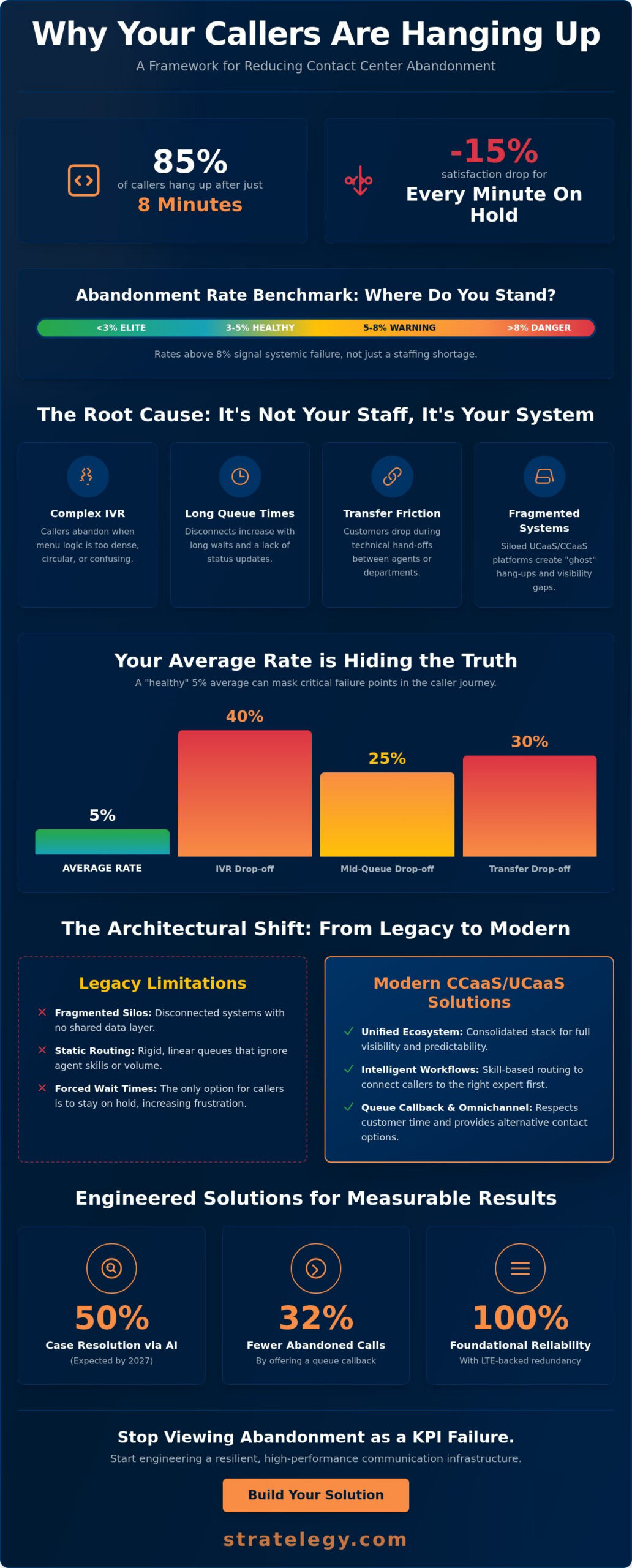
85% of your callers will hang up after eight minutes; even more concerning is that customer satisfaction drops by 15% for every single minute a person waits on hold. You’ve likely seen the impact of these numbers in your own operations through unpredictable spikes in wait times and the frustration of fragmented data across legacy systems. Implementing effective solutions for high call abandonment rate is no longer about hiring more staff. It’s about addressing the structural obsolescence in your communication stack that creates these persistent points of friction.
Operational excellence requires a communication infrastructure that is both stable and predictable. This article outlines a 2026 engineering framework to transform your contact center into a high-performance growth engine by leveraging modern CCaaS and UCaaS architectures. We will explore how to lower abandonment rates to the healthy 2-5% benchmark while establishing a strategic partnership that handles the technical heavy lifting for you. By replacing legacy limitations with engineered reliability, you can ensure your business remains resilient and eliminates the fear of becoming obsolete in a rapidly evolving digital market.
Key Takeaways
- Stop viewing abandonment as a KPI failure and start seeing it as a structural symptom. Learn why elite enterprises now target an abandonment rate of under 3% to maintain a competitive edge.
- Implement engineered solutions for high call abandonment rate through data-driven CCaaS distribution. Intelligent workflows and queue callbacks respect the caller’s time and eliminate friction points.
- Audit your infrastructure for point-of-failure bottlenecks. Consolidating your stack into a UCaaS ecosystem creates the predictability required for long-term operational growth.
- Prioritize foundational reliability with LTE-backed redundancy. True recovery requires moving beyond superficial software fixes toward a managed ecosystem supported by technical experts.
Diagnosing the Structural Roots of Call Abandonment in 2026
Your call abandonment rate is more than a KPI; it’s a diagnostic probe into the integrity of your business infrastructure. In 2026, best-in-class enterprises target an abandonment rate of under 3% to stay competitive in a digital-first economy. When your metrics climb above the 8% threshold, it signals systemic failure rather than a simple staffing shortage. Finding effective solutions for high call abandonment rate requires an audit of three critical failure points: IVR navigation complexity, excessive queue duration, and transfer friction. Legacy hardware latency directly constricts the window of caller patience, forcing abandonment before an agent even receives the initial data packet.
The Hidden Cost of Fragmented Communication Silos
Disconnected UCaaS and CCaaS platforms create visibility gaps that hide the true causes of abandonment. When your internal communication and customer-facing systems don’t share a common data layer, you lose the ability to track a caller’s journey through a transfer. High-latency legacy lines often trigger “ghost” hang-ups, where packet loss makes a caller believe the connection has failed. For those focused on understanding call center operations, it’s evident that structural reliability is the only way to prevent these technical drop-offs. Integrating your stack into a unified communications as a service ecosystem eliminates these silos and ensures every interaction is logged and analyzed.
Why Aggregate Metrics Mask Operational Vulnerabilities
Relying on a single average abandonment number is a dangerous operational oversight. A 5% aggregate rate might seem acceptable, yet it could mask a 40% drop-off rate within a specific IVR menu. You must identify your unique “abandonment curve,” which is the exact second your specific audience loses patience and disconnects. By breaking down the data, you can distinguish between different types of drops:
- IVR Abandonment: Callers who hang up because the menu logic is too dense or circular.
- Mid-Queue Drops: Callers who disconnect after a specific wait time, often correlating with poor hold music or lack of status updates.
- Transfer Abandonment: Callers who drop during the technical hand-off between departments or agents.
Pinpointing these specific moments of friction allows for targeted engineering interventions rather than broad, expensive staffing increases. Modern solutions for high call abandonment rate prioritize this granular visibility to ensure your infrastructure supports, rather than hinders, the customer experience.
Architectural Solutions: Leveraging CCaaS to Eliminate Friction
Engineering a resilient response to call spikes requires moving beyond static routing. Rigid legacy systems often trap callers in linear queues that don’t account for agent expertise or current volume. Modern cloud contact center architectures solve this by providing the elasticity needed to scale during peak events without manual intervention. By adopting intelligent workflows, you transition from simple distribution to skill-based routing. This ensures the caller reaches the correct specialist on the first attempt, effectively neutralizing the transfer friction identified as a primary cause of drop-offs.
Implementing a queue callback feature is one of the most effective solutions for high call abandonment rate. Verified industry data shows that offering a callback option can reduce call abandonment by as much as 32%. It eliminates the physical hold time entirely, preserving the customer’s time while maintaining their place in the digital queue. To achieve this, your infrastructure must support omnichannel continuity. If a caller is waiting, they should have the option to transition the interaction to SMS or live chat without losing context. Adhering to these contact center best practices ensures your brand remains accessible even during high-traffic periods.
Conversational AI and Advanced Self-Service
Modern AI shouldn’t be a gatekeeper; it should be a resolver. By 2027, it’s expected that AI will resolve 50% of all customer service cases, which is a significant increase from 2025. Utilizing Natural Language Understanding (NLU) allows systems to interpret intent accurately, reducing the circular loops that drive IVR abandonment. This technological layer handles routine inquiries, freeing your human agents for complex problem-solving.
Predictive Analytics for Proactive Capacity Management
Stability is built on foresight. Predictive analytics use historical data to engineer staffing levels before a spike occurs. Real-time monitoring tools alert supervisors the moment an abandonment threshold is breached, allowing for immediate tactical adjustments. If your current stack lacks this visibility, exploring a managed CCaaS migration can provide the oversight necessary to protect your customer lifetime value.
The Strategic Framework for Contact Center Optimization
Optimization requires a disciplined roadmap rather than reactionary adjustments. To begin, you must audit your existing infrastructure for latency and point-of-failure bottlenecks that trigger technical disconnects. These structural vulnerabilities often hide within legacy hardware that can’t handle modern packet loads. Once identified, consolidate your voice and data into a unified communications as a service ecosystem. This shift eliminates the data gaps identified in previous sections and creates a single, secure point of governance for your entire enterprise.
Deploying virtual queuing and automated callback systems serves as a primary pillar in your engineering strategy. These are critical solutions for high call abandonment rate because they shift the burden of waiting from the customer to the system. To maintain this performance, establish a continuous maintenance framework. Engineering 99.999% uptime ensures your lines are always available, while systematic hardware update policies prevent the gradual degradation of service quality. You can engineer a resilient communication infrastructure by partnering with specialists who prioritize structural health over superficial features.
Managing the Psychology of the Wait
Unexplained wait times feel significantly longer than those with clear expectations. You should replace generic hold music with productive information delivery or status updates. Use AI-driven engines to provide accurate, real-time wait-time estimations. This transparency builds trust and reduces the anxiety that leads to mid-queue abandonment, turning a point of friction into a controlled experience.
Reducing Transfer Abandonment Through Warm Handoffs
Context sharing is the definitive antidote to transfer friction. By integrating CRM data directly into your CCaaS stack, agents receive the caller’s full history before the first word is spoken. This engineering approach ensures warm handoffs where the caller never has to repeat their issue. Reducing the total handle time through integrated data not only lowers frustration but also increases the overall capacity of your agent pool without additional hiring.
Engineering Your Recovery: Transitioning to a Managed Ecosystem
Software alone cannot resolve structural failures. While digital tools provide the interface for customer engagement, they remain vulnerable to the limitations of the underlying physical connection. True solutions for high call abandonment rate require foundational reliability, specifically through LTE-backed redundancy that ensures your contact center stays online even when primary fiber lines fail. This engineering-first approach shifts the focus from superficial software features to the structural integrity of the communication line itself.
Transitioning to a managed ecosystem means moving away from a simple vendor-client relationship and toward a strategic technical partnership. We prioritize the long-term health of your business infrastructure by replacing the “End of Life” mindset with proactive modernization. Implementing a pots line replacement strategy secures the future of your communication stack, eliminating the instability of decaying copper networks. By closing the loop on abandoned call data, we turn every disconnect into an actionable engineering requirement to prevent future recurrence.
Governance, Security, and Predictability
Cloud-based engagement requires rigorous governance to maintain regulatory compliance and data security. Our proprietary maintenance frameworks are designed to anticipate potential outages before they can impact your abandonment rate or customer satisfaction scores. We provide the oversight necessary to ensure your infrastructure remains a stable, predictable growth engine rather than a point of systemic vulnerability. This disciplined approach eliminates the fear of obsolescence and provides the peace of mind that comes from professional lifecycle management.
The Path Forward: From Legacy to Leading-Edge
Leaders must stop patching obsolete systems and start engineering their customer experience from the ground up. A modernized, zero-abandonment-focused infrastructure delivers a measurable ROI by increasing customer lifetime value and reducing the high cost of live-agent interactions. By moving from legacy limitations to leading-edge reliability, you ensure your business isn’t just surviving the digital transition but leading it. Excellence is achieved through engineering, not just sales, and your communication stack should be the strongest foundation of your enterprise.
Securing Your Infrastructure for a Digital-First Future
Call abandonment is a symptom of architectural decay rather than a simple customer service hurdle. By shifting from reactive patching to a disciplined engineering framework, you address the root causes of friction at the foundational level. We’ve established that consolidating your communication stack into a unified ecosystem and leveraging LTE-backed redundancy are the only ways to drop abandonment rates below the 3% benchmark. These strategic shifts ensure your business remains resilient against unpredictable volume spikes and the failures of legacy hardware.
Achieving operational excellence requires more than software; it demands a commitment to long-term uptime and security. Implementing sustainable solutions for high call abandonment rate involves a strategic partnership with experts who prioritize structural health over superficial features. Stratelegy provides the technical authority needed to manage this transition, offering proprietary maintenance frameworks designed for 99.999% uptime. From critical LTE POTS replacement to seamless enterprise-grade CCaaS and UCaaS integration, we handle the technical heavy lifting of infrastructure lifecycle management.
Partner with Stratelegy to engineer a frictionless contact center today. Secure your operational future and transform your communication stack into a high-performance growth engine. Your path to a predictable, zero-abandonment-focused infrastructure starts with foundational engineering.
Frequently Asked Questions
What is considered a high call abandonment rate in 2026?
A call abandonment rate exceeding 8% is currently considered high and indicates significant underlying issues in your communication infrastructure. Best-in-class enterprises target a healthy range between 2% and 5% by utilizing AI-augmented routing and high-performance architectures. If your metrics consistently sit above the 8% threshold, it’s a sign that your current technology is failing to meet modern caller expectations for speed and reliability.
How does high call abandonment directly impact my bottom line?
High abandonment correlates directly with a decrease in customer lifetime value and an increase in operational overhead. Verified data shows that customer satisfaction drops by 15% for every minute a caller remains on hold. Abandoned calls often result in repeat attempts. This inflates your total interaction volume and increases the cost per contact, which averages 13.50 USD for live agent interactions in 2026.
Can switching to a cloud-based contact center immediately lower abandonment?
Transitioning to a CCaaS architecture provides the immediate elasticity required to handle unpredictable volume spikes that legacy hardware cannot manage. These cloud-based solutions for high call abandonment rate integrate features like virtual queuing and automated callback, which can reduce abandonment by 32%. By eliminating the physical hold time, you preserve the customer relationship while optimizing your agent’s distribution efficiency through skill-based routing.
What is the difference between IVR abandonment and queue abandonment?
IVR abandonment occurs while a caller is navigating the automated menu, whereas queue abandonment happens after they’ve been placed on hold for a live agent. High IVR drop rates typically signal overly complex menu logic or a lack of effective Natural Language Understanding (NLU). In contrast, queue abandonment is usually a symptom of excessive wait times or a failure to provide transparency regarding the expected time to answer.
How does infrastructure reliability (like LTE backup) prevent call drops?
Many calls recorded as abandoned are actually technical drops caused by packet loss or legacy line failures. Implementing LTE POTS replacement provides a secure, redundant failover that ensures 99.999% uptime for your critical communication lines. This foundational engineering prevents “ghost” hang-ups and maintains connection integrity during fiber outages. It ensures that your contact center remains a stable point of growth rather than a source of systemic friction.