
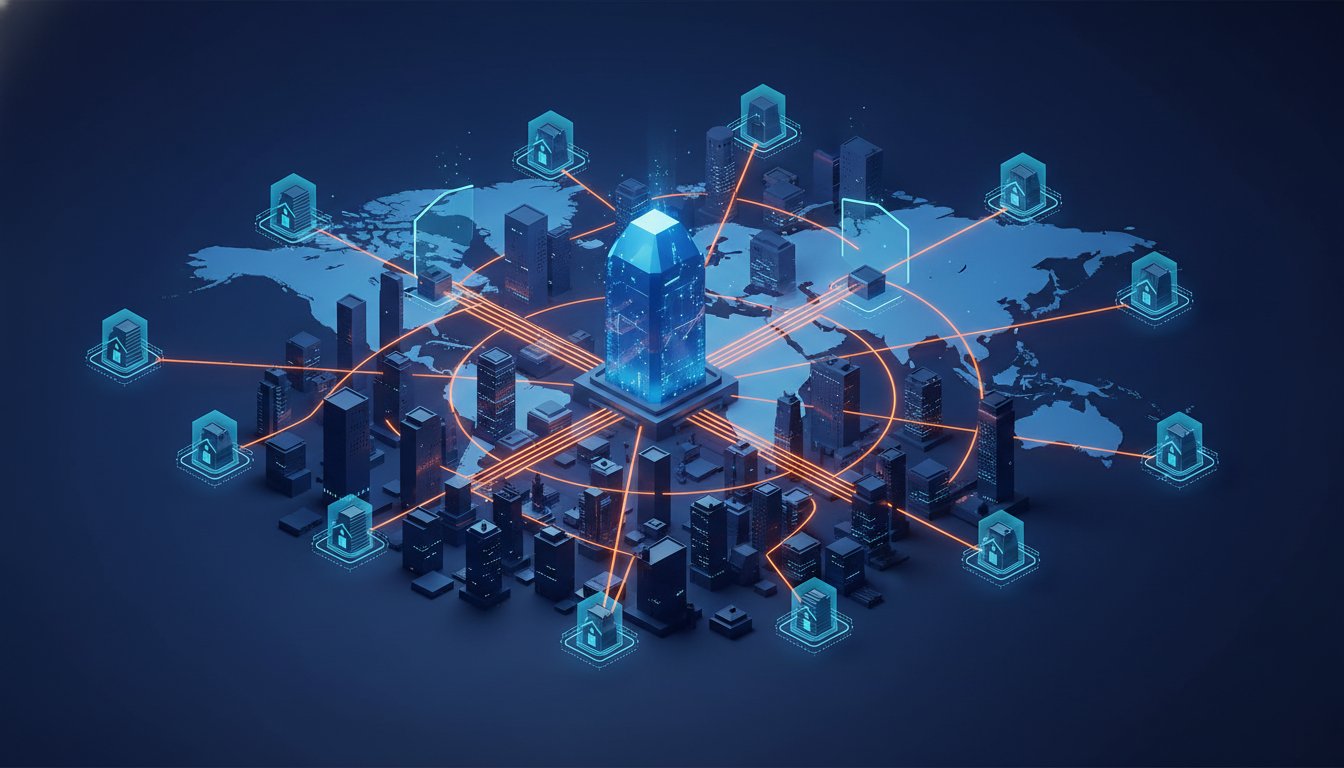
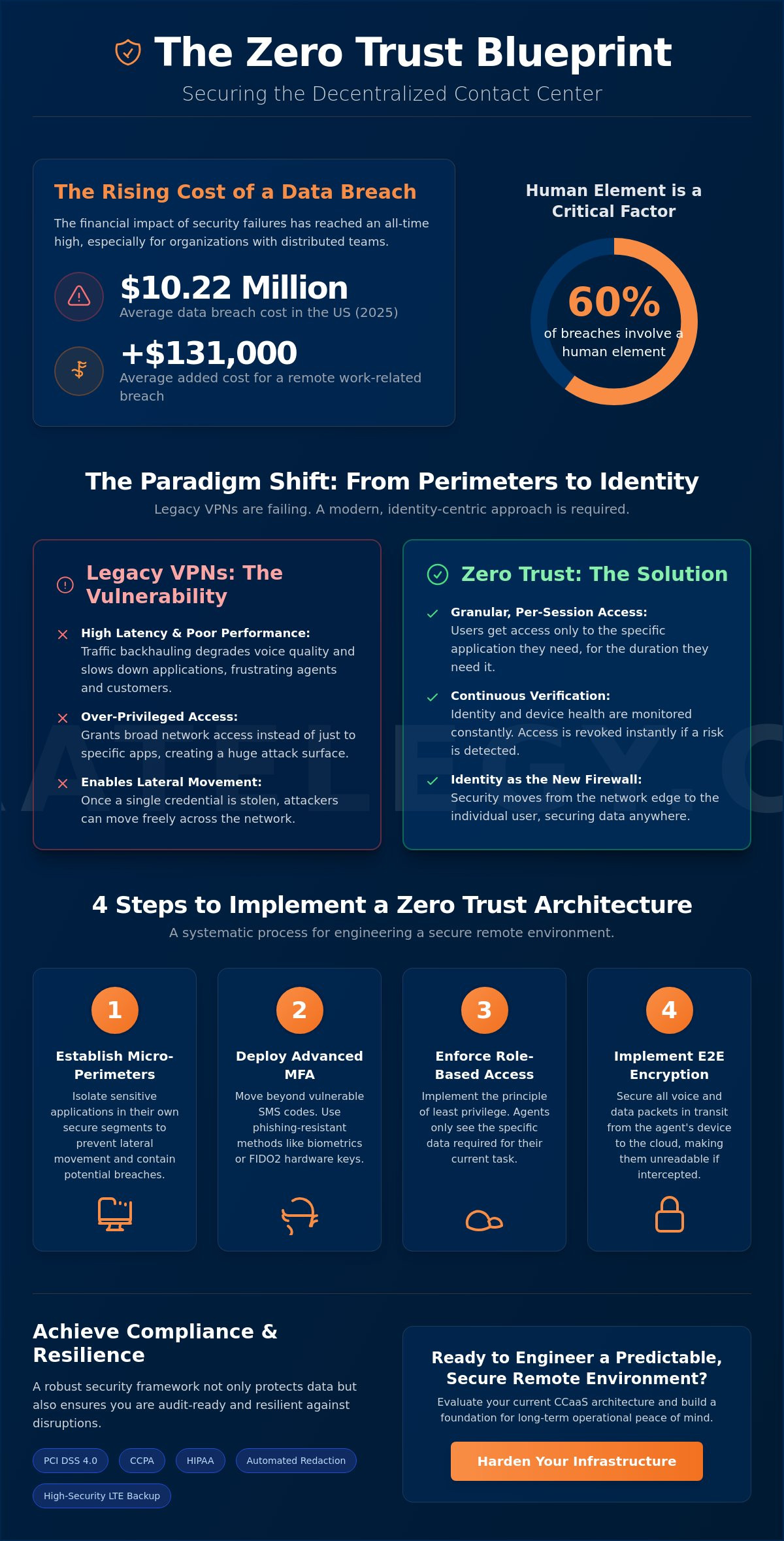
The average cost of a data breach in the United States reached a record $10.22 million in 2025. For organizations managing distributed teams, remote work adds an average of $131,000 to that recovery bill. You know that maintaining data security for remote contact center agents is no longer a simple software setting; it’s a structural engineering challenge. Legacy VPNs create high latency and leave gaps in your defense. True protection requires moving from perimeter-based models to identity-centric Zero Trust architectures that secure the foundation of your operations.
You need to maintain PCI DSS v4.0.1 and 2026 CCPA compliance without compromising agent productivity or exposing PII on personal devices. This article outlines a strategic framework to secure your CCaaS environment using infrastructure-first protocols. We’ll show you how to build a scalable, zero-latency security model that remains fully audit-ready. We’ll preview how to handle new regulatory demands, such as the expanded definition of sensitive information and the elimination of lookback limits, to ensure long-term operational predictability and peace of mind.
Key Takeaways
- Identify why legacy VPNs are a primary vulnerability in 2026 and how to transition toward a decentralized, identity-centric security model.
- Learn to implement Zero Trust through micro-perimeters and hardware-based MFA to secure sensitive customer data applications.
- Navigate the complexities of PCI DSS 4.0 and HIPAA compliance using automated redaction for call and screen recordings in home environments.
- Strengthen data security for remote contact center agents by integrating CCaaS with high-security LTE backup to eliminate vulnerabilities during primary ISP outages.
- Discover how proprietary maintenance frameworks provide the ongoing oversight needed to keep remote infrastructure patched and audit-ready.
The Decentralized Perimeter: Data Security Challenges in 2026
The enterprise firewall is dead. In its place, we have a decentralized perimeter where identity, not location, dictates access. This shift fundamentally changes how we approach data security for remote contact center agents. We’ve moved away from protecting a physical office to securing a distributed web of individual access points. Managing security in this environment requires a shift from trust-by-default to a model of constant, granular validation.
Security leaders must account for three primary threat vectors in this distributed model:
- Unmanaged home hardware: Personal routers and IoT devices that lack enterprise-grade patching and monitoring.
- Public internet transit: Data packets traveling across unencrypted or poorly secured residential connections.
- Social engineering: Sophisticated phishing and voice cloning attacks that target isolated employees.
Traditional VPNs are the primary vulnerability for remote contact centers because they allow lateral movement. Once a single credential is compromised, an attacker can often traverse the entire network. Zero Trust Network Access (ZTNA) is the new enterprise standard for remote CX that replaces these broad tunnels with granular, per-session authentication based on continuous verification.
Why Legacy VPNs Fail Modern Contact Centers
Legacy VPNs create a bottleneck effect that is incompatible with a high-performance cloud contact center. Because all traffic must backhaul to a central data center before reaching the cloud, latency increases and voice quality degrades. This jitter disrupts customer interactions and creates unnecessary friction for your agents.
Beyond performance issues, VPNs rely on over-privileged access. They grant agents entrance to large network segments rather than specific applications. This architecture is a liability; it assumes that once a user is inside the tunnel, they are inherently trustworthy. In a landscape where the human element is involved in over 60% of breaches, this assumption is a structural failure that compromises your entire operation.
Implementing Zero Trust for Remote Contact Center Agents
Transitioning to a Zero Trust model requires a systematic overhaul of your access architecture. It isn’t enough to simply replace a VPN; you must re-engineer how every packet and user interaction is validated. True data security for remote contact center agents relies on a four-step implementation process that prioritizes structural reliability over superficial software fixes.
- Step 1: Establish Micro-Perimeters. Isolate sensitive customer data applications within their own secure segments. This prevents a single compromised endpoint from accessing your entire database.
- Step 2: Deploy Advanced MFA. Move beyond SMS-based authentication, which is vulnerable to SIM swapping. Use biometric verification or FIDO2 hardware keys to ensure the person accessing the system is who they claim to be.
- Step 3: Enforce Role-Based Access Control (RBAC). Limit data visibility based on the specific needs of the agent’s current interaction. If an agent doesn’t need to see a full credit card number to resolve a ticket, the system shouldn’t display it.
- Step 4: Implement End-to-End Encryption (E2EE). Secure all voice and data packets in transit. This ensures that even if data is intercepted over a public ISP, it remains unreadable to unauthorized parties.
Engineering a secure environment means anticipating vulnerabilities before they’re exploited. For organizations seeking to harden their infrastructure, evaluating your current CCaaS architecture is the first step toward achieving a predictable, secure remote environment.
Identity as the New Firewall
Modern unified communications as a service platforms serve as the foundation of this new security logic. By integrating with enterprise Identity Providers (IdP), these systems verify every request in real time. This moves the security focus from the network edge to the individual user identity.
Security isn’t a one-time event at login. Continuous verification monitors session behavior and device health throughout the entire workday. If a device’s security posture changes, access is revoked instantly. This level of oversight is essential for understanding unified communications and collaboration in a high-risk environment. It ensures that the integrity of your CX operations remains intact regardless of the agent’s physical location.
Compliance and Governance in Distributed Support Environments
Compliance in a distributed model is a continuous engineering process, not a static checkbox. As of 2026, organizations must adhere to the full set of PCI DSS v4.0.1 requirements, which demand stricter validation of remote environments than previous standards. Maintaining data security for remote contact center agents requires moving beyond basic encryption. It necessitates automated redaction of sensitive financial data during call and screen recordings. This ensures that PII is never stored in unmanaged home settings, effectively neutralizing the risk of exposure on personal devices.
Infrastructure reliability is now a core compliance pillar. For critical support lines, “Life Safety” uptime is a regulatory expectation. Securing the backend connectivity of your distributed operation often requires a strategic pots line replacement to ensure failover capabilities that residential ISPs can’t provide. This structural approach guarantees that your compliance posture remains stable even during local network outages. If your current infrastructure lacks the documentation needed for upcoming audits, consult with our engineering team to build a compliance-hardened environment.
Audit-Ready Reporting and Monitoring
Real-time threat monitoring is essential for identifying anomalies in remote agent behavior. Modern voip systems provide granular audit trails that serve as regulatory proof of secure handling. These systems track every interaction, providing a transparent record of who accessed what data and when. This proactive oversight eliminates the stress of manual reporting. It ensures your business stays ahead of 2026 CCPA requirements, including the expanded definition of sensitive personal information and stricter consent rules. By automating the data lifecycle, you transform compliance from a burden into a predictable operational advantage.
Stratelegy’s Engineering-First Approach to Remote Security
Stratelegy builds foundational reliability into every remote agent seat. We reject the idea that security is merely a software toggle. True data security for remote contact center agents requires an engineering-first approach that secures the underlying connection itself. By addressing structural vulnerabilities at the network layer, we provide a level of predictability that software-only vendors cannot match. Our focus is on the long-term health of your infrastructure, ensuring your operations remain stable and secure against evolving threats.
We integrate our CCaaS solutions with high-security LTE backup to prevent dangerous security gaps during primary ISP outages. When a residential connection fails, agents frequently pivot to unmanaged hotspots or insecure public networks to stay online. This creates an immediate breach of your security protocols. Our managed LTE failover ensures that every agent remains within a secure, encrypted environment regardless of local ISP performance. This maintains the Zero Trust perimeter automatically, without requiring the agent to make risky connectivity decisions.
For international remote workers who need reliable alternatives to public Wi-Fi, always-mobile.com provides secure eSIM data plans that help bridge the gap between primary connection failures and maintaining a hardened security posture.
Our proprietary maintenance frameworks ensure that remote agent software is always patched and compliant. We act as a strategic specialist rather than a simple vendor. This means we manage the entire lifecycle of your security infrastructure, from initial deployment to systematic hardware updates. We’ve designed these frameworks to provide ongoing oversight, ensuring that every endpoint adheres to your specific governance policies. This disciplined approach eliminates the risk of technical obsolescence and ensures your operation remains audit-ready at all times. By focusing on engineering excellence rather than just sales, we build a foundation that supports your long-term business health.
Securing the Future of Distributed CX
The industry is moving from managing hardware to engineering outcomes. This shift requires a partner who understands the relationship between infrastructure stability and financial business terminology. We provide the technical authority and ongoing maintenance necessary to protect your CX investments and eliminate the fear of systemic failure. Our methodical approach guides your business from legacy operational challenges to a comprehensive, managed solution.
Consult with a Stratelegy expert to secure your remote contact center infrastructure and move toward a more predictable, secure operational model.
Securing Your Distributed CX Infrastructure for 2026
Protecting a distributed workforce is a structural challenge that requires more than just software updates. You’ve seen how legacy VPNs create systemic vulnerabilities and how Zero Trust Network Access (ZTNA) provides the necessary micro-perimeters for modern operations. Maintaining data security for remote contact center agents means integrating these identity-centric controls with robust infrastructure, such as LTE-based backup, to ensure your agents never drift into unmanaged home networks during primary ISP outages.
Stratelegy provides the foundational engineering required to eliminate the fear of obsolescence and ensure long-term operational health. Our enterprise-grade CCaaS solutions feature built-in ZTNA and national LTE-based backup for critical life safety uptime. We use proprietary infrastructure maintenance frameworks to manage the lifecycle of your security hardware; this ensures you remain audit-ready and predictable. Secure your enterprise contact center with Stratelegy’s technical experts to achieve a resilient, compliant, and zero-latency environment. You can scale your operations with confidence when your security is built on a foundation of engineering excellence.
Frequently Asked Questions
Is a VPN enough to secure remote contact center agents in 2026?
No, a VPN is insufficient for modern distributed operations. VPNs create a single point of failure and often grant over-privileged access to the entire network once a user is authenticated. In 2026, attackers exploit these tunnels to move laterally across systems. To achieve true data security for remote contact center agents, you must transition to Zero Trust Network Access (ZTNA), which validates every request individually regardless of the user’s location.
How do you maintain PCI compliance when agents work from home?
Maintaining PCI compliance in unmanaged environments requires a combination of automated data masking and infrastructure-level controls. You must implement automated redaction for all call and screen recordings to ensure sensitive payment information is never stored on remote devices. Under PCI DSS v4.0.1, organizations are also required to validate that remote access points are as secure as on-site workstations. This involves using managed hardware and encrypted CCaaS platforms to ensure a predictable audit trail.
What is the difference between Zero Trust and traditional call center security?
Traditional security focuses on a “castle and moat” strategy that trusts anyone inside the office network. Zero Trust operates on the principle of “never trust, always verify” for every interaction. While traditional models rely on physical firewalls, Zero Trust uses identity as the primary control plane. This ensures that access is granted based on user identity, device health, and context rather than just a successful initial login event.
Can remote agent security protocols impact voice quality?
Legacy security protocols like VPNs often degrade voice quality by forcing traffic through a central data center, which increases latency and jitter. This bottleneck effect is a common pain point for distributed teams. Modern ZTNA frameworks avoid this by allowing direct, secure connections to cloud resources. This engineering approach ensures that high-level security doesn’t compromise the real-time performance of your UCaaS or CCaaS platform.
What are the most common data security threats for remote agents?
The primary threats in 2026 include sophisticated social engineering attacks, such as AI-driven voice cloning and targeted phishing. Unmanaged home hardware, like personal routers with outdated firmware, also provides an easy entry point for attackers. Additionally, the risk of PII exposure on personal devices remains high. Addressing these requires a comprehensive framework that combines rigorous identity verification with proprietary maintenance policies for all remote endpoints.