
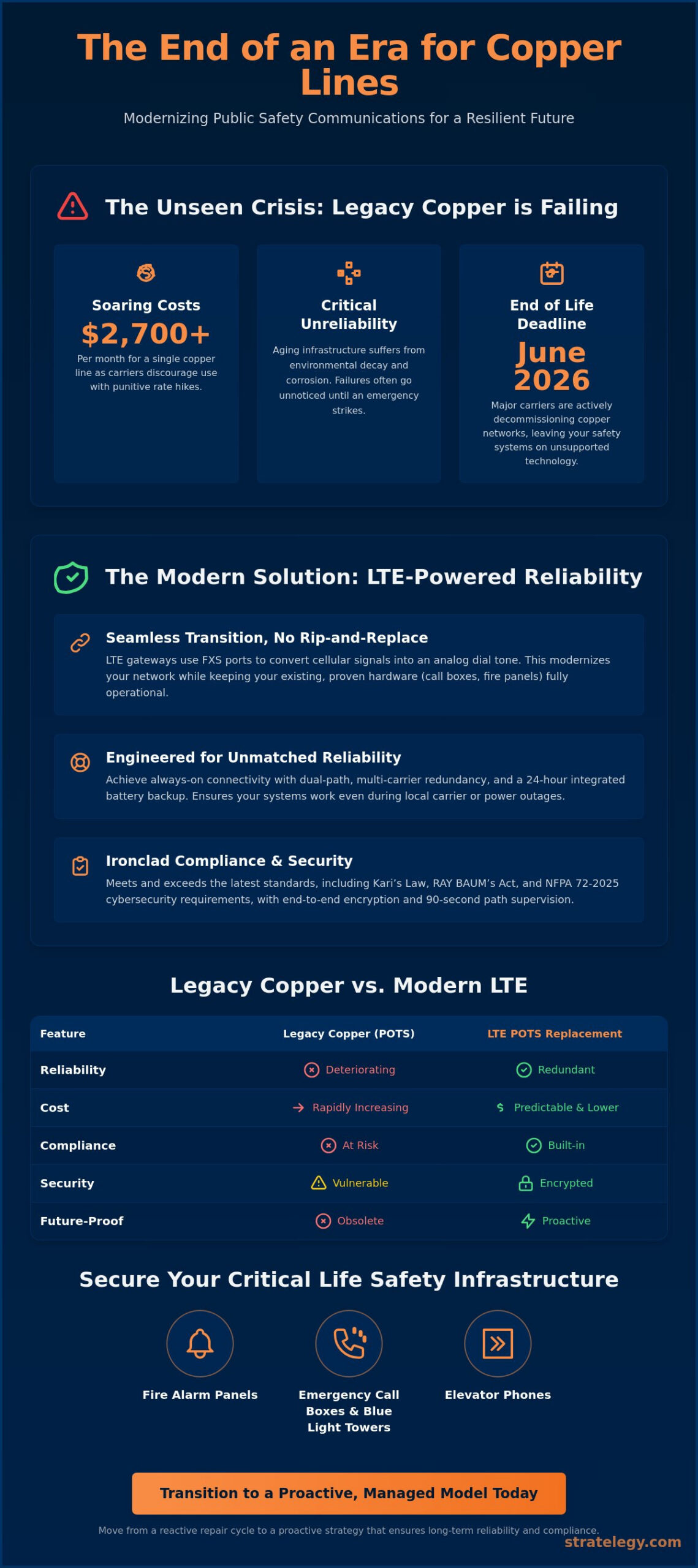
Some organizations now pay over $2,700 per month for a single copper line that carriers have already marked for decommissioning. With major providers issuing discontinuation notices for June 2026, the need for a pots replacement for public safety phones has moved from a strategic goal to an immediate operational requirement. You likely feel the pressure of these rising costs and the growing unreliability of legacy infrastructure. It is a difficult position to manage when your life safety systems depend on technology that carriers no longer prioritize.
This guide explains how to transition to resilient, LTE based infrastructure while keeping your existing hardware intact. You can modernize your systems and achieve significant operational savings by moving to a managed ecosystem designed for long term stability. We will preview the mandatory cybersecurity requirements in the NFPA 72-2025 edition and provide a clear roadmap for maintaining E911 and NFPA compliance. By focusing on structural reliability and proactive engineering, you can secure peace of mind and ensure your emergency systems remain functional during any crisis.
Key Takeaways
- Identify why the FCC’s copper retirement mandates have turned legacy systems into a liability for emergency communications and life safety.
- Explore how LTE technology utilizes FXS ports to provide a seamless transition for existing analog hardware without requiring full equipment replacement.
- Evaluate the necessity of dual-path redundancy and multi-carrier access to maintain connectivity during localized carrier outages or hardware failures.
- Secure your infrastructure by meeting the latest standards for Kari’s Law and RAY BAUM’s Act through a compliant pots replacement for public safety phones.
- Transition from a reactive repair cycle to a proactive managed model that prioritizes long-term structural health and regulatory governance.
The Critical Failure of Legacy Copper in Public Safety Infrastructure
For decades, Plain Old Telephone Service (POTS) served as the gold standard for life safety. These analog lines were prized for their simplicity and their ability to function during local power outages. However, the regulatory environment has shifted. Following the FCC’s orders to deregulate legacy copper networks, major telecommunications carriers have pivoted their resources toward fiber and 5G. This shift has left the nation’s copper footprint in a state of terminal decline.
The transition is no longer a future possibility; it’s an active decommissioning. Carriers aren’t just ignoring repairs; they’re actively sunsetting service areas. This creates a dangerous scenario for emergency infrastructure. When a copper line fails, there’s often no proactive notification from the provider. You might only discover a problem during a real emergency. Implementing a pots replacement for public safety phones is the only way to ensure your critical lines remain functional as the copper era ends.
Why Public Safety Phones are the Weakest Link
Public safety devices often reside in harsh environments where aging infrastructure is most vulnerable. Several factors contribute to this systemic weakness:
- Environmental Decay: Underground copper pairs are prone to moisture intrusion and corrosion. As carriers divest from legacy tech, these physical faults go unaddressed for months.
- Economic Pressure: Maintaining analog lines is increasingly expensive. Carriers pass these costs to customers through dramatic rate hikes to discourage continued use.
- Stranded Assets: Many facilities own functional emergency call boxes that have become “stranded.” The hardware works, but the lack of a reliable dial tone renders them useless.
Choosing a managed pots replacement for public safety phones allows you to bypass these physical vulnerabilities entirely. Relying on copper in 2026 is a gamble with your life safety compliance. The infrastructure is at its end of life. Maintaining the status quo doesn’t just invite high costs; it invites systemic failure when seconds matter most.
LTE POTS Replacement: Engineering Reliability for Life Safety
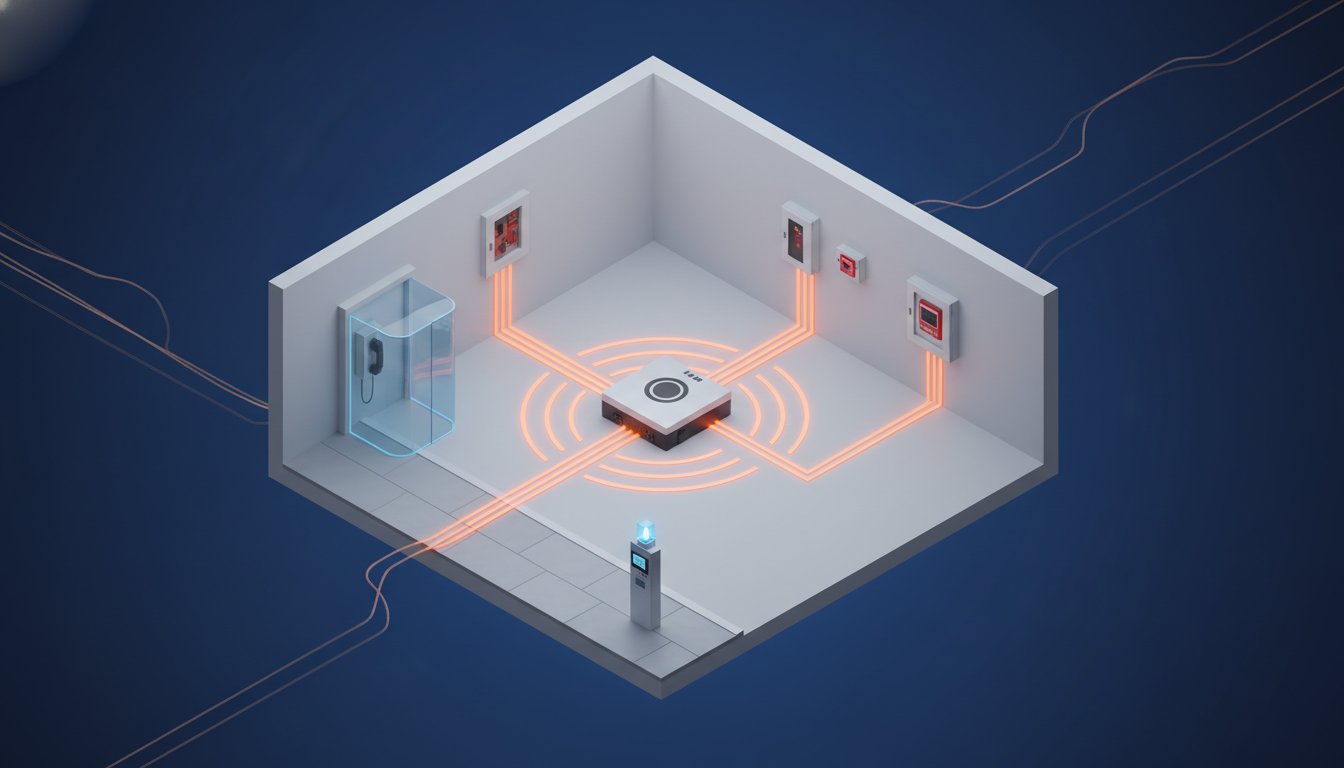
Engineering a resilient life safety network requires more than a simple hardware swap. Modern solutions utilize FXS ports to convert digital cellular signals into the analog dial tone required by legacy hardware. This allows for a pots replacement for public safety phones that doesn’t force a rip-and-replace of expensive end-point devices. It’s a strategic bridge that connects proven analog equipment to a modern, high-speed backbone.
Reliability is non-negotiable. Modern solutions utilize dual-path redundancy to ensure connectivity even if a local carrier tower fails. To meet life safety standards, these systems include integrated battery backups capable of maintaining 24-hour operation during total power loss. Under the NFPA 72-2025 edition, network-connected communicators must also feature 90-second path supervision and documented cybersecurity protocols to prevent unauthorized access.
Data integrity is paramount. All transmissions are secured via end-to-end encryption to protect sensitive public safety communications. This level of security is essential for meeting the requirements of Kari’s Law and RAY BAUM’s Act, ensuring that dispatchable location data remains accurate and protected. For organizations seeking a managed infrastructure partner, these technical safeguards provide a foundation for long-term compliance.
Blue Light Towers and Emergency Call Boxes
Campus safety relies on visible, accessible communication points. LTE gateways can be housed in weather-resistant, NEMA-rated enclosures to withstand extreme environments while utilizing signal-boosting antennas for remote outdoor kiosks. LTE POTS replacement preserves the capital investment of existing blue light towers by extending their operational life through modern connectivity.
Critical Life Safety and Fire Alarm Integration
Fire alarm panels require specific timing and low-latency transmission to communicate effectively with central monitoring stations. Modern LTE solutions are engineered to handle these specialized protocols, ensuring that alarm signals reach their destination in milliseconds. This engineering approach ensures that your pots replacement for public safety phones meets the specific low-latency requirements of fire alarm panels while eliminating the risk of signal failure during high-stress events.
Navigating Compliance: Kari’s Law, RAY BAUM’s Act, and NFPA 72
Compliance is a moving target that demands engineering precision. Kari’s Law mandates that any multi-line telephone system (MLTS) allow for direct 911 dialing without requiring a prefix like “9” or “1.” This is a non-negotiable requirement for all public safety phones. A compliant pots replacement for public safety phones ensures that this direct path is always available, eliminating barriers between a caller and emergency services. This focus on specialized technical niches allows organizations to maintain rigorous regulatory standards without sacrificing operational efficiency.
RAY BAUM’s Act builds on this by requiring “dispatchable location” data. This means a call must provide more than just a street address; it must specify the building, floor, and room number. Modern POTS line replacement solutions utilize digital mapping to transmit this granular data automatically while allowing you to keep your existing analog end-points. This level of detail is critical for NFPA 72 compliance and overall life safety governance. Transitioning to a dedicated pots replacement for public safety phones provides the technical foundation needed to meet these evolving federal mandates without an expensive hardware overhaul.
Dispatchable Location and E911 Accuracy
Generic GPS data often fails in high-rise buildings or sprawling campus environments. It might pinpoint the building but leave responders searching through dozens of floors. Digital replacement solutions solve this by hard-coding specific location identifiers into the signal path. This ensures that when a call box is activated, responders arrive at the exact room, not just the general vicinity. This precision saves minutes that are often the difference between a successful rescue and a tragedy.
Meeting Life Safety Uptime Standards
The NFPA 72-2025 edition introduces rigorous standards for network-connected fire alarm equipment. These include mandatory 90-second communication path supervision and strict secondary power requirements. Your infrastructure must remain operational for 24 hours during a total power failure. This standard applies across the entire life safety ecosystem, including emergency elevator phones and area-of-refuge systems. These systems require constant oversight to guarantee they work when the primary power grid fails.
Achieving this level of predictability requires a proactive approach to maintenance and hardware lifecycle management. Don’t leave your regulatory standing to chance. You can schedule a compliance audit to ensure your emergency systems meet the latest federal and local standards.
Implementing a Managed POTS Replacement Strategy with Stratelegy
Effective infrastructure management requires moving beyond reactive repairs. The Stratelegy approach shifts the focus from fixing failures to maintaining a proactive managed infrastructure. By utilizing proprietary maintenance frameworks, we ensure your hardware stays current and compliant with ever-changing life safety codes. This isn’t just a service; it’s a structural partnership that prioritizes long-term health over temporary fixes.
The financial case for a pots replacement for public safety phones is compelling. Legacy copper lines represent a volatile OpEx burden with unpredictable rate hikes. In contrast, managed LTE solutions offer predictable monthly costs that stabilize your budget. Our implementation process follows a disciplined roadmap:
- Site Survey: We evaluate your existing physical infrastructure to identify potential signal barriers and power requirements.
- Signal Testing: Multi-carrier analysis ensures the strongest possible connection for every device in your network.
- Seamless Cutover: We manage the transition for critical systems, including emergency elevator phones, without interrupting service.
Managed Oversight vs. Hardware-Only Solutions
Hardware alone cannot guarantee safety. Many “POTS in a box” solutions fail because they lack the oversight required to monitor signal health or battery status in real time. A true pots replacement for public safety phones includes remote device management and ongoing compliance auditing. We act as the expert in the room, anticipating systemic vulnerabilities before they lead to a critical outage.
Future-Proofing Your Public Safety Network
Modernize Your Life Safety Infrastructure for 2026
The transition from legacy copper to resilient LTE is no longer optional. As carriers accelerate the decommissioning of analog lines, the risk of silent failures in emergency systems grows. A proactive pots replacement for public safety phones ensures that your facility remains compliant with Kari’s Law, RAY BAUM’s Act, and the latest NFPA 72 standards. By moving to a managed infrastructure model, you eliminate the unpredictability of aging hardware and rising maintenance costs.
Stratelegy provides the engineering expertise and national deployment capability required for complex, multi-site enterprises. Our team specializes in NFPA 72 and E911 compliance, offering 24/7 managed oversight through proprietary maintenance frameworks. We don’t just provide hardware; we provide the long-term structural reliability your life safety systems demand. This partnership approach ensures that your emergency communications are grounded in stability rather than obsolescence.
Secure your critical infrastructure with Stratelegy’s LTE POTS replacement solutions today.
Take the first step toward a more stable and cost-effective future. Your emergency systems are too important to leave to chance, and we’re ready to help you build a roadmap that guarantees performance when it matters most.
Frequently Asked Questions
Is cellular POTS replacement as reliable as copper for 911 calls?
Yes, modern cellular infrastructure provides higher reliability than aging copper lines by utilizing dual-path redundancy and multi-carrier access. While legacy copper is prone to physical decay and silent failures, LTE based systems include proactive path supervision that alerts administrators to connectivity issues in real time. This ensures your emergency communications remain functional when seconds matter most.
Do I need to replace my existing elevator or blue light phone hardware?
You don’t need to replace your current analog hardware to modernize your network. A pots replacement for public safety phones uses FXS ports to simulate a traditional dial tone, allowing your existing elevator phones and blue light towers to function exactly as they did before. This engineering approach preserves your previous capital investments while upgrading the underlying signal path to a more stable, digital backbone.
What happens to the emergency phone during a power outage?
Your emergency phones will remain fully operational during a power outage through integrated industrial grade battery backups. Compliant systems are engineered to provide at least 24 hours of standby power to meet rigorous life safety standards. This ensures that critical communication points stay online even when the building’s primary power grid fails, providing a level of predictability that legacy copper lines can no longer guarantee.
How does LTE POTS replacement handle E911 dispatchable location requirements?
Digital solutions transmit precise “dispatchable location” data that meets all RAY BAUM’s Act requirements. Unlike generic GPS coordinates that might only identify a street address, a managed pots replacement for public safety phones allows you to hard-code specific floor and room identifiers into the signal. This granular data ensures that emergency responders arrive at the exact location of the caller rather than searching a large campus or high-rise.
Is LTE POTS replacement compliant with NFPA 72 fire codes?
Yes, modern LTE replacement solutions are fully compliant with the NFPA 72-2025 edition standards for fire alarm signaling. These units feature mandatory 90-second communication path supervision and meet all documented cybersecurity protocols for network-connected equipment. By choosing a solution designed for life safety applications, you ensure your fire alarm panels communicate reliably with central monitoring stations while adhering to all local and federal regulations.