

With the FCC now allowing carriers to shut down copper lines with only 90 days of notice, your enterprise connectivity is likely more fragile than you realize. You’ve probably watched your monthly costs for legacy POTS lines climb while their reliability plummets. It’s a common frustration for business owners who want to maintain safety but feel trapped by the rising price of aging infrastructure. This guide provides the strategic roadmap you need to transition to ul certified alarm communication that slashes your monthly recurring costs while fortifying your facility against signal failure.
By moving to a managed LTE solution, you can secure your infrastructure against the 2026 copper decommissioning. We’ll explore the critical requirements of the UL 864 11th edition and show you how to achieve a seamless, compliant upgrade that prioritizes long-term structural reliability over temporary fixes. You’ll learn how to replace outdated analog lines with a modern communication path that satisfies both NFPA standards and your bottom line.
Key Takeaways
- Understand why 2026 marks the definitive end for copper-based signaling and how to transition your infrastructure without service interruptions.
- Navigate the complexities of UL 864 and UL 827 standards to ensure your fire and security systems meet the highest benchmarks for signal integrity.
- Discover how ul certified alarm communication mitigates corporate liability while satisfying the rigorous requirements of local Authorities Having Jurisdiction.
- Learn the financial and operational benefits of Managed LTE POTS Replacement, including reduced monthly recurring costs and a roadmap for long-term hardware maintenance.
What is UL Certified Alarm Communication in the Post-POTS Era?
Modern life safety infrastructure requires more than a simple dial tone. For years, enterprises relied on “best effort” digital dialers that pushed signals across aging copper wires. Today, ul certified alarm communication serves as the new benchmark for reliability. This certification from the UL (safety organization) ensures that a communication path, whether LTE, IP, or Dual-Path, has been tested to maintain signal integrity during critical events. It validates the entire journey of a signal from your control panel to the central station.
The year 2026 is a definitive turning point for facility managers. With the FCC reducing notice periods for copper shutdowns to just 90 days, the risk of a sudden signal failure is higher than ever. Implementing ul certified alarm communication allows businesses to move beyond mere component-level listings. While a single device might be “UL Listed,” true system-level certification validates that the entire signal journey meets the rigorous performance requirements necessary for life safety. This transition shifts the industry from passive signaling to proactive, managed connectivity.
The Critical Role of Signal Path Redundancy
Why legacy POTS lines no longer meet the ‘Gold Standard’
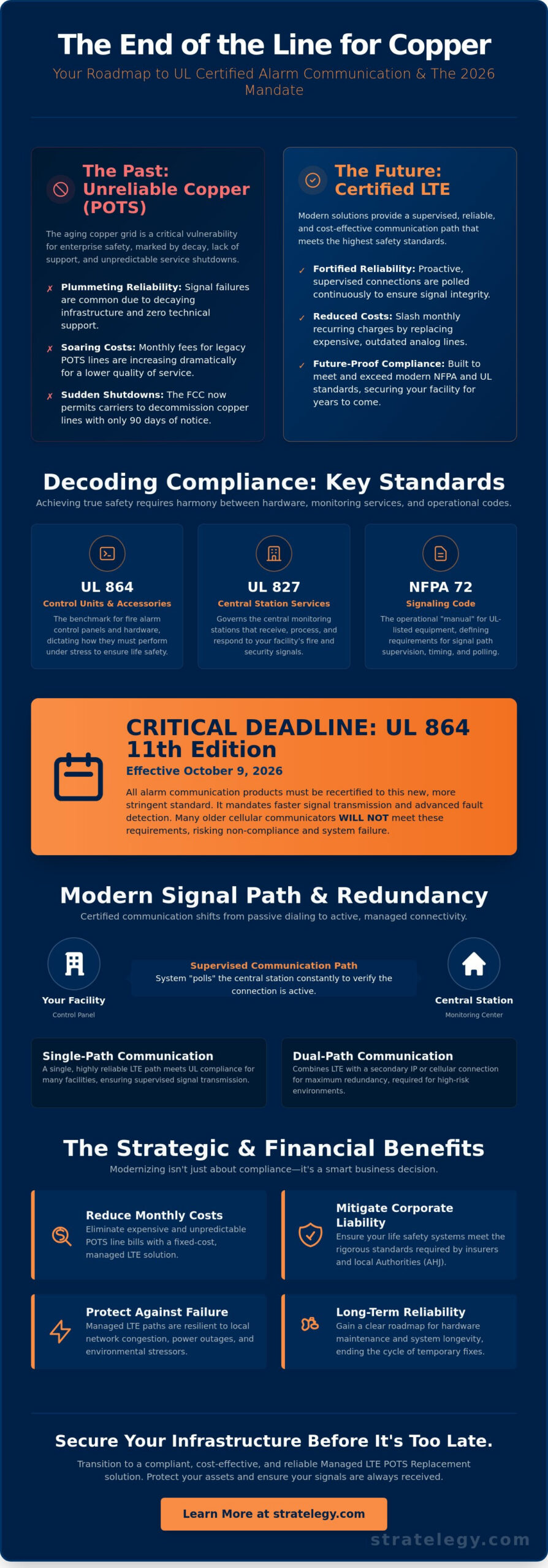
The physical copper grid is in a state of terminal decay. Major carriers are decommissioning facilities, and technical support for analog hardware is virtually non-existent. This lack of oversight creates a dangerous vulnerability in enterprise security. POTS Obsolescence is a primary risk factor for enterprise fire safety in 2026. Transitioning to managed LTE isn’t just about modernizing; it’s about ensuring your signal actually reaches its destination when seconds count. Legacy lines simply cannot offer the supervised polling and data speeds required for modern compliance.
Decoding the Standards: UL 864 and UL 827 for Fire and Security
Compliance is not a static target. For enterprise fire systems, UL 864 stands as the primary benchmark for Control Units and Accessories. It dictates how hardware must perform under stress to ensure life safety. Conversely, UL 827 governs the Central Station Alarm Services that receive and process your signals. To maintain a facility’s safety posture, these two standards must work in harmony. When you integrate a cellular communicator, it’s vital that the installation doesn’t compromise the panel’s original listing.
This is where the distinction between hardware and path becomes critical. Achieving ul certified alarm communication requires that the transmission path meets the rigorous timing and supervised polling requirements set by NFPA 72. This code acts as the operational manual for UL-listed equipment. If your communication path isn’t supervised according to these standards, your entire system could be deemed non-compliant during an inspection. You can find more detail on the evolution of these standards in the UL 864 Ninth Edition requirements, which laid the groundwork for modern digital signaling.
UL 864 11th Edition: Current Requirements for 2026
The transition to the 11th edition of UL 864 is a major milestone for the industry. Effective October 9, 2026, all products certified under the 10th edition must be recertified to meet new, more stringent criteria. This update focuses heavily on signal transmission speeds and advanced fault detection. Many older cellular communicators simply won’t meet these 2026 enforcement standards. If your hardware is aging, it’s time to evaluate a managed LTE replacement to ensure continued compliance and structural reliability.
The Importance of Dual-Path vs. Single-Path Certification
A single LTE path is often sufficient for UL compliance, provided it meets the specific polling intervals required by the National Fire Alarm and Signaling Code. However, complex environments or high-risk facilities often require dual-path communication. This typically combines LTE with a secondary IP or cellular connection. The Authority Having Jurisdiction (AHJ) has the final say on whether a single path provides enough redundancy for your specific building. Understanding these local nuances is essential for a successful 2026 safety strategy.
The Business Logic: Risk Mitigation and Regulatory Compliance
Risk is a financial variable that requires active management. Relying on uncertified communication paths invites significant corporate liability. In the context of the FCC copper retirement rules, the transition to digital signaling isn’t optional; it’s a structural necessity. Implementing ul certified alarm communication provides the forensic evidence needed to prove you’ve met your duty of care. Without this certification, a single system failure during a life safety event could lead to a devastating “uninsured loss” claim.
Non-compliance carries heavy operational costs that extend beyond insurance. If an Authority Having Jurisdiction (AHJ) discovers a communication failure, they can mandate an immediate 24/7 fire watch. This requires physical personnel to patrol your facility until the system is restored to code. These labor costs quickly eclipse the price of a proactive hardware upgrade. Proactive engineering ensures you never face the operational downtime associated with a red-tagged facility.
Insurance Advantages of Certified Infrastructure
Insurance carriers prioritize predictability and verified performance. They view unmanaged VoIP adapters as high-risk vulnerabilities because they weren’t designed for life safety signaling. Conversely, UL-listed LTE solutions offer the supervised reliability that keeps premiums stable and claims valid. You’ll need specific documentation of your system’s UL status during your next annual audit to ensure full coverage. It’s the difference between a secure asset and a liability waiting to happen.
While upgrading your signaling path is a critical step in risk mitigation, businesses should also consider how comprehensive insurance policies protect their broader operations; you can learn more about Univers Ubezpieczenia and their approach to specialized coverage to ensure your enterprise is fully shielded from unforeseen liabilities.
Governance and Predictability in Multi-Site Management
Managing compliance across a national portfolio is complex. Standardizing your hardware simplifies reporting and ensures every branch meets the same high standard. Implementing a strategic POTS line replacement program across all locations eliminates “patchwork” vulnerabilities. It creates a unified, manageable infrastructure that your team can monitor with confidence. Secure your enterprise today with a managed LTE solution designed for long-term stability.
Modernizing with Stratelegy: Managed LTE POTS Replacement
Stratelegy approaches life safety through the lens of foundational engineering. Our LTE POTS replacement isn’t a simple hardware swap; it’s a managed lifecycle designed for total infrastructure stability. Transitioning to ul certified alarm communication with our team ensures your enterprise bridges the gap between legacy fire panels and modern cloud-based monitoring centers. We act as technical partners who prioritize your system’s long-term health over superficial features. Our approach eliminates the frantic energy of emergency repairs by replacing them with disciplined, proactive oversight.
Our proprietary maintenance framework is the cornerstone of our service delivery. We’ve already anticipated the technical shifts of the next decade, implementing systematic hardware update policies that ensure your communicators never face obsolescence. The Stratelegy Advantage combines this disciplined oversight with proactive signal monitoring. We don’t just wait for a failure; we maintain the structural reliability of your signal path through constant, automated validation.
The 4-Step Transition to UL-Certified Cellular
- Step 1: We conduct a comprehensive site audit and signal strength mapping to identify the optimal placement for your communicators.
- Step 2: Our engineers select UL 864-compliant LTE hardware specifically tailored to integrate with your existing fire and security panels.
- Step 3: We manage the professional installation, verifying dual-path redundancy to meet the most stringent local requirements.
- Step 4: Your system enters our managed service platform for continuous oversight and lifecycle management.
Beyond the Alarm: Integrating UCaaS and CCaaS
Modernizing your alarm path is often the first step toward a more resilient digital ecosystem. The same LTE infrastructure that secures your life safety systems can serve as a foundation for unified communications as a service. By consolidating your connectivity, you improve operational predictability across the board. This structural approach also enhances your cloud contact center resilience, ensuring that your customer engagement and safety protocols share the same high benchmark for uptime and reliability.
Future-Proofing Your Enterprise Life Safety Infrastructure
The transition away from legacy copper is no longer a distant projection. With carrier decommissioning schedules accelerating toward 2026, the window for reactive maintenance has closed. Adopting ul certified alarm communication is the only way to ensure your facility remains compliant with evolving UL 864 standards while eliminating the rising costs of obsolete analog lines. You’ve seen how these managed paths mitigate corporate liability and satisfy the rigorous demands of local fire marshals. It’s about moving from a state of vulnerability to one of total operational predictability.
Success in this transition requires more than just a hardware swap. It demands a partnership with a compliance-first engineering team that understands the nuances of national-scale deployment. By utilizing our proprietary managed maintenance frameworks, you can eliminate the threat of technical obsolescence once and for all. It’s time to shift from fragile, aging infrastructure to a predictable, engineered solution that prioritizes long-term stability. Secure your infrastructure with Stratelegy’s UL-certified LTE POTS replacement solutions today. We look forward to helping you build a more resilient foundation for your business.
Frequently Asked Questions
Is cellular alarm communication as reliable as a landline for fire safety?
Cellular communication is now considered more reliable than legacy landlines because it eliminates the physical vulnerabilities of copper wire. Unlike landlines, which can be silenced by a single cut or infrastructure decay, managed LTE paths utilize continuous polling to verify connectivity. If a signal is blocked or a network goes down, the system identifies the failure immediately, providing a level of supervised reliability that analog lines simply cannot match.
What does it mean for an alarm communicator to be UL 864 listed?
A UL 864 listing signifies that a device meets the industry standard for fire alarm control units and accessories. This certification involves rigorous laboratory testing to ensure the hardware maintains signal integrity under extreme conditions, including power surges and temperature fluctuations. When you implement ul certified alarm communication, you’re using hardware that has been validated for the specific, high-stakes requirements of life safety signaling.
Can I use any LTE ‘POTS in a box’ solution for my fire alarm system?
You cannot use a generic “POTS in a box” solution because most are built for standard voice traffic rather than critical data. Fire alarm systems require specific signaling protocols and supervised paths that standard VoIP or consumer LTE adapters don’t support. To maintain compliance, your solution must be specifically listed for fire protective signaling, ensuring it communicates accurately with both your panel and the central station.
How often does UL-certified alarm communication hardware need to be tested?
Testing frequency is determined by the National Fire Alarm and Signaling Code (NFPA 72) and your local fire marshal. While the hardware itself performs automated polling tests as frequently as every few minutes, physical inspections of the transmission equipment are typically required on an annual basis. These regular checks ensure that the backup power supplies and physical connections remain in peak operational condition.
Will switching to LTE alarm communication lower my monthly business costs?
Transitioning to LTE typically results in a significant reduction of monthly recurring costs for most enterprises. As telecommunications carriers decommission copper infrastructure, the price of maintaining legacy lines has skyrocketed. By switching to a managed LTE path, you replace these expensive, unpredictable analog fees with a stable, cost-effective digital service that offers better performance and more reliable ul certified alarm communication.