
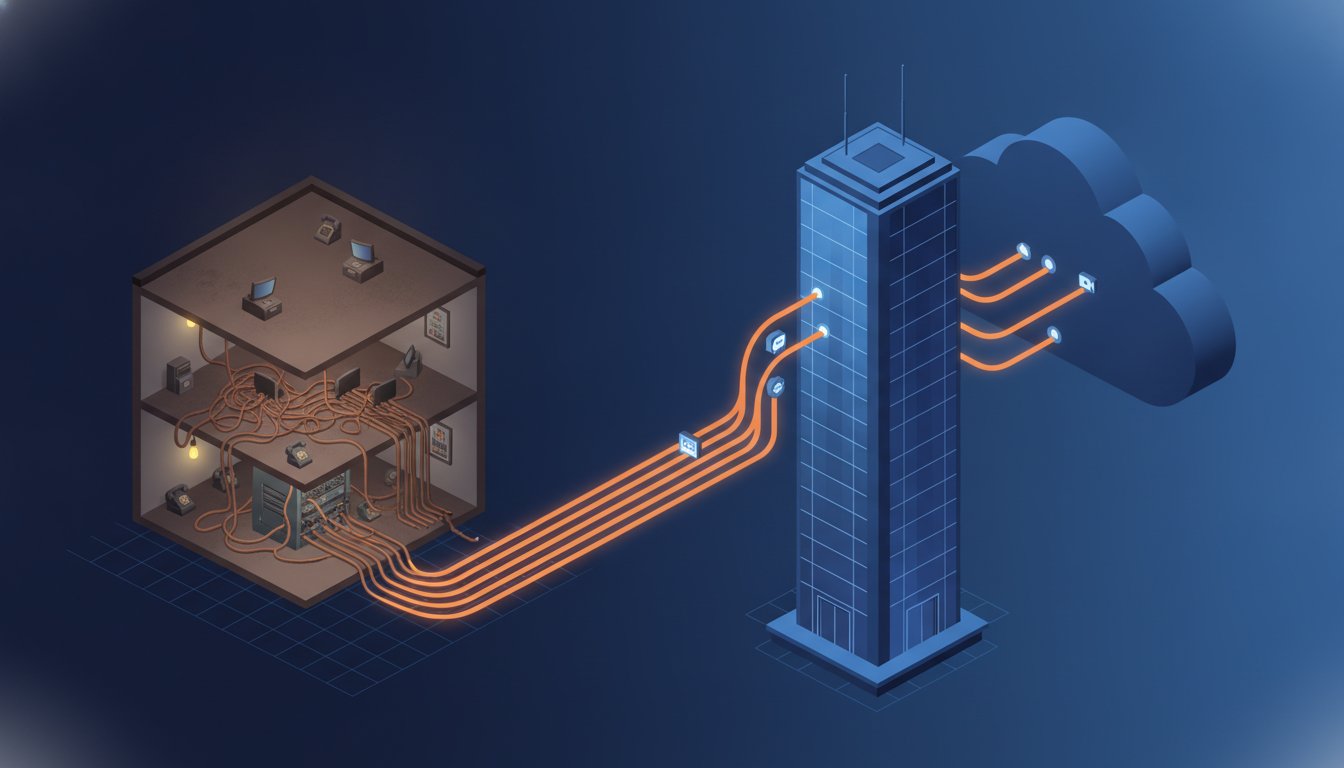
Maintaining a legacy PBX system in 2026 isn’t a conservative choice; it’s a high-interest loan against your company’s operational future. You’ve likely felt the pressure to modernize, yet the challenge of justifying ucaas investment to cfo stakeholders often comes down to a language barrier. While you see technical debt, they see a stable asset that’s already paid for. It’s time to shift the conversation from software features to structural reliability and financial predictability.
We understand that bridging the gap between infrastructure engineering and fiscal strategy is where most digital transformations stall. You’ll learn how to translate technical benefits into a clear framework for TCO comparison and risk mitigation. We’ll explore how the FCC’s March 2026 order on copper retirement makes the move a regulatory necessity while demonstrating how cloud-based systems can reduce communication costs by 40% to 60%. This guide provides the evidence you need to prove that UCaaS is a strategic asset for long term stability.
Key Takeaways
- Reframe communications from a depreciating hardware utility into a scalable cloud ecosystem that eliminates ongoing technical debt.
- Identify the true cost of inaction by quantifying hidden expenses like specialized legacy labor and escalating maintenance fees for aging infrastructure.
- Learn a proven framework for justifying ucaas investment to cfo leaders by focusing on operational predictability and long-term risk mitigation.
- Secure business continuity by transitioning from reactive recovery models to geodiversified cloud redundancy that protects against systemic outages.
- Maintain a modern infrastructure without new capital outlays through systematic hardware update policies and proprietary maintenance frameworks.
Beyond the Dial Tone: Reframing UCaaS as Strategic Financial Infrastructure
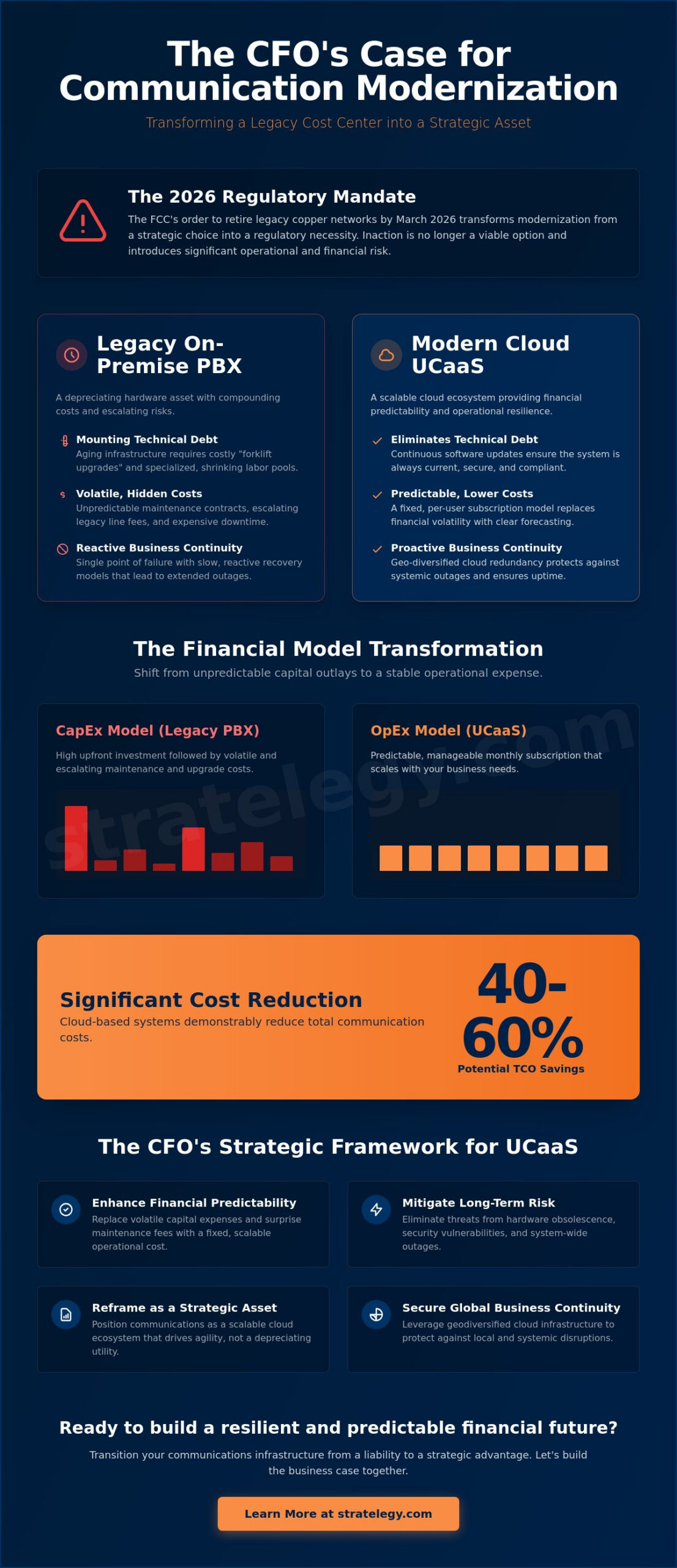
Modern communication is a structural asset, not a peripheral utility. Reframing Unified Communications as a Service (UCaaS) as strategic financial infrastructure is the first step in justifying ucaas investment to cfo stakeholders. It isn’t just a phone system. It’s a cloud-based ecosystem that eliminates the burden of physical asset depreciation. By moving away from capital-heavy hardware (CapEx), organizations gain a predictable, scalable service model (OpEx) that aligns with modern fiscal governance.
Waiting to modernize creates a compounding liability. As legacy copper networks face retirement following the FCC’s March 2026 mandates, the technical debt of maintaining obsolete systems increases daily. A unified platform provides the foundation for enterprise agility. It allows for global scalability without the friction of local hardware installs or specialized maintenance contracts. This transition ensures that communication capabilities grow alongside the business rather than acting as a bottleneck.
The 2026 CFO Mindset: From Cost Center to Strategic Value
Recent findings from EY indicate that CFOs have transitioned into primary drivers of infrastructure health and digital transformation. They no longer look for the lowest initial cost. Instead, they prioritize operational predictability and the elimination of systemic risk. A successful business case for justifying ucaas investment to cfo leaders demonstrates how cloud-based communication transforms a volatile cost center into a stable, managed asset. It’s about securing the long-term health of the business infrastructure.
Eliminating the Burden of On-Premise Obsolescence
Physical PBX systems have a finite lifecycle, often ending in expensive, unbudgeted “forklift upgrades.” In contrast, cloud platforms operate on a continuous update model. From a foundational engineer’s perspective, we build for longevity through software rather than hardware. This shift ensures your communication stack remains current, secure, and fully compliant without requiring recurring capital infusions. You gain peace of mind knowing the system is engineered for stability and ongoing oversight.
The TCO Reality: Quantifying the Cost of Inaction
Retaining legacy hardware is an active financial decision with compounding risks. Many organizations overlook the hidden expenses of “doing nothing,” assuming that a paid-off PBX system is essentially free. This is a misconception. When justifying ucaas investment to cfo stakeholders, you must expose the drain of specialized labor, proprietary maintenance contracts, and escalating legacy line fees. These costs don’t just stay flat; they accelerate as the pool of available parts and expertise shrinks.
The 2026 fiscal environment is particularly hostile to copper-wire infrastructure. Following the FCC’s recent modernization orders, carriers have accelerated the retirement of legacy networks, triggering exponential price increases for remaining analog connections. Organizations still relying on these lines face unpredictable monthly bills that lack long-term price protection. Shifting to a cloud-based model replaces this volatility with a fixed, per-user subscription that is easier to forecast and manage.
Downtime remains the ultimate hidden cost. A single systemic failure in an aging on-premise system often requires sourcing discontinued components from secondary markets, resulting in extended outages. The lost revenue and reputational damage from such an event frequently outweigh the cost of several years of a modern subscription. Transitioning to a managed service moves the burden of uptime to the provider, ensuring business continuity through geodiversified redundancy.
Calculating the Total Cost of Ownership (TCO)
A rigorous TCO analysis compares the five-year lifecycle of hardware maintenance against cloud subscription models. Beyond the base price, UCaaS offers lower upfront costs, increased flexibility and scalability. Don’t forget to include “soft costs” in your calculation. Significant gains in employee productivity and the total elimination of “truck rolls” for simple configuration changes provide immediate operational relief. You can evaluate how LTE POTS replacement further stabilizes these specific operational expenses.
The Risk Premium of Legacy Infrastructure
Legacy systems are often the weakest link in an organization’s security perimeter. Outdated firmware and unpatchable vulnerabilities increase the risk of data breaches, which directly translates into higher cyber-insurance premiums. Modern CFOs recognize that legacy hardware is a financial liability masquerading as a stable asset. Moving to a cloud platform ensures that security patches and compliance updates are handled automatically, protecting the organization from expensive regulatory failures. To learn how specialized Managed Detection and Response solutions can further enhance your security posture, read more.
Building the Business Case: Three Pillars of CFO-Level ROI
ROI in 2026 isn’t just about saving pennies. It’s about structural resilience. When justifying ucaas investment to cfo leadership, you must present a case built on three distinct pillars of value. These pillars move the conversation from “how much does it cost” to “how much does it protect and generate.”
The first pillar is operational efficiency. Consolidating vendors reduces the administrative tax on your IT and accounting departments. Managing multiple invoices for voice, data, and support is an inefficient use of specialized labor. The second pillar involves business continuity. We’ve moved past the era of “hope-based” recovery. Geodiversified cloud redundancy ensures that your infrastructure remains operational even if a regional data center goes dark. Finally, revenue acceleration provides the strongest fiscal argument. Integrated cloud contact center features allow organizations to transform customer communications, directly reducing churn through better engagement. This ecosystem supports a global “Work from Anywhere” model without the need for high-maintenance VPN hardware.
Vendor Consolidation and Billing Predictability
Financial leaders prize certainty. Having a single partner for UCaaS, CCaaS, and underlying infrastructure eliminates the “bill shock” associated with legacy usage fees. Fixed-rate per-user pricing models provide the predictability required for accurate long-term budgeting. This transparency allows the CFO to treat communication as a controlled, linear expense rather than a volatile variable. It simplifies the entire governance process.
Mitigating Life Safety and Compliance Costs
A critical component of any modernization strategy is pots line replacement for fire and life safety systems. As copper networks decay, the liability of relying on them for critical infrastructure grows. Modernizing these specific lines reduces liability insurance premiums and ensures you meet strict regulatory compliance standards. You can contact our engineering team to audit your current life safety infrastructure for potential vulnerabilities and ensure your facility remains fully protected.
Executing the Transition: Predictability, Governance, and Stability
Implementation risk is the primary barrier to modernization. A botched transition disrupts revenue and erodes the projected ROI. When justifying ucaas investment to cfo stakeholders, you must address the “Day 2” operational reality. It isn’t just about the initial migration. It’s about long-term governance. A unified platform centralizes data security and user access management, reducing the surface area for compliance failures. This transition effectively future-proofs the organization’s balance sheet by replacing unpredictable repair costs with a structured, managed service model.
We utilize proprietary maintenance frameworks to ensure that communication infrastructure never reaches a state of obsolescence. Many providers focus solely on the cloud layer. We prioritize the structural reliability of the entire stack. Our systematic hardware update policies mean your terminal equipment remains current without requiring new capital outlays. This approach eliminates the fear of technical debt becoming a sudden financial liability while maintaining peak operational performance.
The Stratelegy Partnership: Engineering for Predictability
Partnership means having a technical advisor who has already anticipated the problems you haven’t encountered yet. We act as foundational engineers, not just service providers. By prioritizing ongoing oversight and lifecycle management, we provide the peace of mind that comes from infrastructure stability. Our proactive stance ensures that your communication ecosystem remains disciplined and secure throughout its entire operational life. We focus on achieving excellence through engineering rather than just sales.
Finalizing the Investment Case
The executive summary for justifying ucaas investment to cfo leaders is clear. UCaaS is a comprehensive risk-mitigation strategy rather than a simple software purchase. It protects the business against the collapse of legacy copper networks and the rising costs of maintaining aging hardware. To prove this value in a controlled environment, we recommend starting with a phased pilot program. This allows your team to validate the ROI and operational benefits without risking systemic disruption to the enterprise.
Securing Long-Term Infrastructure Stability
Transitioning to the cloud is no longer a matter of technical preference. It’s a strategic move to insulate your balance sheet from the decay of legacy copper networks and the volatility of unbudgeted hardware failures. By focusing on operational predictability and geodiversified redundancy, you move the organization toward a model where communication is a managed asset rather than a growing liability.
Successfully justifying ucaas investment to cfo leadership requires shifting the focus to structural reliability and regulatory compliance. We provide the foundational engineering expertise and proprietary maintenance frameworks necessary for 100% uptime. As specialists in life safety integration, we ensure your transition meets every regulatory standard at a national scale. This focus on total protection is mirrored by experts like Broadway Security Services, who help organizations secure their physical assets alongside their digital infrastructure. Our methodical approach eliminates the fear of obsolescence and builds a bridge to a more resilient future.
Download our 2026 CFO Guide to UCaaS ROI and Infrastructure Stability to begin building your business case with confidence. Modernizing your communication stack is the most direct path to sustainable enterprise agility.
Frequently Asked Questions
How does UCaaS reduce the total cost of ownership compared to an on-premise PBX?
UCaaS reduces the total cost of ownership by eliminating the need for large upfront capital expenditures and ongoing proprietary maintenance contracts. On-premise systems require specialized labor, dedicated cooling, and rack space, all of which represent hidden operational drains. By shifting to a subscription model, organizations replace these volatile costs with a predictable monthly fee that includes automatic software updates and security patches. This transparency is a key factor when justifying ucaas investment to cfo stakeholders who prioritize long-term fiscal predictability.
Can we move to UCaaS without replacing our existing fire and life safety POTS lines?
While it’s technically possible to maintain legacy copper lines, it’s financially and operationally risky. Under the FCC-26-19A1 order released in March 2026, carriers have streamlined the retirement of legacy copper networks. This has led to skyrocketing costs and reduced reliability for analog lines. We recommend LTE POTS Replacement as a parallel strategy. This ensures your fire panels, elevator phones, and security alarms remain fully compliant while benefiting from the same cloud-based stability as your primary communication stack.
What is the typical timeframe for seeing a positive ROI on a UCaaS investment?
Most organizations realize a positive ROI within 12 to 18 months of implementation. Immediate cash flow improvements often appear in the first billing cycle due to the elimination of expensive trunking fees and maintenance agreements. Research indicates that switching to cloud telephony can reduce communication costs by 40% to 60%. Beyond direct savings, the removal of “forklift upgrades” and the reduction in IT ticket volume for simple configuration changes contribute to significant long-term financial gains.
How does cloud communication improve our organization’s risk profile for cyber-insurance?
Cloud communication platforms improve your risk profile by centralizing security governance and automating threat mitigation. Legacy PBX hardware often runs on outdated firmware that is difficult or impossible to patch, creating significant vulnerabilities. Insurers increasingly look for modern, managed infrastructure when calculating premiums. A unified platform ensures that encryption and access controls are applied consistently across the enterprise, which directly reduces the likelihood of a costly data breach or regulatory fine.
Is UCaaS reliable enough for enterprise-grade life safety and security applications?
Yes, but only when it’s engineered with geodiversified redundancy and specialized hardware. Standard UCaaS handles general business communications, but for life safety, it must be paired with LTE POTS Replacement technology. This combination provides the foundational reliability required for critical infrastructure. When justifying ucaas investment to cfo leadership, it’s vital to emphasize that this dual approach provides the structural stability needed to protect the organization from liability while ensuring 100% operational uptime for emergency services.