
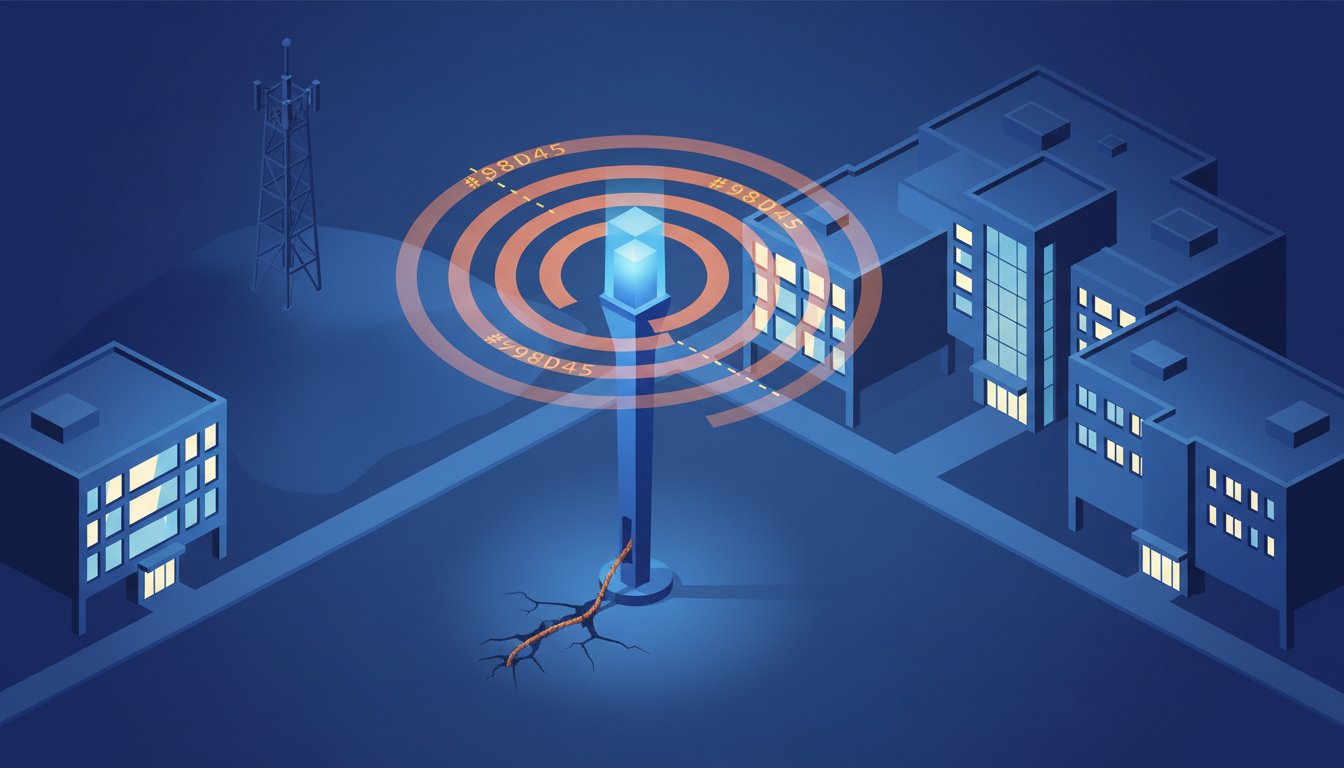
The silent sunset of traditional copper infrastructure has reached a critical tipping point, with many telecommunications providers increasing legacy line rates by over 450 percent since the FCC 19-72 order went into effect. Relying on these decaying circuits for campus safety isn’t just an operational hurdle; it’s a strategic risk that demands a sophisticated cellular pots replacement for blue light phones. You’ve likely noticed that as monthly invoices climb, the reliability of these aging lines continues to plummet. It’s a frustrating paradox where you pay more for a service that offers less security with every passing day.
We understand that maintaining life safety compliance while managing a tightening budget requires more than a simple patch; it requires a transformative alignment of technology and vision. This guide provides the clarity you need to transition from fragile analog connections to a resilient, high-visibility cellular framework. We’ll explore how modernizing your emergency communication nodes can simultaneously reduce recurring spend and enhance system uptime. By the end of this analysis, you’ll possess a clear roadmap to future-proof your campus safety infrastructure with precision and elegance.
Key Takeaways
- Identify the critical vulnerabilities of “silent failures” in legacy copper lines and why analog infrastructure has become a strategic liability for campus safety.
- Navigate the evolving regulatory landscape of FCC Order 19-72A1 to ensure rigorous life safety compliance as traditional carriers phase out POTS support.
- Evaluate the strategic advantages of a cellular pots replacement for blue light phones, prioritizing superior network uptime over the limitations of physical wiring.
- Follow a structured implementation framework to assess hardware compatibility and streamline the integration of high-performance LTE gateway solutions.
- Discover how a managed modernization strategy transforms fragmented emergency points into a resilient, future-proof communication ecosystem.
The Obsolescence of Analog: Why Copper is a Liability for Campus Safety
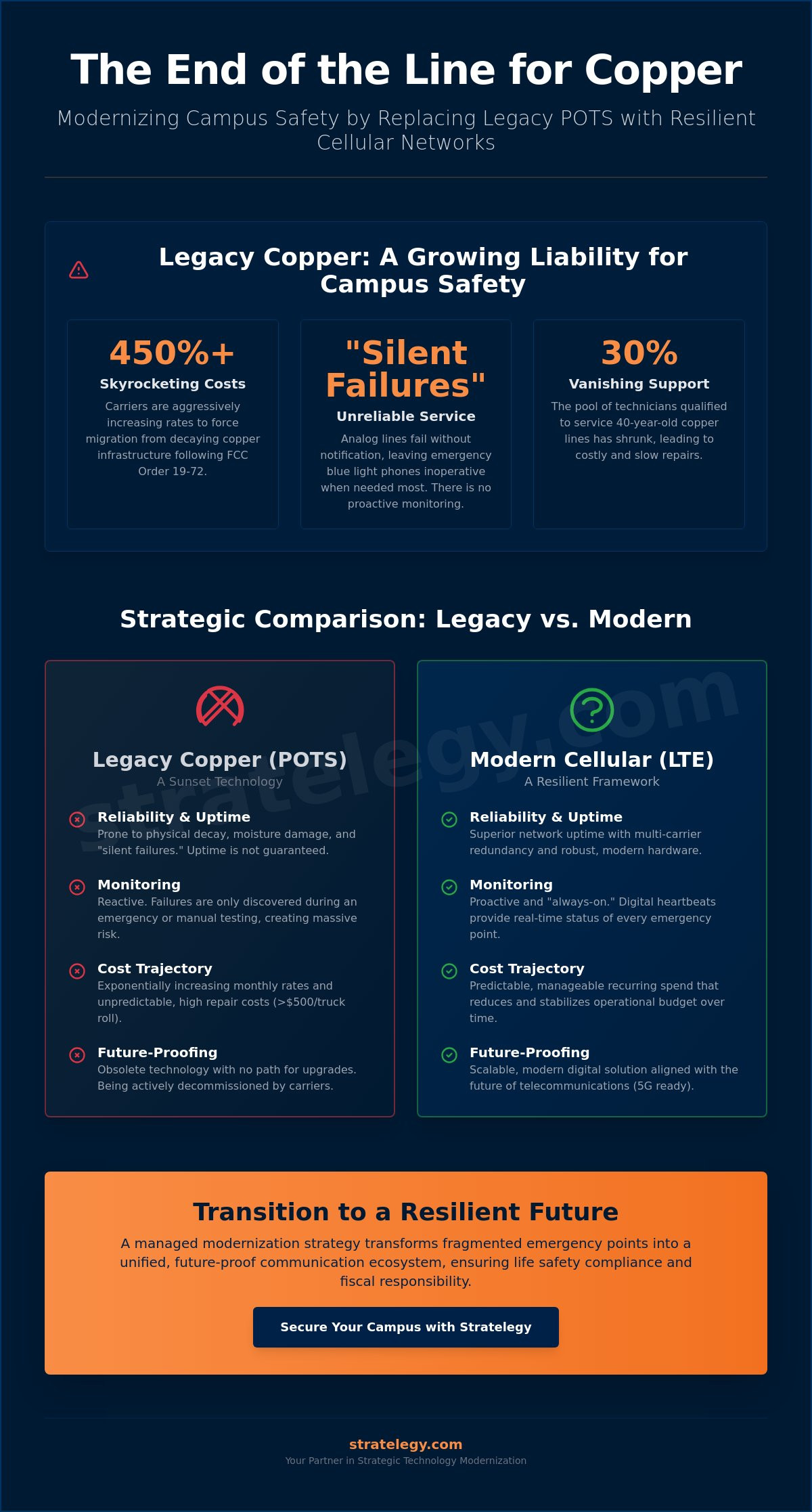
By 2026, the persistence of Plain Old Telephone Service (POTS) within modern security frameworks represents more than a technical debt; it’s a profound structural vulnerability. Following the conclusion of the FCC Order 19-72 transition period, the deregulation of copper lines has transformed legacy infrastructure from a reliable utility into a sunset technology. Major telecommunications carriers have responded by implementing aggressive price hikes. Data from industry reports indicate costs for analog lines have surged between 200% and 400% since 2022. This fiscal pressure is a deliberate strategy to force migration away from the copper local loop.
Organizations that delay a cellular pots replacement for blue light phones find themselves subsidizing a decaying medium. The physical decline of copper is terminal. Underground lines installed decades ago now suffer from moisture ingress and insulation breakdown. This leads to the “silent failure” risk. Unlike digital systems that heartbeat, an analog line often fails without any notification to the central monitoring station. The system appears operational until a student or employee presses the button during an emergency, only to find a dead line. This lack of supervised connectivity is no longer acceptable under modern risk management protocols.
The High Cost of Maintaining Status Quo
Maintaining legacy copper isn’t just expensive; it’s becoming logistically impossible. The workforce capable of servicing 40-year-old punch-down blocks and lead-sheathed cables is vanishing. Industry estimates show the pool of qualified copper technicians has contracted by 30% as the senior workforce reaches retirement. When a fault occurs, the cost of a single truck roll can exceed $500, yet these repairs offer no long-term stability. This creates a precarious liability. If a campus security system fails due to known infrastructure decay, the legal and reputational consequences are transformative. A strategic migration is the only path to fiscal and operational harmony.
Blue Light Phones as Critical Infrastructure
Blue light towers function as the psychological and practical anchor of campus security. They represent a visible commitment to stakeholder safety. These emergency telephone systems provide a vital lifeline when mobile devices are lost, damaged, or out of battery. When these towers remain tethered to failing copper, the perceived security of the entire facility erodes. Modern safety standards now require “always-on” digital monitoring that analog lines simply cannot provide. Implementing a cellular pots replacement for blue light phones shifts the paradigm from reactive maintenance to proactive, supervised connectivity. This ensures that every emergency point is monitored in real-time, replacing the uncertainty of the analog era with a resilient, digital-first framework.
Decoding the Regulatory Landscape: FCC Mandates and Life Safety Compliance
The regulatory framework governing analog telecommunications has undergone a seismic shift, moving from public utility protection to a market-driven model. This transition crystallized with FCC Order 19-72A1, a pivotal directive that granted carriers “forbearance” from the obligation to provide traditional Plain Old Telephone Service (POTS) at regulated rates. This wasn’t merely a policy adjustment; it was the starting gun for the decommissioning of the copper loop. By August 2, 2022, the federal requirement for carriers to maintain these lines effectively expired, leading to a 450% increase in service costs for some legacy users. As we approach 2026, the industry anticipates a final phase-out where remaining copper infrastructure will be retired in favor of fiber and wireless alternatives.
For safety directors, this deregulation creates a precarious gap. When a blue light phone fails, the carrier is no longer legally bound to repair the underlying copper line within a specific timeframe. This makes a cellular pots replacement for blue light phones not just an upgrade, but a necessity for maintaining continuous life safety coverage. Modern LTE solutions bridge this gap by providing the reliable “dial tone” that emergency hardware expects, while operating on resilient, supervised wireless networks.
The Sunset of the Copper Loop
The decline of analog infrastructure is marked by diminishing Service Level Agreements (SLAs). In many jurisdictions, an “active” line no longer guarantees a functional one; technicians frequently lack the parts or training to repair 40-year-old switches. Institutions like the University of Michigan recognize this shift; they recently initiated programs to enhance campus safety technology by upgrading aging infrastructure. Distinguishing between an active line and a supported one is critical for liability management. If your emergency phones rely on copper, you’re likely operating on borrowed time, as 75% of major carriers have already filed transition plans to abandon legacy maintenance entirely by 2026.
Compliance and Certification Standards
Transitioning to a cellular pots replacement for blue light phones requires meticulous attention to life safety codes. To remain compliant, cellular gateways must meet rigorous standards, specifically UL 864 for fire signaling and NFPA 72 for emergency communications. These codes demand that the communication path is supervised, meaning the system must detect and report a path failure within 200 seconds. A strategic modernization plan ensures your hardware provides:
- Dual-SIM redundancy to prevent single-point-of-failure outages.
- Battery backup systems capable of 24-hour standby operation.
- Machine-to-Machine (M2M) encryption for secure data transmission.
- Detailed audit logs for insurance and safety compliance verification.
Adhering to these benchmarks protects the organization from the legal exposures associated with equipment failure. Evaluating your current risk profile is the first step toward a tailored infrastructure transition that aligns modern technology with legacy reliability.
Cellular vs. Legacy Copper: A Strategic Comparison for Emergency Communications
The transition from analog infrastructure to digital ecosystems represents a fundamental shift in how organizations approach public safety. Traditional copper lines, once the gold standard, now suffer from systemic decay and escalating maintenance requirements. A cellular pots replacement for blue light phones offers more than just a technical update; it provides a strategic alignment between emergency readiness and modern network efficiency. The move from physical wires to wireless gateways isn’t merely a change in medium, it’s an evolution in reliability.
Legacy copper wires are vulnerable to physical disruption. Construction accidents, environmental corrosion, and even copper theft can sever a campus’s safety lifeline without warning. In contrast, LTE gateways bypass these physical vulnerabilities. Deploying these systems takes hours rather than the weeks required for trenching and cable laying. This speed allows for rapid scaling across large university campuses or corporate complexes where digging is often cost-prohibitive. Organizations can deploy a fully functional emergency station in a single afternoon, avoiding the logistical chaos of heavy machinery and ground disturbance.
Resilience in the Face of Infrastructure Failure
Modern LTE gateways incorporate sophisticated failover mechanisms to ensure 99.99% uptime. These devices utilize internal battery backups that provide up to 24 hours of operation during a total power loss, exceeding many local safety mandates. By employing multi-carrier SIM cards, the system can automatically switch between providers like Verizon, AT&T, or T-Mobile if a local tower fails. Wireless signals aren’t susceptible to the water ingress or ground shifting that frequently plagues 50-year-old underground conduits, ensuring the signal remains clear during extreme weather events.
Transitioning from Reactive to Proactive Management
The most profound advantage of a cellular pots replacement for blue light phones is the shift toward data-driven oversight. Analog systems are essentially “dark” until someone attempts a call or a technician performs a manual site visit. Digital gateways provide a centralized dashboard for real-time health checks, turning a blind spot into a transparent asset. This visibility allows for a more elegant, structured approach to facility management.
- Automated Alerts: Security teams receive instant notifications via SMS or email if a station loses power or signal strength drops below a specific threshold.
- Signal Analytics: Administrators monitor decibel levels to predict potential connectivity issues before they impact emergency calls, allowing for preemptive maintenance.
- Centralized Control: One interface manages hundreds of stations, replacing the fragmented record-keeping and manual testing cycles of the analog era.
The financial logic is equally compelling. Since the FCC issued Order 19-72 in 2019, the cost of maintaining legacy copper has risen by as much as 500% in some service areas. Cellular solutions eliminate these compounding costs, offering a predictable monthly expense and a superior return on investment. By removing the need for specialized analog technicians and expensive physical repairs, organizations can redirect their capital toward transformative growth rather than stagnant maintenance.
Implementation Framework: Integrating LTE POTS Replacement into Your Infrastructure
Successful modernization requires more than a simple hardware swap; it demands a disciplined architectural approach. The transition to a cellular pots replacement for blue light phones follows a rigorous sequence designed to maintain life-safety integrity while eliminating legacy costs. This framework ensures that the shift from copper to cloud remains seamless, secure, and strategically aligned with long-term campus safety goals.
- Site Assessment: Engineers must audit every tower to identify hardware compatibility. While 82% of existing pedestals support internal gateway mounting, older units may require external NEMA enclosures to protect sensitive electronics.
- Gateway Selection: Choose an LTE solution that provides true analog-to-digital conversion. The hardware must include a battery backup capable of meeting the 24-hour standby requirement mandated by NFPA 72 standards for emergency systems.
- Pilot Testing: Deploy three to five units in high-traffic zones for a 72-hour validation period. This phase measures voice clarity and confirms that DTMF tones correctly reach the emergency dispatch center without latency issues.
- Phased Migration: Avoid a “big bang” approach. Transition towers in clusters of 10 to ensure zero downtime for the campus safety network. This allows for real-time adjustments based on localized signal performance.
- Post-installation Audit: Every unit undergoes a signal strength verification. We look for a Reference Signal Received Power (RSRP) better than -95 dBm to guarantee 99.999% reliability.
Retrofitting vs. Replacement
Deciding between a retrofit and a total hardware overhaul is a matter of structural health. Most blue light towers installed after 2010 possess the internal volume to house a cellular gateway and its accompanying power supply. Retrofitting these units saves approximately 60% in capital expenditures compared to full replacement. The focus remains on the internal wiring. Technicians must ensure the existing RJ11 or terminal block connections are free of corrosion. Integrating the gateway into the tower’s 12V or 24V DC power source requires a regulated transformer to prevent voltage spikes during charging cycles.
Network Optimization and Security
Security isn’t an afterthought in cellular pots replacement for blue light phones; it’s the foundation. We utilize private Access Point Names (APNs) to isolate emergency traffic from the public internet. This creates an encrypted tunnel directly to the monitoring station, preventing unauthorized access. For parking garages, antenna placement is critical. External high-gain antennas often become necessary when signal penetration through reinforced concrete drops below -105 dBm. Managing data plans involves prioritizing voice traffic over administrative heartbeats. This ensures that even during peak network congestion, emergency calls receive immediate bandwidth allocation.
Effective infrastructure management starts with a clear vision of your digital future. Partner with Stratelegy to design a resilient communication framework that protects your campus and your budget.
The Stratelegy Advantage: Elevating Emergency Resilience through LTE Modernization
Transitioning from legacy copper to LTE isn’t merely a hardware swap; it’s a fundamental evolution of life safety infrastructure. Stratelegy views cellular pots replacement for blue light phones as a critical pillar within a broader enterprise communication strategy. We don’t just deliver a device. We engineer a resilient ecosystem where emergency endpoints interact seamlessly with your cloud-based systems. This strategic alignment ensures that a distress signal from a remote parking garage triggers a coordinated, sophisticated response across your UCaaS and CCaaS platforms. True business success isn’t just about efficiency; it’s about a structurally harmonious design that bridges the gap between legacy necessity and modern innovation.
Managed Connectivity for Peace of Mind
Reliability requires more than a signal; it demands constant vigilance. Our proactive monitoring protocols track every critical endpoint every minute of the day. If a device loses its heartbeat or a battery backup dips below a specific threshold, our operations center identifies the anomaly immediately. For national portfolios, consistency remains the greatest hurdle. We apply a customized framework across all locations, ensuring that a campus in Seattle maintains the same rigorous safety standards as a facility in Miami. Managing both UCaaS and POTS replacement through a single partner eliminates the friction of vendor fragmentation, providing a unified view of your entire communication landscape.
- Proactive Oversight: 24/7 monitoring that identifies failures before they impact safety.
- Unified Architecture: Integrating emergency lines into your broader digital transformation roadmap.
- National Scalability: Standardized deployment models that ensure compliance across diverse geographic regions.
Next Steps in Your Modernization Journey
The path toward resilience begins with a deep, consultative assessment. We identify the specific vulnerabilities in your current infrastructure, particularly lines still tethered to the 100-year-old copper grid. Since the FCC’s 2019 deregulation order, the cost of maintaining these legacy lines has surged, with some organizations reporting price increases of over 400% as carriers phase out support. We don’t believe in temporary fixes. We design a future-proof roadmap that consolidates these high-cost, low-reliability lines into a managed LTE solution that scales with your growth. It’s time to transform your emergency response from a legacy liability into a modern strategic asset.
Ready to redefine your safety infrastructure? Partner with Stratelegy to secure your critical communications and ensure your organization remains connected when it matters most.
Securing Your Campus Through Strategic LTE Modernization
The transition from decaying copper infrastructure isn’t just a technical upgrade; it’s a strategic mandate for institutional safety. As legacy analog lines become increasingly unreliable, implementing a cellular pots replacement for blue light phones ensures your campus remains compliant with FCC Order 19-72 and NFPA 72 standards. This shift replaces fragile physical wires with enterprise-grade LTE solutions engineered for 99.999% reliability, providing a stable foundation for life safety systems.
Stratelegy bridges the gap between complex regulatory requirements and seamless operational execution. Our frameworks integrate emergency endpoints directly into broader UCaaS and CCaaS platforms, creating a unified communication ecosystem that’s both efficient and elegant. We don’t just solve the problem of obsolescence; we create a path for transformative growth and structural harmony.
Take the first step toward a more secure and sophisticated infrastructure today. Request a Strategic Infrastructure Assessment to align your safety protocols with modern technological standards. Your commitment to community security deserves an infrastructure that’s as visionary as your leadership.
Frequently Asked Questions
Is cellular connectivity reliable enough for blue light emergency phones?
Cellular connectivity offers 99.99% uptime, surpassing the aging copper infrastructure it replaces. Modern LTE and 5G networks provide redundant signal paths that ensure emergency calls reach dispatch centers without interruption. This technological shift creates a resilient communication framework that eliminates the single point of failure inherent in traditional landlines. By integrating multi-carrier SIM cards, these systems maintain a continuous link even if one specific carrier experiences a localized outage.
Will I need to replace my existing blue light towers to switch to cellular?
You don’t need to replace existing blue light towers because cellular POTS replacement for blue light phones works via a strategic retrofit gateway. These devices bridge the gap between legacy analog hardware and modern digital networks. This approach preserves your capital investment in physical infrastructure while upgrading the underlying communication logic. Most installations require only a compact interface module housed within the existing enclosure, maintaining the aesthetic integrity of your campus safety assets.
How does cellular POTS replacement compare to VoIP for emergency use?
Cellular solutions provide superior reliability compared to VoIP because they operate independently of your local area network. VoIP systems often fail during network congestion or internal server reboots, which compromises safety during critical incidents. Cellular systems bypass these vulnerabilities by connecting directly to national carrier towers. This architectural separation ensures that emergency communications remain functional even if your organization’s primary IT infrastructure suffers a breach or a total system collapse.
What happens to the blue light phone if the power goes out?
Blue light phones remain fully operational during power outages through integrated battery backups that provide 24 to 72 hours of standby time. NFPA 72 standards require these systems to maintain functionality without external power for specific durations. Modern cellular gateways include sophisticated power management units that switch to internal reserves the moment the primary grid fails. This ensures that a student or employee can still reach emergency services during a total blackout.
How much can an organization save by switching from POTS to cellular?
Organizations typically realize a 40% to 60% reduction in monthly recurring costs by eliminating traditional copper line leases. The FCC Order 19-72 led to a sharp increase in POTS pricing, with some rates rising by 500% since 2019. By transitioning to a unified cellular framework, you consolidate multiple expensive analog lines into a streamlined digital subscription. This shift transforms a rising operational burden into a controlled, predictable expense that aligns with long-term fiscal strategies.
Does cellular POTS replacement meet NFPA and UL safety codes?
Modern cellular solutions meet or exceed NFPA 72 and UL 2054 standards for emergency communication systems. These regulations mandate specific requirements for signal supervision and power redundancy that older analog lines often struggle to satisfy. A properly engineered cellular POTS replacement for blue light phones ensures full compliance with life safety codes. This alignment protects your organization from liability while providing the highest level of protection for your community members and staff.
How long does the transition from copper to cellular typically take?
The transition from copper to cellular typically takes 1 to 2 business days per cluster of phones once the hardware arrives. Professional installers can complete a standard retrofit in approximately 45 minutes per unit. This swift deployment minimizes downtime and ensures that your safety network remains active throughout the modernization process. Your organization can achieve a full campus conversion within a single week, depending on the total number of endpoints and geographical distribution.
Can I monitor the health of my blue light phones remotely with cellular?
You can monitor the real-time health of your blue light phones through centralized cloud dashboards that provide 24/7 visibility. These systems send immediate alerts if a unit loses power, experiences signal degradation, or fails a self-test. This proactive oversight replaces the manual, labor-intensive inspections required for legacy analog lines. By leveraging automated diagnostics, your maintenance team can address potential issues before they impact emergency response capabilities, ensuring a harmonized and reliable safety environment.