
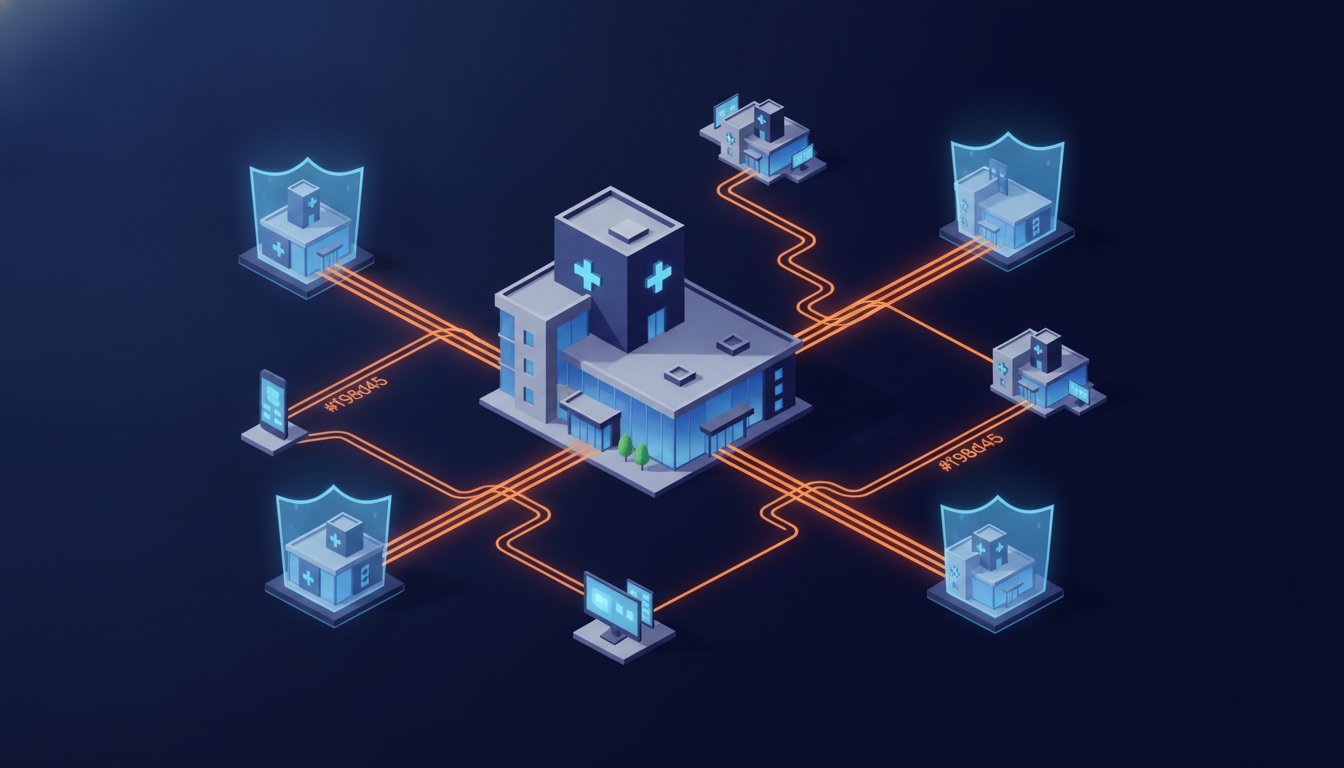
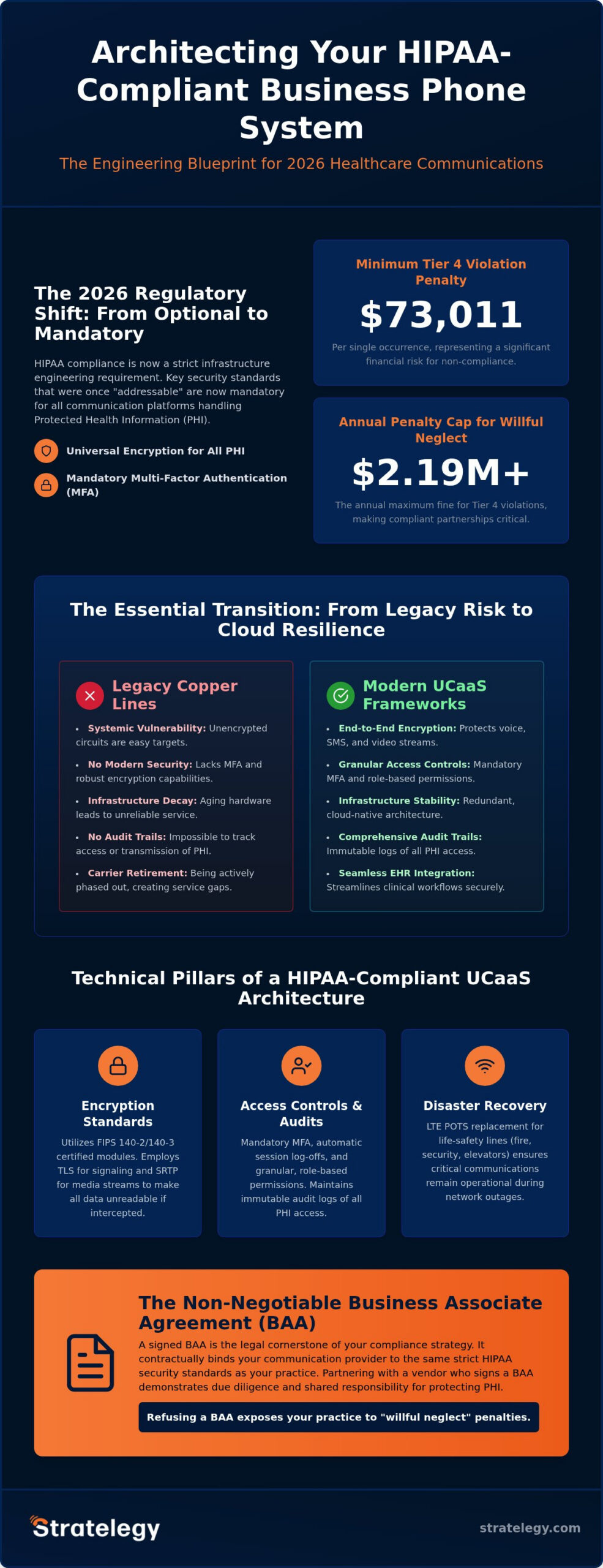
In 2026, HIPAA compliance is an infrastructure engineering requirement, not a software feature toggle. You’ve likely felt the pressure of shifting regulations as mandatory encryption and multi-factor authentication move from suggestions to strict requirements. The fear of a Tier 4 violation penalty, which now starts at $73,011 per occurrence, is a rational response to an increasingly litigious environment. Managing security across remote and on-site staff shouldn’t feel like a gamble with your practice’s future.
This guide provides the blueprint to architect a secure, hipaa compliant business phone system that protects patient data while modernizing your clinical operations. We’ll examine the technical transition from legacy copper lines to resilient UCaaS frameworks, the non-negotiable necessity of a signed Business Associate Agreement, and the seamless integration of these platforms with your existing EHR. You’ll gain the technical clarity needed to ensure your communication infrastructure remains a predictable asset rather than a systemic liability.
Key Takeaways
- Master the transition from addressable to mandatory HIPAA security standards, ensuring your infrastructure meets the 2026 requirements for universal encryption and multi-factor authentication.
- Architect a hipaa compliant business phone system that utilizes end-to-end encryption and robust access controls to protect sensitive voice, SMS, and video communications.
- Streamline clinical workflows by integrating secure UCaaS platforms with existing EHR systems while maintaining strict governance through verified Business Associate Agreements.
- Eliminate the risks of legacy hardware obsolescence by implementing LTE POTS replacement for critical fire, security, and emergency communication lines.
The Regulatory Landscape of Healthcare Communications in 2026
Regulatory compliance is no longer a passive state. It’s an active engineering discipline. In 2026, the definition of a hipaa compliant business phone system has evolved beyond basic data scrambling. It requires a holistic view of how Protected Health Information (PHI) moves through voice, SMS, and video streams. Every digital packet containing a patient’s name, callback number, or clinical detail constitutes PHI that must be governed under strict NIST standards. This alignment between covered entities and their business associates ensures that security isn’t lost during handoffs between different communication platforms.
The Shift from Legacy Copper to Secure Cloud
Traditional analog lines are failing. As carriers retire legacy copper infrastructure, these unencrypted circuits become systemic vulnerabilities. They lack the capacity for mandatory encryption and multi-factor authentication (MFA) required by the 2025 Security Rule updates. Transitioning to a secure cloud architecture isn’t just an upgrade; it’s a move toward infrastructure stability. Modern UCaaS frameworks provide the audit trails and granular access controls that legacy systems simply can’t offer. This transition eliminates the risk of emergency communication failures caused by decaying physical lines.
The Non-Negotiable Business Associate Agreement (BAA)
A BAA is the legal cornerstone of your communication strategy. It’s a contract that binds your service provider to the same security standards as your clinical practice. Without a signed BAA, even the most advanced hipaa compliant business phone system is legally deficient. Using a vendor that refuses to sign a BAA exposes your organization to willful neglect penalties. These fines are now capped at $2,190,294 annually for Tier 4 violations, making the choice of a compliant partner a critical financial decision. True partnership means your vendor shares the burden of governance and risk mitigation.
Technical Requirements for HIPAA-Compliant UCaaS Architectures
Technical compliance is a structural commitment. Transitioning to a hipaa compliant business phone system requires more than just a software license; it demands a rigorous engineering approach to data security. Every endpoint and transmission path must satisfy the latest 2026 regulatory standards to mitigate the risk of unauthorized PHI disclosure. This involves a layered defense strategy that prioritizes both accessibility for clinicians and impenetrable barriers for external threats.
Encryption Standards for 2026
Modern UCaaS platforms must utilize Transport Layer Security (TLS) for SIP signaling and Secure Real-time Transport Protocol (SRTP) for the media stream. As of 2026, NIST-validated encryption for VoIP requires the use of FIPS 140-2 or 140-3 certified modules to protect electronic PHI during all stages of transmission and storage. This ensures that even if data packets are intercepted, the content remains unreadable to unauthorized parties.
Access Controls and Auditability
Access controls must extend to every layer of the communication stack. Multi-factor authentication (MFA) is now a mandatory requirement for all systems accessing ePHI, ensuring that call recordings and patient metadata remain restricted to authorized personnel. An engineered hipaa compliant business phone system also incorporates these features:
- Automatic Log-offs: Terminating sessions after periods of inactivity to secure shared workstations in clinical environments.
- Audit Logs: Maintaining immutable records of every instance where PHI was accessed, modified, or transmitted.
- Granular Permissions: Restricting access to call logs and recordings based on specific clinical roles and necessity.
Disaster Recovery and Data Redundancy
Redundancy is the backbone of clinical reliability. Relying on a single network path creates a dangerous point of failure for emergency communications. Implementing LTE POTS replacement ensures that life safety systems, such as fire alarms and elevator phones, remain operational during primary network outages. This hardware-level redundancy provides the predictability required for 24/7 healthcare operations, anchoring your digital infrastructure in physical stability.
Selecting and Implementing Your Compliant Communication Platform
Procurement is a strategic governance decision. It requires a systematic audit of vendor capabilities against your specific clinical risk profile. Selecting a hipaa compliant business phone system means evaluating a vendor’s operational maturity as much as their software features. You aren’t just buying a service; you’re architecting a foundational layer of your practice’s security. This process begins with a comprehensive Risk Assessment of your current communication infrastructure to identify legacy vulnerabilities and systemic gaps.
The Healthcare Evaluation Framework
A disciplined evaluation follows three primary steps. First, verify the vendor’s willingness to sign a comprehensive BAA that explicitly covers all communication modalities. A vendor that won’t sign a BAA isn’t a partner; they’re a liability. Second, assess the platform’s ability to generate granular audit trails. These logs must be immutable and easily accessible for compliance reviews. Third, test the reliability of critical life safety connections. Ensure your provider offers LTE POTS replacement to maintain elevator and fire alarm functionality during primary network outages.
Integrating your communication platform with Electronic Health Records (EHR) requires technical precision. These connections must utilize secure APIs that maintain end-to-end encryption without creating systemic backdoors. Simultaneous to this technical setup, you must implement a formal staff training program. Clinical teams need to understand the security protocols of using softphones on mobile devices, specifically regarding the separation of personal and professional data and the risks of accidental PHI disclosure.
Avoiding Common Implementation Gaps
Shadow IT is the greatest threat to a secure clinical environment. When official tools are cumbersome, staff often revert to unapproved messaging apps, which lack the governance of a hipaa compliant business phone system. Every communication channel, including virtual faxing, must be consolidated under your managed infrastructure. This prevents PHI from leaking into unencrypted consumer platforms that don’t meet NIST standards. Secure your facility’s future by partnering with specialists in enterprise-grade UCaaS and infrastructure stability.
Stratelegy: Foundational Engineering for Secure Healthcare
Reliability is the product of disciplined engineering. At Stratelegy, we prioritize security and governance over superficial features. We understand that a hipaa compliant business phone system is only as secure as the network it sits upon. Our approach focuses on infrastructure stability, ensuring your clinical operations remain predictable and protected against evolving regulatory threats. We act as strategic specialists who anticipate technical friction before it impacts your patient care. By managing the underlying IT network infrastructure, we remove the burden of technical oversight from your medical staff.
Modernizing Life Safety and Critical Systems
Medical facilities often overlook the vulnerabilities of their legacy hardware. As carriers sunset traditional copper lines, critical systems like fire alarms and emergency elevator phones face immediate obsolescence. Stratelegy eliminates this risk through LTE POTS replacement. By transitioning these life safety systems to resilient cellular connectivity, we ensure constant uptime and compliance with municipal safety codes. This hardware-level modernization is a prerequisite for any secure healthcare environment, bridging the gap between legacy reliability and modern digital security.
Your Partner in Long-Term Compliance
Security isn’t a one-time setup. It requires ongoing oversight and systematic maintenance. Stratelegy provides a managed framework that includes regular hardware updates and end-to-end cybersecurity monitoring. We support your growth as you scale unified communications across multiple clinics, maintaining a unified security posture throughout your expansion. You can explore our unified communications as a service pillar for broader context on how we architect these resilient systems. Our partnership ensures your infrastructure remains compliant with the latest 2026 NIST standards. We provide the technical expertise that allows you to focus on clinical excellence with total peace of mind.
Securing Your Clinical Communication Infrastructure
Modernizing your practice requires more than a simple software migration. It demands a commitment to foundational engineering that addresses both the digital transmission of PHI and the physical reliability of your life safety systems. You’ve learned that a truly hipaa compliant business phone system integrates mandatory encryption, multi-factor authentication, and robust audit trails into a single, managed framework. By replacing obsolete copper lines with LTE POTS connectivity and implementing end-to-end cybersecurity, you eliminate the systemic vulnerabilities that lead to costly regulatory penalties.
Stratelegy provides the technical authority needed to navigate this transition with confidence. Our enterprise-grade UCaaS and CCaaS solutions are built for predictable performance and long-term compliance. Consult with a Stratelegy specialist on HIPAA-compliant infrastructure to architect a platform that prioritizes security and infrastructure stability. Taking these proactive steps today ensures your organization remains resilient, secure, and fully prepared for the regulatory challenges of tomorrow.
Frequently Asked Questions
Is a standard VoIP phone system HIPAA compliant?
A standard VoIP system is not inherently compliant. It lacks the mandatory encryption, audit trails, and access controls required by the HIPAA Security Rule. For a platform to be part of a hipaa compliant business phone system, the provider must also sign a Business Associate Agreement (BAA). This contract legally binds the vendor to protect your data according to federal standards, ensuring accountability for every packet of voice data.
Does HIPAA require encryption for all business phone calls?
Yes, encryption is now a mandatory requirement under the 2025 Security Rule updates. Previous versions treated encryption as addressable, but current standards require all electronic PHI to be encrypted at rest and in transit. This includes voice data packets, call recordings, and patient metadata. Implementing NIST-validated encryption protocols ensures that intercepted data remains unreadable to unauthorized parties, maintaining the long-term health of your digital infrastructure.
What is a Business Associate Agreement (BAA) in telecommunications?
A BAA is a legally binding contract between a healthcare provider and their technology vendor. It outlines the responsibilities of the Business Associate in protecting PHI. In telecommunications, this agreement ensures that your phone service provider maintains the technical safeguards necessary for a hipaa compliant business phone system. Using a vendor without a signed BAA constitutes willful neglect under current regulatory frameworks, exposing your practice to significant financial and legal liabilities.
Can I use a mobile app for HIPAA-compliant business calls?
Yes, provided the app is part of a managed UCaaS framework. Compliant mobile apps use secure containers to separate professional PHI from personal data on a staff member’s device. These apps must require multi-factor authentication and provide full audit logs of all communications. Using unapproved consumer messaging apps or standard cellular calls for clinical business violates federal privacy standards, as these consumer tools lack the governance required for medical data.
How does POTS line replacement affect my facility’s HIPAA compliance?
POTS line replacement ensures the physical reliability of your compliance infrastructure. As legacy copper lines are retired, they become prone to failure, risking the stability of fire alarms and emergency communications. Transitioning to LTE-based connectivity maintains the 24/7 uptime required for clinical safety. This modernization prevents operational gaps that could lead to systemic vulnerabilities or failure to meet municipal safety requirements, anchoring your compliance strategy in stable, modern hardware.