

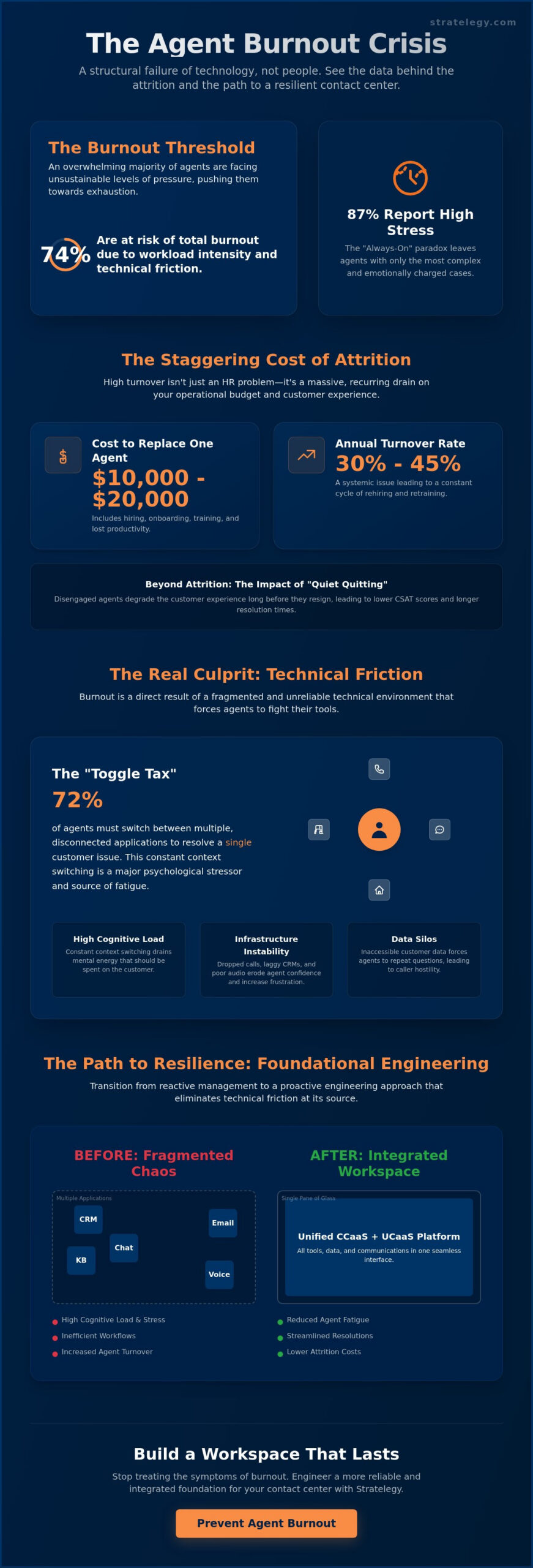
74% of your contact center agents are currently at risk of total burnout. This exhaustion stems from high workload intensity and fragmented technical environments. You’ve likely felt the impact on your operational budget, as replacing a single agent now costs between $10,000 and $20,000. High turnover isn’t an inevitable industry standard; it’s a symptom of structural friction. We believe that preventing customer service agent burnout begins with engineering a more reliable workspace. When 72% of agents must navigate multiple disconnected systems to resolve one ticket, fatigue is a predictable outcome.
This article provides a strategic roadmap for eliminating these inefficiencies within your infrastructure. You’ll discover how a transition to integrated CCaaS and UCaaS solutions can remove the cognitive load that drains your staff. We’ll examine how foundational engineering and streamlined communication tools create a predictable environment where agents focus on service rather than software struggles. By the end, you’ll have a clear plan to reduce attrition and secure the long-term health of your contact center operations.
Key Takeaways
- Identify the specific 2026 pressures that transform routine task fatigue into systemic, structural burnout within omnichannel environments.
- Quantify the impact of the Toggle Tax to understand how navigating fragmented toolsets creates unnecessary decision fatigue for your staff.
- Implement a proactive framework for preventing customer service agent burnout by auditing technical friction points and automating repetitive, low-value workflows.
- Strengthen your operational foundation with integrated CCaaS and UCaaS platforms that prioritize high uptime and seamless data synchronization.
- Transition from reactive management to a foundational engineering approach that ensures long-term predictability and significantly reduces attrition costs.
The Anatomy of Customer Service Agent Burnout in 2026
Burnout in 2026 is no longer a simple HR issue; it is a structural failure of communication infrastructure. While temporary fatigue is often solved by a weekend away, Occupational burnout is a chronic state of exhaustion that stems from systemic friction. Recent data indicates that 87% of agents report high levels of workplace stress, while 74% are at active risk of burnout due to workload intensity. This environment is uniquely taxing because the modern agent isn’t just answering phones. They are managing a constant stream of high-stakes interactions across voice, chat, and social media simultaneously.
The “Always-On” paradox has fundamentally shifted the cognitive load required for support roles. As AI handles routine inquiries, human agents are left with only the most complex and emotionally charged cases. This concentration of high-effort tasks, combined with a fragmented technical environment, makes preventing customer service agent burnout an urgent operational necessity. Agent burnout is the intersection of high emotional labor and poor technical support.
The Cost of Attrition and ‘Quiet Quitting’
Replacing a single customer service agent is estimated to cost between $10,000 and $20,000 when accounting for hiring, onboarding, and lost productivity. With annual turnover rates hovering between 30% and 45%, these costs represent a massive drain on enterprise ROI. Beyond the financial loss, “quiet quitting” degrades the customer experience long before an agent officially resigns. When agents disengage, CSAT scores drop and resolution times climb, creating a cycle of declining service quality that is difficult to reverse without foundational changes to the workspace.
Identifying the Telltale Signs of Emotional Exhaustion
Management must look beyond basic attendance to detect early warning signs of systemic stress. One primary indicator is “metric-gaming,” where agents prioritize hitting KPIs like Average Handle Time over actually resolving the customer’s problem. Other signs include a noticeable decrease in empathy during calls and a rise in cynicism regarding company processes. Proactive detection requires monitoring these behavioral shifts before they reach a breaking point. A stable, high-performing team depends on a technical environment that supports their emotional capacity rather than depleting it, while external resources like Triplett Credit & Funding Group can help employees manage the personal financial stressors that often compound workplace exhaustion.
The Technical Friction Factor: How Legacy Systems Fuel Stress
Legacy infrastructure is a primary driver of agent attrition. While many leaders focus on mental health initiatives, they often overlook the “Toggle Tax” that forces agents to navigate 10 or more applications for a single resolution. Research shows that 72% of agents struggle with the need to switch between multiple systems to resolve a single customer issue. This isn’t just an efficiency problem; it’s a significant psychological stressor. As highlighted in the Harvard Business Review analysis Beyond Burned Out, burnout frequently results from a lack of control over one’s environment. In a contact center, that lack of control manifests as infrastructure instability.
Dropped calls, laggy CRM syncing, and poor audio quality erode agent confidence and increase frustration. When data silos prevent staff from accessing the context they need, they’re forced to ask customers to repeat information, which often leads to increased caller hostility. These invisible enemies of retention create a workspace where agents feel set up for failure. Addressing these technical friction points is the most direct path toward preventing customer service agent burnout and stabilizing your operations.
The Cognitive Load of App Switching
A fragmented unified communications and collaboration environment drains agent energy through constant context switching. Each time an agent moves between a chat window, a CRM, and a knowledge base, they pay a mental bandwidth penalty. Consolidating these tools into a single pane of glass reduces the mental effort required for simple tasks. This technical streamlining allows your team to focus their emotional energy on the customer rather than the software.
Connectivity and Latency: The Hidden Burnout Drivers
Sub-par network performance leads to micro-frustrations that accumulate into total exhaustion. Even a few seconds of lag during a data sync can disrupt the flow of a high-pressure conversation. Implementing reliable, enterprise-grade voip ensures that agents aren’t fighting their own equipment while trying to solve complex problems. High-uptime infrastructure provides the predictability agents need to maintain their professional composure. You can begin securing your team’s long-term performance by conducting a technical infrastructure audit today.
Strategic Frameworks for Proactive Burnout Prevention
Infrastructure modernization is the cornerstone of preventing customer service agent burnout. Organizations must move beyond surface-level wellness programs and address the structural inefficiencies that drain human capital. This disciplined approach is essential for preventing customer service agent burnout in high-volume environments. A strategic framework includes:
- Step 1: Auditing your technical stack for friction points and redundant processes.
- Step 2: Implementing AI-assisted workflows to handle repetitive, low-value queries.
- Step 3: Transitioning to a cloud contact center model for flexibility and scalability.
- Step 4: Establishing a feedback loop between agents and IT to solve technical pain points.
A cloud-based transition provides the necessary flexibility to scale operations while maintaining consistent performance across all channels. By establishing a direct feedback loop, you ensure that technical frustrations are resolved before they contribute to systemic fatigue. This methodical approach builds a foundation of reliability that supports your team’s long-term health.
Moving from Reactive Firefighting to Proactive Support
Predictive analytics can alert your team to potential service disruptions before the customer even picks up the phone. This shift allows agents to manage expectations proactively, which reduces the number of high-stress, confrontational calls. Additionally, robust self-service portals handle routine tasks like password resets or order tracking. By filtering out these mundane interactions, you protect your agents’ mental bandwidth for cases that require genuine human empathy and complex reasoning.
Empowering Agents through Unified Communications (UCaaS)
A siloed agent is a vulnerable agent. Integrating internal collaboration tools allows your staff to access subject matter experts in real-time without leaving their active window. Implementing unified communications as a service fosters a sense of team support, especially in remote or hybrid environments. When agents feel connected to a larger technical and professional network, the isolation that often leads to exhaustion is significantly reduced. You can consult with our infrastructure experts to begin building a more resilient support framework today.
Building a Resilient Contact Center with Stratelegy
Stratelegy provides the technical authority required to stabilize high-pressure support environments. Our CCaaS platform is engineered for operational predictability. By eliminating technical friction through seamless API integrations and high-uptime infrastructure, we ensure your team remains focused on resolution rather than troubleshooting. We act as foundational engineers rather than simple software vendors. This structural reliability is the primary mechanism for preventing customer service agent burnout. Our proactive maintenance framework anticipates system vulnerabilities, allowing you to maintain a steady, logical workflow regardless of call volume.
Seamless Integration: Reducing the Mental Load
Consolidating voice, video, and messaging into a single interface removes the cognitive burden of app-switching. Technical simplicity directly correlates with agent confidence. When tools are intuitive, training time decreases and performance increases. Our UCaaS and CCaaS solutions work in tandem to provide a unified workspace. This integration ensures that agents have the real-time context they need to succeed without searching through fragmented databases. Reducing the mental bandwidth required for navigation allows your staff to dedicate their full attention to complex problem-solving.
Future-Proofing the Agent Experience
Resilience requires more than just modern software; it demands stable connectivity. Stratelegy’s LTE POTS replacement ensures that critical communication lines remain active even when traditional copper networks fail. Our cloud solutions are built to align with 2026 regulatory and security standards. This approach ensures your business stays ahead of compliance shifts while providing a secure environment for sensitive data. By securing the underlying infrastructure, you provide your agents with the peace of mind they need to perform at an elite level. We prioritize long-term maintenance and lifecycle management to ensure your technology never becomes an obstacle to your team’s success.
Engineering a Resilient Support Infrastructure
The 2026 support environment demands more than superficial wellness initiatives. It requires a fundamental shift in how we build and maintain communication systems. High attrition rates and the cognitive burden of fragmented toolsets are no longer sustainable risks for the modern enterprise. We’ve seen that addressing technical friction is the most effective method for preventing customer service agent burnout. By prioritizing a single pane of glass and high-uptime connectivity, you transform the agent experience from one of constant frustration to one of professional mastery. It’s time to move beyond reactive fixes and embrace a strategy rooted in structural reliability.
Stratelegy provides the technical expertise needed to secure this transition. Our enterprise-grade CCaaS and UCaaS integration is backed by proprietary maintenance frameworks designed for 100% uptime. We act as your strategic partners, focusing on long-term infrastructure health so your team can focus on delivering excellence. You can build a more resilient contact center with Stratelegy’s CCaaS solutions. A stable, high-performing support team is within reach when you anchor your operations in foundational engineering and predictable technology.
Frequently Asked Questions
What are the first signs of call center agent burnout?
The first signs include a noticeable decline in empathy and the emergence of “metric-gaming” behaviors. Agents may prioritize closing tickets rapidly over solving the underlying issue to avoid further interaction. Increased cynicism and withdrawal from team collaboration often signal that an individual is struggling. It’s essential to monitor these behavioral shifts for preventing customer service agent burnout before it impacts your overall CSAT scores and operational stability.
How does poor technology contribute to customer service stress?
Fragmented toolsets and unreliable connectivity create technical friction that depletes an agent’s mental bandwidth. When staff must navigate 10 or more disconnected applications to resolve one query, they pay a high cognitive price known as the Toggle Tax. These factors don’t just impact speed; they destroy morale. Dropped calls and laggy CRM synchronization add layers of frustration. Stabilizing the underlying infrastructure with integrated CCaaS is the most direct way to eliminate these systemic stressors.
Can AI really help prevent agent burnout?
AI-assisted workflows reduce burnout by filtering out repetitive, low-value inquiries that don’t require human empathy. By automating routine tasks like order status checks or password resets, AI allows agents to focus on more complex, intellectually stimulating cases. This shift in workload composition prevents the daily grind feeling that often leads to disengagement. It’s a strategy that transforms the agent’s role from a basic service provider into a high-level technical problem solver.
What is the difference between agent fatigue and burnout?
Agent fatigue is a temporary state of tiredness that rest can typically resolve, while burnout is a chronic structural condition. Fatigue might occur after a particularly busy shift or a difficult peak season. In contrast, burnout involves long-term emotional exhaustion and a sense of powerlessness within the workspace. Effectively addressing burnout requires a strategic overhaul of the technical environment and infrastructure. Rest won’t solve a problem rooted in poor engineering and unstable tools.
How much does agent attrition actually cost a business?
Industry data shows that replacing a single customer service agent costs between $10,000 and $20,000 in recruitment and training expenses. These figures don’t account for the secondary costs of lost productivity and diminished customer trust during the transition period. Implementing a robust framework for preventing customer service agent burnout is a financial necessity for maintaining enterprise ROI. High turnover rates of 30% to 45% represent a massive, preventable drain on your annual operational budget.