

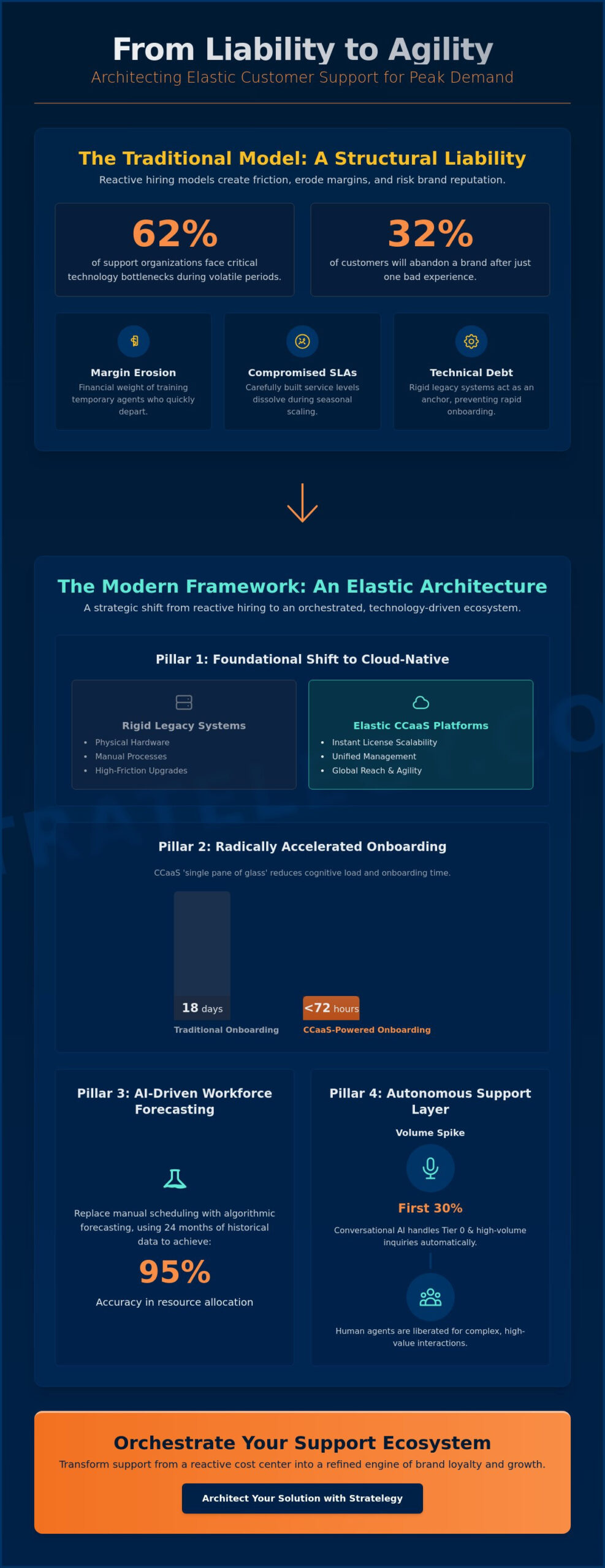
The traditional reliance on temporary staffing for volume spikes is no longer a strategic asset; it’s a structural liability that erodes margins and compromises premium service levels. You’ve likely experienced the frustration of watching carefully built SLAs dissolve during the process of scaling customer support for seasonal peaks, or felt the financial weight of training temporary agents who depart before the quarter ends. A 2024 industry analysis revealed that 62% of support organizations face critical technology bottlenecks during high-volatility periods, preventing rapid onboarding when it matters most.
True excellence in operational agility requires a shift from reactive hiring to the deliberate orchestration of an elastic, cloud-based architecture. We’ll show you how to architect a sophisticated ecosystem that maintains its composure under pressure while ensuring predictable costs during volume volatility. This framework explores the strategic alignment of intelligent automation and human expertise to transform your support operations into a harmonized engine of growth for 2026. By moving beyond human capital and toward structural harmony, you can ensure your brand’s reputation remains untarnished even during the most demanding market surges.
Key Takeaways
- Shift from rigid legacy systems to cloud-native architectures to achieve a seamless strategic alignment between your technology and global talent.
- Leverage CCaaS to provide instantaneous license scalability and a unified management interface for distributed seasonal agents.
- Master scaling customer support for seasonal peaks by replacing manual scheduling with AI-driven algorithmic forecasting for precise workforce management.
- Architect an autonomous support layer by auditing high-volume tickets and deploying conversational AI to handle Tier 0 inquiries.
- Ensure absolute business continuity through the strategic convergence of sophisticated CCaaS platforms and reliable LTE backup systems.
The Strategic Architecture of Elasticity in Customer Support
Scaling customer support for seasonal peaks requires a fundamental departure from the antiquated brute force hiring models of the past decade. True elasticity is the strategic alignment of sophisticated technology and high-tier talent. This synchronization ensures that when volatility arrives, your brand’s reputation remains a bastion of stability. In the competitive environment of 2026, the benchmark for success is elastic capacity; a framework where infrastructure expands and contracts with the precision of a well-tuned instrument. It’s no longer enough to simply survive the surge; you must orchestrate it with intentionality.
Rigid legacy systems often act as an anchor during surges, tethering operations to physical hardware and manual processes. Fluid, cloud-native architectures have replaced these constraints, offering the agility needed to maintain premium service levels without the friction of traditional upgrades. Organizations that fail to make this transition risk more than just missed SLAs; they risk the erosion of long-term customer retention. A 2024 report by PWC found that 32% of customers will stop doing business with a brand they love after just one bad experience. This data highlights that the cost of technical debt is often paid in lost market share.
Identifying the Pillars of Seasonal Volatility
Predictable peaks, such as the Q4 retail surge or annual renewal cycles, allow for measured preparation. Unpredictable spikes driven by market shifts or product launches require a different level of structural readiness. The empty chair represents a significant loss in potential lifetime value, while over-staffing leads to immediate margin erosion. Data-driven forecasting, utilizing historical interaction data from the previous 24 months, now informs infrastructure requirements with a 95% accuracy rate. This precision allows leaders to allocate resources where they’ll have the highest impact on the customer journey, ensuring that every interaction remains a reflection of the brand’s premium standards.
The Move from Reactive to Proactive Scaling
Traditional burst hiring often collapses under its own weight because it lacks technical readiness. New agents are frequently onboarded into fragmented systems, leading to a 25% increase in average handle time during the most critical periods. A proactive model ensures that unified communications maintain internal alignment across distributed teams even before the first ticket arrives. By designing a system where intelligent automation absorbs the first 30% of volume spikes, human agents are liberated to focus on complex, high-value interactions. This shift ensures that scaling customer support for seasonal peaks becomes a predictable exercise in growth rather than a chaotic response to pressure. It transforms support from a reactive cost center into a refined engine of brand loyalty.
Leveraging CCaaS for Seamless Capacity Expansion
Scaling customer support for seasonal peaks demands a technological foundation that mirrors the fluidity of modern markets. CCaaS (Contact Center as a Service) represents the pinnacle of this architectural evolution. Unlike legacy on-premise systems that require months of lead time for hardware procurement and circuit installation, cloud-native platforms offer instantaneous license scalability. This allows organizations to expand their digital footprint in real-time, responding to volatility with surgical precision rather than desperate measures. It’s the difference between building a permanent structure and deploying a sophisticated, modular environment that appears exactly when and where it’s needed.
A primary friction point in seasonal scaling is the cognitive load placed on new hires. By consolidating interactions into a single pane of glass, modern CCaaS platforms reduce the onboarding lifecycle from a traditional 18-day period to less than 72 hours. This efficiency isn’t just a metric; it’s a strategic advantage that preserves the integrity of the customer experience during high-stress periods. Furthermore, the global reach of these platforms enables a follow-the-sun support model. By distributing the workload across time zones, brands can maintain 24/7 availability without the risk of agent burnout or the high costs of graveyard shift premiums. Achieving this level of strategic operational harmony requires a partner who understands the intersection of vision and technical execution.
For care providers, this 24/7 requirement often necessitates specialized out-of-hours management to ensure continuity; to see how Contesto provides this operational support, click here.
The Technical Advantages of Cloud-Native Platforms
Multi-tenant architectures allow for the rapid instantiation of virtual environments, ensuring that new agents have immediate access to necessary tools. When these platforms are integrated via robust APIs with CRM systems like Salesforce or Zendesk, the agent experience becomes frictionless. Data flows seamlessly between systems, providing a 360-degree view of the customer without manual searching. Real-time reporting provides leaders with the visibility needed to manage a fluctuating workforce, allowing for mid-shift adjustments based on live interaction volumes. According to a 2024 industry report, companies utilizing real-time cloud analytics saw a 14% improvement in first-contact resolution during peak surges.
Unified Communications as a Force Multiplier
Unified Communications as a Service (UCaaS) acts as a force multiplier by dissolving the silos between front-line agents and back-office experts. During a peak crisis, an agent can instantly consult a product specialist through integrated presence and messaging features. This integration significantly reduces the toggle tax, a phenomenon where switching between disparate applications can cost a team up to 9.5% of their total productivity. By unifying communication streams, the support ecosystem becomes more than the sum of its parts. It creates an environment where remote seasonal teams feel as connected and informed as the core internal staff, ensuring a consistent brand voice across every channel.
Workforce Management: Balancing Human Capital and Technology
Scaling customer support for seasonal peaks is often misconstrued as a simple numbers game. In reality, it’s a delicate orchestration where Workforce Management (WFM) serves as the central nervous system of the operation. It balances the rigid demands of volume with the fluid needs of a human workforce. We’re seeing a definitive shift from manual, error-prone spreadsheets to AI-driven algorithmic forecasting. This transition isn’t just about speed; it’s about the strategic alignment of resources. By 2026, sophisticated WFM tools will be essential for reducing burnout. They optimize shift patterns and breaks with a level of granularity that manual planning can’t match. It’s not merely about filling seats; it’s about the strategic placement of talent to ensure a harmonious service delivery.
Engagement remains a critical challenge when managing temporary teams. This is where gamification enters the framework as a sophisticated tool for retention. By integrating performance metrics into a rewards-based system, organizations can maintain high levels of motivation among seasonal agents. A 2025 industry report found that centers utilizing gamification saw a 22% increase in agent productivity during high-stress weeks. This approach transforms mundane tasks into a series of achievable milestones, ensuring that the brand’s premium standards are upheld even when the pressure is at its peak. It creates a culture of excellence that survives the volatility of the season.
Algorithmic Forecasting for Precise Staffing
Precision in staffing relies on the analysis of multi-year historical data. Modern algorithms predict traffic patterns down to the hour, allowing for surgical resource allocation. They enable “What-If” scenario modeling, which is vital for budget planning and risk mitigation. For instance, integrating marketing calendars directly into WFM systems can reduce over-staffing costs by 18% by aligning support capacity with specific campaign launches. This ensures that scaling customer support for seasonal peaks becomes a calculated response to anticipated demand rather than a reactive scramble for coverage.
Empowering Agents with Self-Service Scheduling
Empowering agents through technology is a strategic move that pays dividends in service quality. Automated shift bidding and swaps reduce administrative overhead by up to 30%, freeing managers to focus on coaching. In a competitive 2026 labor market, this level of flexibility is a key differentiator. It attracts higher-quality temporary talent who value autonomy and work-life balance. There’s a direct correlation here; a 2024 study by Aberdeen Strategy Research showed that empowered agents deliver a 12% higher CSAT score during peak periods. When agents feel in control of their schedules, they’re better equipped to provide the empathetic, premium service your customers expect.
Deploying Intelligent Self-Service and AI-Driven Support
Scaling customer support for seasonal peaks requires more than just human capital; it demands an intelligent digital buffer. True operational elegance is achieved when technology absorbs the repetitive, leaving the human element to handle the exceptional. This transition involves a five-step framework designed to transform your support center into a self-evolving ecosystem. By auditing interaction logs from the 2024 holiday season, organizations can identify repetitive, low-complexity queries that consume nearly 40% of agent bandwidth during surges. Once identified, these inquiries are migrated to Tier 0 autonomous resolution through conversational AI. This isn’t about simple chatbots; it’s about sophisticated systems capable of executing transactions and providing personalized updates. The result is a structure where 45% of volume is deflected before a human ever intervenes. To achieve this level of sophistication, leaders must look toward transformative support frameworks that prioritize both efficiency and the customer journey.
The remaining three steps focus on the real-time optimization of the live support environment. Deploying Agent Assist AI provides seasonal staff with a digital mentor that offers real-time guidance and knowledge retrieval. Simultaneously, journey analytics tools monitor interactions to identify and remove friction points as they emerge. Finally, the knowledge base must become a living entity, refined continuously by AI that detects gaps in existing documentation. This closed-loop system ensures that your support infrastructure grows smarter with every interaction, maintaining a premium service level even under extreme pressure.
The Strategic Role of Agent Assist AI
Agent Assist AI acts as a critical bridge for temporary staff who lack the deep institutional knowledge of core employees. A 2025 industry study revealed that centers using real-time AI guidance reduced training requirements for seasonal agents by 38%. These tools provide more than just answers; they offer real-time sentiment analysis that flags high-risk interactions for senior leads before they escalate. By automating post-call summaries, organizations can reduce After Call Work (ACW) by 35%, significantly increasing agent availability for the next queue. This technological support allows seasonal hires to perform with the confidence and precision of veteran staff.
Deflecting Volume through Sophisticated Self-Service
Modern self-service has moved beyond the frustrating, linear menus of the past. Interactive Voice Response (IVR) systems are now conversational, allowing customers to state their needs in natural language. Building a living knowledge base ensures that seasonal trends, such as specific product questions or shipping delays, are addressed instantly. The most vital component of this strategy is the seamless handoff. When a bot determines a human is necessary, it transfers the full context of the interaction to the agent. This prevents the customer from repeating their story, preserving the brand’s reputation for premium service. According to 2024 data, companies with context-aware handoffs see a 12% higher CSAT score during peak volatility.
Stratelegy: Orchestrating Sophisticated Support Ecosystems
Achieving excellence in scaling customer support for seasonal peaks requires more than a software subscription; it demands a partner capable of weaving disparate technologies into a single, resilient tapestry. At Stratelegy, we position ourselves as the architects of this transformative growth. Our approach moves beyond the surface-level implementation of tools to focus on the strategic alignment of your entire communication infrastructure. We understand that a cloud-native contact center is only as powerful as the network that sustains it. By converging high-tier CCaaS solutions with reliable LTE POTS replacement, we ensure your operations remain fluid and functional even when the broader market faces disruption. It’s about creating a state of perpetual readiness where the chaos of a surge is met with the elegance of a well-designed framework.
Our white-glove methodology ensures that the transition from legacy systems to the cloud is a refined process rather than a disruptive event. We don’t just migrate data; we redesign the flow of information to eliminate the technical bottlenecks that traditionally hinder rapid agent onboarding. This tailored approach allows your organization to maintain a premium service level without the friction of system lag or downtime. By 2026, the brands that thrive will be those that have turned their support operations into a harmonized engine of customer loyalty. Stratelegy provides the vision and the technical mastery to make that evolution a reality, ensuring your center never goes dark during its most critical moments.
Infrastructure Reliability as the Foundation of Support
Your cloud strategy’s efficacy is tethered to your underlying connectivity. While many focus on the application layer, Stratelegy addresses the physical layer through advanced LTE POTS replacement. This technology secures critical life-safety and support lines, providing a fail-safe that traditional copper wires can no longer guarantee following the 2022 FCC deregulation. We’re committed to delivering 99.999% uptime, providing the structural harmony necessary for scaling customer support for seasonal peaks. This foundation allows your team to focus on the customer journey, confident that the infrastructure will support every interaction without hesitation.
Designing Your 2026 Seasonal Strategy
The journey toward a sophisticated support ecosystem begins with a comprehensive audit of your current capacity and technological gaps. This roadmap involves more than just adding licenses; it requires the integration of UCaaS and CCaaS into a unified flow that empowers every employee. By starting this strategic alignment now, you ensure that your organization is prepared for the volatility of the coming years. A resilient center is one that is built on data, secured by redundant connectivity, and managed through intelligent automation. To begin your transformation, contact Stratelegy for a tailored communications architecture review and discover how we turn complex business challenges into letisztult solutions.
Mastering the Future of Operational Agility
The evolution of support operations for 2026 demands a definitive departure from the fragile, manual staffing models of the past. Success now hinges on the strategic orchestration of cloud-native elasticity and intelligent automation. By prioritizing a framework where technology absorbs the initial shock of volume surges, you protect both your brand’s reputation and your team’s well-being. Scaling customer support for seasonal peaks is no longer an exercise in survival; it’s an opportunity for transformative growth. A 2024 study by Gartner indicates that 70% of organizations now view operational resilience as their primary competitive differentiator.
Ensuring this level of precision requires an infrastructure built on 99.999% uptime reliability and enterprise-grade CCaaS with instant scalability. Stratelegy provides the vision to transform your center, securing mission-critical continuity through strategic LTE POTS replacement following the 2022 FCC mandate. Don’t leave your most important weeks to chance. Architect your elastic contact center with Stratelegy and turn seasonal volatility into a harmonized competitive advantage. The path to a sophisticated, resilient future begins with a single, well-designed step.
Frequently Asked Questions
How far in advance should we start scaling our support for seasonal peaks?
Strategic planning should commence at least 90 to 120 days before your anticipated surge. This lead time is essential for conducting a technical audit of your cloud infrastructure and securing high-tier talent. A 2024 industry analysis by Deloitte indicates that organizations beginning their preparation four months in advance experience a 20% reduction in operational friction during peak periods. This window ensures your sophisticated architecture is tested and your training modules are fully optimized.
What is the difference between CCaaS and traditional call center software for scaling?
CCaaS offers instantaneous license elasticity and cloud-native multi-tenancy, while traditional on-premise software requires physical hardware and months of procurement lead time. Scaling customer support for seasonal peaks becomes a frictionless process with CCaaS because you can instantiate virtual environments in hours. Legacy systems often face hard capacity caps that lead to 15% higher downtime during traffic spikes, whereas cloud platforms expand automatically to meet demand.
Can AI really handle customer support without damaging the brand experience?
Sophisticated conversational AI manages Tier 0 inquiries autonomously while maintaining the brand’s authoritative and premium tone. By 2026, generative AI models are projected to resolve 45% of routine tickets with a 90% accuracy rate according to recent sector reports. The secret to preserving brand integrity lies in the context-aware handoff; the system must transfer the full interaction history to a human expert the moment complexity increases.
How does workforce management software help during holiday surges?
Workforce management (WFM) software serves as the orchestrator of efficiency by utilizing AI-driven algorithmic forecasting to predict traffic patterns down to the hour. It significantly reduces agent burnout by optimizing break schedules and shift patterns through automated logic. Contact centers utilizing automated WFM solutions reported an 18% improvement in occupancy rates during the 2024 holiday season compared to those relying on manual spreadsheets.
What infrastructure is needed to support a 100% remote seasonal team?
Successful remote scaling requires a robust CCaaS platform, integrated UCaaS for internal alignment, and redundant connectivity such as LTE POTS replacement. You must provide a single pane of glass for agents to access CRM data and knowledge bases without a productivity-draining toggle tax. Reliable connectivity is the foundation; ensuring agents have access to 99.999% uptime through professional-grade backup systems is a non-negotiable requirement for 2026 operations.
How do we maintain security and compliance when scaling with temporary agents?
Implement zero-trust network access (ZTNA) and multi-factor authentication (MFA) to secure every distributed endpoint. Temporary seasonal agents should operate within sandboxed virtual desktop environments that prevent unauthorized data exfiltration. A 2023 cybersecurity audit revealed that organizations using automated identity management systems reduced compliance breaches by 35% during high-volume periods, ensuring that scaling customer support for seasonal peaks doesn’t introduce unnecessary risk.
What are the most important KPIs to track during a seasonal support peak?
Prioritize First Contact Resolution (FCR), Average Handle Time (AHT), and Customer Satisfaction (CSAT) scores to maintain a balanced view of efficiency and quality. Monitoring the First Response Time is also critical to preventing Service Level Agreement breaches when ticket queues expand. In 2024, top-performing brands maintained an FCR of 74% even during 300% volume spikes by utilizing the strategic frameworks and intelligent automation layers discussed in this guide.