

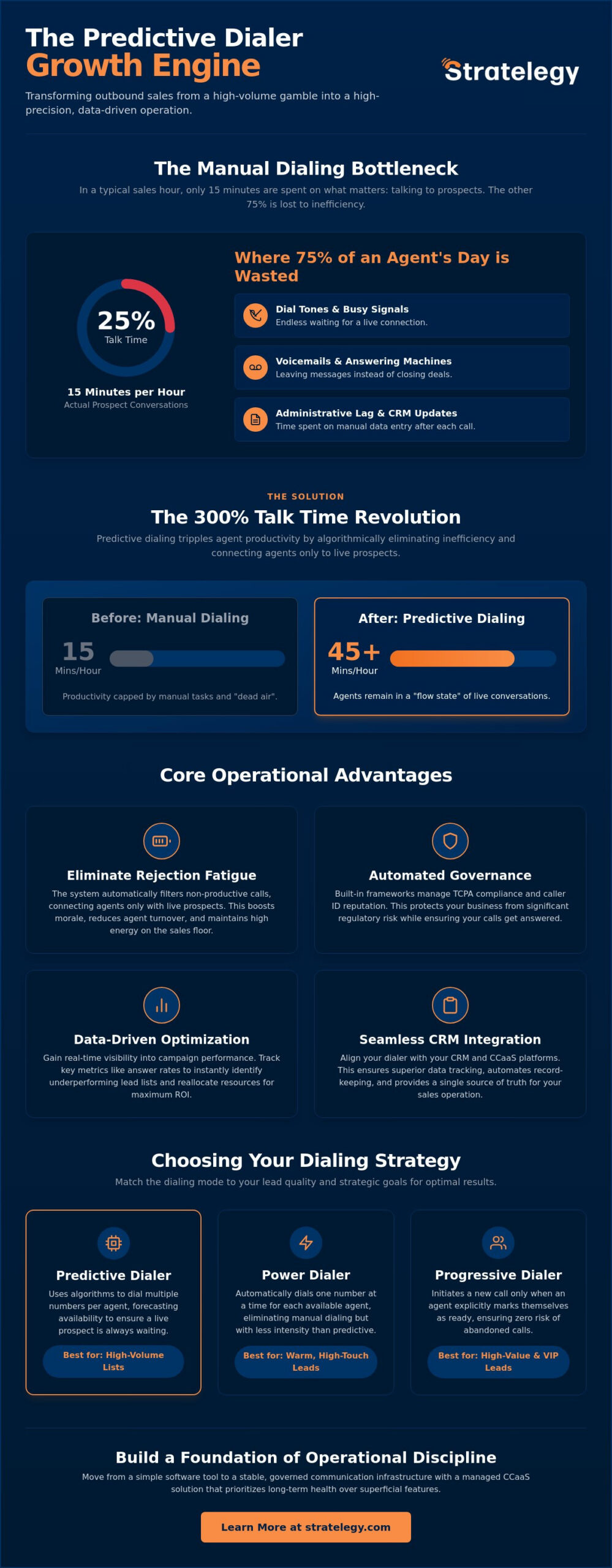
The average sales agent spends only 15 minutes of every hour actually speaking with prospects, meaning 75% of their day is lost to dial tones, busy signals, and administrative lag. It’s a frustrating reality for sales leaders who see their growth throttled by manual inefficiencies and the constant threat of “Spam Likely” labels. You’re likely tired of the volume-based grind that yields diminishing returns and creates unnecessary compliance risks in an increasingly strict regulatory environment. Understanding the predictive dialer benefits for sales teams is no longer about just making more calls; it’s about building a foundation of operational discipline and technical governance.
This article explores how predictive dialing transforms outbound sales from a high-volume gamble into a high-precision, data-driven growth engine. We’ll show you how modern infrastructure can facilitate a 300% increase in agent talk time while automating TCPA compliance and CRM data tracking. We will break down the strategic impact of moving to a cloud-native dialing solution that prioritizes caller ID reputation and long-term business health over superficial features.
Key Takeaways
- Master the algorithmic pacing mechanics that transform outbound calling from a volume-based grind into a high-precision, automated operation.
- Realize the full scope of predictive dialer benefits for sales teams, specifically the ability to triple agent talk time while reducing rejection fatigue.
- Implement automated governance frameworks that handle TCPA compliance and caller ID reputation management to protect your business from regulatory risk.
- Align your communication infrastructure by integrating predictive dialers with CCaaS and CRM platforms for superior data tracking and long-term operational stability.
The Mechanics of Efficiency: What is a Predictive Dialer?
Efficiency in 2026 is no longer about working harder; it’s about engineering better workflows. A predictive dialer is an automated outbound calling system that uses sophisticated algorithms to forecast agent availability and dial multiple numbers simultaneously. By analyzing real-time data such as average talk time and historical answer rates, the system ensures a live prospect is on the line the moment an agent finishes their previous call. This technology represents a significant evolution of the foundational Auto dialer, moving from simple automation to intelligent forecasting.
One of the primary predictive dialer benefits for sales teams is the elimination of the “dead air” that plagues manual outreach. Manual dialing acts as a structural bottleneck, forcing agents to spend roughly 75% of their day navigating voicemails, busy signals, and disconnected lines. A predictive dialer is a strategic infrastructure tool that uses mathematical forecasting to align call volume with agent capacity, effectively eliminating idle time between connections.
The core of this technology lies in the pacing ratio. Unlike static systems, predictive algorithms adjust in real-time. If answer rates drop during a specific time of day, the system accelerates dialing to compensate. If agents are tied up in long discovery calls, it slows down to prevent abandoned calls and maintain compliance. This precision ensures that your team remains focused on high-value conversations rather than administrative friction.
Predictive vs. Power vs. Progressive Dialing
Choosing the right tool depends on your lead quality and sales strategy. Predictive dialing is ideal for high-volume lists where answer rates fluctuate. In contrast, power dialing calls one number at a time for each available agent, which is better for warm, high-touch leads. Progressive dialing only initiates a call when an agent is explicitly ready, ensuring zero abandoned calls but offering less volume than its predictive counterpart. Matching these predictive dialer benefits for sales teams to your specific lead tiers—and utilizing high-quality lead sources like when you discover Landvoice for real estate prospecting—is essential for maximizing ROI.
The Evolution of Outbound Technology
Modern outbound systems have migrated from rigid legacy hardware to cloud-native CCaaS integrations. In 2026, a basic dialer is insufficient for enterprise needs. Strategic organizations now require deep integration with UCaaS platforms to ensure a unified communication stack. This shift from software-as-a-service to structural reliability allows for better regulatory governance and provides a more stable foundation for long-term growth.
Quantifying the Advantages: Key Predictive Dialer Benefits for Sales Teams
Talk time is the primary metric of sales productivity. In a manual dialing environment, agents often average only 15 minutes of live conversation per hour. Transitioning to automated systems allows teams to reach 45 to 50 minutes of talk time per hour, effectively tripling their output without increasing headcount. To Make Cold Calling More Efficient, organizations must move away from the high-friction mechanics of legacy outreach.
Automation addresses the psychological burden of sales. Manual dialing forces agents to process constant rejection, from busy signals to immediate hang-ups. One of the core predictive dialer benefits for sales teams is the removal of this “rejection fatigue.” By filtering out non-productive calls, the system keeps agents focused on live prospects, maintaining high morale and reducing turnover. This operational predictability creates a steady flow of conversations, allowing leadership to forecast revenue with much higher accuracy.
Maximizing Agent Occupancy
Reducing idle time directly impacts the bottom line by maximizing agent occupancy. When agents remain in a “flow state” of constant conversation, their performance improves through repetition and focus. This continuous engagement prevents the mental lag associated with switching between administrative tasks and sales pitches. Maintaining this momentum is crucial for high-growth organizations looking to scale their outbound operations effectively. For those seeking technical guidance on these deployments, exploring a managed CCaaS solution can provide the necessary infrastructure stability.
Data-Driven Campaign Optimization
Real-time reporting enables managers to pivot strategies instantly. If a specific lead list isn’t performing by midday, the dialer provides the data visibility needed to reallocate resources. Integrating these tools within a broader cloud contact center framework ensures that every interaction is tracked and analyzed. This level of oversight turns raw data into actionable intelligence, ensuring high-intent leads are prioritized at the optimal moment for conversion.
Governance and Compliance: Navigating the Regulatory Landscape
Compliance is a structural requirement for sustainable growth. The regulatory environment in 2026 demands more than just a basic “Do Not Call” filter. Modern systems must account for the FTC’s Telemarketing Sales Rule, which establishes strict guidelines for consumer protection and data handling. One of the critical predictive dialer benefits for sales teams is the automation of these complex legal frameworks, which prevents human error from resulting in significant financial penalties.
Risk mitigation starts with managing call abandonment rates. The FCC mandates a maximum abandonment rate of 3% over a 30-day period for each campaign. A compliant dialer ensures that a live agent is available within two seconds of the recipient answering, as required by federal law. Since the closure of the “lead generator loophole” on January 27, 2025, one-to-one consent is non-negotiable. Your infrastructure must be engineered to track and honor these specific permissions at the individual level while providing a clear mechanism for consent revocation.
Automating Regulatory Oversight
Modern systems handle localized time-zone restrictions and holiday dialing rules without manual intervention. Beyond simple filtering, enterprise sales communications require robust audit trails. These logs provide a verifiable record of consent and call duration, which are essential for defending against litigation and ensuring transparency. We prioritize these governance layers to ensure your business remains resilient against shifting federal and state-level regulations. For broader strategic support in navigating these legislative environments, you can explore Professional Advisory and Consulting Fees to see how expert advocacy can protect your interests. This proactive approach to predictive dialer benefits for sales teams builds long-term brand equity through operational discipline.
Protecting Your Caller ID Reputation
Connection rates depend heavily on your STIR/SHAKEN attestation level. Calls without proper verification often appear as “Spam Likely,” which destroys campaign ROI. Maintaining a high connection rate requires foundational engineering that includes number rotation and carrier-level blacklist monitoring. If you’re ready to secure your communication infrastructure against obsolescence, we invite you to consult with our technical specialists to build a compliant-first sales engine.
The Stratelegy Approach: Integrating Dialers into a Unified Strategy
A predictive dialer shouldn’t exist in a vacuum. To fully realize the predictive dialer benefits for sales teams, the technology must be woven into the fabric of your unified communications as a service (UCaaS) and CCaaS environment. This integration ensures that voice data is never siloed. Instead, it flows directly into your CRM, whether you use Salesforce or HubSpot, eliminating the friction of manual data entry and ensuring every lead interaction is captured with precision.
Scalability requires more than just adding licenses. It demands a commitment to the long-term health of your communication infrastructure. We move beyond superficial features to focus on the underlying architecture that supports high-volume outreach. This approach provides the stability needed to transition into omnichannel strategies where voice, SMS, and email work in concert to drive engagement. By centering your strategy on structural reliability, you eliminate the fear of technical obsolescence.
Beyond the Software: The Engineering of Reliability
Our commitment is rooted in lifecycle management and systematic hardware updates. We apply the same rigorous “POTS replacement” mindset to modernizing sales tech stacks as we do to critical business infrastructure. This foundational engineering ensures that your outbound engine remains compatible with evolving carrier standards and regulatory requirements. Reliability isn’t a one-time setup; it’s a result of ongoing oversight and disciplined maintenance of the entire communication lifecycle.
Next Steps for Sales Leaders
Hidden inefficiencies often lurk in current outbound performance, from misconfigured pacing ratios to poor data hygiene. Auditing these metrics is the first step toward reclaiming lost talk time and protecting your brand’s reputation. We invite you to request a strategy session to align your technology with your 2026 growth goals. This collaborative review helps identify structural vulnerabilities and ensures your team is equipped with a high-precision, data-driven growth engine designed for the long haul.
Building a Foundation for Sustainable Sales Growth
The transition from manual outreach to automated, intelligent dialing is a strategic necessity for 2026. We’ve explored how shifting from a 15-minute talk time average to 45 minutes transforms productivity while reducing the psychological burden on your agents. By prioritizing caller ID reputation and TCPA governance, you protect your brand’s long-term equity against regulatory volatility. Realizing the full scope of predictive dialer benefits for sales teams requires a shift from viewing software as a standalone tool to treating it as critical business infrastructure.
It’s time to move beyond superficial features and invest in structural reliability. You can partner with Stratelegy to build a resilient sales infrastructure that leverages enterprise-grade CCaaS and UCaaS integration. Our compliance-first engineering ensures your operation stays ahead of STIR/SHAKEN requirements while establishing a national-scale technical authority for your outbound campaigns. Your growth shouldn’t be limited by legacy bottlenecks. Secure your competitive edge with a system designed for predictability, performance, and peace of mind.
Frequently Asked Questions
Is a predictive dialer legal for B2B sales teams?
Predictive dialers are legal for B2B outreach as long as your organization maintains strict adherence to TCPA and FCC mandates. You must ensure your call abandonment rate does not exceed 3% over a 30-day period per campaign. Since the closure of the lead generator loophole in January 2025, you also need verifiable one-to-one consent for automated calls. Legal operation requires a disciplined infrastructure that respects state-level regulations and honors immediate opt-out requests.
How does a predictive dialer integrate with my existing CRM?
Modern predictive dialers integrate with CRMs like Salesforce and HubSpot through secure API connectors or native CCaaS modules. This integration allows for real-time data synchronization, ensuring every call is logged and every lead status is updated without agent intervention. High-precision systems move data between the dialer and your database without friction. This structural alignment prevents data silos and allows for better lifecycle management of your lead lists.
What is the difference between a predictive dialer and an auto-dialer?
An auto-dialer is a broad category of software that dials numbers automatically, while a predictive dialer is a specific, algorithm-driven subset. Predictive systems use mathematical models to forecast when an agent will be free, dialing numbers before the agent even finishes their current call. Simple auto-dialers often lack this forecasting capability, which can lead to higher idle times or increased abandonment rates if the pacing isn’t manually adjusted.
How many agents do I need to make a predictive dialer effective?
Predictive dialing typically requires a minimum of 8 to 10 active agents to be statistically effective. The algorithm needs a sufficient pool of data and agent availability to accurately predict pacing ratios. For teams smaller than this threshold, the risk of call abandonment increases because the system has fewer agents to receive answered calls. Smaller organizations often find better stability using power or progressive dialing modes to maintain connection quality.
Can a predictive dialer help improve our caller ID reputation?
Yes, a sophisticated dialer improves your caller ID reputation by utilizing the STIR/SHAKEN framework to verify your identity to carriers. One of the strategic predictive dialer benefits for sales teams is the ability to monitor number health and rotate caller IDs before they are flagged as “Spam Likely.” This foundational engineering ensures higher connection rates by maintaining a clean reputation across national telecommunication networks and avoiding carrier-level blacklists.