
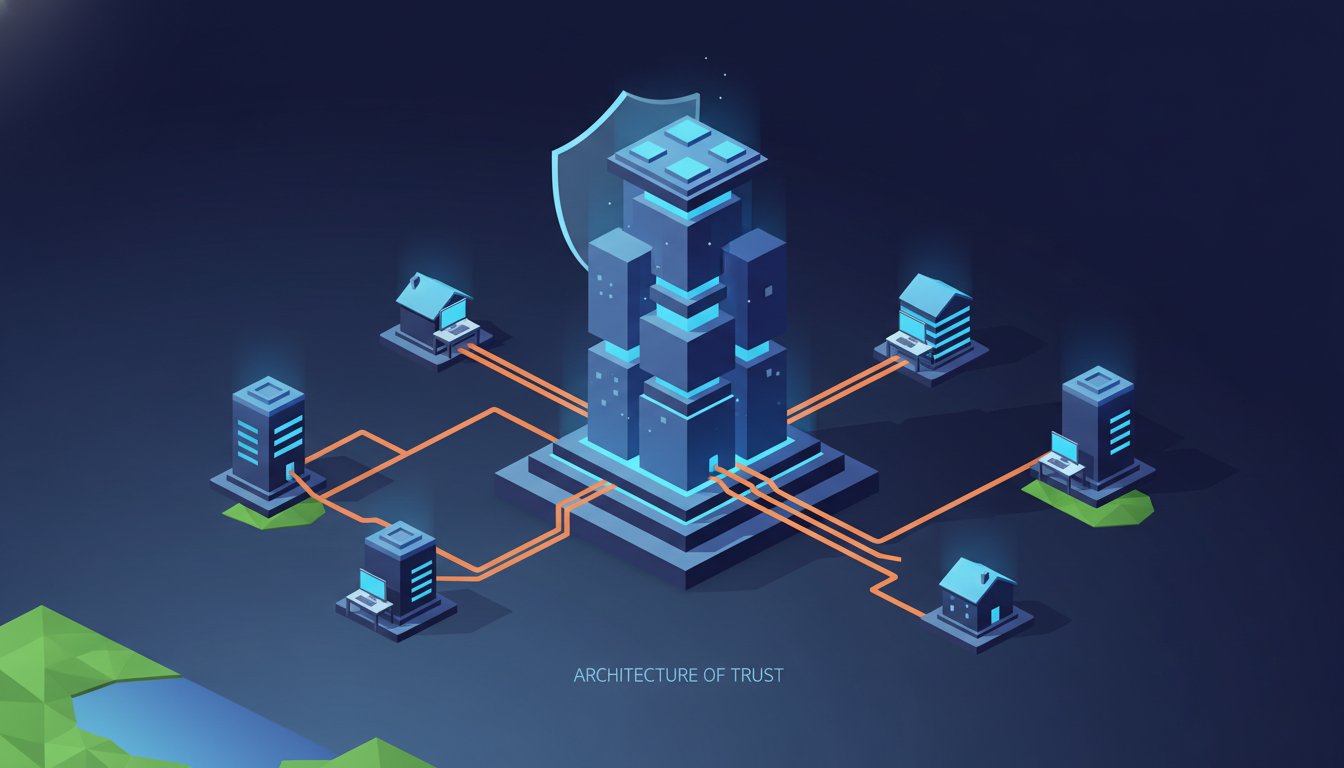
What if the very protocols designed to protect your enterprise are the same ones strangling your team’s creative momentum? You’ve likely experienced the friction of legacy security slowing down critical workflows or the risk of fragmented data leaking through uncoordinated applications. It’s a common tension for leaders who demand both absolute compliance and frictionless execution. Selecting a secure communication platform for hybrid teams shouldn’t require a compromise between safety and speed; it requires a vision for architectural harmony.
This guide demonstrates how to unify enterprise-grade security with seamless collaboration through a sophisticated UCaaS framework. You’ll discover how to navigate the May 2026 HIPAA Security Rule updates and the mandatory ISO 27001:2022 standards without sacrificing the user experience. We will analyze the strategic alignment of modern infrastructure, comparing the latest 2026 pricing models from Microsoft to Google, and provide a roadmap to transform your communication from a chaotic necessity into a well-designed engine for growth.
Key Takeaways
- Master the shift from perimeter-based defenses to identity-centric security, ensuring your enterprise communications remain resilient against the sophisticated threats of 2026.
- Evaluate the essential pillars of a secure communication platform for hybrid teams, focusing on the non-negotiable integration of Zero Trust Architecture and end-to-end encryption.
- Eliminate the “VPN Tax” by transitioning from fragmented security tools to a unified UCaaS framework that prioritizes both team productivity and data integrity.
- Uncover actionable steps to audit internal communication silos and modernize critical infrastructure by replacing vulnerable legacy lines with secure, high-performance LTE solutions.
- Align your technical infrastructure with a vision of structural harmony, transforming communication from a basic utility into a sophisticated engine for transformative growth.
The Architecture of Trust: Why Hybrid Teams Require More Than Just Connectivity
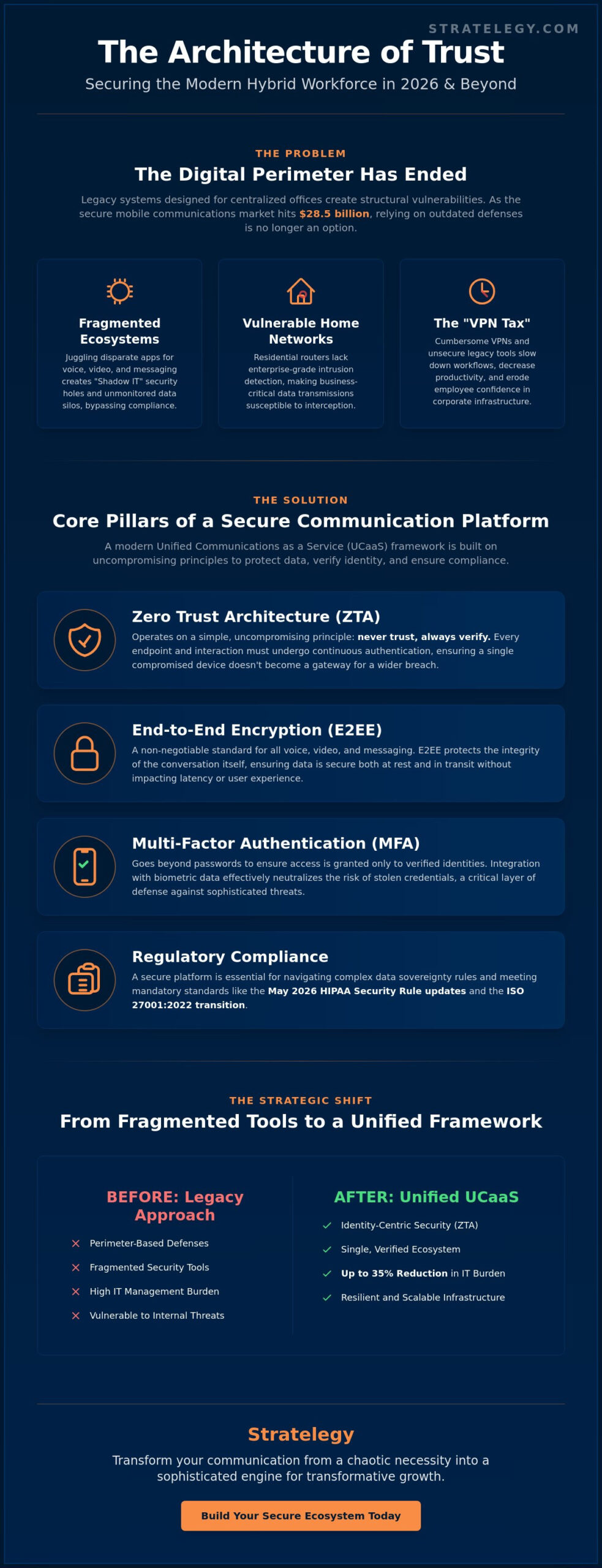
The era of the digital perimeter has effectively ended. As of April 2026, the global secure mobile communications market has expanded to $28.5 billion, a figure that reflects a profound shift from protecting physical offices to securing individual identities. For the modern enterprise, a secure communication platform for hybrid teams is no longer a peripheral IT concern; it’s the very foundation of organizational integrity. Relying on legacy systems designed for a centralized workforce creates structural vulnerabilities that no amount of patching can resolve. True security now demands a transition to identity-centric models where trust is never assumed and every interaction is verified in real-time.
Fragmented communication ecosystems are the primary catalysts for “shadow IT” security holes. When team members juggle disparate applications for voice, video, and messaging, they inevitably gravitate toward unauthorized tools to bypass friction. This fragmentation doesn’t just hinder productivity; it creates unmonitored data silos that bypass the fundamental principles of secure communication. For national enterprise operations, “good enough” encryption is a liability. Sophisticated leaders recognize that a unified, elegant workspace is a strategic asset that transforms logistical hurdles into a competitive advantage.
The Security Gap in Distributed Environments
Residential networks serve as the frontline of the modern corporate battlefield, yet they remain notoriously difficult to defend. Most home routers lack the sophisticated intrusion detection systems found in corporate hubs, making business-critical voice and data transmissions vulnerable to interception. This gap creates a tangible psychological impact. When employees struggle with cumbersome VPNs or unsecure tools, their confidence in the organization’s infrastructure wavers. Furthermore, legacy hardware often lacks the processing power to support the mandatory multi-factor authentication and mandatory encryption standards required by the May 2026 HIPAA updates and the ISO 27001:2022 transition.
Strategic Alignment of Communication and Growth
A sophisticated UCaaS framework functions as the backbone of organizational scalability. By consolidating communication into a single, verified ecosystem, firms can reduce the IT burden of managing national workforces by up to 35% compared to fragmented setups. This isn’t merely an operational efficiency; it’s a commitment to visionary infrastructure. In a talent market where 48% of the market share is concentrated in North America, providing an elegant and secure digital environment is essential for attracting top-tier hybrid professionals. When strategy and technology achieve a state of harmonic alignment, the resulting framework supports not just daily tasks, but transformative growth.
Core Pillars of a Secure Communication Platform in 2026
Building a resilient digital architecture requires more than just high-level encryption; it demands a fundamental shift in how we perceive every interaction. In 2026, a secure communication platform for hybrid teams must be anchored by Zero Trust Architecture (ZTA). This framework operates on a simple, uncompromising principle: never trust, always verify. Every endpoint, whether it’s a mobile device in a home office or a workstation in a corporate hub, must undergo continuous authentication before accessing the enterprise ecosystem. This ensures that a single compromised device doesn’t become a gateway for a wider breach.
End-to-End Encryption (E2EE) has evolved from a premium feature into a non-negotiable standard for voice, video, and messaging. As cyber threats grow more sophisticated, protecting the integrity of the conversation itself is paramount. This protection is bolstered by Multi-Factor Authentication (MFA) and biometric integration, which are now mandatory for many organizations following the May 2026 HIPAA Security Rule updates. These layers of defense ensure that access is granted only to verified identities, effectively neutralizing the risk of stolen credentials. A secure communication platform is an integrated ecosystem that protects data at rest and in transit without impacting latency.
Data Sovereignty and Regulatory Compliance
Navigating the complexities of SOC2, HIPAA, and GDPR requires a communication stack that does more than just transmit data; it must meticulously document it. The 2026 regulatory environment, characterized by the EU’s “Digital Omnibus” initiative, places a high premium on automated logging and immutable audit trails. For national enterprises, cloud-based Contact Center as a Service (CCaaS) platforms offer a refined way to manage sensitive customer data. These systems ensure that every interaction adheres to specific geographic mandates, providing a testreszabott keretrendszer for compliance that scales alongside your organizational growth.
Infrastructure Reliability: Beyond the Software
True security is an architectural harmony that extends into the physical realm. Many organizations overlook the vulnerability of legacy hardware, yet replacing outdated POTS lines is a critical security conversation. Modern life-safety systems and office alarms now require LTE-based backups to ensure functionality during primary network failures. Achieving 99.999% uptime for national teams is only possible through redundant cloud nodes and resilient hardware that bridges the gap between office and remote environments. By integrating these sophisticated infrastructure solutions, enterprises can ensure that their communication remains both bulletproof and beautifully efficient.
Beyond the VPN: Evaluating UCaaS vs. Fragmented Security Tools
The traditional virtual private network was never designed for the sustained, high-bandwidth demands of the 2026 workforce. This “VPN Tax” manifests as a persistent drain on organizational energy, where latency in voice calls and jitter in video conferencing directly erode team output. When a secure communication platform for hybrid teams is forced through a legacy tunnel, the resulting friction often drives employees toward unsecure, consumer-grade alternatives. True structural harmony requires moving beyond these bottlenecks toward a cloud-native architecture that prioritizes both speed and integrity.
Unified Communications as a Service (UCaaS) offers a sophisticated alternative to the fragmented silos of the past. While “best-of-breed” strategies once seemed logical, they often result in a patchwork of uncoordinated security protocols that leave data vulnerable during transit between apps. An integrated ecosystem provides a consistent security posture, ensuring that identity verification and encryption remain unbroken across voice, video, and messaging channels. Skeptics often ask if browser-based communication is truly enterprise-ready. The reality is that modern WebRTC frameworks, combined with advanced identity-based access, often provide a smaller attack surface than locally installed software that requires constant patching.
The Death of the Legacy PBX
On-premise hardware has become the weakest link in the modern enterprise security chain. Maintaining aging copper lines and physical servers creates a liability that no firewall can fully mitigate. The transition to cloud voice, supported by resilient LTE backups, represents a critical strategic alignment for national operations. A cost-benefit analysis reveals that the expense of maintaining legacy infrastructure far outweighs the investment in a transformatív növekedés framework. By replacing physical vulnerabilities with redundant cloud nodes, organizations ensure that their communication remains live even when local infrastructure fails.
User Experience as a Security Feature
Elegance in design is not a luxury; it’s a fundamental security requirement. When a platform is intuitive and provides a single, polished interface for voice, video, and CCaaS, employees don’t feel the need to bypass protocols. App fatigue is a genuine threat to compliance in distributed teams. By reducing the number of logins and interfaces, an enterprise can significantly improve security adherence. A well-designed system fosters a culture of safety by making the secure path the easiest one to follow, effectively turning the user interface into a silent guardian of corporate data.
Strategic Implementation: Transitioning to an Enterprise-Grade Ecosystem
Transitioning to a secure communication platform for hybrid teams requires a methodical audit of existing silos to identify hidden security risks. Many organizations operate with vulnerabilities buried in legacy workflows where sensitive data leaks between uncoordinated applications. Identifying these gaps is the first step toward strategic alignment. A national deployment plan must ensure that a team member in a satellite office receives the same level of encryption and oversight as a director at headquarters. This consistency is what transforms a disparate workforce into a unified enterprise capable of sustained, high-performance operation.
Consolidation serves as the cornerstone of this transition. By merging voice, video, and contact center operations into a single UCaaS and CCaaS framework, you eliminate the friction of multiple logins and fragmented data. This isn’t just an IT upgrade; it’s a testreszabott keretrendszer designed for transzformatív növekedés. Moving away from copper-based infrastructure toward secure LTE solutions ensures that your connectivity remains resilient. When these elements are harmonized, the communication ecosystem becomes a reliable engine for business continuity rather than a source of constant maintenance. To begin this transformation, you can consult with our experts on infrastructure modernization.
Modernizing Life Safety and Critical Systems
Critical infrastructure often remains tethered to vulnerable legacy lines that are increasingly difficult to maintain. Fire alarms, elevator phones, and building security systems must move to secure cellular communicators to meet modern reliability standards. “POTS in a box” solutions provide a sophisticated bridge, allowing legacy hardware to function over secure, cloud-managed LTE networks. This integration is vital for business continuity, ensuring that life-safety protocols remain active even during a primary network failure. It’s a precise solution for a complex challenge that many providers overlook.
Training for a Culture of Security
Technology alone cannot guarantee safety; it requires a workforce that understands the stakes. Hybrid teams must be trained to recognize sophisticated social engineering attempts that target the human element of the communication chain. Modern platforms offer advanced analytics that help identify unusual patterns, such as unexpected login locations or abnormal data transfer volumes. These insights allow for proactive mitigation rather than reactive cleanup. Your communication provider should act as a long-term strategic partner, helping you refine these processes as threats evolve and your organization scales across new regions.
Stratelegy: Sophisticated Unified Communications for the Modern Enterprise
The true measure of a communication ecosystem lies in its ability to support transzformatív növekedés while maintaining an unbreakable architecture of trust. At Stratelegy, we believe that sophisticated strategy and elegant technology are not separate disciplines; they are the two halves of a single, functional whole. As a premier provider of a secure communication platform for hybrid teams, Stratelegy transcends simple connectivity. We serve as a visionary advisor for organizations that demand more than just a vendor. Our role is to transform the inherent chaos of distributed work into a state of structural harmony, ensuring that every voice, video call, and data packet moves through a verified and resilient framework.
Bridging the gap between cloud innovation and critical legacy infrastructure is a hallmark of our approach. Many national enterprises struggle with aging hardware that creates a strategic bottleneck. Stratelegy resolves this tension through advanced UCaaS and CCaaS solutions designed for national scalability, alongside specialized LTE POTS replacement services. This ensures that even your most vital life-safety systems are integrated into a modern, secure cloud-managed environment. By aligning your technical infrastructure with your long-term business objectives, we create a stratégiái összehangolás that facilitates seamless expansion without compromising on the rigorous security standards required in 2026.
Enterprise-Grade Reliability Nationwide
Our commitment to excellence is reflected in our exclusive 100% B2B focus. We understand that enterprise communication requires a high-touch professional partnership rather than a self-service retail model. This dedication allows us to modernize critical infrastructure for fire, life safety, and security systems with surgical precision. We develop testreszabott keretrendszerek that align with the specific compliance needs of your industry, whether you are navigating the May 2026 HIPAA Security Rule updates or the mandatory ISO 27001:2022 protocols. This bespoke attention to detail ensures that your reliability is not just a promise, but a verified architectural reality across every national node.
Take the Next Strategic Step
The era of settling for fragmented tools and the “VPN Tax” has passed. Leaders who prioritize the future recognize that a unified ecosystem is the only way to sustain momentum in a hybrid world. Transitioning to an enterprise-grade platform doesn’t have to be a source of friction. With a partner that understands the complexity of national workforces and legacy integration, the path to modernization is clear and purposeful. We invite you to move beyond the limitations of disparate applications and embrace a future where your communication technology is as sophisticated as your business strategy. It’s time to elevate your hybrid team’s communication with Stratelegy and secure the foundation of your next era of growth.
Harmonizing Strategy and Security for the 2026 Workforce
The transition toward a truly resilient enterprise architecture requires more than incremental software updates. It demands a fundamental strategic alignment where every communication endpoint is verified and every legacy vulnerability is addressed. By moving beyond the limitations of the “VPN Tax” and embracing a cloud-native secure communication platform for hybrid teams, organizations can finally achieve the structural harmony required for sustained growth. We’ve explored how Zero Trust principles and the modernization of critical life-safety systems through specialized LTE POTS replacement create a foundation that is both bulletproof and beautifully efficient.
Stratelegy remains dedicated to this vision of excellence. Our nationwide B2B focus ensures that your enterprise-grade UCaaS and CCaaS integration is managed with the precision of a long-term strategic partner. We don’t just provide tools; we build the infrastructure that supports your most ambitious goals. It’s time to move past fragmented silos and secure your organization’s future. Connect with a Stratelegy Advisor to Modernize Your Communication Strategy and begin your journey toward a more sophisticated, unified, and secure operational reality. Your team’s potential is limitless when their connection is absolute.
Frequently Asked Questions
What is a secure communication platform for hybrid teams?
A secure communication platform for hybrid teams is a unified digital ecosystem that validates every identity and encrypts every interaction through Zero Trust Architecture. It replaces fragmented applications with a single, elegant interface where security is a core structural component rather than an added layer. This framework ensures that organizational data remains protected whether a team member is in a corporate headquarters or a remote satellite location.
Why is UCaaS more secure than traditional office phone systems?
Traditional systems rely on physical hardware and copper lines that lack native encryption, making them vulnerable to interception and local failure. UCaaS platforms provide superior safety by utilizing cloud-native protocols and redundant nodes that ensure 99.999% uptime. By moving to a centralized cloud model, enterprises can enforce consistent security policies across a national workforce, which is impossible with legacy PBX hardware.
Do hybrid teams still need a VPN for secure communication in 2026?
Most hybrid teams are moving away from VPNs in 2026 because modern cloud-native platforms utilize WebRTC and end-to-end encryption to secure data directly at the application level. This shift eliminates the latency and productivity loss often called the “VPN Tax.” By focusing on identity-centric access rather than a network perimeter, organizations provide a more fluid and safe experience for their distributed professionals.
How does LTE POTS replacement improve business security?
LTE POTS replacement improves security by migrating critical life-safety systems from aging copper lines to encrypted cellular networks. These solutions ensure that fire alarms and elevator phones remain operational even if a building’s primary internet or physical wires fail. It is a vital component of business continuity that protects both physical assets and personnel through a resilient, cloud-managed bridge.
What security features should I look for in a cloud contact center (CCaaS)?
Essential CCaaS security features include mandatory multi-factor authentication, granular access controls, and immutable audit trails. These tools are critical for meeting the May 2026 HIPAA Security Rule updates, which require mandatory encryption for data in transit and at rest. A sophisticated platform should also provide real-time analytics to detect and mitigate unusual communication patterns before they result in a breach.
Can secure communication platforms help with HIPAA or SOC2 compliance?
Yes, a secure communication platform for hybrid teams is specifically designed to facilitate compliance with SOC2, HIPAA, and GDPR through automated logging and data sovereignty controls. These platforms provide the necessary technical safeguards to meet the rigorous ISO 27001:2022 standards. Compliance becomes a natural outcome of a well-designed architectural framework rather than a manual, administrative burden.
How do I transition my team to a new communication platform without downtime?
Transitioning without downtime requires a phased deployment plan that runs your new unified platform in parallel with legacy systems during the initial migration. A strategic partner can oversee the transfer of voice, video, and data silos to ensure a seamless transition for your national workforce. This methodical approach allows for thorough testing of security protocols before the final cutover, maintaining operational continuity.
What are the risks of using residential-grade tools for business communication?
Residential-grade tools lack the enterprise-grade encryption and administrative oversight required to protect sensitive corporate data in a professional environment. Using these uncoordinated apps creates “shadow IT” holes that bypass your security protocols and risk non-compliance with 2026 regulatory standards. The lack of a centralized audit trail means that any data breach on a residential tool remains invisible to your IT department.