
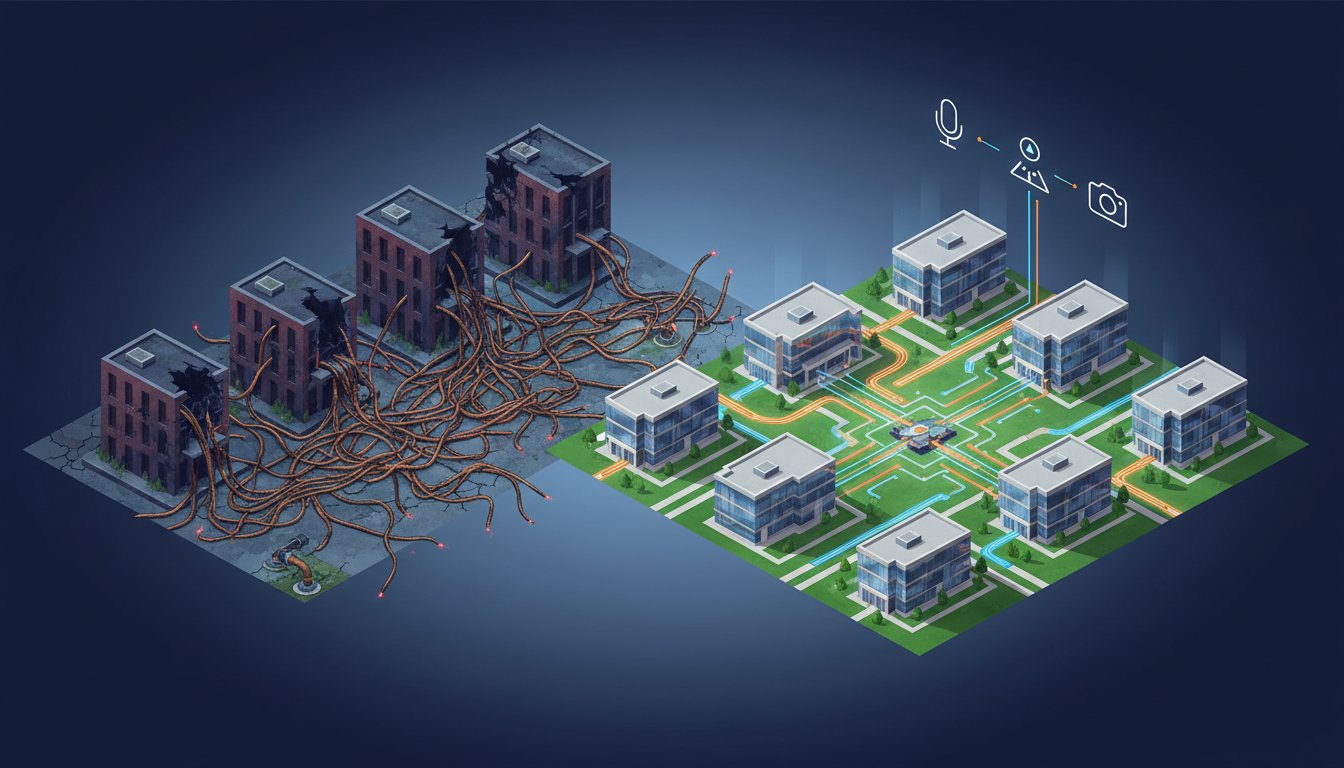
What if the legacy copper lines you treat as a fixed utility are actually the silent anchors dragging down your strategic agility? You likely feel the strain of maintaining aging hardware while your team struggles with a fragmented ecosystem of disconnected apps. Building a compelling business case for unified communications has shifted from a back-office IT task to a vital strategic imperative for 2026. Industry reports from 2024 indicate that the cost of maintaining legacy analog lines has surged by up to 450% since 2021, turning what was once a reliable asset into a financial and compliance liability.
We understand that your goal isn’t just to replace a phone system, but to create a seamless environment where technology serves vision. You’ve likely noticed how siloed tools contribute to employee fatigue and slow down critical decision-making. We’ll show you how modernizing your infrastructure transforms this operational friction into strategic elegance and measurable financial ROI. This guide provides a clear roadmap for achieving organizational agility and securing a future-proofed architecture that remains resilient long after the legacy hardware fades.
Key Takeaways
- Discover how to transcend legacy silos by architecting a unified platform that transforms fragmented connectivity into a cohesive, strategic framework.
- Learn to quantify the financial impact of modernization, balancing immediate cost savings against the compounding risks of the “Cost of Inaction.”
- Resolve the hidden drain of the “toggle tax” by orchestrating workflows where voice, messaging, and data converge with intellectual elegance.
- Identify the critical necessity of LTE POTS replacement to ensure the resilience of your enterprise’s life safety and security infrastructure.
- Build a compelling business case for unified communications through a structured migration framework that bridges the gap between vision and operational excellence.
Defining the Modern Communication Paradigm: Beyond Simple Connectivity
The traditional view of corporate telephony has reached its expiration date. In the high-stakes environment of 2026, communication is no longer a utility; it’s a strategic framework that integrates voice, video, and data into a cohesive architecture. This shift represents an intellectual elegance where disparate silos are replaced by an orchestrated platform. To understand the transition, one must first ask, What is Unified Communications? It’s the synthesis of real-time and non-real-time communication services to optimize business processes and enhance human interaction.
Building a robust business case for unified communications requires moving past the hardware-centric mindset of the previous decade. By 2026, the global UCaaS market is projected to reach 210 billion dollars, reflecting a massive migration toward cloud-based agility. Companies that rely on fragmented tools face a 15% reduction in operational efficiency compared to those using unified ecosystems. For businesses seeking local expertise in navigating these transitions, Gradient Data Solutions, Inc. offers specialized guidance on optimizing communication frameworks for the modern era. Connectivity is now the backbone of enterprise strategy, acting as the primary driver for both internal innovation and external client engagement.
The Evolution from Legacy PBX to UCaaS
The decline of on-premise hardware is absolute. Legacy PBX systems, once the gold standard, now function as anchors that prevent rapid scaling. Bolted-on tools, where a video app is taped onto a legacy phone system, create friction and security gaps. Modern enterprises require cloud-native collaboration that adapts to fluctuating workloads. UCaaS serves as the fundamental catalyst for modern B2B growth by harmonizing disparate communication channels into a single, scalable cloud architecture.
Strategic Alignment and the Enterprise Vision
Communication tools must mirror an organization’s strategic intent. If a firm values agility, its communication architecture shouldn’t be rigid or geographically limited. Unified Communications functions as the nervous system of the modern, distributed enterprise, ensuring that data flows without interruption. This alignment fosters a culture of transparency and accelerates decision-making by 25% in high-performing teams.
A well-designed business case for unified communications isn’t just about cost savings; it’s about building a structure that supports transformative growth. When communication is harmonized, the distance between a strategic decision and its execution disappears. This creates a state of operational flow where the technology becomes an invisible yet powerful enabler of the corporate vision, turning a distributed workforce into a singular, focused entity.
The Financial Architecture: Calculating ROI and the Cost of Inaction (COI)
Constructing a robust business case for unified communications requires moving beyond simple spreadsheet math. It demands a vision of fiscal harmony where every digital interaction contributes to a leaner, more resilient balance sheet. In the landscape of 2026, financial leadership views communication not as a utility cost, but as a strategic lever for value creation. True ROI emerges when we bridge the gap between direct savings and the intangible gains of organizational velocity.
Direct vs. Indirect Financial Gains
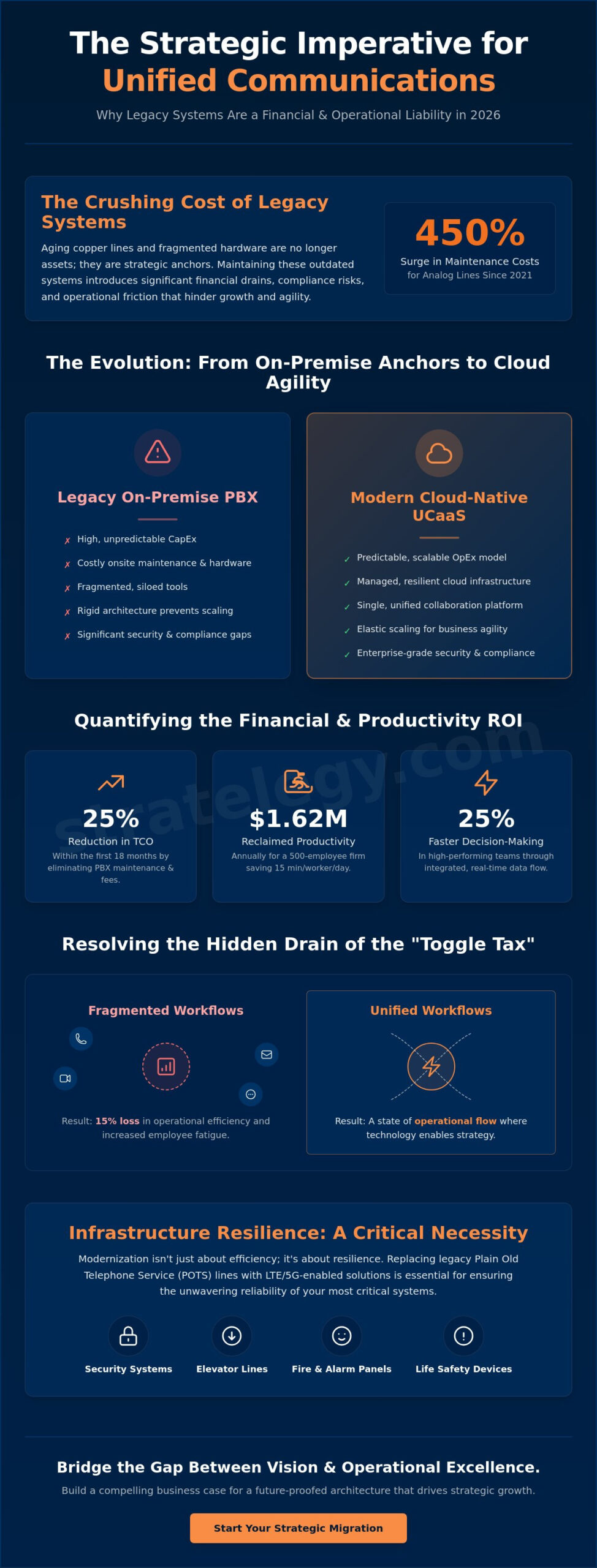
The transition from legacy systems to a unified framework facilitates an immediate shift from capital expenditure (CapEx) to a predictable operating expense (OpEx) model. Consolidating fragmented licensing into a single, cohesive SaaS architecture eliminates the subscription sprawl that currently drains approximately 18% of average IT budgets. By removing the need for onsite PBX maintenance and redundant long-distance fees, enterprises often realize a 25% reduction in total cost of ownership within the first 18 months.
Efficiency is the oxygen of the modern enterprise. If a 500-employee firm saves just 15 minutes per worker daily through streamlined file sharing and integrated presence, they recover 32,500 hours of annual capacity. At an average burdened labor rate of $50 per hour, this represents $1.62 million in reclaimed productivity. This level of Revolutionizing the Workplace with UC ensures that technical infrastructure serves the human element of the business rather than obstructing it. Managing one platform instead of five disparate tools allows IT departments to pivot from reactive troubleshooting to high-value strategic orchestration.
The Risk of the Status Quo
The “Copper Sunset” is no longer a distant threat; it is a current fiscal drain. As major carriers aggressively phase out legacy POTS lines, the cost to maintain these obsolete connections has surged by over 450% since 2022. Maintaining the status quo is a choice to accept compounding technical debt. The financial impact of communication-related downtime in a globalized 24/7 market can exceed $9,000 per minute for mid-market enterprises, a risk that legacy hardware cannot mitigate.
- The 2026 Migration: Planned transition allows for meticulous vendor negotiation and phased deployment, ensuring zero disruption to revenue streams.
- The 2029 Emergency: Forced migration due to hardware failure or carrier termination typically costs 2.8 times more than a planned rollout, factoring in emergency labor rates and lost opportunity costs.
The agility dividend provides the final, most compelling layer of the business case for unified communications. In a market where scaling a team up or down must happen in hours, not weeks, the ability to provision seats instantly across global regions is a competitive necessity. This structural flexibility reduces recruitment friction. In fact, 74% of high-tier talent in 2026 cites seamless remote collaboration tools as a non-negotiable factor in retention, directly lowering the $4,000 average cost-per-hire associated with avoidable turnover.
Operational Harmony: How UCaaS Orchestrates Enterprise Productivity
Operational harmony represents the zenith of organizational design. It is the deliberate transition from fragmented noise to a synchronized symphony of data and dialogue. In a fragmented environment, employees lose 59 minutes every day simply searching for information across disparate applications, according to a 2021 study by Qatalog and Cornell University. This friction creates a structural deficit that no amount of individual effort can overcome. A robust business case for unified communications hinges on the elimination of these micro-losses, replacing chaos with a strategic architecture that prioritizes cognitive flow.
For IT administrators, the shift to a “single pane of glass” management philosophy is transformative. Instead of juggling six different vendor portals, teams manage voice, video, and security from one centralized command center. This consolidation is not merely a convenience; it is a risk mitigation strategy. Industry benchmarks from Gartner indicate that centralized UCaaS platforms can reduce IT administrative overhead by up to 20% through automated provisioning and simplified troubleshooting. When the infrastructure is elegant, the enterprise becomes agile.
Eliminating the Toggle Tax
The “toggle tax” is the hidden cost of context switching. Harvard Business Review research suggests that the mental leap required to move between apps can consume up to 40% of a worker’s productive time. When building a business case for unified communications, leaders must quantify the value of integrated workflows where CRM data, instant messaging, and voice calls converge into a single interface. Operational harmony is the result of this seamless tool integration, where the technology recedes into the background to let the intellect lead.
- Unified presence indicators reduce “ghosting” and accelerate project timelines.
- Integrated directory services ensure that the right expert is always one click away.
- Automated data logging between UC and CRM systems eliminates manual entry errors.
Empowering the Hybrid and Global Workforce
Modern enterprises operate across time zones and borders, requiring a digital anchor that remains constant. UCaaS provides a consistent “office” experience regardless of geographic location. Whether an executive is in a London boardroom or a field engineer is accessing a mobile-first UC app on a remote site, the interface and access to data remain identical. This uniformity is essential for maintaining brand consistency across all customer touchpoints.
The integration of UC with Contact Center (CCaaS) capabilities ensures that customer engagement is never siloed. A 2022 Microsoft report highlighted that 72% of consumers expect agents to have immediate access to their previous interaction history. By bridging the gap between back-office experts and front-line agents, UCaaS ensures that the business case for unified communications is felt by the customer as much as the employee. This strategic alignment turns communication from a utility into a competitive advantage.
Infrastructure Resilience: The Critical Role of LTE POTS Replacement
A persistent misconception limits the business case for unified communications to the visible tools of collaboration: the headsets, the video screens, and the chat interfaces. This perspective overlooks the silent, critical infrastructure that maintains building safety and operational integrity. True resilience requires a sophisticated gaze toward the foundational layers, specifically the replacement of aging Plain Old Telephone Service (POTS) lines. These copper circuits, which once served as the gold standard for fire alarms and security systems, have become a precarious point of failure in a digital-first economy.
Modernizing this layer isn’t merely a technical upgrade; it’s a strategic alignment of safety and technology. When legacy wires fail, the cost isn’t measured in minutes of downtime, but in legal liability and physical risk. Integrating LTE-based connectivity into your unified architecture ensures that critical life safety systems remain online, even when the local power grid or traditional internet services falter. This structural reliability is the bedrock upon which all other digital transformation efforts are built.
Modernizing Life Safety and Security
Reliability in life safety systems isn’t negotiable. Copper infrastructure is deteriorating rapidly, with some regions reporting a 20% increase in line noise and signal loss over the last three years. LTE-based solutions provide a more robust alternative, offering encrypted, dedicated channels for fire panels and elevator emergency phones. Stratelegy prioritizes the modernization of these vital business lines to prevent the catastrophic risk of non-compliance. By adopting cellular bridge technology, companies meet the rigorous requirements of NFPA 72 and UL standards while gaining real-time monitoring capabilities that legacy copper simply can’t provide.
The 2029 Copper Sunset: A Strategic Deadline
The FCC Order 19-72 has already paved the way for the total retirement of copper networks. Major carriers like AT&T have signaled a final sunset by 2029, yet many organizations remain paralyzed by inertia. Proactive replacement is the hallmark of a visionary leader. Waiting until the final months of the decade will trigger a labor shortage and equipment scarcity, potentially doubling the cost of emergency migrations. Incorporating this transition into the business case for unified communications today creates a seamless path to 2026. It replaces a crumbling legacy with a refined, future-proof framework. This isn’t just about avoiding a deadline; it’s about crafting an environment where safety and strategy operate in perfect harmony.
Secure your organization’s future by replacing legacy liabilities with resilient, modern architecture. Discover how Stratelegy designs transformative growth through infrastructure.
Executing the Transition: A Framework for Strategic Migration
A transition of this magnitude is rarely a simple software update. It’s a deliberate architectural evolution. A robust business case for unified communications depends entirely on the precision of its execution. We view this process through a four-stage framework designed to transform raw infrastructure into a vessel for organizational elegance: Audit, Architect, Implement, and Optimize. Each phase is a calculated step toward a more harmonious operational state.
- Audit: We begin by cataloging existing assets and identifying hidden redundancies. 85% of migration failures are traced back to inadequate pre-migration assessments.
- Architect: Design must be intentional. We build frameworks that anticipate the technological shifts of 2026, ensuring your stack remains relevant.
- Implement: Execution happens in controlled phases. Data from 2023 suggests that phased rollouts reduce operational downtime by 42% compared to “big bang” deployments.
- Optimize: The final stage ensures the system evolves alongside the business, turning static tools into dynamic assets.
Success also hinges on the human element. Change management is the bridge between a functional system and a transformative one. Research indicates that 70% of digital initiatives fail because of employee resistance. We address this through immersive training and clear communication, ensuring every team member understands how these tools elevate their daily workflow. This isn’t just about learning new buttons; it’s about adopting a more sophisticated way of working that rewards clarity and speed.
Selecting the Right Strategic Partner
Enterprise environments are far too nuanced for “one-size-fits-all” providers. These generic platforms often collapse under the weight of complex legacy integrations or specific security requirements. You need a partner that possesses both national coverage and a deep understanding of critical LTE infrastructure. A 2023 industry survey found that 60% of enterprises experienced connectivity gaps during their UCaaS migration because their provider lacked infrastructure depth. You deserve a boutique level of service where your strategic alignment is the priority. Explore Stratelegy’s enterprise UCaaS solutions to see how we bridge the gap between vision and reality.
The Post-Migration Optimization Phase
The “go-live” date marks the start of a new era, not the conclusion of a project. True organizational elegance is achieved through continuous refinement. By leveraging advanced analytics, leaders can identify bottlenecks in real time and adjust workflows for maximum fluidity. Organizations that commit to ongoing optimization report a 25% higher ROI within the first 18 months of deployment. This ensures your business case for unified communications remains valid as market conditions shift. Partner with Stratelegy to architect your communications future and turn your strategic vision into a permanent competitive advantage.
Orchestrating Your Enterprise Evolution
The window for reactive infrastructure upgrades is rapidly closing. With the 2029 copper phase-out mandate approaching, the transition to LTE POTS replacement is no longer a discretionary project; it’s a fundamental requirement for life safety and institutional resilience. Every day spent maintaining fragmented legacy systems increases the cost of inaction and erodes the potential for transformative growth. A compelling business case for unified communications centers on this shift toward a harmonized, national architecture where enterprise-grade UCaaS and CCaaS drive measurable productivity gains across every department. It’s about replacing operational chaos with a vision that’s both efficient and structurally sound. By prioritizing a framework that addresses these technical shifts today, you ensure your organization remains competitive and compliant well into 2026. True business success isn’t found in simple connectivity. It’s forged through the precise orchestration of strategy and elegance. The future belongs to those who build it with intention.
Architect your strategic communications future with Stratelegy
Your journey toward a more resilient, integrated enterprise starts with a single, well-placed step.
Frequently Asked Questions
What is the primary difference between VoIP and Unified Communications?
VoIP is the foundational technology that transmits voice over the internet, whereas Unified Communications is a strategic framework that integrates voice, video, messaging, and file sharing into one interface. It’s the difference between a single communication channel and a holistic digital ecosystem. The global UC market is projected to reach 310.8 billion dollars by 2030, reflecting a shift from simple calling to comprehensive enterprise collaboration.
How does Unified Communications actually save my business money?
Unified Communications reduces costs by consolidating multiple software licenses into a single subscription and eliminating the need for expensive on-site hardware maintenance. A well-structured business case for unified communications often cites the 20% to 50% reduction in operational expenses reported by Nemertes Research. You’ll transition from unpredictable capital expenditures to a refined, predictable monthly operating model that scales with your headcount.
Is UCaaS secure enough for highly regulated industries like finance or healthcare?
Modern UCaaS platforms deliver enterprise-grade security that exceeds the capabilities of legacy systems by adhering to SOC2, HIPAA, and GDPR standards. Data encryption and multi-factor authentication ensure that sensitive records remain protected against evolving cyber threats. Since 94% of businesses report improved security after migrating to the cloud, the transition serves as a vital defensive alignment for your firm’s digital assets.
What happens to our fire alarms and elevators if we switch to UC?
Fire alarms and elevator phones require Analog Telephone Adapters or dedicated cellular bridges to maintain connectivity, as they can’t connect directly to a digital UC cloud. You must ensure these life-safety systems remain compliant with NFPA 72 standards, which require 24-hour battery backups. We recommend a hybrid approach where these critical lines are handled through specialized gateways to maintain 100% uptime during power outages.
How long does a typical enterprise-wide UC migration take?
A standard enterprise migration typically spans 120 to 180 days, depending on your geographic footprint and the complexity of your existing integrations. Gartner data indicates that the most successful transitions allocate 30% of this time to strategic planning and 70% to execution and user adoption. This timeline ensures a transformative growth period where your internal workflows are carefully remapped for maximum efficiency.
Why is the 2029 copper line phase-out relevant to my business case today?
The 2029 deadline marks the final sunset of the Public Switched Telephone Network, meaning legacy copper lines will physically cease to function. Integrating this reality into your business case for unified communications now prevents the risk of service blackouts and inflated emergency installation fees. Proactive organizations are migrating today to secure current hardware pricing and avoid the inevitable bottleneck of the 2028-2029 rush.
Can Unified Communications integrate with our existing CRM and ERP systems?
Modern UC platforms integrate seamlessly with Salesforce, Microsoft Dynamics, and SAP through robust REST APIs and pre-built connectors. This synchronization allows for automated call logging and instant data retrieval, which significantly reduces manual entry errors. Forrester research shows that these integrations reclaim 3.5 hours of productivity per week for every employee, creating a more harmonious and data-driven operational structure.