
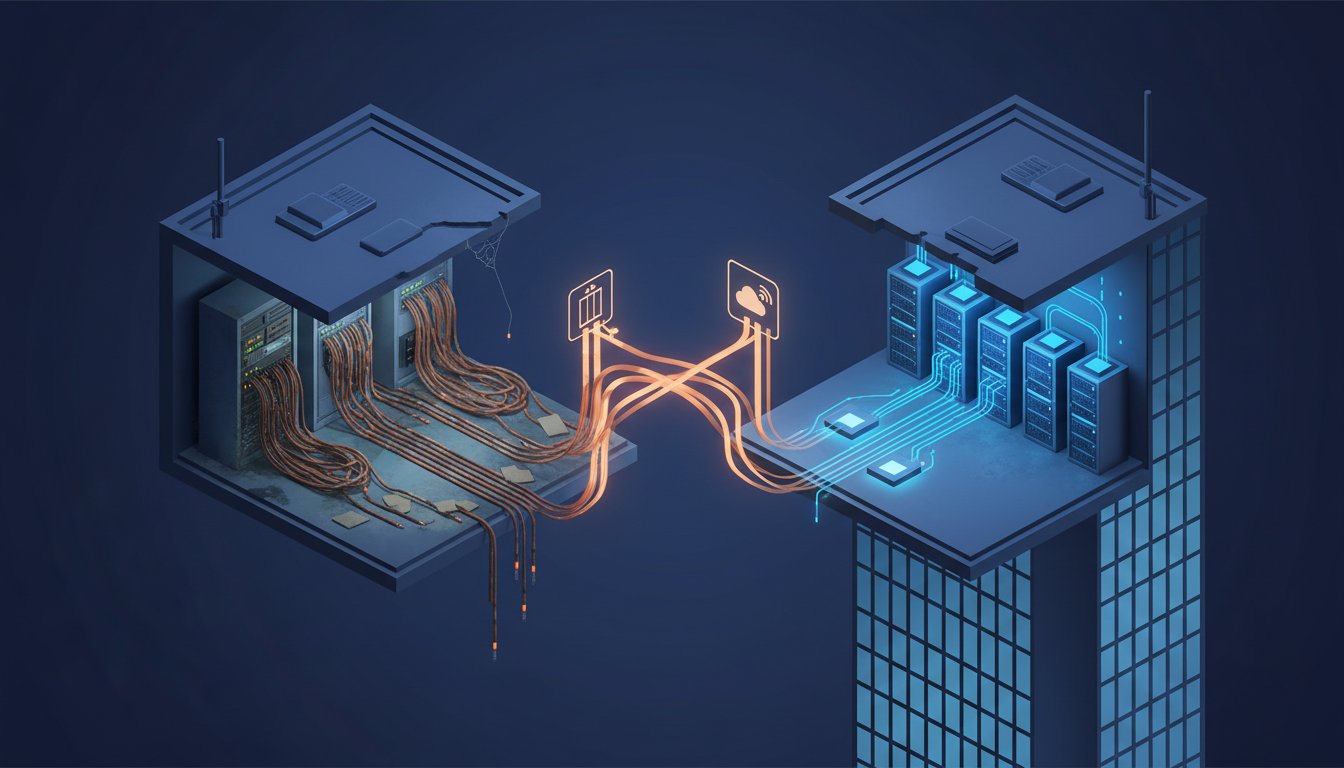
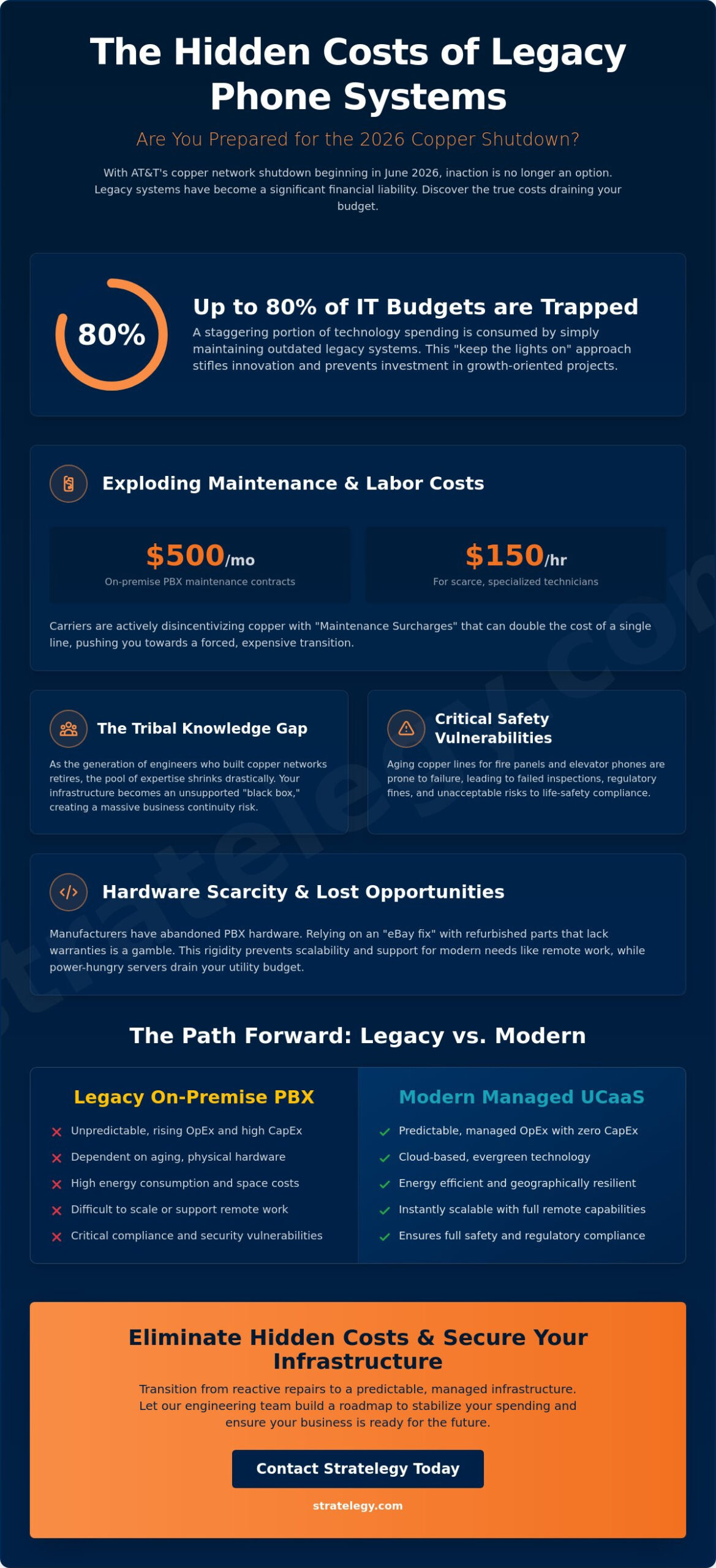
Did you know that 70% to 80% of the average technology budget is currently spent just to maintain legacy systems? For enterprise leaders in 2026, the hidden costs of legacy phone systems have transitioned from a minor nuisance to a significant financial liability. With AT&T beginning the official shutdown of copper facilities in June 2026 and the FCC accelerating retirement rules this past March, the price of inaction is rising. You’re likely seeing monthly maintenance contracts for on-premise PBX hardware climb as high as $500 while specialized technicians now command rates up to $150 per hour.
It’s frustrating to pay more for hardware that’s increasingly difficult to support and prone to outages that threaten your fire and life-safety compliance. We’ll show you how to identify these draining liabilities and replace them with a predictable, managed infrastructure. This article provides a clear breakdown of technical debt, a roadmap for stabilizing your communications spending, and a strategy to ensure your elevators and fire panels remain fully certified through modern engineering.
Key Takeaways
- Evaluate the financial impact of the 2026 Copper Sunset and how the hidden costs of legacy phone systems manifest as unmanaged liabilities rather than simple service fees.
- Identify the risk of the “Tribal Knowledge Gap” as legacy engineers retire, leaving your business dependent on expensive, specialized contractors for obsolete hardware.
- Assess the critical safety vulnerabilities of running fire panels and elevator phones on aging lines, which can lead to failed inspections and regulatory fines.
- Compare the rigidity of on-premise PBX systems against the scalability of UCaaS to quantify the lost opportunity costs of manual data entry and limited remote work support.
- Discover how to secure total cost predictability through a Device Lifecycle and Technology Refresh Policy, ensuring your infrastructure stays current without capital expenditure spikes.
Beyond the Monthly Invoice: The 2026 Reality of Legacy Infrastructure
Legacy systems are no longer just old technology. They’re financial anchors. In 2026, a legacy phone system is defined as any on-premise PBX hardware or copper POTS line still in operation. These systems represent the hidden costs of legacy phone systems that many CFOs overlook until the infrastructure fails. While the hardware might still dial out, the underlying framework is deteriorating. Major carriers like AT&T and Verizon have shifted their capital focus entirely to fiber and wireless networks. With the copper facility shutdown beginning in June 2026, businesses still tied to these lines face aggressive, unmanaged rate hikes. Carriers use these price increases to signal that the end of support is here.
The visible invoice you receive each month is just the tip of the iceberg. The real danger lies in invisible costs, specifically unmanaged technical debt. This is the accumulated financial burden of choosing an easy, outdated solution over a modern, engineered one. Relying on the “if it ain’t broke, don’t fix it” mentality is a dangerous financial fallacy. In our modern landscape, a system that hasn’t failed yet isn’t necessarily a system that succeeds; it’s simply a liability waiting for a trigger event. For business owners committed to long-term growth, 41 Legacy provides strategic advisory to help understand and protect the enterprise value that such technical debt can erode. True communications excellence requires a shift from reactive repairs to a managed, predictable infrastructure.
The Escalation of POTS Line Pricing
Carriers are actively disincentivizing copper use because the physical maintenance of aging wires is no longer profitable. You’ll likely see “Maintenance Surcharges” appearing on utility bills, which can double the cost of a single line without adding any new features. POTS obsolescence is a forced transition by national carriers designed to eliminate the burden of physical wire maintenance once and for all. For businesses, this means the price of a single elevator or fire line can now exceed the cost of an entire modern cloud seat.
The Hidden Drain on IT Resource Allocation
When 70% to 80% of a technology budget goes toward maintaining legacy systems, innovation dies. Your IT team shouldn’t spend their days sourcing refurbished parts for 15 year old servers or troubleshooting wiring closets. This “keeping the lights on” mentality prevents strategic investment in growth-oriented projects. Modern 2026 energy standards also make power-hungry on-premise server rooms a liability. Transitioning to Unified Communications as a Service (UCaaS) allows you to shift from a high-maintenance CapEx model to a predictable, cloud-based OpEx structure that stays current automatically.
The Technical Debt Trap: Maintenance, Specialized Labor, and Obsolescence
Maintaining a legacy system in 2026 is like trying to service a vintage car with parts that are no longer manufactured. The Tribal Knowledge Gap is a real threat to your business continuity. As the generation of engineers who built these copper networks reaches retirement, the pool of expertise shrinks. When your only technician who understands your PBX’s proprietary wiring leaves, your infrastructure becomes a black box. This is one of the most critical hidden costs of legacy phone systems. You aren’t just paying for hardware; you’re paying for a disappearing skill set.
Hardware scarcity has moved from a minor nuisance to a major operational risk. Manufacturers have largely abandoned PBX card production, forcing IT managers to browse secondary markets and unverified third-party vendors for critical components. These refurbished parts often lack warranties and may carry latent defects. Relying on an “eBay fix” for a system that handles your enterprise voice traffic isn’t a strategy. It’s a gamble that compromises your foundational reliability.
Energy consumption adds another layer of financial drain that often stays buried in utility bills. Modern 2026 efficiency standards highlight how much power outdated on-premise hardware actually wastes. Legacy PBX units and the cooling systems required to keep them from overheating in server rooms contribute significantly to your monthly overhead. Moving to a cloud-based model eliminates these localized power costs entirely, allowing you to reallocate those funds toward strategic growth.
The Scarcity of Legacy Expertise
Modern technicians aren’t learning copper infrastructure. They’re training on fiber and cloud protocols. This creates a supply imbalance that drives labor costs upward. While a standard technician might average $18.27 per hour, specialized consultants for legacy systems now charge between $75 and $150 per hour. If your system fails on a weekend, you’ll likely pay an “Emergency Dispatch” premium that can double those rates. It’s better to partner with infrastructure engineers who prioritize long-term stability over reactive repairs.
Hardware End-of-Life (EOL) Realities
Manufacturer support eventually ends for every piece of hardware. When your PBX reaches its EOL date, security patches stop immediately. This leaves your network vulnerable to exploits that modern firewalls might not catch. Research shows that security issues are much more complex when dealing with aging protocols that weren’t designed for today’s threat landscape. Hardware EOL is a hard deadline for business continuity that no amount of maintenance can bypass.
Critical Safety Vulnerabilities: The High Cost of Legacy Fire and Life-Safety Lines
Safety is the foundational layer of any enterprise infrastructure. When you rely on deteriorating copper for fire alarm panels and elevator phones, you’re introducing unmanaged risk into your building’s core. These are the most dangerous hidden costs of legacy phone systems because they involve life-safety compliance rather than just office productivity. In 2026, many carriers have stopped maintaining the physical integrity of copper lines in the ground. This neglect leads to static, signal attenuation, and eventual total failure of the communication path.
Regulatory bodies and insurance providers have noticed the decline in reliability. Failed safety inspections don’t just result in a simple notice to repair; they often lead to immediate daily fines or the requirement of a 24/7 Fire Watch. This is a manual, human-led patrol that costs significantly more than a modern communication line. Your liability premium is also at stake. Insurance companies are increasingly auditing communication paths for critical systems. Relying on obsolete technology can lead to higher premiums or even denied claims in the event of an incident. Engineering-grade LTE POTS replacement offers a path to 99.99% reliability while eliminating these compliance headaches forever.
Fire Alarm and Life Safety Compliance
The 2026 standards for fire panel communication prioritize dual-path reporting and cellular connectivity. If a legacy line fails, local fire marshals may mandate a Fire Watch, which is an expensive and inefficient use of labor. It’s about more than just a dial tone. You need to ensure E-911 certification and precise location accuracy. Modern LTE solutions provide the necessary data packets to ensure emergency responders arrive at the exact location without the signal degradation common in aging copper loops. This is where the hidden costs of legacy phone systems become a matter of physical safety and legal exposure.
Elevator and Security Monitoring Risks
Elevator shafts are notoriously difficult environments for communication. Legacy copper lines in these shafts are prone to electromagnetic interference and physical wear over time. An emergency entrapment scenario is a high-liability event for any property owner. If the communication line fails during an entrapment, the legal and financial consequences are severe. Transitioning to LTE-based POTS replacement provides a dedicated, supervised connection. It stays active even if the building’s main power or physical wiring is compromised, providing the peace of mind that comes from true infrastructure stability.
Quantifying the Opportunity Cost: Rigidity vs. Scalable UCaaS
The most expensive word in enterprise management is “no.” Legacy systems force IT directors to say “no” to remote work, “no” to CRM integrations, and “no” to rapid scaling. These hidden costs of legacy phone systems represent a massive opportunity loss. While you’re managing a complex on-premise PBX, your competitors are using omnichannel platforms to engage customers across every touchpoint. Every hour your staff spends on manual data entry between a desk phone and a CRM is an hour of wasted labor. Modern Unified Communications as a Service (UCaaS) platforms automate these workflows, turning communication into a data-driven asset rather than a siloed utility.
Scalability friction is another silent budget killer. Adding a single user to a legacy PBX often requires purchasing proprietary hardware cards and scheduling a site visit from a specialized technician. This process can take weeks and carries significant capital expenditure. In contrast, a cloud-based model allows for instant provisioning with zero CapEx. You pay for what you use, and the system grows alongside your business. This shift from constant hardware refresh cycles to a managed infrastructure model ensures your technology stays current without the periodic financial shocks of equipment failure.
The Agility Tax on Growth
Legacy systems tether your workforce to physical desks, which artificially inflates your real estate costs. If your phone system can’t support a hybrid or remote model, you’re paying for square footage that you don’t actually need. There’s also the cost of missed revenue. Legacy systems often lack the sophisticated call routing and sentiment analysis tools found in modern CCaaS solutions. If a customer can’t reach you or experiences a frustrating delay, they’ll move to a competitor who has invested in a responsive, next-generation infrastructure. Managing disparate systems across multiple geographic locations only compounds these inefficiencies, creating a fragmented brand experience that erodes customer loyalty.
Security and Cyber Liability
Security is an infrastructure requirement, not an optional feature. In 2026, the average cost of a data breach in the United States has reached $10.22 million. Legacy PBX systems are prime targets because they often run on unpatched software that manufacturers no longer support. It takes an average of 241 days to identify and contain a breach, and 68% of these incidents involve a human element that older systems aren’t equipped to monitor. Meeting modern data privacy standards like HIPAA or PCI compliance is nearly impossible on hardware designed decades ago. To protect your enterprise, you should request a comprehensive infrastructure audit to identify these vulnerabilities before they become liabilities.
Stratelegy’s Infrastructure Engineering: Eliminating Hidden Costs Forever
Infrastructure is the backbone of your enterprise. It shouldn’t be a source of constant financial surprise. At Stratelegy, we don’t just provide services; we act as infrastructure engineers who prioritize security, governance, and long-term predictability. The hidden costs of legacy phone systems discussed in this analysis are often the result of a reactive “break-fix” mentality. We replace this cycle with a proactive, managed infrastructure model. This shift ensures that your communication tools are built to stay current, so your business never falls behind. By engineering the foundation correctly, we eliminate the technical debt that drains modern IT budgets.
Our approach centers on foundational reliability rather than just software features. We understand that a phone system is only as good as the network it sits on. This is why we focus on specialized needs like E-911 certification and life-safety compliance. While others might offer a simple cloud license, we provide a comprehensive architectural refresh. This includes transitioning your most critical lines-like those for fire panels and elevators-to high-reliability LTE solutions. This modernization happens without the need for expensive, invasive rewiring of your physical premises.
The Technology Refresh Policy Advantage
The most distinct signature of our partnership is the industry-first Device Lifecycle and Technology Refresh Policy. This policy ensures your hardware never becomes “legacy” again. We’ve eliminated the periodic capital expenditure spikes that define traditional PBX ownership. Instead, your business benefits from a predictable, flat-rate monthly fee with zero hidden surcharges. This managed lifecycle approach means we’ve already thought of the problems you haven’t encountered yet. Proactive management eliminates the need for $150 per hour emergency repair premiums and ensures your security patches are always current. It’s a zero CapEx model designed for total financial governance.
Modernizing Critical Infrastructure
Critical safety systems require an engineering-grade solution, not a patchwork fix. Our LTE POTS replacement strategy provides the 99.99% reliability required for fire, elevator, and security monitoring. We ensure your building meets the strict 2026 standards for location accuracy and E-911 compliance. This cellular-based engineering bypasses the deteriorating copper networks that carriers are abandoning in June 2026. You gain peace of mind knowing your life-safety systems are supported by a supervised, dedicated connection that remains active even during local power failures. See how Stratelegy replaces legacy risk with infrastructure excellence.
Securing Your Infrastructure for the 2026 Transition
The June 2026 copper shutdown represents a firm boundary for enterprise stability. Relying on aging hardware drains 70% to 80% of technology budgets through unmanaged maintenance and specialized labor costs. These hidden costs of legacy phone systems compromise your financial predictability and safety compliance. It’s time to move from a reactive break-fix model to a managed infrastructure that stays current automatically. Our infrastructure-first engineering approach ensures that your foundation is built for longevity rather than just temporary connectivity.
Stratelegy provides the architectural expertise needed to navigate this transition with confidence. Our industry-first Device Lifecycle and Technology Refresh Policy eliminates the threat of obsolescence. We also provide certified LTE POTS replacement to secure your fire and life-safety systems against the copper sunset. We prioritize engineering over sales to ensure your foundation remains stable and compliant. Request an Infrastructure Audit from Stratelegy to eliminate technical debt and secure your business for the future. You deserve the peace of mind that comes from a partner who has already solved the problems you haven’t encountered yet.
Frequently Asked Questions
What are the most common hidden costs of a legacy PBX system?
Hidden costs include specialized labor, hardware scarcity, and excessive energy use. In many organizations, 70% to 80% of the technology budget is spent just maintaining these aging assets. The hidden costs of legacy phone systems also encompass the lost productivity of IT teams who must source refurbished parts from unverified third party vendors. These expenses are unmanaged liabilities that drain capital without providing any new business features.
Why are my POTS line monthly costs increasing in 2026?
Monthly costs are rising because major carriers are aggressively phasing out copper networks by June 2026. They’ve introduced maintenance surcharges to disincentivize the use of obsolete facilities. The FCC’s March 2026 rule changes also streamlined the process for carriers to retire copper lines. This results in higher invoices for the same basic dial tone as carriers shift their focus to fiber and wireless infrastructure.
Can I keep my existing fire alarm panel if I move to the cloud?
You can keep your existing fire alarm panel by using an LTE POTS replacement device. This hardware acts as a bridge between your legacy panel and modern cellular networks. It provides the required E-911 certification and location accuracy without needing a complete system overhaul. Our infrastructure engineers specialize in these life-safety transitions to ensure your building remains fully compliant with 2026 safety standards.
What is the “Tribal Knowledge Gap” in legacy telecommunications?
The Tribal Knowledge Gap refers to the shrinking pool of technicians who understand 20 year old copper wiring and proprietary PBX systems. As these experts retire, businesses are forced to hire specialized consultants who charge between $75 and $150 per hour. This scarcity creates a significant risk of prolonged downtime during a system failure. It’s a critical component of the hidden costs of legacy phone systems that often goes unmeasured.
How does UCaaS reduce the Total Cost of Ownership (TCO)?
UCaaS reduces TCO by moving communication from a high CapEx model to a predictable OpEx structure. You eliminate the need for on-premise server cooling and localized power costs. Because the platform is cloud based, updates and security patches are automated. This allows your IT team to reallocate their time toward strategic growth projects rather than performing manual hardware maintenance on obsolete equipment.
Is LTE POTS replacement as reliable as traditional copper for elevators?
LTE POTS replacement is actually more reliable than traditional copper for elevators in 2026. It offers 99.99% reliability and a supervised connection that monitors signal strength in real time. Unlike copper lines in elevator shafts, which are prone to interference and physical wear, cellular engineering provides a dedicated path. This ensures emergency communication remains active even if the building’s physical wiring is compromised.
What happens when my phone system hardware reaches End-of-Life (EOL)?
When hardware reaches its EOL date, manufacturers immediately stop issuing security patches and technical support. This leaves your network vulnerable to data breaches, which now average $10.22 million per incident in the United States. Sourcing replacement parts becomes a gamble involving unreliable secondary markets. EOL is a hard deadline for business continuity that requires a planned transition to supported, modern infrastructure.
How does Stratelegy handle hardware refreshes for enterprise clients?
Stratelegy manages hardware through our industry-first Device Lifecycle and Technology Refresh Policy. We ensure your infrastructure stays current so your business never falls behind. Our model provides flat-rate monthly fees that cover proactive maintenance and periodic hardware updates. This eliminates the financial shocks of unexpected equipment failure and ensures your communication system is always supported by the latest security and governance standards.