
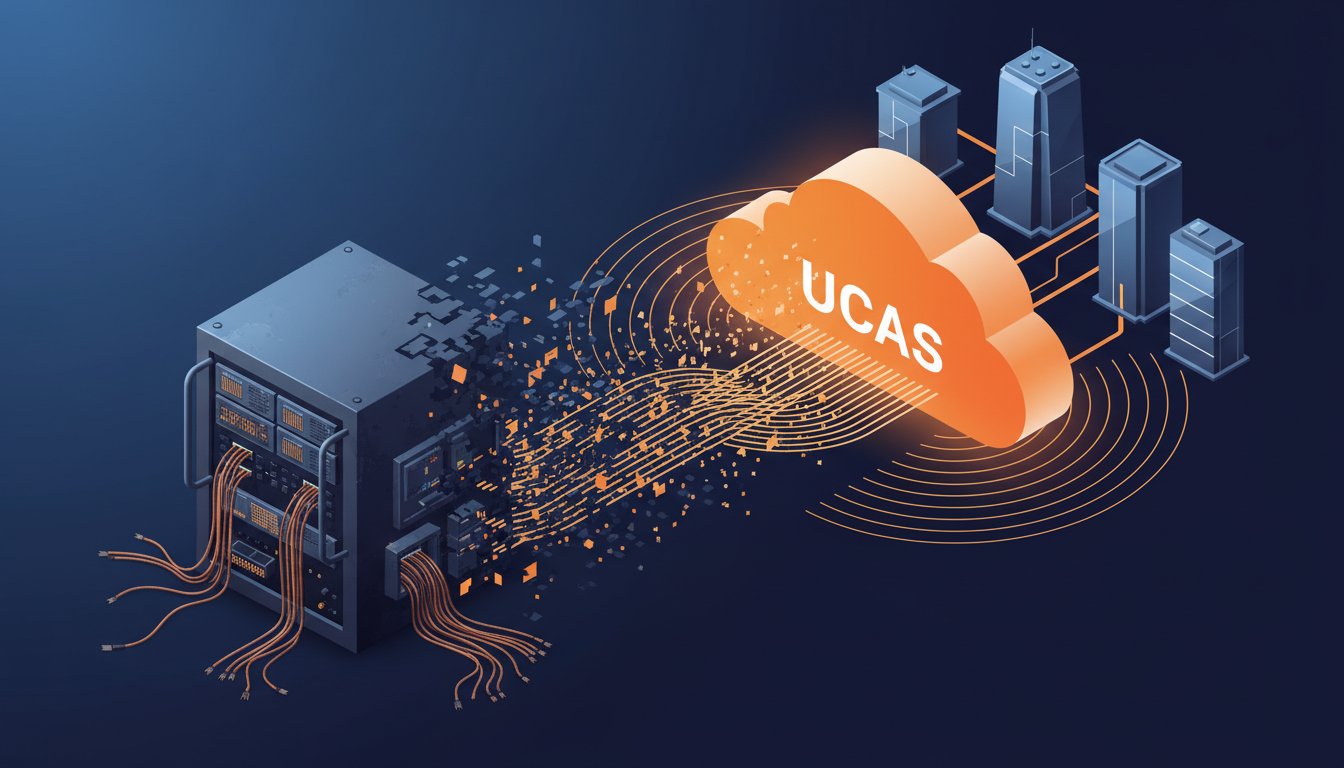
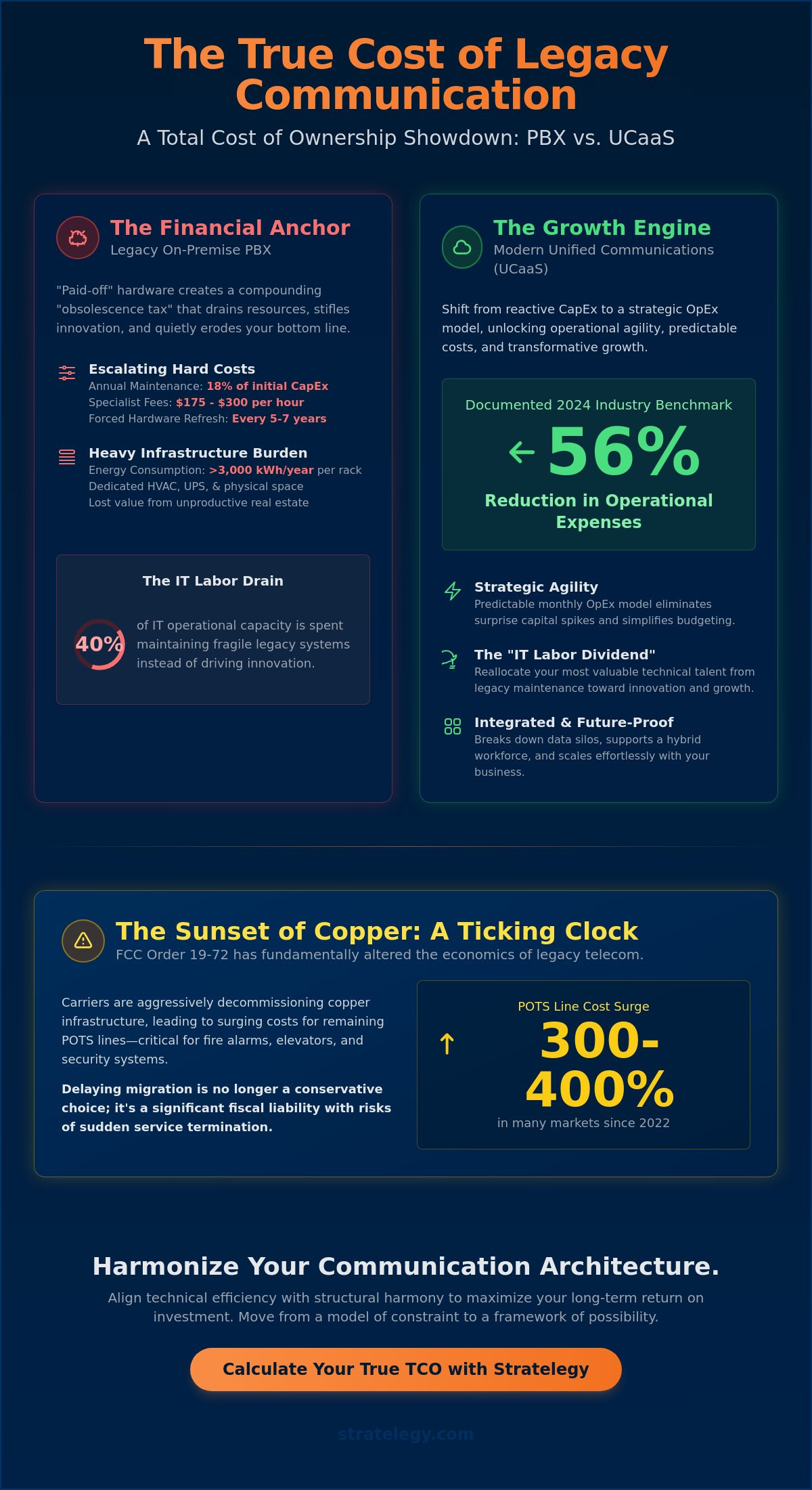
Your legacy PBX isn’t just a communication tool anymore; it’s a silent financial anchor dragging down your 2026 growth projections. While the hardware sits in a climate-controlled room, it generates a compounding “obsolescence tax” that traditional balance sheets often fail to capture. You likely feel the strain as your IT department dedicates 40% of its operational capacity to maintaining fragile copper lines instead of driving innovation. We understand that the decision to migrate is rarely about the technology itself; it’s about achieving a state of structural harmony where your infrastructure finally matches your ambition.
This executive framework masters the complex variables within the total cost of ownership pbx vs ucaas to provide a clear financial justification for your digital transition. You’ll learn to identify the hidden drains on your capital and how a 56% reduction in operational expenses, documented in 2024 industry benchmarks, can fund your next phase of transformative growth. We’ll examine the specific roadmap required to align your communication architecture with the demands of a sophisticated, hybrid workforce.
Key Takeaways
- Expose the financial illusion of “paid-off” hardware by quantifying the hidden infrastructure costs that silently erode your organizational bottom line.
- Master a comprehensive framework for evaluating the total cost of ownership pbx vs ucaas to shift from reactive capital expenditures to a model of strategic operational agility.
- Identify the “IT labor dividend” to reallocate your most valuable technical talent from legacy maintenance toward initiatives that drive transformative growth.
- Implement a step-by-step auditing process to project long-term financial trajectories, accounting for the inevitable price hikes of aging copper infrastructure.
- Align your communication architecture with the Stratelegy approach, where technical efficiency meets structural harmony to maximize your long-term return on investment.
The 2026 TCO Paradigm: Why “Paid-Off” PBX Hardware is a Financial Illusion
The balance sheet often masks the true burden of legacy infrastructure. While an on-premise PBX might appear as a zero-cost asset once the initial capital expenditure is fully depreciated, this perspective ignores the escalating operational friction of 2026. True total cost of ownership pbx vs ucaas analysis requires a shift from viewing hardware as a static asset to evaluating it as a dynamic liability. In the current fiscal environment, “paid-off” hardware frequently conceals a web of hidden premiums. These range from specialized labor scarcity to the rising costs of proprietary replacement parts for systems that manufacturers no longer support.
Modern executives must recognize that zero CapEx doesn’t equal zero expense. Maintaining a legacy footprint requires dedicated floor space, climate control, and complex disaster recovery configurations that cloud-native solutions have rendered obsolete. The financial weight of these systems is no longer a matter of hardware longevity; it’s a matter of strategic agility.
The Sunset of Copper: FCC Order 19-72 and Your Bottom Line
The regulatory environment has fundamentally altered the math of enterprise telephony. FCC Order 19-72 effectively deregulated the pricing of legacy POTS (Plain Old Telephone Service) lines, allowing carriers to aggressively decommission maintenance for copper infrastructure. By 2026, the cost of maintaining these lines has surged by an estimated 300% in many urban markets as providers prioritize fiber and 5G investments.
This year marks the definitive tipping point for legacy viability. Organizations that delay migration face not only higher monthly recurring costs but also the threat of sudden service termination. The financial risk of a forced, emergency migration in a de-commissioning market is significantly higher than a planned, strategic transition. Waiting until the final 2029 copper sunset is no longer a conservative choice; it’s a fiscal liability.
Strategic Alignment vs. Technical Debt
Technical debt in communications isn’t just about old wires; it’s about the missed opportunity of integration. Legacy PBX systems create silos that isolate voice data from the broader enterprise ecosystem. Understanding the evolution of unified communications reveals that modern value lies in interoperability. When analyzing the total cost of ownership pbx vs ucaas
Deconstructing the Visible and Invisible Costs of Legacy PBX
Legacy PBX systems represent a deceptive financial anchor. While the hardware sits quietly in a rack, its fiscal impact vibrates through the balance sheet. Executing a precise total cost of ownership pbx vs ucaas analysis requires unmasking the “Hard Costs” that often escape initial scrutiny. Traditional maintenance contracts typically command 18% of the initial capital expenditure annually. When systems fail, specialized technician fees ranging from $175 to $300 per hour add immediate pressure to operational budgets. These figures don’t account for the inevitable hardware refresh cycles. Every 5 to 7 years, organizations face a massive capital spike to replace aging components, a cycle that destroys long-term budget predictability.
The Infrastructure Burden: Beyond the Server Room
Telecom closets aren’t just storage; they’re high-maintenance real estate. A standard server rack requires dedicated HVAC cooling and uninterruptible power supplies (UPS). According to 2023 energy benchmarks, a single legacy PBX rack can consume over 3,000 kWh annually. This creates a hidden utility tax that compounds over time. Beyond power, the physical footprint carries a real estate cost. In metropolitan markets, dedicated server space represents thousands in lost square footage value. Transitioning to a strategic technology framework allows for the reclaiming of this physical and fiscal space, converting a cost center back into a productive asset.
LTE POTS Replacement: A Critical TCO Component
The most resilient expenses often hide in the walls. Fire alarms, elevator phones, and security systems frequently rely on Plain Old Telephone Service (POTS) copper lines. As major carriers accelerated their copper retirement plans in 2022, the cost of these legacy lines surged by as much as 400%. Neglecting these life safety connections during a migration creates a dangerous gap in compliance. Deploying LTE-based POTS replacement solutions provides a 24-month ROI by eliminating high monthly copper fees while ensuring 99.99% uptime for critical systems. Integrating these life safety elements into the broader migration strategy is essential for a holistic financial overview.
Downtime represents the ultimate invisible cost. A 2024 Gartner report indicates that the average cost of IT downtime has reached $5,600 per minute. For a legacy PBX, a single hardware failure can paralyze client communications for hours. The lack of inherent geographic redundancy in on-premise systems turns a localized power outage into a total business blackout. When these risks are quantified, the total cost of ownership pbx vs ucaas shifts from a simple hardware comparison to a study in organizational resilience and risk mitigation.
- Annual Maintenance: Often exceeds 15% of original purchase price.
- Technician Latency: Waiting for on-site repairs can cost $336,000 per hour in lost productivity.
- Energy Efficiency: Cloud solutions reduce on-site power consumption by up to 90%.
UCaaS and the Economics of Operational Agility
Traditional PBX systems demand a reactive financial posture. Organizations frequently encounter 20% spikes in unplanned maintenance costs as hardware reaches its fifth year of service. Transitioning to a cloud-native model replaces these volatile expenditures with a stable, per-user subscription. This shift clarifies the long-term total cost of ownership pbx vs ucaas, allowing leadership to forecast communications spending with surgical precision. Beyond the balance sheet, the move to UCaaS eliminates the hidden drain of redundant hardware sites. While legacy systems require a mirrored physical infrastructure to ensure 99.999% uptime, cloud providers distribute this risk across geographically diverse data centers at no additional capital expense to the enterprise.
The Opportunity Cost of IT Labor
Legacy telephony acts as an anchor on technical talent. A 2023 benchmark study by Nemertes Research highlighted that IT teams spend approximately 36% of their weekly schedule on routine PBX patches, software updates, and manual “moves, adds, changes” (MACs). These tasks offer zero competitive advantage. UCaaS platforms introduce a self-service architecture where end-users manage their own call routing and profiles through intuitive interfaces. This shift reduces internal support tickets by an average of 45% within the first six months of deployment. The Labor Dividend is the reinvestment of IT time into revenue-generating projects.
By automating the mundane, the total cost of ownership pbx vs ucaas calculation reveals a significant shift in human capital value. When engineers stop configuring desk phones, they start architecting the digital workflows that drive 2026 market share. This transition from a “maintenance mindset” to an “innovation mindset” is the hallmark of a sophisticated executive strategy.
Agility as a Financial Asset
Speed is a measurable financial metric. Deploying a new international branch via legacy PBX requires hardware procurement, shipping, and local technician visits, a process that typically spans 30 to 60 days. Cloud systems reduce this “Time to Value” to less than 24 hours. This structural harmony between technology and growth objectives ensures that expansion doesn’t lead to operational paralysis.
- Remote Onboarding: Provisioning a global employee takes minutes rather than the days required to ship and configure proprietary hardware.
- Global Centralization: A single administrative console replaces the fragmented management of disparate local PBX units.
- Elastic Scaling: Organizations pay for exactly what they use, avoiding the “shelfware” costs associated with over-provisioning legacy line cards.
In a 2024 analysis of mid-market enterprises, those utilizing cloud-native communication saw a 14% faster response rate to market shifts compared to peers tethered to on-premises hardware. This agility isn’t just a convenience; it’s a calculated asset that protects the organization against the friction of traditional infrastructure.
A Step-by-Step Framework for Building Your TCO Model
Constructing a precise total cost of ownership pbx vs ucaas model requires moving beyond surface-level subscription comparisons. It demands a rigorous examination of hidden fiscal leaks and the strategic valuation of operational agility. A 2024 study by Nemertes Research indicated that companies often underestimate legacy maintenance by 22 percent. To avoid these pitfalls, executives must adopt a multi-phased approach that aligns fiscal discipline with technological vision.
Phase 1: The Infrastructure Audit
Precision begins with transparency. Organizations must inventory every physical asset, from aging chassis to the “dark” lines that sit idle yet continue to draw monthly fees. This audit serves as the baseline for all future projections.
- Audit legacy PRI and T1 circuits, which often cost 300 percent more than modern SIP trunking equivalents.
- Identify underutilized hardware that demands power and cooling without providing proportional value.
- Assess specialized emergency lines for elevators and fire alarms; these must meet 2026 compliance standards like Ray Baum’s Act to avoid significant liability risks.
Phase 2: The 5-Year Projection
A 60-month horizon reveals the true trajectory of legacy decay. When modeling the status quo, apply a 15 percent risk multiplier to hardware nearing its end-of-life. The scarcity of technicians trained in legacy PBX systems has driven labor costs up by 12 percent annually since 2022. Your model must reflect the rising cost of maintaining copper-based infrastructure as carriers aggressively de-prioritize these services, leading to inevitable price hikes.
The transition to UCaaS simplifies the balance sheet. You replace unpredictable capital expenditures and specialized labor costs with a predictable, per-user subscription. This shift eliminates the burden of local server maintenance, redundant power supplies, and manual security patching. By 2026, the cost of maintaining a private data center for voice services is projected to be 40 percent higher than leveraging a hyperscale cloud provider’s infrastructure.
Soft benefits provide the final layer of the framework. While harder to quantify, the gains in user productivity and security posture are transformative. A 2025 Gartner report suggests that integrated communication platforms can reduce employee “app switching” by 40 minutes per day. Beyond internal efficiency, the impact on Customer Experience (CX) is measurable; cloud-integrated contact centers typically see a 15 percent improvement in first-contact resolution rates compared to fragmented legacy systems.
Refining your total cost of ownership pbx vs ucaas analysis ensures your organization isn’t just buying software, but investing in a scalable future. This framework moves the conversation from “what does it cost” to “what value does it unlock.”
The Stratelegy Approach: Harmonizing Strategy and Elegance
Realizing the full potential of a communications overhaul requires more than a simple vendor swap. At Stratelegy, we operate at the intersection of UCaaS, CCaaS, and LTE connectivity, treating these not as disparate silos but as a unified nervous system for the modern enterprise. Our framework focuses on the total cost of ownership pbx vs ucaas by identifying hidden technical debt and replacing it with scalable, high-performance architecture. We don’t just move your dial tone to the cloud; we architect a platform where customer experience and internal collaboration feed into each other with rhythmic efficiency.
Our methodology is rooted in technical precision. We understand that for a large-scale enterprise or a decentralized healthcare network, a single hour of downtime carries a price tag that can exceed $300,000. Therefore, our migration strategies prioritize continuity above all else. We’ve developed a proprietary roadmap that balances the immediate need for ROI with the long-term requirement for magisterial stability. By 2026, the gap between organizations using integrated cloud platforms and those clinging to legacy hardware will be insurmountable. Stratelegy ensures you’re on the right side of that divide through a partnership built on foresight and intellectual elegance.
Beyond the Rip-and-Replace
Complex enterprise environments rarely suit a “one size fits all” transition. We design hybrid paths that allow for a graceful exit from legacy systems while immediately capturing cloud benefits. Security and compliance aren’t bolted on at the end; they’re baked into the initial migration architecture. This is vital for sectors like finance or legal services where regulatory standards evolve quarterly. A critical component of this transformation is LTE POTS replacement. As carriers sunset copper lines, we transition life-safety systems, such as fire alarms and elevators, to secure LTE. This move alone often reduces monthly recurring costs by 40% while increasing reliability, proving that modernizing critical infrastructure is a core part of the total cost of ownership pbx vs ucaas equation.
Your Next Strategic Move
The shift in communication technology isn’t just a line item on a budget; it’s a pivot toward a more agile future. We invite you to a strategic alignment session to evaluate your current infrastructure and uncover the vision needed to turn your communication stack into a competitive advantage. We’ll analyze your current spend and provide a clear, data-driven roadmap for 2026 and beyond. Don’t let legacy hardware dictate your speed of innovation. It’s time to consult with Stratelegy on your migration roadmap and experience the elegance of a perfectly executed strategy that transforms chaos into order.
Mastering the Transition to Strategic Communications
The financial safety of a paid-off PBX is a fading mirage in the 2026 landscape. As technical debt accumulates, the real burden of legacy hardware shifts from capital expenditure to an invisible drain on operational agility. Organizations must prepare now for the 2029 copper sunset, a firm industry deadline that will render traditional analog infrastructure obsolete and prohibitively expensive. Navigating this shift requires more than a simple upgrade; it demands a sophisticated total cost of ownership pbx vs ucaas model that accounts for long-term resilience and enterprise-grade scalability.
Stratelegy provides the vision to turn these complex technical challenges into streamlined business advantages. We specialize in LTE POTS replacement for critical infrastructure and the design of robust UCaaS and CCaaS architectures that prioritize both performance and poise. It’s time to move beyond the limitations of the past and embrace a communications framework designed for the future. Begin your strategic communications audit with Stratelegy to harmonize your technology with your broader executive goals. Excellence is never accidental; it’s the result of intentional, elegant design.
Frequently Asked Questions
Is UCaaS always cheaper than an on-premise PBX in the long run?
UCaaS isn’t universally less expensive than an on-premise PBX over a ten-year horizon. While the total cost of ownership pbx vs ucaas favors the cloud in 75% of mid-market deployments, organizations with 500 or more users and fully depreciated hardware often see higher cumulative costs after year seven. Strategic leaders view this shift as a transition from capital expenditure to operational agility rather than a simple price reduction.
What are the hidden costs of migrating from PBX to UCaaS?
Hidden expenses typically emerge from network infrastructure upgrades and comprehensive user adoption programs. Gartner reports that 80% of enterprises fail to account for the bandwidth requirements of high-definition video conferencing during their initial planning phase. You’ll likely need to invest in SD-WAN technology or Layer 3 switches to ensure the quality of service that a premium communication framework demands.
How does the AT&T landline phase-out affect my 2026 budget?
The AT&T landline phase-out, accelerated by FCC Order 19-72, creates a mandatory budgetary shift toward digital alternatives by 2026. Maintaining legacy copper lines has become 300% more expensive in certain markets as carriers prioritize fiber expansion. This transition isn’t just a technical necessity; it’s a strategic catalyst for migrating mission-critical services to more resilient, software-defined platforms.
Can I keep my existing desk phones when moving to a UCaaS platform?
You can only retain your existing desk phones if they support the open Session Initiation Protocol (SIP). Industry data indicates that 90% of legacy digital handsets are proprietary and won’t function with modern cloud providers. Transitioning to a UCaaS environment usually involves a hardware refresh or a shift to softphones, which aligns your infrastructure with a more mobile, modern workforce.
What happens to my fire alarm and elevator lines during a UCaaS migration?
Fire alarms and elevator lines require specialized analog telephone adapters or cellular bridges because they can’t run on standard VoIP protocols. NFPA 72 life safety codes mandate that these connections remain functional during power outages. We recommend a hybrid approach where these critical safety circuits utilize dedicated LTE-M connections to ensure 99.999% uptime and regulatory compliance.
How do I calculate the ROI of IT labor savings when switching to the cloud?
Calculating ROI requires quantifying the reduction in administrative hours spent on moves, adds, changes, and deletions. Nemertes Research confirms that IT teams experience a 40% decrease in maintenance labor after migrating to a cloud-managed interface. When you factor this into the total cost of ownership pbx vs ucaas, the value isn’t just in the license price but in the strategic redirection of your technical talent toward high-impact innovation.
Is UCaaS secure enough for highly regulated industries like finance or healthcare?
Modern UCaaS platforms provide robust security that often exceeds the capabilities of on-premise systems through 256-bit AES encryption and SOC2 Type II compliance. For healthcare and finance, these platforms offer HIPAA and PCI-DSS certifications as standard features. Security in the cloud isn’t a compromise; it’s a sophisticated, multi-layered framework that protects your data with the same rigor as global banking institutions.
What is the typical timeframe for a full enterprise PBX-to-UCaaS transition?
A full enterprise transition typically spans 120 to 270 days depending on the complexity of your global footprint. This timeline includes a 30-day discovery phase, a 60-day network optimization period, and a phased rollout to prevent operational disruption. A well-designed migration isn’t a race; it’s a disciplined sequence that ensures your communication architecture reaches its peak performance without compromising stability.