
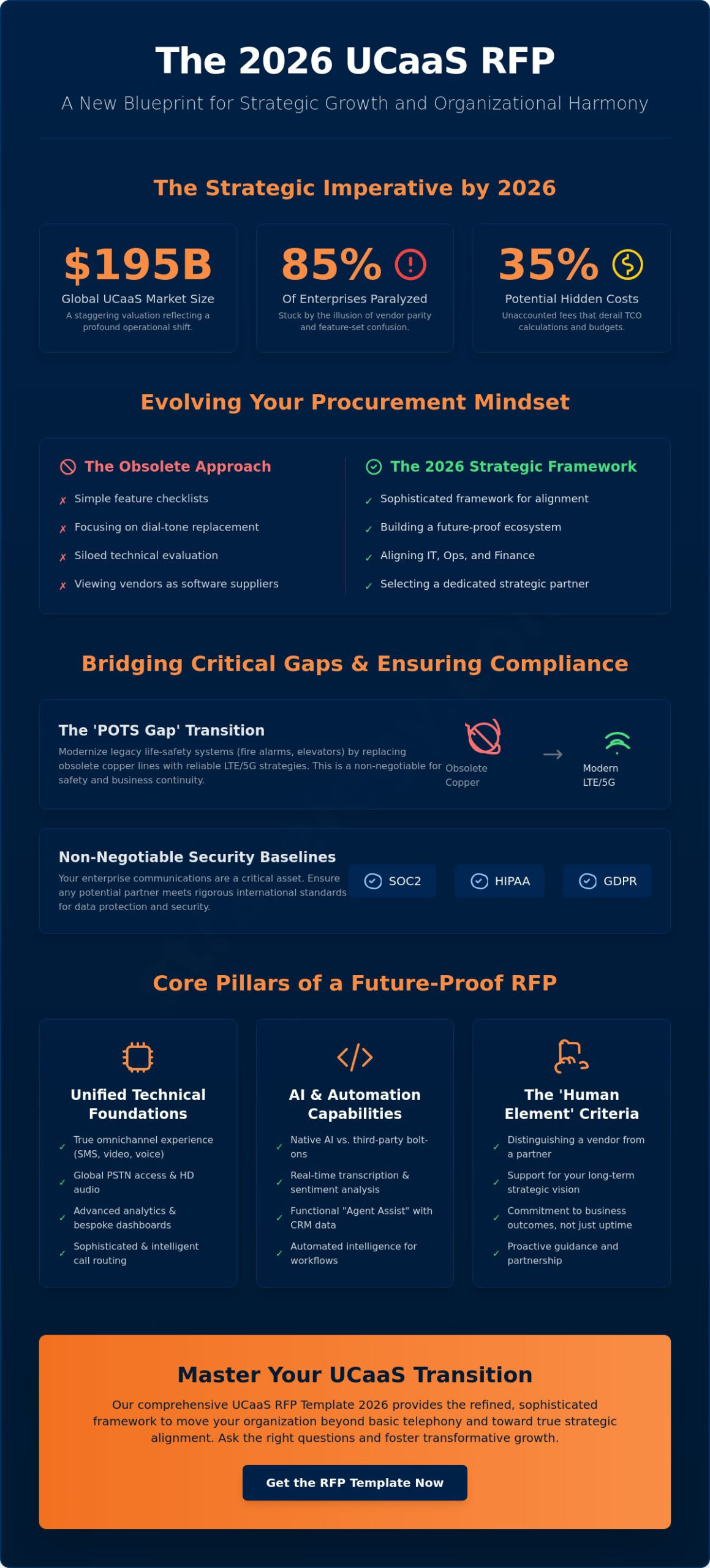
By May 2026, the global UCaaS market has reached a staggering $195 billion, yet 85% of enterprises still find themselves paralyzed by the illusion of vendor parity. You likely feel the mounting pressure to select a platform that must do far more than simply replace a dial tone. It’s exhausting to navigate the hidden 35% in additional costs or the lingering anxiety of integrating legacy fire and life safety systems into a modern cloud environment. Our ucaas rfp template 2026 offers a refined, sophisticated framework to move your organization beyond basic telephony toward true strategic alignment.
You’ll gain the professional confidence to ask the right questions about AI-driven intelligence and security while ensuring your procurement process fosters transformative growth. We’ll provide a ready-to-use structure that bridges the gap between complex technical requirements and elegant business outcomes. This guide explores how to master the transition from obsolete copper lines to a harmonious, future-proof communication ecosystem that scales with your vision.
Key Takeaways
- Shift your procurement mindset from a simple feature checklist to a sophisticated framework for strategic alignment and long-term organizational harmony.
- Utilize our comprehensive ucaas rfp template 2026 to navigate the convergence of global voice, omnichannel video, and AI-driven intelligence with professional precision.
- Learn to bridge the critical “POTS Gap” by securing legacy life-safety systems, such as fire alarms and elevators, through modern LTE replacement strategies.
- Establish non-negotiable baselines for security and compliance, ensuring your enterprise communications meet the rigorous standards of SOC2, HIPAA, and GDPR.
- Identify the essential “human element” criteria to distinguish between a mere software vendor and a dedicated strategic partner who supports your vision.
The Strategic Imperative of the UCaaS RFP in 2026
By May 2026, the global market for cloud-based communication has reached a staggering $195 billion. This growth reflects a profound shift in how enterprises operate. We’ve moved past the era where voice and video were siloed tools; they are now integrated components of a broader intelligence ecosystem. Selecting the right provider is no longer a simple procurement hurdle to clear. It’s a foundational decision that dictates your organization’s ability to achieve transformative growth. A sophisticated ucaas rfp template 2026 serves as the blueprint for this transition, ensuring that every technical requirement aligns with your overarching business goals.
The traditional “feature-set” buying model has become obsolete. In 2026, over 85% of enterprises operate entirely on cloud-based systems, making the distinction between vendors increasingly subtle. True differentiation now lies in partnership-based selection. You aren’t just buying software; you’re choosing a partner to manage the backbone of your corporate identity. This requires a document that prioritizes strategic alignment over a mere checklist of buttons and icons. The foundational principles of Unified Communications (UC) have evolved to include real-time sentiment analysis and automated intelligence, demanding a more rigorous evaluation framework.
Why 2026 Requires a New Procurement Philosophy
We’ve reached the tipping point for the total cloud transition. Legacy copper lines are no longer a viable option for modern business. They’re expensive to maintain and lack the flexibility required for a hybrid workforce. This shift creates a vacuum that “technological chaos” often fills if left unmanaged. A structured ucaas rfp template 2026 mitigates this risk by creating order from the complexity of modern collaboration ecosystems. It forces vendors to demonstrate how they integrate with your existing workflows rather than just offering another VoIP endpoint. With a projected market CAGR of 10.4% through 2034, the decisions you make today must account for a decade of rapid evolution.
Defining Your Organization’s Strategic Vision
Before drafting a single line of your RFP, you must identify the “Job to be Done.” This requires a deep internal assessment that bridges the gap between IT, Operations, and Finance. IT seeks security and uptime; Operations demands seamless user experiences; Finance requires a predictable Total Cost of Ownership (TCO) that accounts for the 25-35% in hidden fees often found in cloud contracts. Aligning these stakeholders ensures that the procurement process isn’t just a technical exercise but a strategic one. UCaaS functions as a comprehensive strategic framework that orchestrates technology and human capital to achieve enterprise-wide harmony.
Essential Technical Requirements for Modern Enterprise Collaboration
Modern collaboration requires a technical foundation that transcends the basic dial tone. In 2026, high-definition audio and global PSTN access are merely the entry stakes. Your ucaas rfp template 2026 must demand sophisticated call routing and an omnichannel experience where transitions between SMS, video, and voice are invisible to the user. This level of orchestration ensures that communication flows naturally across the enterprise. It’s about creating a unified environment where data isn’t trapped in silos but moves fluidly to support every business decision. When technology works in harmony, the friction of daily operations simply dissolves.
Analytics must move beyond basic call logs to provide deep customer journey insights. Bespoke dashboards that visualize sentiment and interaction patterns are essential for strategic alignment. You aren’t just looking for data; you’re looking for the narrative within the data. This clarity allows leadership to pivot quickly and respond to market shifts with confidence. If your reporting doesn’t tell a story, it isn’t serving your strategy. High-performing organizations use these insights to refine their communication workflows and drive transformational growth.
Evaluating AI and Automation Capabilities
The market is saturated with “marketing AI,” yet functional intelligence is rare. Your RFP should distinguish between native AI and third-party bolt-on solutions that often suffer from latency or data leakage. Ask vendors how their transcription models perform in noisy, real-world business environments. True “Agent Assist” technology should act as a silent partner, surfacing relevant CRM data or knowledge base articles in real-time. This reduces employee burnout and elevates the customer experience from transactional to transformational. For a deeper look at how these systems integrate with your existing infrastructure, explore our strategic communication frameworks.
Network Architecture and Reliability Standards
Reliability in 2026 is measured by the “five nines” standard. Achieving 99.999% uptime means less than six minutes of downtime per year. Your RFP should mandate clear evidence of how a provider maintains this in a cloud-native environment. Business continuity depends on sophisticated failover mechanisms, including SD-WAN and cellular LTE backup. These aren’t optional luxuries; they’re the safety nets that prevent catastrophic communication blackouts. Finally, ensure interoperability with your existing CRM and legacy hardware to avoid the “rip and replace” trap that plagues so many cloud transitions. A well-designed network architecture is the silent backbone of a successful enterprise.
Critical Security, Compliance, and the ‘POTS Gap’
Security serves as the bedrock of modern enterprise communications. It’s not merely about protecting data; it’s about preserving the integrity of your corporate vision. Your ucaas rfp template 2026 must mandate SOC2 Type II, HIPAA, and GDPR compliance as absolute minimums. In an environment where 85% of enterprises are now entirely cloud-dependent, the threat landscape has matured significantly. We’ve reached a point where End-to-End Encryption (E2EE) for sensitive internal communications is a standard expectation rather than a premium add-on. This level of protection ensures that your intellectual property remains shielded from increasingly sophisticated external threats.
Compliance is a dynamic alignment with global regulations, not a static checkbox. Data residency and sovereignty have become paramount in 2026, requiring precise documentation of where your information resides. A sophisticated RFP scrutinizes a vendor’s incident response and disaster recovery protocols with clinical detail. For healthcare and legal entities, virtual faxing remains a critical requirement for maintaining HIPAA compliance while moving away from the inefficiencies of physical hardware. This ensures that your digital transformation doesn’t come at the cost of regulatory vulnerability.
Navigating the Compliance Landscape
You must challenge vendors on their specific incident response timelines and data sovereignty guarantees. In 2026, it’s vital to know if your data crosses international borders and how that impacts your specific industry regulations. Don’t settle for vague promises; demand documented disaster recovery protocols that align with your business continuity objectives. This level of scrutiny transforms compliance from a hurdle into a strategic advantage.
Modernizing Life Safety Infrastructure
One of the most significant risks in cloud migration is the “POTS Gap.” Traditional UCaaS platforms are designed for collaboration, but they lack the specialized architecture to support fire alarms, emergency elevator phones, or security panels. These life-safety systems rely on analog signals that cloud voice simply can’t replicate reliably. Your ucaas rfp template 2026 should explicitly require LTE POTS replacement solutions to bridge this divide safely.
Transitioning legacy infrastructure to cellular-based LTE replacement solutions delivers both safety and financial clarity. By removing the burden of copper maintenance, your organization can focus on more strategic initiatives that drive transformative growth. Reliable connectivity for life-safety systems is a non-negotiable component of a harmonized communication architecture. It ensures that your leap into the cloud doesn’t leave your most critical security foundations behind, creating a truly resilient enterprise environment.
The 2026 UCaaS RFP Template: A Structured Framework
Designing a high-performance ucaas rfp template 2026 requires more than a simple list of features. It’s an exercise in architectural precision. To achieve strategic alignment, your document must follow a logical progression that moves from high-level vision to granular technical execution. This structure ensures that vendors don’t just provide data; they provide solutions that resonate with your organizational goals. A well-ordered RFP consists of five essential pillars:
- Section 1: Executive Summary and Organizational Goals. Define the “why” behind your transformation and the specific business outcomes you expect to achieve.
- Section 2: Technical Specifications and Functional Requirements. Detail the core voice, video, and AI capabilities required for your hybrid workforce.
- Section 3: Security, Compliance, and Business Continuity. Address the non-negotiables, including SOC2 Type II, GDPR, and the critical integration of life-safety systems.
- Section 4: Implementation, Training, and Support Models. Evaluate the vendor’s ability to manage the transition and provide ongoing, high-tier professional services.
- Section 5: Pricing Structure and Total Cost of Ownership (TCO). Demand transparency to avoid the common 25-35% increase in costs often hidden in regulatory fees and hardware requirements.
By early 2026, the combined user base of leading collaboration platforms has surpassed 54 million seats. This scale means major providers often rely on generic, automated responses. Your framework must be designed to break through this noise, forcing providers to demonstrate how their platform integrates with your unique workflow. If you’re ready to refine your procurement process, you can download our comprehensive strategy guides to ensure your next communication investment is built on a foundation of excellence.
Drafting the Technical Questionnaire
The quality of your results depends entirely on the phrasing of your questions. Avoid binary “yes or no” queries that allow vendors to hide limitations. Instead, ask how their specific feature set solves a defined business challenge. Implement a weighting system to prioritize “Must-Have” requirements over “Nice-to-Have” luxuries. This clarity allows you to score responses objectively, ensuring that the most critical functions, such as mobile application performance and AI accuracy, receive the attention they deserve. A sophisticated questionnaire transforms a document into a powerful diagnostic tool.
Financial Evaluation and TCO Analysis
A truly strategic RFP looks far beyond the initial per-user monthly fee. You must account for the full spectrum of expenses, including implementation, hardware, and the cost of adding future AI modules. A significant portion of your ROI will come from the elimination of obsolete copper lines. By integrating LTE POTS replacement into your financial model, you can offset the costs of modernizing your communication stack. This holistic approach to TCO ensures that your budget remains stable as your organization scales toward transformative growth.
Beyond the Document: Selecting a Partner for Strategic Alignment
The document is merely the beginning. While a well-crafted ucaas rfp template 2026 provides the necessary data, the true value emerges in the selection of a partner who understands your long-term trajectory. A vendor views your organization as a transaction; a strategic partner views it as a collaborative ecosystem. This distinction becomes clear when you evaluate the “human element.” You need more than a standard help desk. You require dedicated account management and professional services that align with your specific business goals. True partnership is about shared vision and meticulous execution.
High-tier support models are essential for maintaining the 99.999% uptime standards we’ve established. When a primary circuit fails, you don’t need an automated response. You need an advocate who has already orchestrated your cellular failover and LTE backup systems. Moving from the RFP to a successful implementation requires a structured pilot program. This phase tests the platform’s interoperability with your CRM and legacy hardware in a controlled, real-world environment. It’s the final bridge between theoretical strategy and operational excellence, ensuring that your transition is as seamless as it is transformative.
The Stratelegy Approach: Sophistication in Execution
We don’t simply provide software. We create bespoke frameworks that integrate enterprise UCaaS with critical LTE POTS replacement for a holistic, resilient solution. Our approach addresses the complexities of the modern communications landscape by providing visionary guidance. We help you bridge the “POTS Gap,” ensuring that your fire alarms and elevator phones remain secure while you scale your digital infrastructure. This commitment to strategic alignment is what drives transformative growth for our partners. We turn technical necessity into an aesthetic and functional advantage.
Next Steps: Initiating Your Strategic Transformation
Success in 2026 requires a proactive stance. You can adapt the principles of this ucaas rfp template 2026 to fit your unique organizational culture and technical requirements. We invite you to move beyond the spreadsheet and engage in a deeper conversation about your future. Our advisors are ready to help you refine your communication architecture, ensuring every component works in perfect harmony. When you’re prepared to elevate your procurement process, connect with a Stratelegy advisor to refine your UCaaS strategy and begin your journey toward a more elegant, efficient operation.
Orchestrating Your Communication Future
Achieving structural harmony in your enterprise communications requires a shift from transactional procurement to visionary design. We’ve explored how a sophisticated ucaas rfp template 2026 serves as the catalyst for this transformation, bridging the gap between modern cloud collaboration and critical legacy safety systems. Strategy and elegance belong together. By prioritizing strategic alignment and addressing the “POTS Gap” through reliable LTE replacement, you ensure your organization is built on a foundation of resilience. The journey from complexity to clarity begins with a partner who values your long-term success as much as your immediate efficiency.
Stratelegy offers the national reach and high-touch consulting necessary to navigate these intricate transitions with confidence. Our expertise in LTE POTS replacement ensures your fire and life safety systems remain secure while your workforce thrives in a unified collaboration environment. We invite you to elevate your enterprise communications with a bespoke Stratelegy solution that reflects the unique ambitions of your brand. Let’s work together to create a future where your technology isn’t just a tool, but a reflection of your organizational excellence. Your path to a more elegant and effective operation starts today.
Frequently Asked Questions
How do I write an RFP for UCaaS in 2026?
Start by establishing a structured framework that prioritizes strategic alignment over a simple feature checklist. By May 2026, an effective ucaas rfp template 2026 must address the convergence of voice, video, and AI-driven intelligence. You should define your internal organizational goals first, then move into technical specifications, security requirements, and long-term support models. This logical progression ensures the final document reflects your vision for transformative growth rather than a generic industry standard.
What are the most important criteria in a UCaaS RFP?
Reliability, AI functionality, and security are the three essential pillars of modern vendor selection. In 2026, you must demand a 99.999% uptime guarantee and native AI capabilities such as real-time sentiment analysis. You should also evaluate a vendor’s ability to integrate with existing CRM systems and manage the “POTS Gap” for critical safety infrastructure. These criteria allow you to distinguish a true strategic partner from a basic software provider.
How does AI impact UCaaS vendor selection in 2026?
AI is now a foundational requirement, with 85% of enterprises expecting intelligent features as core components of their communication stack. You should evaluate whether AI is native to the platform or a third-party add-on to ensure data privacy and minimize latency. Focus on functional intelligence, such as automated meeting summaries and agent assist tools, to reduce employee burnout. This selection process determines your organization’s future analytical capabilities and operational efficiency.
Do I need to include POTS replacement in my UCaaS RFP?
Yes, including LTE POTS replacement is essential for securing life-safety systems like fire alarms and elevators. Traditional UCaaS platforms cannot support these critical analog lines, which have become obsolete and expensive to maintain by May 2026. A comprehensive RFP must specify cellular-based alternatives to bridge this gap effectively. This ensures your cloud transition doesn’t compromise physical security or leave you vulnerable to regulatory non-compliance.
What is the typical timeline for a UCaaS RFP process?
A thorough procurement process usually spans three to five months from initial assessment to final selection. This timeline includes four weeks for internal discovery, six weeks for vendor responses, and one month for scoring and pilot programs. The complexity of AI and security integrations in 2026 requires this deliberate pace to avoid costly implementation errors. Rushing this sequence often leads to misaligned technology and a failure to achieve long-term strategic goals.
How can I compare UCaaS pricing models effectively?
Focus on the Total Cost of Ownership (TCO) rather than the base per-user monthly fee. Initial quotes often exclude taxes, regulatory fees, and hardware costs, which can increase the total expense by 25% to 35%. Your ucaas rfp template 2026 should mandate a transparent breakdown of all implementation and recurring costs. This level of clarity allows for an honest ROI analysis that accounts for both immediate savings and long-term scalability.
What security certifications should I require in a 2026 RFP?
You must mandate SOC2 Type II, HIPAA, and GDPR as non-negotiable minimums for any enterprise-grade solution. In 2026, data residency and sovereignty have become paramount, so your RFP should ask for documented evidence of where information is stored. Demand end-to-end encryption for sensitive communications to protect your corporate identity and intellectual property. These certifications ensure your platform meets the highest global standards for data integrity and risk mitigation.
Can I use a generic RFP template for enterprise-grade UCaaS?
No, generic templates fail to address the specific complexities of modern hybrid work environments. A one-size-fits-all document ignores the unique integration requirements of your CRM and the tactical difficulty of replacing legacy copper lines. You need a bespoke framework designed for strategic alignment to achieve true transformative growth. Customizing your RFP ensures the resulting partnership supports your specific vision rather than a generic industry average.