
By 2028, 90% of organizations will rely on cloud platforms for enterprise telephony, yet many firms are currently paying for shelfware that employees actively avoid. If your team still reverts to unauthorized personal messaging apps for business workflows, you don’t have a training problem. You have an infrastructure gap. Wasted subscription costs and security risks are symptoms of a fragmented system that lacks a professional engineering foundation. It’s time to stop treating your communication stack like a software trial and start treating it like the critical infrastructure it is.
You need a communication environment built for longevity and predictability. This guide outlines a high-impact ucaas adoption strategy for employees based on our 2026 Engineering Framework. This methodology transforms ignored platforms into high-adoption growth engines by prioritizing governance and technical stability over mere software features. We’ll explore how to eliminate fragmented workflows and secure your data through a lifecycle management approach that ensures your business never falls behind. You’ll discover how to merge UCaaS and CCaaS into a single, managed solution that your team actually wants to use.
Key Takeaways
- Calculate the true ROI of your communication stack by identifying the hidden costs of low engagement and the risks of shadow IT.
- Implement a proactive ucaas adoption strategy for employees that aligns technical infrastructure with actual departmental workflows.
- Avoid feature fatigue by mapping specific platform capabilities to real-world “Jobs to be Done” across your organization.
- Execute a 5-phase roadmap starting with a rigorous discovery and infrastructure audit to build a foundation for sustained adoption.
- Shift from a vendor-client relationship to a strategic partnership that prioritizes governance, security, and long-term predictability.
The Hidden Cost of Failed UCaaS Adoption in 2026
Software is only as valuable as its utilization rate. When an organization invests in Unified Communications (UC), the goal is a seamless flow of data; however, the reality often results in “shelfware.” This term describes expensive software licenses that sit idle because the implementation lacked a technical foundation. In 2026, failed adoption costs your business more than just the monthly $20 to $50 per-user subscription fee. It creates an environment where employees revert to “Shadow IT,” using personal SMS and WhatsApp to bypass corporate friction.
This shift to unmanaged channels isn’t just a habit; it’s a massive security vulnerability. When business data leaves your governed environment, you lose oversight of client interactions and intellectual property. A successful ucaas adoption strategy for employees must address why these personal apps are preferred. Usually, it’s because the corporate platform was deployed as a standalone tool rather than being engineered into the existing workflow. True ROI isn’t found in the software features. It’s found in the governance and stability that a fully utilized platform provides to the business lifecycle.
Predictability vs. Chaos in Business Communications
Fragmented tools destroy organizational governance by scattering data across disconnected silos. When your team uses disparate apps, there’s no single source of truth for customer sentiment or project history. Transitioning to an integrated UCaaS environment replaces this chaos with a controlled, predictable infrastructure. Communication predictability is the strategic assurance that every business interaction remains secure, retrievable, and aligned with organizational governance.
The 2026 Regulatory Landscape for Enterprise Voice
Compliance is no longer optional for modern infrastructure. In 2026, industry standards for E-911 certification and life safety systems mean that legacy habits are a direct liability. If an employee uses a personal messaging app during an emergency, your business lacks the location-accurate reporting required by law. Bridging the gap between “it works” and “it is compliant” requires a ucaas adoption strategy for employees that prioritizes technical standards over convenience. Professional engineering ensures your voice traffic meets HIPAA, GDPR, and FINRA requirements without sacrificing the user experience. You don’t just need a dial tone; you need a managed environment that supports the long-term health of your business infrastructure.
Defining a UCaaS Adoption Strategy for Employees
A ucaas adoption strategy for employees isn’t a collection of “how-to” videos or HR emails. It’s a proactive engineering framework designed to align technical capabilities with human workflows. In 2026, simply purchasing a license isn’t enough to drive growth. You need a governance-first approach that treats unified communications as a foundational layer of your business infrastructure. This requires a fundamental shift from a vendor-client relationship to a strategic partnership. You aren’t just buying a dial tone; you’re building a managed environment where every connection is intentional and secure.
Every organization has “Trusted Architects” already working within its walls. These are the employees who naturally optimize their own workflows and influence their peers. Identifying these individuals allows you to lead the charge from within. They help bridge the gap between technical potential and daily reality. By empowering these internal leaders, you ensure that the platform isn’t forced upon the staff but is instead integrated into their success. This engineering-led mindset ensures that the technology serves the mission, providing the predictability business owners need to scale confidently.
Adoption as an Infrastructure Lifecycle
One-off training sessions fail because they ignore the reality of software updates and shifting business requirements. We view adoption as a core component of infrastructure stability, not a single event. This begins with “Day Zero” planning. Before the first user logs in, the entire communications lifecycle must be established. This mirrors the core principles of teamwork, where shared goals and clear structures drive long-term performance. Continuous optimization ensures the platform evolves alongside your team, preventing the system from becoming obsolete.
The Role of Infrastructure Engineers in Software Adoption
IT teams must think like engineers, not just support staff. Their goal is to engineer the “Path of Least Resistance” for daily employee tasks. If it’s easier for a team member to use a personal app than the corporate platform, the engineering has failed. By integrating voice, video, and messaging into a singular, predictable flow, you eliminate the friction that leads to shadow IT. Achieving this level of managed communication excellence ensures that the technology supports the business rather than complicating it. When the infrastructure is predictable, the employees can focus on their work instead of the tools.
Aligning UCaaS Features with Real-World Employee Workflows
Feature fatigue is a primary barrier to successful implementation. In 2026, the average enterprise employee interacts with 11 different apps daily. This leads to cognitive overload and platform abandonment. A successful ucaas adoption strategy for employees focuses on “Jobs to be Done” rather than a list of technical specs. For example, a support agent doesn’t just need “omnichannel capabilities.” They need a singular interface where SMS, voice, and web chat converge without data loss. By mapping features to specific departmental tasks, you eliminate the noise. Citing Technology Adoption Best Practices, we know that identifying friction points early is essential. When employees see a tool that solves a specific headache, adoption happens naturally.
In our work with high-volume contact centers, we’ve seen how next-generation tools like sentiment analysis drive employee confidence. Instead of guessing how a customer feels, the platform provides real-time emotional cues. This allows agents to pivot their approach mid-call. It reduces stress and improves outcomes. This is a shift from reactive communication to proactive engagement. It turns a standard CCaaS tool into a growth engine for the entire department. When employees feel supported by their tools, they’re less likely to revert to unmanaged personal apps.
Workflow Engineering: From Legacy to Cloud
Transitioning away from the “desk phone” mentality is critical for the modern workforce. We engineer solutions that integrate UCaaS directly into your existing CRM and productivity stacks. This reduces the “toggle tax.” Research indicates that switching between apps can cost employees up to 40% of their productive time. By creating a unified experience, you ensure that the path of least resistance stays within your governed infrastructure. Your team stays focused on the client, not the software. This level of integration is what separates a strategic deployment from a simple software purchase.
Feature Prioritization for Different User Groups
A sales team requires different tools than a support department. Sales needs high-velocity dialing and CRM logging. Support requires advanced routing and omnichannel queues. We tailor the platform experience to these specific roles. To keep these tools modern, our industry-first Technology Refresh Policy provides zero-CapEx hardware refreshes. This ensures your team isn’t struggling with 2021-era hardware in a 2026 landscape. Your infrastructure stays current so your business never falls behind. We provide the following comparison to help you visualize the shift:
- Legacy Hardware: Fixed location, high maintenance, siloed data, and aging components.
- Managed UCaaS: Mobile-first, zero maintenance, integrated governance, and automatic updates.
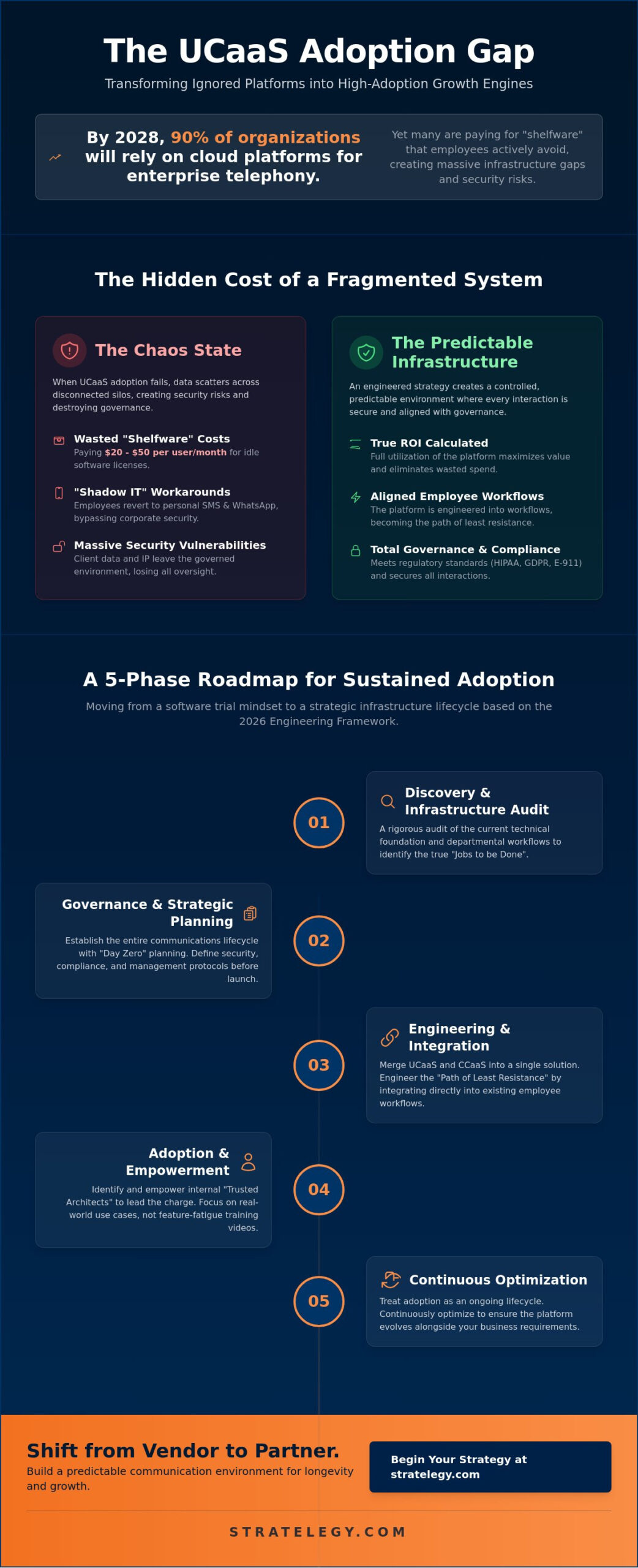
A 5-Phase Roadmap for Sustained Platform Adoption
A successful ucaas adoption strategy for employees requires a disciplined, phase-based approach that prioritizes technical stability over flashy software demos. Most implementation failures happen because the platform is treated as an isolated application rather than a core piece of business infrastructure. We’ve engineered a 5-phase framework designed to ensure your communication stack becomes a high-utilization growth engine. This roadmap shifts the focus from a simple rollout to a long-term lifecycle management plan that protects your investment and secures your data.
- Phase 1: Discovery and Infrastructure Audit. We identify legacy gaps and network readiness to build an engineering foundation.
- Phase 2: Workflow Mapping and Persona Development. Technical capabilities are aligned with specific departmental “Jobs to be Done.”
- Phase 3: Managed Deployment and White Glove Onboarding. A hands-on transition that eliminates the friction of self-service setups.
- Phase 4: Governance Review and Security Hardening. Ensuring compliance with 2026 regulatory standards and zero-trust architectures.
- Phase 5: Continuous Optimization and the Technology Refresh Cycle. Maintaining momentum through proactive maintenance and hardware updates.
Phase 1: The Discovery and Audit Process
Infrastructure engineers know that software performance is capped by the quality of the underlying network. Before the first user is invited to the platform, we conduct a comprehensive audit of your existing environment. This includes identifying aging copper lines that require LTE POTS replacement to maintain life safety systems like fire panels and elevators. We also evaluate bandwidth capacity to prevent “lag-induced” rejection from employees. If a call drops or a message hangs, the user loses trust in the system immediately. Setting measurable benchmarks for latency and jitter ensures the platform is reliable from day zero. This technical due diligence is the only way to build a predictable ucaas adoption strategy for employees that actually scales.
Phase 5: The Stratelegy Technology Refresh Policy
Platform abandonment often stems from hardware obsolescence. Employees grow frustrated when modern software features are throttled by 2021-era desk phones or sluggish headsets. Our industry-first Device Lifecycle and Technology Refresh Policy solves this by keeping your team’s tools current without capital expenditure spikes. Providing your staff with cutting-edge, reliable hardware has a significant psychological impact; it signals that their productivity is a priority. Maintaining adoption requires more than just software patches. It demands a commitment to the entire communication lifecycle. By scheduling regular refreshes, we ensure your infrastructure stays modern so your business never falls behind. You can partner with our infrastructure engineers to build a communication environment that stays current and compliant for years to come.
Stratelegy: Your Strategic Partner in Communications Excellence
Stratelegy is more than a service provider. We are infrastructure engineers who prioritize the long-term stability and predictability of your business communications. Most software vendors focus solely on the initial sale, leaving you to navigate the complexities of employee engagement alone. Our ucaas adoption strategy for employees is built on a foundation of technical authority and security. We don’t just hand over a login; we engineer a managed environment where every user feels supported by the technology. This disciplined approach ensures that your communication stack remains a high-utilization growth engine rather than a collection of idle licenses.
Our expertise in specialized areas like LTE POTS replacement gives us a unique perspective on unified communications. We understand that enterprise communication isn’t just about chat or video; it’s about life safety and regulatory compliance. Whether it’s ensuring E-911 certification for fire panels or maintaining high-availability voice for critical operations, we apply the same engineering rigor to your UCaaS deployment. This ensures that your ucaas adoption strategy for employees accounts for the reliability requirements of a regulated 2026 landscape. We manage the foundational infrastructure so you can focus on scaling your business with total confidence.
Built for Impact: Our Managed UCaaS Solutions
We integrate fire, life safety, and unified communications into a single managed ecosystem. This holistic view eliminates the data silos that often lead to platform abandonment and shadow IT. You won’t have to worry about falling behind because our industry-first Device Lifecycle and Technology Refresh Policy keeps your hardware current. By removing the financial burden of capital expenditure through a zero-CapEx model, we ensure your team always has access to next-generation tools. This commitment to ongoing maintenance is why our clients experience sustained adoption rates. Schedule your infrastructure audit with Stratelegy today.
The Peace of Mind Factor
Achieving communications excellence requires more than just modern software. It requires a partner who has already thought of the problems you haven’t encountered yet. We provide the “Day 2” support and beyond that ensures every employee is empowered by the infrastructure rather than hindered by it. When tools are predictable and reliable, employees don’t look for unauthorized workarounds. They focus on their specific “Jobs to be Done.” Our partnership model is rooted in the long-term health of your business. We are the trusted architects who build for longevity, governance, and total peace of mind.
Engineering a Resilient Communication Ecosystem
With 90% of organizations projected to rely on cloud telephony by 2028, the transition to UCaaS is inevitable. However, success isn’t defined by the migration itself but by the long-term engagement of your workforce. By implementing a ucaas adoption strategy for employees that prioritizes technical governance and workflow integration, you move beyond the trap of expensive shelfware. This approach eliminates the 40% productivity loss caused by the toggle tax and secures your data against the risks of unmanaged messaging apps.
True communications excellence is built on foundational reliability. Our infrastructure-first engineering approach ensures your platform remains compliant with 2026 life safety standards. Through our industry-first Technology Refresh Policy and specialized expertise in LTE POTS replacement, we provide the longevity your business requires. You don’t have to navigate this transition alone. This framework provides the predictability you need to scale without the fear of technical obsolescence. Ready to engineer a more predictable communication future? Partner with Stratelegy. We are here to ensure your infrastructure stays current so your business never falls behind.
Frequently Asked Questions
What is the most common reason employees resist UCaaS adoption?
Employees resist when a platform introduces more friction than their existing habits. If a corporate app requires three extra clicks compared to a personal messaging tool, usage drops significantly. A successful ucaas adoption strategy for employees identifies these workflow bottlenecks during the discovery phase. We find that 40% of employees revert to personal apps when the corporate tool isn’t integrated into their primary CRM or productivity stack.
How long does a typical UCaaS implementation and adoption phase take?
A full implementation typically spans 90 to 180 days for complete organizational alignment. While technical cutovers can happen in a few weeks; the behavioral shift requires consistent lifecycle management. This timeline includes our 5-phase roadmap from initial discovery to continuous optimization. Rushing this process often leads to “shelfware,” where licenses are paid for but only 20% of features are actually utilized by the staff.
Can we keep our existing hardware while transitioning to a UCaaS platform?
You can technically use existing SIP-enabled hardware; however, this often creates a subpar user experience. Legacy devices lack the processing power for next-generation features like real-time sentiment analysis or omnichannel syncing. We recommend a zero-CapEx refresh policy to ensure your team uses modern tools. This prevents the frustration that occurs when 2026 software runs on 2021 hardware, which is a major cause of platform abandonment.
How does UCaaS adoption impact business security and compliance?
High adoption rates directly improve security by bringing communication back into a governed environment. Unmanaged personal apps create data silos that bypass HIPAA, GDPR, and FINRA requirements. When employees use a managed platform, every interaction is encrypted and archived for audit purposes. This is especially critical for E-911 certification, where location accuracy is mandatory for life safety systems like fire panels and elevators.
What metrics should we use to measure employee adoption of UCaaS?
Measure success through Daily Active Usage (DAU) and specific feature utilization rates across different departments. A high-performing ucaas adoption strategy for employees also tracks the reduction in “Shadow IT” traffic on corporate networks. Monitoring these KPIs allows for proactive adjustments during the optimization phase. If utilization in the sales department stays below 60%, it signals a need for better CRM integration or role-specific workflow engineering.
Is a technology refresh policy necessary for UCaaS success?
A technology refresh policy is essential for maintaining long-term platform engagement. Hardware typically reaches its performance limit within 36 months in a high-volume environment. Without a scheduled refresh, employees struggle with audio lag and battery degradation, leading them to abandon the platform. Our industry-first policy ensures your infrastructure stays current so your business never falls behind, providing the predictability required for true communications excellence.
How do we handle employees who continue to use personal apps for work?
Address personal app usage by engineering a “path of least resistance” within your corporate platform. If employees use personal SMS because the UCaaS app is slow, the solution is technical optimization, not just policy enforcement. We focus on integrating messaging directly into the employee’s existing workflow. This eliminates the “toggle tax” and makes the managed platform the most efficient choice for daily business tasks.
What role does leadership play in a UCaaS adoption strategy?
Leadership must act as the “Trusted Architects” who model platform usage and prioritize governance. When executives use the unified platform for all internal communications, it signals that the tool is a core business asset. Leaders are responsible for shifting the organizational mindset from a vendor-client view to a strategic partnership. This top-down commitment ensures that the adoption framework receives the necessary resources for sustained success.