
By 2026, the traditional on-premise PBX won’t just be obsolete; it’ll be a structural liability that drains 22% of enterprise productivity through tool fragmentation. If your leadership team is still juggling siloed platforms for voice, video, and messaging, you’re likely subsidizing friction rather than fostering innovation. Defining what is ucaas has moved beyond a technical curiosity into a vital component of strategic alignment. It’s the architectural foundation required to transform scattered conversations into a synchronized engine of organizational intelligence.
You’ve likely felt the weight of aging infrastructure and the mounting security risks that come with legacy hardware. This guide provides a sophisticated framework to replace those vulnerabilities with a single-pane-of-glass platform that offers both clarity and control. We’ll examine how migrating to a cloud-native ecosystem secures your connectivity while delivering the predictable recurring costs and agility necessary for transformative growth. From technical integration to executive vision, here’s how to orchestrate your communication strategy for the next decade.
Key Takeaways
- Recognize the shift from fragmented tools to unified platforms as a core requirement for organizational intelligence in the 2026 landscape.
- Master the fundamental concepts of what is ucaas to leverage cloud-native architectures that provide the resilience and redundancy essential for modern operations.
- Clarify the distinction between internal collaboration and external engagement to ensure your telecommunications framework is both strategically sound and operationally efficient.
- Evaluate the financial and operational advantages of migrating from legacy copper lines to a flexible, cloud-based model that facilitates scalable, transformative growth.
- Orchestrate a successful transition by aligning your communication technology with a sophisticated framework that turns infrastructure into a competitive advantage.
Defining UCaaS: The Strategic Evolution of Business Communication
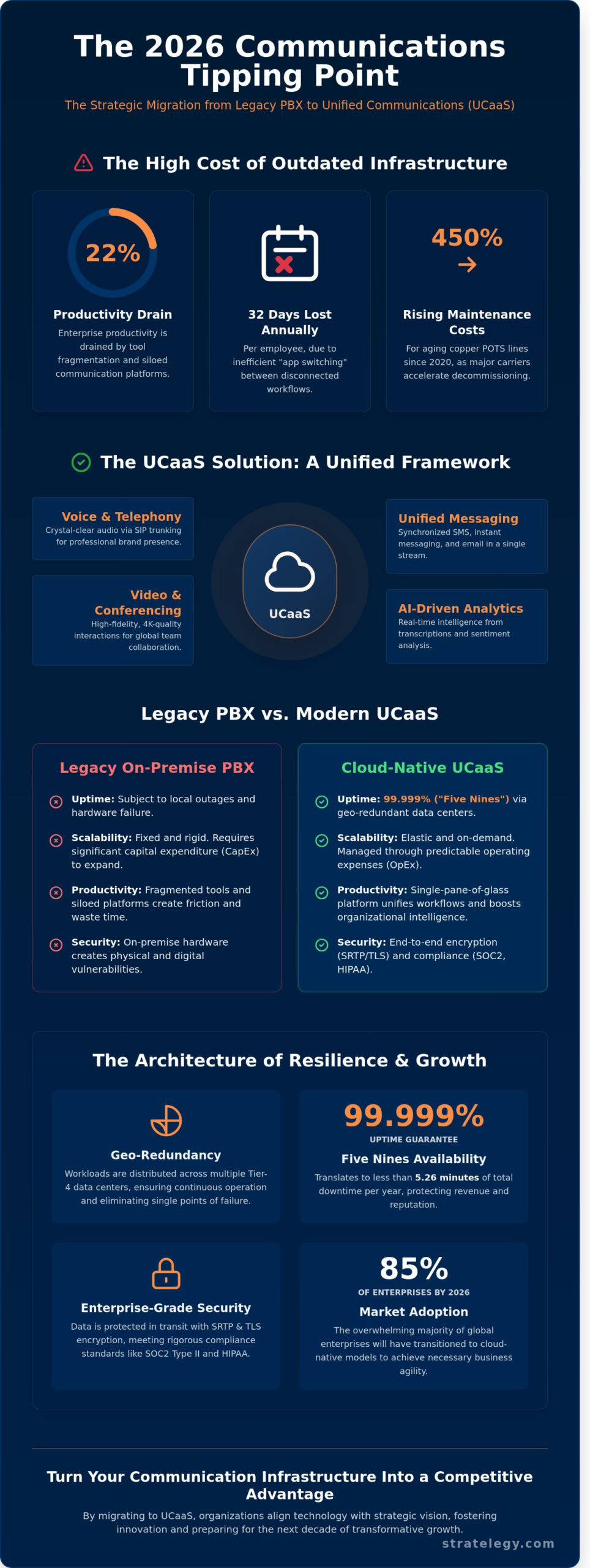
Understanding what is ucaas requires a shift in perspective from viewing communication as a utility to seeing it as a strategic asset. Unified Communications as a Service (UCaaS) is a cloud-native delivery model that integrates enterprise-grade tools into one architectural framework. By 2026, the era of managing isolated vendors for telephony, video, and chat has effectively ended. Organizations have moved toward unified platforms to eliminate the 32 days of productive work lost annually per employee due to “app switching” and fragmented workflows.
The transition from siloed tools to integrated ecosystems isn’t merely a technical upgrade; it’s a competitive requirement. Legacy on-premise PBX systems represent a stagnant era of hardware dependency and high capital expenditure. In contrast, the UCaaS model provides an elastic framework that scales with organizational demand, offering 99.999% uptime through geographically redundant data centers. This shift ensures that communication remains a constant, reliable pulse within the corporate structure, regardless of external volatility.
The Core Pillars of Unified Communications
- Voice and telephony: This remains the backbone of professional presence. Modern UCaaS platforms leverage SIP trunking to provide crystal-clear audio that maintains brand authority during every client interaction.
- Video and web conferencing: High-fidelity remote collaboration is no longer optional. Integrated video tools facilitate 4K-quality interactions that bridge the physical gap between global teams.
- Unified messaging: This pillar synchronizes SMS, instant messaging, and email into a single stream. It ensures that no data silos exist between different modes of contact, allowing for a seamless transition from a chat to a live call.
Why 2026 is the Tipping Point for UCaaS
This year marks a definitive boundary in the digital transformation timeline. Major carriers like AT&T and Verizon have accelerated the decommissioning of Plain Old Telephone Service (POTS) lines, with maintenance costs for aging copper infrastructure rising by 450% since 2020. Defining what is ucaas in 2026 means recognizing it as the only viable successor to these sunsetting systems. It’s the engine of the mobile-first enterprise.
The integration of AI-driven analytics has also reached maturity. Approximately 75% of business communications now pass through platforms that provide real-time sentiment analysis and automated transcription. This intelligence allows leaders to move from reactive management to proactive strategy. When every device becomes a professional workstation, the demand for “anywhere connectivity” is met not through more hardware, but through the sophisticated software-defined networks that UCaaS provides.
The Architecture of UCaaS: How Cloud-Native Communication Operates
To truly grasp what is ucaas, one must look beneath the user interface at the structural harmony that defines modern enterprise connectivity. Unlike legacy systems that rely on physical hardware stored in a closet, cloud-native communication operates through a sophisticated, distributed framework. This architecture is meticulously engineered to ensure that voice, video, and messaging remain fluid across any device. By 2026, 85% of global enterprises have transitioned to these models to achieve a level of agility that traditional PBX systems simply cannot match.
The backbone of this system relies on geo-redundancy. Leading providers distribute their workloads across multiple tier-4 data centers. This geographic dispersion is the mechanism that delivers “five nines” or 99.999% uptime; this translates to less than 5.26 minutes of total downtime per year. Security isn’t an afterthought in this design. Modern platforms utilize SRTP and TLS encryption to protect data in transit, while maintaining compliance with rigorous standards like SOC2 Type II and HIPAA. Strategic decision-makers often seek tailored communication frameworks to ensure their technology stack remains a competitive asset rather than a technical debt.
Single-Instance vs. Multi-Tenant Delivery
The shift from single-instance to multi-tenant architecture represents a fundamental evolution in efficiency. In a multi-tenant environment, a single software instance serves multiple organizations while maintaining strict data isolation. This model reduces the operational burden on internal IT teams by 45% compared to on-premise setups. It ensures that every user benefits from real-time, automated updates. When a security patch or a new AI-driven feature is released, it’s deployed globally in seconds, ensuring your organization never falls behind the technological curve.
The Integration Ecosystem
A UCaaS platform reaches its full potential when it functions as the central nervous system of the business. Through robust APIs, these systems achieve strategic alignment with existing CRM and ERP tools. When a client calls, the system automatically pulls records from Salesforce or HubSpot, presenting a “single pane of glass” for the employee. This visibility increases first-call resolution rates by 22% on average. Reliability is further bolstered by LTE-based failover systems; these ensure that if a primary fiber connection fails, the communication flow remains uninterrupted by switching to cellular backups in less than 300 milliseconds.
UCaaS vs. CCaaS vs. VoIP: Navigating the Modern Cloud Landscape
Understanding the distinction between these technologies is a prerequisite for achieving structural harmony within your digital infrastructure. While the terms are often used interchangeably, they represent distinct layers of a transformative growth strategy. Deciphering what is ucaas requires looking beyond simple voice transmission to the broader horizon of organizational intelligence. It’s about how your team breathes and functions as a single, cohesive unit.
UCaaS vs. CCaaS: Focus and Functionality
The divergence between UCaaS and CCaaS lies in the direction of the communication flow. UCaaS empowers the internal knowledge worker; it streamlines collaboration through integrated video, chat, and file sharing. It’s the engine of internal synergy. Conversely, CCaaS manages the external customer interface. It prioritizes high-volume interaction through advanced routing and AI-driven sentiment analysis. Gartner reports that by 2026, 65% of organizations will evaluate UCaaS and CCaaS as a single, combined purchase. This convergence creates a “Total Experience” model, bridging the gap between employee satisfaction and customer loyalty.
Is VoIP Enough for Your Enterprise?
VoIP is a foundational technology, not a comprehensive solution. It converts voice into data packets for transmission over the internet, yet it lacks the “Unified” element essential for modern agility. Relying solely on basic VoIP leaves your team trapped in siloed environments. Data from a 2024 Metrigy study reveals that enterprises migrating from standalone VoIP to a full UCaaS framework saw a 41% improvement in operational efficiency. When stakeholders ask what is ucaas in a strategic context, the answer lies in its ability to synchronize disparate workflows into a single, elegant interface.
The strategic advantage of a full framework is undeniable:
- Scalability: UCaaS scales instantly across global regions without hardware constraints.
- Integration: Seamless connection with CRM systems like Salesforce or HubSpot ensures data fluidity.
- Resilience: Redundant cloud architectures ensure 99.999% uptime, a standard basic VoIP often fails to meet.
Choosing the right mix involves a rigorous audit of your communication touchpoints. If 70% of your staff is internal-facing, a UCaaS-heavy approach is vital. If your revenue depends on high-volume support, a hybrid UCaaS and CCaaS architecture provides the necessary tailored framework for success. True business elegance stems from this type of precise, strategic alignment. Evaluating the elite UCaaS providers of 2026 is an essential step in identifying which platform best aligns with your specific operational requirements.
From Legacy Copper to Cloud: The Strategic Benefits of Migration
Migrating to the cloud represents a fundamental recalibration of corporate fiscal architecture. Traditional PBX systems demand heavy upfront Capital Expenditure (CapEx); these often exceed $1,100 per user when factoring in handsets, server racks, and specialized wiring. By contrast, understanding what is ucaas involves embracing a predictable Operating Expenditure (OpEx) model that preserves liquidity. This shift allows leadership to reallocate capital toward core innovation rather than depreciating hardware. Organizations seeking a structured approach to this transition will find that consulting a comprehensive enterprise ucaas solutions buying guide provides the strategic clarity needed to evaluate platforms against real operational requirements.
This transition eliminates the physical constraints of geographical growth. Scaling a workforce from 100 to 500 participants happens through a centralized dashboard, not a three-week wait for a technician’s truck roll. True business continuity ensures that 99.999% uptime isn’t a goal but a baseline, maintaining operational synchronicity even if a physical headquarters becomes inaccessible due to local outages or environmental disruptions.
The ROI of Strategic Communication
Maintaining legacy on-premise hardware typically costs 18% of the initial purchase price every year in support contracts and emergency repairs. A 2023 industry study revealed that “app switching” between disconnected tools drains up to 32 days of productivity per employee annually. Consolidating these functions into a single interface recovers this lost time, directly impacting the bottom line through improved labor efficiency.
Strategic ROI in the UCaaS framework is defined as the compounding value of architectural agility and human capital optimization over a five-year horizon.
Mitigating the Risks of the POTS Phase-Out
The “Copper Sunset” is no longer a theoretical threat for the modern enterprise. Following FCC Order 19-72, carriers have aggressively decommissioned Plain Old Telephone Service (POTS) lines, leading to price surges of 450% in certain regions since 2019. These aging lines are increasingly fragile and expensive to maintain as providers prioritize fiber and cellular infrastructure.
Critical systems like fire alarms, elevator phones, and security gates represent a single point of failure when tied to legacy copper. Transitioning to a cloud-native foundation ensures these life-safety systems remain functional via LTE and IP-based failovers. Modern business connectivity requires a platform that doesn’t just replace copper, but transcends it to provide a resilient, future-proof communications backbone.
Design a resilient future and architect your migration strategy with our expert consultants.
Implementing UCaaS: Orchestrating Your Transformative Growth
Implementing a modern communication suite isn’t a simple software installation; it’s a profound architectural evolution. To truly grasp what is ucaas in a 2026 business environment, one must view it as the strategic alignment of human capital and digital infrastructure. Success requires a partner who respects the rigid reliability of legacy systems while harnessing the fluid power of cloud innovation. Stratelegy bridges this divide, ensuring your transition doesn’t disrupt the 99.999% uptime your clients expect. We build tailored frameworks that mirror your unique workflows rather than forcing your team into rigid, pre-packaged silos. This orchestration transforms communication from a utility into a competitive advantage.
A Partner-Oriented Approach to Migration
The “set it and forget it” mentality leads to a 35% decline in feature adoption within the first eighteen months of a new rollout. Enterprise communications demand more than a login; they require a sophisticated, ongoing dialogue. Stratelegy provides the consultative depth needed to navigate complex migrations for multi-site organizations. We don’t just deliver a platform; we orchestrate a transition where every voice is heard and every digital touchpoint is optimized for clarity. This partnership ensures that your investment continues to yield dividends as your organizational needs shift.
Next Steps: Evaluating Your Communication Readiness
Before the transformation begins, a cold assessment of your current environment is vital. You must audit fragmented legacy lines and disconnected tools that currently siphon 15% of your team’s weekly productivity. Define your clear benchmarks for collaboration, customer experience, and business continuity for the 2026 fiscal year. To move from operational chaos to a state of structured elegance, it’s time to align your communication strategy with Stratelegy. This is the definitive way to determine what is ucaas for your specific enterprise future.
- Audit: Identify every redundant legacy trunk and siloed application.
- Define: Establish KPIs for cross-departmental collaboration and response times.
- Execute: Deploy a phased migration that prioritizes business continuity.
True success in unified communications is found at the intersection of strategy and elegance. By choosing a partner that values both, you ensure your organization remains resilient, responsive, and ready for whatever the next decade demands.
Mastering Your Digital Communication Architecture
The transition toward cloud-native communication represents more than a technical upgrade; it’s a fundamental requirement for business resilience. By 2026, the global market for these platforms is projected to reach $140 billion, driven by the necessity of integrating voice, video, and messaging into a single, cohesive interface. Understanding what is ucaas allows your organization to move beyond the limitations of fragmented legacy systems. With the FCC 19-72 and 22-110 orders accelerating the retirement of traditional copper lines, the transition to modern infrastructure is no longer optional.
Stratelegy brings 20 years of expertise to this modernization process, ensuring your migration is both seamless and secure. We’re specialists in LTE POTS replacement for critical systems, providing a reliable bridge to a high-performance future. Our enterprise ucaas solutions are tailored specifically for the B2B landscape, creating the strategic alignment your growth requires. We don’t just provide software; we architect the frameworks that turn communication into a competitive advantage.
Elevate your business communication with Stratelegy
Your journey toward a more connected and efficient organization begins with a single, well-planned step.
Frequently Asked Questions
Is UCaaS the same as a cloud phone system?
No, UCaaS represents a more expansive ecosystem where cloud telephony is merely one foundational element. While a cloud phone system focuses primarily on voice over IP, UCaaS integrates video conferencing, team messaging, and presence management into a unified interface. Research from 2024 indicates that 85% of global enterprises now favor these integrated suites to eliminate the friction of switching between disparate communication apps.
Can UCaaS replace my traditional POTS lines for fire and safety systems?
UCaaS shouldn’t replace the specialized analog lines required for life-safety systems like fire alarms or elevator emergency phones. These critical systems rely on the consistent 48-volt power delivered by copper POTS lines, which digital platforms can’t provide during local power outages. Most organizations maintain compliance with NFPA 72 standards by utilizing dedicated cellular bridges or MFVN adapters rather than standard UCaaS seats for these specific functions.
How much does a typical enterprise UCaaS solution cost?
Enterprise UCaaS pricing generally scales from $20 to $45 per user each month based on the depth of the feature set. Premium tiers often incorporate advanced AI analytics and unlimited calling to over 50 countries. Organizations transitioning from legacy systems frequently realize a 30% reduction in total cost of ownership within the first 24 months by eliminating on-site hardware maintenance and expensive proprietary upgrades.
What happens if my internet goes down while using UCaaS?
Your business communications remain functional through mobile applications and automated failover protocols if your primary office connection fails. Top-tier providers offer a 99.999% uptime guarantee, which ensures calls automatically route to secondary devices or backup data centers. This geographic redundancy means a local fiber cut won’t paralyze your operations; your team stays connected through any available LTE or 5G network.
Is UCaaS secure enough for highly regulated industries?
Modern UCaaS platforms provide robust security frameworks that comply with HIPAA, PCI-DSS, and SOC2 Type II requirements. These systems utilize AES 256-bit encryption for all data whether it’s moving across the network or sitting in storage. To truly grasp what is UCaaS in a professional context, you must view it as a hardened environment that offers superior protection compared to the physical vulnerabilities of aging on-premise PBX hardware.
How long does it take to migrate from an on-premise PBX to UCaaS?
A standard migration for a firm with 250 employees typically requires 4 to 8 weeks from the initial audit to the final cutover. This period allows for comprehensive network testing, hardware provisioning, and structured user training. Larger global deployments involving multiple international jurisdictions can take up to 6 months to ensure every regional requirement and synchronization point aligns with the broader corporate strategy.
Can I keep my existing phone numbers when moving to UCaaS?
You can retain all your existing phone numbers through the regulated process of Local Number Portability. The FCC requires carriers to facilitate these transfers, which usually conclude within 7 to 14 business days. This ensures your established clients face no disruption and your brand’s visual identity remains consistent across all marketing collateral and digital directories during the transition to a more agile infrastructure.
What is the difference between UCaaS and a Contact Center (CCaaS)?
UCaaS streamlines internal collaboration and general business calling, while CCaaS provides the specialized tools needed for high-volume customer support operations. Understanding what is UCaaS requires recognizing it as the backbone for your entire workforce’s daily interactions. In contrast, CCaaS focuses on external engagement, offering features like intelligent skill-based routing, interactive voice response systems, and detailed agent performance metrics for specialized service teams.