
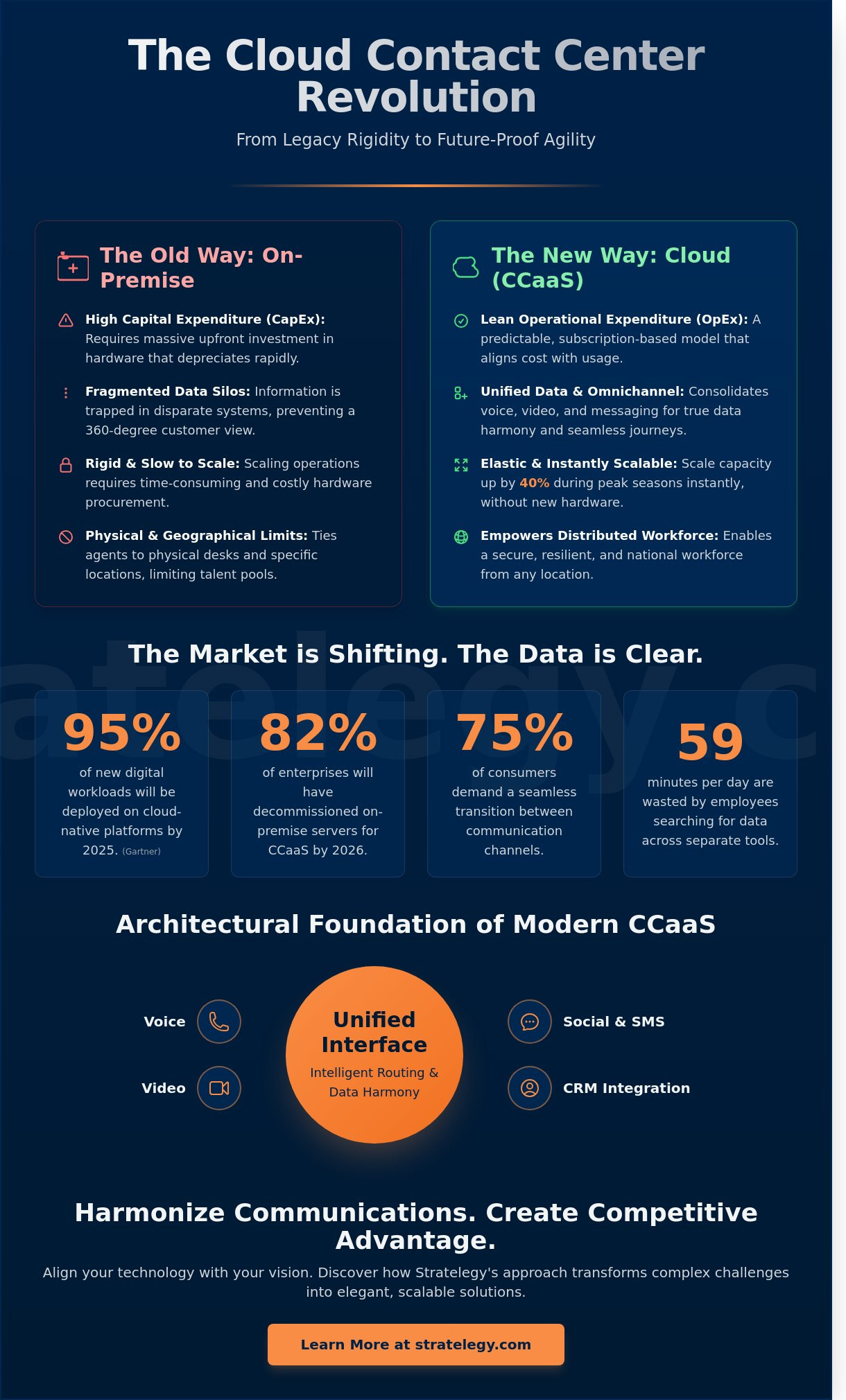
The hardware-heavy infrastructure that once signaled corporate permanence has become a silent architect of stagnation. By 2025, Gartner predicts that 95% of new digital workloads will be deployed on cloud-native platforms, leaving rigid legacy systems to face inevitable obsolescence. You’ve likely felt the friction of fragmented data silos and the mounting costs of maintaining iron that simply can’t scale. It’s frustrating when your technology dictates your strategy rather than enabling it. Transitioning to a modern cloud contact center is more than a shift in hosting. It’s a commitment to strategic alignment and operational harmony.
You deserve a unified ecosystem where communication flows without borders and your total cost of ownership actually retreats. This article reveals how cloud-based frameworks serve as the architectural foundation for transformative customer experiences as we approach 2026. We’ll examine the shift from high-maintenance silos to future-proofed scalability and show you how to empower a distributed, national workforce with a single, elegant solution.
Key Takeaways
- Explore the shift from restrictive on-premise hardware to cloud-native architectures designed for superior enterprise agility and scale.
- Learn to integrate voice, video, and social messaging into a singular, elegant interface that optimizes every customer interaction through intelligent routing.
- Understand how a modern cloud contact center acts as a catalyst for operational harmony while significantly reducing the total cost of ownership.
- Navigate the transition from aging POTS lines to resilient LTE connectivity to ensure your critical communication infrastructure remains secure and compliant.
- Master the strategic alignment of UCaaS and CCaaS to transform complex organizational challenges into a sophisticated, vision-led competitive advantage.
Defining the Cloud Contact Center Landscape in 2026
A cloud contact center represents a sophisticated, web-based ecosystem designed to orchestrate customer engagements across a tapestry of digital channels. Unlike the rigid silos of the past, these platforms leverage cloud-native architectures to provide the agility required for transformative growth. By 2026, the transition from legacy hardware has reached a critical inflection point, as 82% of national enterprises have decommissioned their physical server rooms in favor of Contact Center as a Service (CCaaS) models. This strategic alignment ensures 24/7 operational availability through high-speed LTE and fiber connectivity, effectively decoupling business continuity from localized hardware failures.
The role of the internet has shifted from a mere utility to the foundational backbone of the modern enterprise. National organizations now prioritize CCaaS as a core pillar of their digital transformation strategies. This isn’t merely about software; it’s about creating a refined framework where data flows without friction. The result is a resilient operation that maintains a premium service level regardless of geographical disruptions or sudden shifts in market demand.
The Shift from Call Hubs to Engagement Platforms
Modern platforms facilitate a holistic, omnichannel journey where text, video, and social messaging converge into a single interface. To understand this progression, one can examine the History of the Contact Center, which highlights the technological constraints that once tethered agents to physical desks. Today, cloud systems eliminate these brick-and-mortar boundaries. In this post-digital-first era, 75% of consumers demand a seamless transition between channels, making the legacy call hub a relic of the past.
Cloud vs. On-Premise: A Strategic Comparison
The financial architecture of customer service is undergoing a radical realignment. Legacy systems represent a heavy capital expenditure (CapEx) burden, requiring massive upfront investments in hardware that depreciates. Cloud solutions pivot this model toward operational efficiency (OpEx), allowing for a leaner, more responsive budget. Maintaining aging copper lines creates a reservoir of technical debt; it’s a risk to business continuity. Cloud-native platforms offer the scalability to expand national operations without the friction of hardware deployments, allowing businesses across the nation to scale capacity by 40% during peak seasons instantly.
The Architectural Foundations of Modern CCaaS Platforms
Modern business architecture requires more than functional tools. It demands a cohesive digital ecosystem where technology and strategy converge. The transition to a sophisticated cloud contact center isn’t just a technical upgrade; it’s a commitment to structural excellence. At the foundation of this transition lies the integration of voice, video, SMS, and social messaging into a single, unified interface. This design eliminates the friction of switching between disparate applications. A 2022 study by Qatalog and Cornell University found that workers waste 59 minutes every day simply searching for information across different tools. By consolidating these channels, Lake Mary service businesses can regain that lost productivity while maintaining a singular, elegant brand voice.
Intelligent routing serves as the cognitive engine of these platforms. It doesn’t merely distribute calls based on the next available person. Instead, it aligns complex customer requirements with the specific expertise of national agents through precision algorithms. This mechanism ensures that high-value inquiries reach the most qualified personnel instantly. The efficacy of this system relies on robust API integrations. These connections create a seamless flow of data between the contact center and CRM systems. When a call arrives, the agent doesn’t just see a phone number; they see a comprehensive history of the relationship, allowing for a more informed and professional interaction.
Omnichannel Orchestration and Data Harmony
True data harmony requires the total elimination of information silos. A 360-degree view of the customer journey allows agents to access historical context without delay. This context is vital for premium service. According to the 2023 Zendesk Customer Experience Trends Report, 70% of consumers expect anyone they interact with to have full access to their past purchases and interactions. Achieving this level of strategic alignment ensures that every digital and voice touchpoint feels like a continuation of a single, professional conversation.
Artificial Intelligence as a Strategic Partner
AI-driven intelligence acts as a silent, expert consultant during every interaction. Agent Assist AI provides real-time knowledge base suggestions and predictive responses. This capability can reduce trainee ramp-up time by 20% or more in complex service environments. Automated quality assurance monitors 100% of interactions for compliance and sentiment. This is a massive leap from the 1% to 2% manual review rate typical in legacy systems. Meanwhile, intelligent self-service tools resolve 40% of routine inquiries through sophisticated virtual assistants, allowing human agents to focus on complex, high-stakes problem solving.
Strategic Benefits: Transforming Engagement into Competitive Advantage
Transitioning to a cloud contact center represents more than a technical upgrade; it’s a strategic alignment of resources designed for the modern enterprise. Traditional Lake Mary firms often struggle with fragmented communication silos that hinder clear decision-making. Unifying these systems into a single cloud-native architecture creates a sense of operational harmony. This shift eliminates the exhausting cycle of on-site hardware maintenance and manual software patches. A 2023 McKinsey report indicates that cloud-based transitions can reduce IT overhead by 25% to 30% on average. This leaner structure lowers the Total Cost of Ownership by removing the need for periodic server refreshes. It replaces unpredictable capital expenditures with a stable, predictable operational model.
Security and accessibility are no longer mutually exclusive. Modern platforms offer secure, browser-based access protected by multi-factor authentication and enterprise-grade encryption. This allows a national remote workforce to operate with the same precision as an in-office team. Resilience is woven into the very fabric of the cloud. Providers typically offer a 99.99% uptime guarantee. This ensures that even during local Florida weather disruptions, service remains uninterrupted through geo-redundant data centers located across the country. Business continuity becomes a standard feature rather than a costly add-on.
Scalability and National Growth
Rapid expansion requires a framework that breathes with the market. Lake Mary enterprises can now deploy 50 new agent seats in under 48 hours without purchasing a single physical handset. This agility allows leadership to pilot new customer service strategies in emerging regions without heavy infrastructure risk. Centralized reporting provides a clear vision of performance across all time zones. It ensures that growth never compromises the elegance of the brand’s service delivery. A cloud contact center allows for a distributed team model that maintains strict centralized oversight.
Elevating the Agent and Customer Experience
Complexity is the primary driver of performance fatigue. Simplifying the technology stack reduces agent burnout by 15% according to recent industry benchmarks. Intelligent, skills-based routing ensures callers reach the most qualified expert immediately. This precision drives First Contact Resolution (FCR) rates higher; SQM Group data indicates every 1% improvement in FCR correlates with a 1% rise in customer satisfaction. Frictionless interactions build lasting brand loyalty through consistent, high-value engagement. By automating repetitive data entry tasks, agents can focus on the nuanced, human elements of problem-solving. This creates a more sophisticated interaction for both parties involved.
Navigating the Migration: From Legacy Infrastructure to Cloud Connectivity
The transition from legacy hardware to a modern cloud contact center represents a pivot from maintenance-heavy operations to strategic agility. It’s a journey that demands architectural precision. Lake Mary service providers often find themselves tethered to aging copper infrastructure that no longer meets the demands of a digital-first economy. In August 2022, the FCC’s shift in POTS regulations catalyzed a move toward more resilient, cost-effective alternatives. This migration isn’t merely a technical upgrade; it’s a transformative alignment of your communication framework with your long-term business vision. By replacing brittle systems with scalable cloud logic, organizations can achieve a level of operational harmony that was previously unattainable.
Critical Infrastructure and Life Safety Considerations
Replacing legacy POTS lines requires a nuanced understanding of life safety systems. Fire alarms, elevator phones, and security panels rely on the steady heartbeat of a dial tone. Modern LTE POTS replacement solutions bridge this gap, providing a cellular-backed connection that exceeds the reliability of aging copper. By deploying cellular routers, firms create a robust failover architecture. If the primary fiber line experiences a 15-minute outage, the LTE system takes over instantly; this ensures that E911 compliance and emergency connectivity remain uninterrupted. It’s about creating a safety net that operates silently in the background, maintaining 99.99% uptime for the most critical paths. Enterprises navigating this transition can benefit from a comprehensive POTS line replacement strategy that addresses both life-safety compliance and long-term cost reduction.
Securing the Enterprise Cloud
Data integrity is the cornerstone of a sophisticated cloud contact center. Transitioning to the cloud introduces new entry points that require rigorous defense mechanisms. Implementing end-to-end encryption ensures that customer interactions remain private from the moment a call is placed until the data is archived. For businesses in Lake Mary handling sensitive information, adhering to national standards like HIPAA, PCI-DSS, and SOC 2 is a baseline requirement. This same compliance imperative extends to document exchange; enterprises managing regulated records should explore virtual faxing solutions that provide encrypted, cloud-based document transmission as a secure alternative to legacy analog lines. Multi-factor authentication (MFA) adds another layer of protection, particularly for the 74% of agents who now work in remote or hybrid environments. This layered security posture transforms potential vulnerabilities into a fortified digital perimeter.
A successful migration follows a phased roadmap to prevent operational paralysis. It begins with a comprehensive audit of existing assets, followed by a pilot program that isolates specific departments for the initial rollout. This methodical approach allows for the calibration of workflows before a full-scale national deployment. It ensures that the transition is a source of growth rather than a cause of disruption. By moving in calculated stages, leadership can maintain oversight while the organization adapts to its new, more capable environment.
Prepare your business for a seamless transition and explore our custom migration frameworks to ensure zero downtime.
The Stratelegy Approach: Harmonizing Communications for National Enterprises
Stratelegy doesn’t simply provide tools; we engineer organizational harmony. For complex national enterprises, the divide between internal collaboration and external service often creates costly friction. We bridge this gap through the strategic alignment of UCaaS and CCaaS, ensuring your cloud contact center operates as a vital organ within your business ecosystem rather than a disconnected silo. Our methodology transforms communication from a utility into a competitive advantage.
Critical infrastructure requires modernization that matches your customer-facing innovations. By 2025, the sunsetting of traditional copper-based phone lines will reach a critical point for many American businesses. Our focus on LTE POTS replacement ensures that your life-safety systems, alarms, and elevators remain secure and compliant. We provide a tailored framework for transitioning from legacy systems to high-performance cloud ecosystems, minimizing risk while maximizing technical agility. Partnering with Stratelegy means choosing a future-proofed vision for your national communication strategy.
The Synergy of UCaaS and CCaaS
Unifying internal collaboration with external customer engagement creates a seamless flow of information. When your back-office specialists and front-line agents utilize a unified platform, the speed of resolution increases. We advocate for a single-vendor approach to communications because it reduces technical complexity and simplifies your support structure. This integration allows us to customize your communication stack to reflect your brand’s unique goals. Our design ensures that every interaction within your cloud contact center aligns with your broader corporate identity.
- Strategic consolidation of internal and external communication channels to eliminate data silos.
- Reduction of technical debt through single-platform management and streamlined vendor relations.
- Enhanced data visibility across all customer and employee touchpoints for better decision-making.
Your Journey Toward Transformative Growth
Success begins with a consultative assessment where we analyze your existing infrastructure and future vision. We don’t believe in generic deployments. Our expert implementation team guides your national team through a seamless cloud transition, ensuring zero downtime for critical operations. Research from Salesforce indicates that 73% of customers expect companies to understand their unique needs; our framework provides the data-driven insights necessary to meet that expectation at scale.
We facilitate continuous evolution, ensuring your systems adapt to the technological breakthroughs of 2026 and beyond. We move beyond data analysis to create a vision that turns operational chaos into structural elegance. Your growth isn’t just a goal; it’s the inevitable result of a well-designed communication architecture that prioritizes both the agent experience and the customer journey. By choosing Stratelegy, you’re investing in a partnership that values precision, strategy, and long-term excellence.
Mastering the Evolution of Enterprise Connectivity
The transition toward a 2026-ready communication model demands more than just incremental changes; it requires a deliberate alignment of technology and vision. Establishing a modern cloud contact center creates a resilient foundation where every interaction becomes a data-driven opportunity for growth. Industry research from Gartner indicates that 80% of customer service organizations will shift toward messaging-first strategies by 2025, making architectural agility a non-negotiable requirement for the coming decade. Stratelegy delivers the enterprise-grade UCaaS and CCaaS expertise needed to navigate this shift with precision. Our specialized LTE POTS replacement solutions protect critical infrastructure while our national service coverage maintains business-to-business excellence across the entire organization. We don’t just bridge the gap between legacy hardware and the cloud; we build the frameworks that turn complexity into a distinct competitive advantage. It’s time to move beyond fragmented systems toward a unified, elegant communication strategy. Discover how Stratelegy can transform your communication architecture today. Your future is waiting to be built on a foundation of clarity and performance.
Frequently Asked Questions
What is the primary difference between a cloud call center and a cloud contact center?
A cloud contact center manages omnichannel communication including SMS, chat, and social media, whereas a call center focuses exclusively on voice interactions. Research by Dimension Data shows that 71% of modern consumers expect consistent service across multiple digital touchpoints. This strategic alignment of channels ensures your Lake Mary business meets clients where they’re most comfortable. It transforms a simple phone line into a sophisticated engagement hub.
How does a cloud contact center integrate with my existing CRM system?
Integration happens through robust APIs that bridge your cloud contact center with CRM platforms like Salesforce and other leading enterprise solutions. This connection eliminates data silos and reduces manual entry tasks by 30% according to industry benchmarks. It allows for a tailored framework where customer history appears instantly as a call arrives. Your team gains the clarity needed to drive transformative growth through personalized service.
Can my business maintain its existing phone numbers when migrating to the cloud?
You’ll retain all existing phone numbers through the Local Number Portability (LNP) process mandated by the FCC. This transition ensures zero disruption to your established brand identity in the Lake Mary market. The migration process is seamless, as 100% of your current vanity or local numbers move to the new environment. It’s a critical step in maintaining the continuity your long-term clients expect.
What are the security standards for protecting customer data in a CCaaS environment?
Security is maintained through rigorous adherence to SOC 2 Type II, PCI DSS, and HIPAA compliance frameworks. These standards ensure that 100% of sensitive customer data remains encrypted both at rest and in transit. Leading providers invest billions in cybersecurity to prevent the data breaches that affected 45% of US companies in 2023. This creates a secure foundation for your digital operations.
How does cloud contact center software support a remote or hybrid workforce?
The software enables a remote workforce by providing secure, browser-based access to the full communication suite from any location. Since the infrastructure lives in the cloud, agents only need a 10 Mbps internet connection to maintain crystal-clear voice quality. This flexibility aligns with the 97% of employees who prefer remote work options according to Buffer’s 2023 report. It turns geographical constraints into a strategic advantage for talent acquisition.
What happens to my contact center if the primary internet connection goes down?
Calls automatically reroute to mobile apps or secondary locations if your primary internet connection fails. This failover logic ensures your business maintains its 99.99% uptime commitment regardless of local outages. Most Lake Mary service businesses utilize dual-WAN routers to provide an additional layer of redundancy. It’s a calculated approach to risk management that keeps your operations resilient and consistent.
Is a cloud contact center cost-effective for mid-market businesses?
Mid-market enterprises find a cloud contact center for mid-market operations highly cost-effective because it converts large capital expenditures into predictable operating expenses. Deloitte identifies that 70% of organizations achieve significant savings by eliminating on-premise hardware maintenance. You’ll avoid the costs of physical server rooms and specialized cooling systems. This financial efficiency allows for the strategic reallocation of resources toward core business development.
How long does it typically take to migrate from an on-premise system to the cloud?
Migration from a legacy on-premise system to the cloud typically requires 4 to 12 weeks for a full strategic deployment. This timeline accounts for data porting, agent training, and the configuration of custom workflows. Gartner indicates that businesses using a structured framework experience 25% faster implementations than those without a clear roadmap. We focus on a disciplined transition to ensure your operational harmony remains undisturbed.