
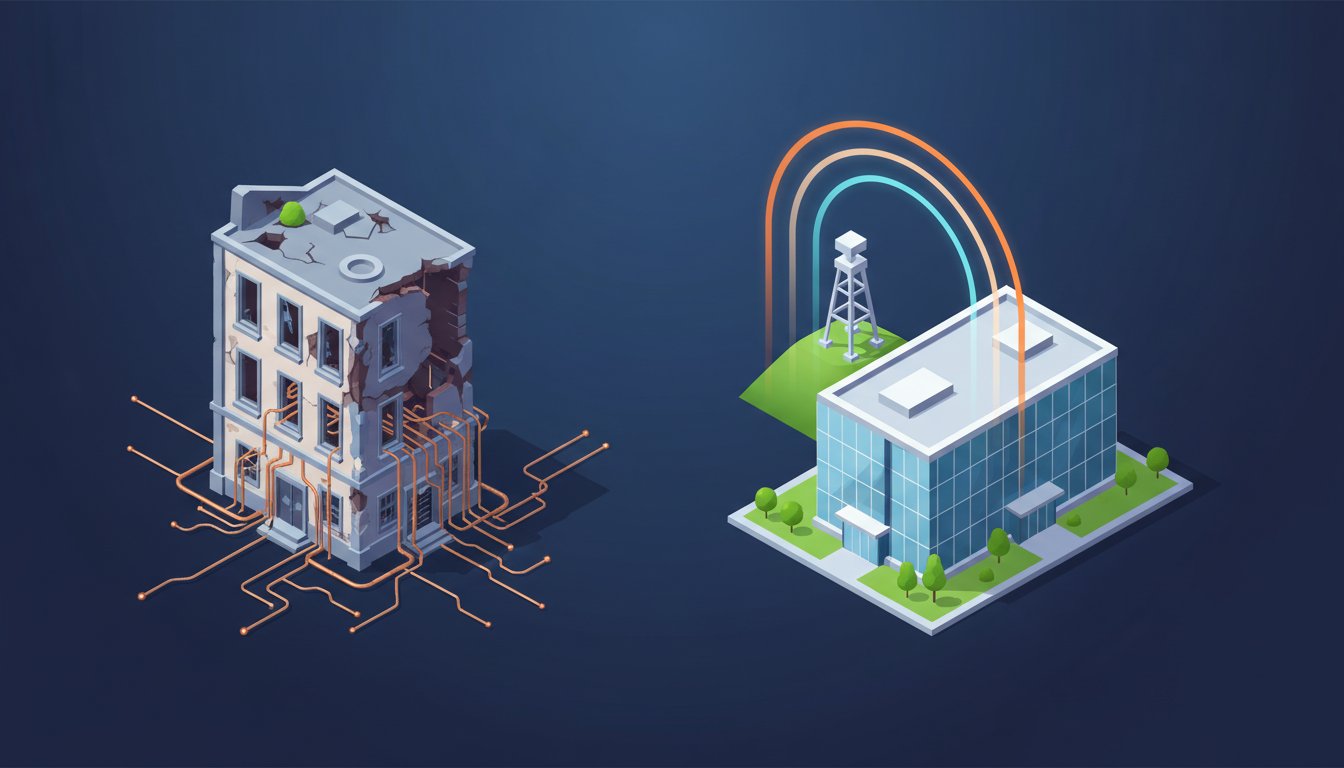
Since the FCC Order 19-72 took full effect on August 2, 2022, the era of predictable analog connectivity has vanished, leaving many enterprises tethered to a decaying infrastructure that now costs up to 450% more than it did just three years ago. You likely recognize that maintaining these aging circuits is no longer a matter of simple utility; it’s a growing risk to your operational integrity and a persistent drain on your strategic resources. It’s an exhausting cycle to find technicians who still understand the nuances of copper while fire marshals demand immediate modernization of your life-safety systems. This guide moves beyond the basic definition of what is a pots line to explore how you can achieve a sophisticated alignment between your safety requirements and modern connectivity. We’ll provide a refined roadmap to replace your legacy hardware with a tailored framework that ensures both resilience and cost-efficiency. You’ll gain the clarity needed to justify this transformative growth to your stakeholders while securing your most vital communication channels against future obsolescence.
Key Takeaways
- Gain a definitive understanding of what is a pots line and why its legacy architecture requires a sophisticated strategic alignment with modern digital standards.
- Decode the regulatory implications of the Copper Sunset and FCC Order 19-72 to safeguard your enterprise against the volatility of deregulated pricing and infrastructure phase-outs.
- Assess the operational risks inherent in legacy life-safety systems, such as fire alarms and elevators, to maintain uncompromising compliance and structural reliability.
- Explore the transformative potential of LTE-based solutions to bridge the gap between analog hardware and secure, high-performance cellular networks.
- Discover how to convert legacy constraints into a resilient, future-ready framework through precise signal conversion and strategic infrastructure modernization.
Defining the Plain Old Telephone Service (POTS) in a Modern Context
To accurately define what is a pots line, one must look beyond simple copper cabling and view it as the foundational architecture of global connectivity. This legacy infrastructure refers to the traditional analog voice transmission service that operates over twisted-pair copper wires. For over 140 years, this system has served as the bedrock of the Public Switched Telephone Network (PSTN), facilitating reliable communication through a series of physical switches and dedicated circuits. While the digital revolution has introduced sophisticated alternatives, the structural harmony of the original system remains a testament to 19th-century engineering durability.
By the year 2026, the industry consensus has shifted. The term Plain Old Telephone Service (POTS) is now frequently used to categorize any legacy copper-based connection facing inevitable obsolescence. These lines are characterized by their use of analog signaling, where sound waves are translated into electrical pulses. Unlike modern packet-switched networks, a POTS line requires a dedicated circuit to be maintained for the duration of a call, ensuring a consistent, albeit narrow, band of communication that is increasingly difficult to maintain in a software-defined world.
The Architecture of Analog Communication
The physical journey of an analog call begins with the local loop, a dedicated pair of copper wires that connects the subscriber’s premises directly to the service provider’s Central Office (CO). Within this framework, the system converts acoustic sound waves into fluctuating electrical signals. In most enterprise environments, this connection terminates at the ubiquitous RJ11 interface. This modular connector has remained the standard for decades, providing a simple, physical bridge between the complex PSTN and the end-user’s hardware. It’s a system that prioritizes physical continuity over digital flexibility, creating a direct link that bypasses the need for local data processing or complex networking protocols.
Why POTS Remained the Standard for Decades
The longevity of analog infrastructure isn’t accidental; it stems from a level of reliability that modern digital systems often struggle to replicate without significant redundancy. The primary strength of a POTS line is its unique power delivery system. Because the Central Office provides the necessary voltage directly through the copper wire, the telephone remains functional even during localized power outages. This “always-on” capability turned the system into a critical safety net for emergency services and fire alarm monitoring.
Simplicity and ubiquity further solidified its dominance. Organizations didn’t need to understand what is a pots line to benefit from its reach, as the massive global footprint of copper wiring established in the 20th century ensured connectivity in the most remote locations. The lack of complex networking requirements allowed for a “plug-and-play” experience long before the term existed. However, as maintenance costs for these aging copper networks rise and hardware manufacturers cease production of analog components, the strategic alignment of business operations must now pivot toward more sustainable, digital-first frameworks.
The Technical Mechanics of Copper-Based Connectivity
Understanding what is a pots line requires looking beneath the surface of modern connectivity to the physical copper pairs that once defined global communication. Unlike digital systems that translate voice into binary code, the Plain Old Telephone Service (POTS) utilizes analog signaling. This method represents sound through continuous physical quantities, specifically variations in electrical frequency and amplitude. It’s a system built on a foundational simplicity that modern digital frameworks have largely transcended, yet its technical nuances remain critical for legacy hardware.
The architecture relies on the “Tip and Ring” configuration, a technical standard originating from the early days of manual switchboards. The “Tip” is the ground side, while the “Ring” carries the negative 48V DC power from the provider’s central office. This local power source is a hallmark of the system. It ensures that critical communication remains functional during local power outages, a level of reliability that 70% of emergency infrastructure still depends upon today. However, this power is only sufficient for low-voltage tasks, leaving the system incapable of supporting the power-hungry demands of modern networking equipment.
Analog Signaling vs. Digital Packets
The fundamental difference between legacy copper and modern IP networks lies in how they handle data transmission. POTS operates on circuit-switching, where a dedicated physical path is established for the duration of a call. This creates an environment with nearly zero jitter and minimal latency. But it’s structurally limited. These copper loops are restricted to a narrow 4kHz bandwidth, a ceiling designed specifically for voice-grade service. While sufficient for human speech, this 4kHz limit makes the system incompatible with the high-speed data requirements of modern enterprise operations. Digital packets, by contrast, offer scalability but require robust conversion processes to interface with these legacy analog loops.
The Central Office and the “Last Mile” Challenge
The logistical reality of the “Last Mile” represents the final physical connection from the service provider to the building. Signal quality in this segment is governed by physics; the further a building sits from the Central Office, the more the signal attenuates. By the time a signal travels three miles, data speeds and voice clarity often drop by 15% or more. This degradation is a primary reason why what is a pots line has become a question of distance as much as technology.
Maintaining this aging grid has become a strategic liability. Carriers are rapidly pivoting away from copper, a shift accelerated by the August 2019 FCC order on POTS phase-out. This regulatory milestone granted providers relief from outdated requirements to maintain these burdensome analog paths. As a result, the cost of upkeep for these lines has increased by as much as 300% in some regions since 2020, forcing organizations to seek more sustainable, digital-first frameworks.
The Copper Sunset: Navigating the Phase-Out of Legacy Lines
The “Copper Sunset” represents a calculated, industry-wide decommissioning of the infrastructure that defined 20th-century communication. Major carriers are aggressively pivoting toward fiber-optic and LTE alternatives, leaving analog systems behind. This transition reached a critical inflection point with FCC Order 19-72. This regulation, finalized in August 2019, effectively ended the requirement for carriers to offer analog services at capped, regulated rates. By removing these price protections, the FCC signaled that the era of government-mandated legacy support has ended.
Maintaining a century-old network is no longer economically viable for providers. Carriers face mounting costs to power and repair deteriorating copper lines. AT&T plans to discontinue traditional landline phone service by 2029, and the broader phase-out horizon stretches toward that same deadline across the industry. For any executive asking what is a pots line in a modern context, the answer is increasingly “a strategic liability.” The sunset is not a suggestion; it’s a scheduled obsolescence of the physical wires that once powered global commerce.
Deregulation and the Rise of “POTS Tax”
Carriers now use aggressive pricing as a primary tool to force migration. Since the 2019 deregulation, enterprise customers have seen monthly rates for single analog lines jump from $50 to $250, or even $600 in specific metropolitan regions. This 300% to 500% increase acts as a “POTS Tax.” It’s designed to make legacy infrastructure financially untenable. Relying on these lines creates a volatile budget environment where costs escalate without warning. Maintaining these connections is no longer a matter of simple utility; it’s a strategic financial risk that drains resources away from digital transformation initiatives. Enterprises seeking to convert this financial burden into a managed asset should explore a structured pots line replacement strategy for modernizing enterprise infrastructure in 2026, which outlines how to achieve a 30% reduction in operational overhead through deliberate migration planning.
Declining Reliability of Aging Infrastructure
Physical decay is inevitable, and the consequences are becoming more frequent. Buried copper loops suffer from moisture ingress and oxidation, leading to persistent static and sudden outages. This environmental degradation is compounded by a widening skill gap. Most technicians who understand 40-year-old analog switches are reaching retirement age. New hires are trained in IP networking and fiber optics, not copper splicing. Proactive migration is the only way to avoid catastrophic failure. Waiting for the infrastructure to fail before acting isn’t just risky; it’s a failure of strategic foresight. Modern business continuity demands a transition to more resilient, software-defined alternatives before the last copper switch goes dark.
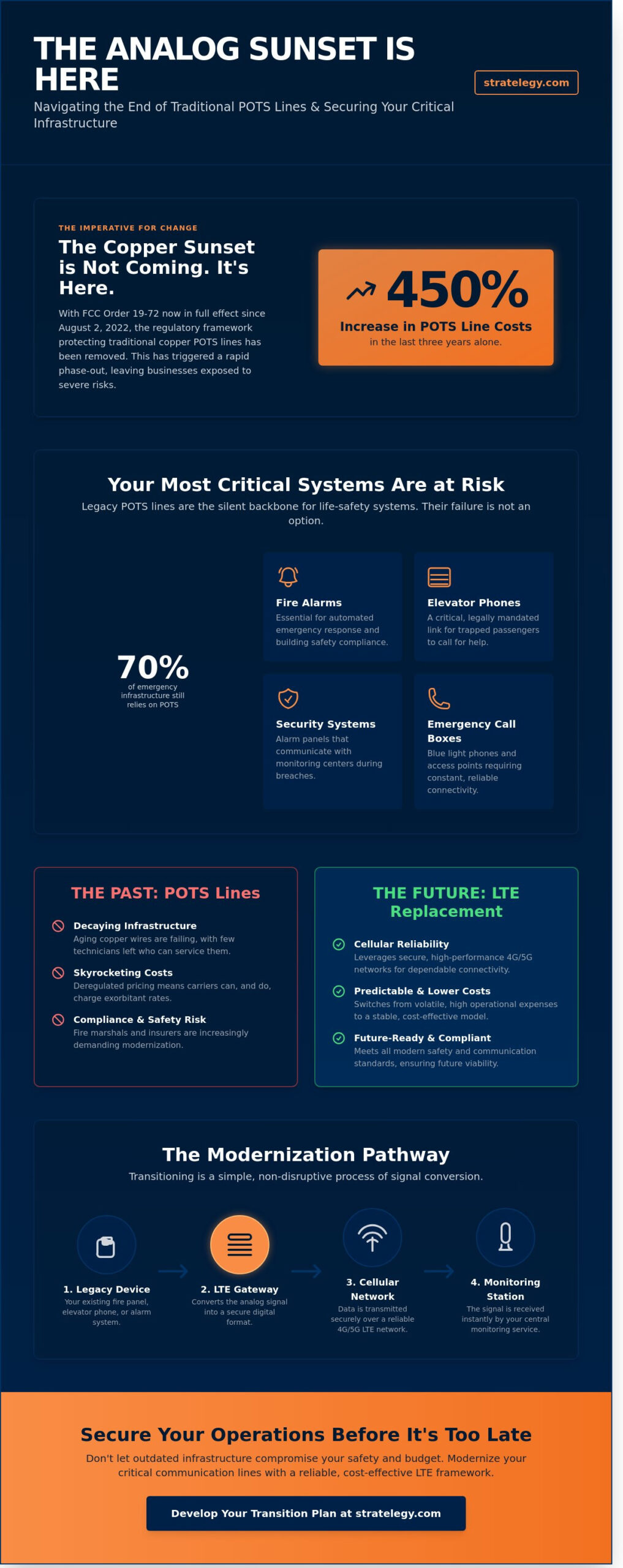
Critical Infrastructure Risks: Fire Alarms, Elevators, and Life Safety
In the architecture of modern enterprise, certain systems exist in the background until a crisis demands their absolute performance. Many organizations continue to utilize legacy copper because understanding what is a pots line involves recognizing its role as the bedrock of life safety infrastructure. Fire alarm panels, elevator emergency phones, and security systems weren’t designed for the packet-switched nature of the modern internet. They were built for the consistent, 48-volt DC power and analog signaling of the public switched telephone network. This specialized electrical environment provides a level of reliability that standard digital alternatives struggle to replicate without specific engineering.
According to the NFPA 72 National Fire Alarm and Signaling Code, fire panels must maintain constant communication with monitoring centers. If a building transitions to a standard digital line without the proper interface, it risks failing these 2022 edition requirements. The primary concern is the transmission of life-saving data. Traditional panels use Contact ID or SIA protocols that require a stable, uncompressed path. When these signals encounter modern network jitter, the message often fails to reach emergency responders. This isn’t merely a technical glitch; it’s a fundamental break in the safety chain.
Why Standard VoIP Fails Critical Safety Standards
Standard VoIP services rely on the building’s local power and internet gateway. If the power cuts, the emergency phone goes silent. This violates ASME A17.1 safety codes for elevators, which require a dedicated means of communication that remains operational during a power failure for at least four hours. Digital codecs often compress audio signals to save bandwidth. While this works for human speech, it distorts the modem tones used by older fire panels. This distortion results in failed signals and delayed responses. A strategic transition requires hardware that mimics the electrical characteristics of a traditional line while providing modern backhaul. It’s about maintaining the integrity of the signal from the device to the monitoring station. Facility managers navigating these requirements should review the full compliance framework outlined in this guide to LTE POTS replacement for fire alarms, which details how to harmonize NFPA 72 and UL 864 standards with modern cellular infrastructure.
Legal and Operational Liability
The transition away from legacy copper isn’t just a technical hurdle; it’s a matter of legal exposure. Insurance providers often stipulate that life safety systems must meet specific UL listings. If a fire occurs and the alarm system fails because of an uncertified connection, the liability can be catastrophic for the building owner. In 2021, many jurisdictions began enforcing stricter oversight on how emergency lines are transitioned to ensure no loss of life occurs due to technical incompatibility. Stratelegy provides the specialized hardware and managed connectivity required to bridge this gap. We ensure your team understands what is a pots line replacement strategy entails to keep your infrastructure compliant with both local building codes and national safety standards.
Transitioning to Resilience with LTE POTS Replacement
The sunset of traditional copper infrastructure isn’t merely a technical hurdle; it’s a strategic catalyst for organizational evolution. Understanding what is a pots line in the modern era requires looking beyond the physical wire toward LTE POTS replacement, frequently identified as “POTS in a Box.” This solution functions as a sophisticated bridge, meticulously converting legacy analog signals into digital packets for secure transmission over encrypted cellular networks. It replaces the inherent fragility of aging physical wires with the precision of software-defined connectivity, ensuring that your legacy hardware remains relevant in a digital-first environment.
Legacy systems often incur unpredictable maintenance costs and escalating service fees. Following the 2019 FCC order that relieved carriers of the obligation to maintain copper lines, monthly costs for legacy circuits have surged by 200% to 500% in many regions. Transitioning to LTE provides immediate cost stability and predictable operational expenditures. It transforms a decaying liability into a managed asset. This strategic alignment ensures that infrastructure modernization supports, rather than hinders, long-term enterprise growth. It creates a structural foundation where communication is both seamless and scalable.
Cellular-Based Connectivity for Life Safety
Resilience defines the modern enterprise, particularly regarding critical safety systems. LTE replacement units prioritize life safety through integrated internal battery backups, typically providing 12 to 24 hours of operation during total power failures. While a traditional answer to what is a pots line involves vulnerability to local cable cuts or central office outages, LTE solutions utilize multi-carrier redundancy. If one cellular provider experiences downtime, the system automatically switches to an alternate carrier like Verizon or AT&T. This shift from reactive repair cycles to proactive remote monitoring ensures that elevator, fire, and security lines remain operational without manual intervention or onsite inspections. Organizations seeking a comprehensive 2026-ready strategy for these systems can find detailed guidance in this strategic guide to LTE POTS replacement for fire alarms and critical infrastructure modernization.
The Stratelegy Approach to Modernization
Stratelegy delivers a tailored framework designed to transition critical fire, security, and elevator lines with surgical precision. We replace fragmented legacy systems with a single, managed platform that harmonizes all enterprise communication needs under one pane of glass. This isn’t just about hardware; it’s about creating structural harmony within your digital environment. Our methodology ensures that every connection serves a specific purpose and every byte contributes to transformative growth. By centralizing management and diagnostics, we move your organization away from the chaos of legacy maintenance toward a future of elegant, reliable operation.
Modernize your critical infrastructure with Stratelegy’s LTE solutions and secure the future of your business communications today.
Securing Your Infrastructure Beyond the Copper Sunset
Understanding what is a pots line is no longer just a technical exercise; it’s a matter of operational continuity. As the FCC Order 19-72 accelerates the decommissioning of legacy networks, maintaining safety systems like fire alarms and elevator phones requires a swift shift from aging copper to resilient digital frameworks. Transitioning isn’t simply about replacing a wire. It’s about aligning your facility with modern NFPA 72 standards while ensuring enterprise-grade reliability through multi-carrier redundancy.
Stratelegy provides the bridge between legacy limitations and future-proof reliability. Our specialized LTE solutions are engineered specifically for life safety applications, ensuring every signal reaches its destination without the vulnerabilities of decaying infrastructure. We provide a compliance-first framework that harmonizes building codes with sophisticated performance. Your path to a more resilient and sophisticated connectivity model starts with a single strategic choice today.
Consult with a Stratelegy expert on your POTS replacement strategy to transform your legacy risks into a foundation of structural harmony.
Frequently Asked Questions
Is a POTS line the same as a landline?
A POTS line is a specific type of landline that utilizes analog signals over copper wiring, representing the foundational technology of the 20th century public switched telephone network. While many people use these terms interchangeably, modern landlines often utilize digital or fiber optic connections. Understanding what is a pots line requires recognizing its reliance on physical copper loops that provide their own power, a feature that distinguishes it from newer, broadband dependent alternatives.
Why are POTS lines being discontinued by major carriers?
Major carriers are phasing out these services because maintaining a century old copper infrastructure isn’t economically viable compared to modern fiber and wireless alternatives. The FCC reported in 2019 that maintenance costs for legacy networks were rising while the user base declined by over 70% between 2010 and 2020. This shift allows providers to achieve strategic alignment with digital first infrastructure, reducing operational overhead and focusing resources on 5G and high speed data networks.
Can I use a standard VoIP line for my fire alarm system?
You can’t use a standard VoIP line for fire alarm systems because most residential grade VoIP services fail to meet the NFPA 72 signaling requirements for reliability and power redundancy. Standard internet connections often lack the 24 hour battery backup and dedicated transmission paths mandated by fire marshals. To ensure safety and compliance, businesses must utilize specialized LTE-M or Managed Facilities-Based Voice Over IP solutions that provide a secure, supervised connection to monitoring centers.
How much does it cost to replace a POTS line with LTE?
Transitioning to an LTE replacement typically reduces monthly recurring charges by 30% to 60% compared to the escalating rates of traditional copper lines. Industry reports from 2023 indicate that legacy copper lines now cost between $100 and $250 per month in many markets, while LTE based alternatives often stabilize costs at a lower, predictable price point. This transition offers a clear path to transformative growth by converting a rising utility expense into a manageable, fixed cost.
What is FCC Order 19-72 and how does it affect my business?
FCC Order 19-72, issued on August 2, 2019, granted price cap carriers relief from the obligation to offer analog voice services at regulated rates. This regulatory shift means carriers can now increase prices or discontinue copper services with minimal notice, directly impacting your operational budget. Businesses must develop a tailored framework for migration to avoid sudden service termination or the 500% price hikes observed in some metropolitan areas since the order’s implementation.
Will my legacy fax machine work with an LTE POTS replacement?
Your legacy fax machine will function with an LTE replacement provided the solution includes an Analog Telephone Adapter that supports the T.38 protocol. This technology converts analog signals into data packets while maintaining the precise timing required for successful transmissions. It’s a refined solution that bridges the gap between 1980s hardware and modern cellular networks, ensuring your existing equipment remains a functional part of your strategic infrastructure without requiring a total hardware overhaul.
What happens to my elevator phone during a power outage if I switch from POTS?
An elevator phone remains operational during a power outage if the LTE gateway is equipped with a battery backup that meets ASME A17.1 safety standards. Most professional grade replacement units provide 12 to 24 hours of standby power, ensuring the emergency line stays active even when the building’s main power fails. This creates a resilient environment where safety isn’t compromised by the transition away from the self powered nature of a traditional copper connection.
How long does the transition from copper to LTE typically take?
A standard transition from copper to LTE typically requires 14 to 30 days from the initial site audit to final activation. The process involves a strategic assessment of signal strength, hardware installation, and the porting of existing phone numbers to the new digital platform. By following a structured deployment schedule, businesses can eliminate the risks associated with legacy infrastructure failure while achieving a seamless integration of modern wireless connectivity into their daily operations.