
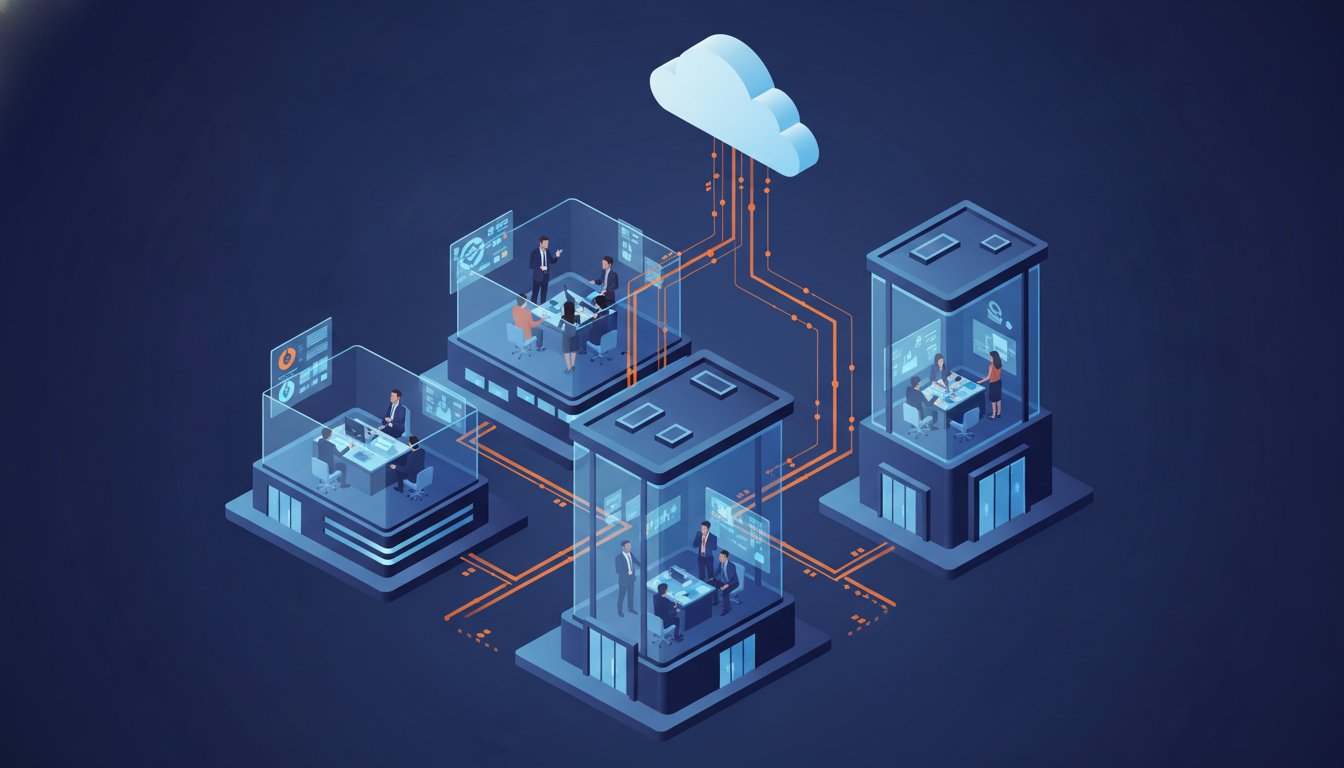
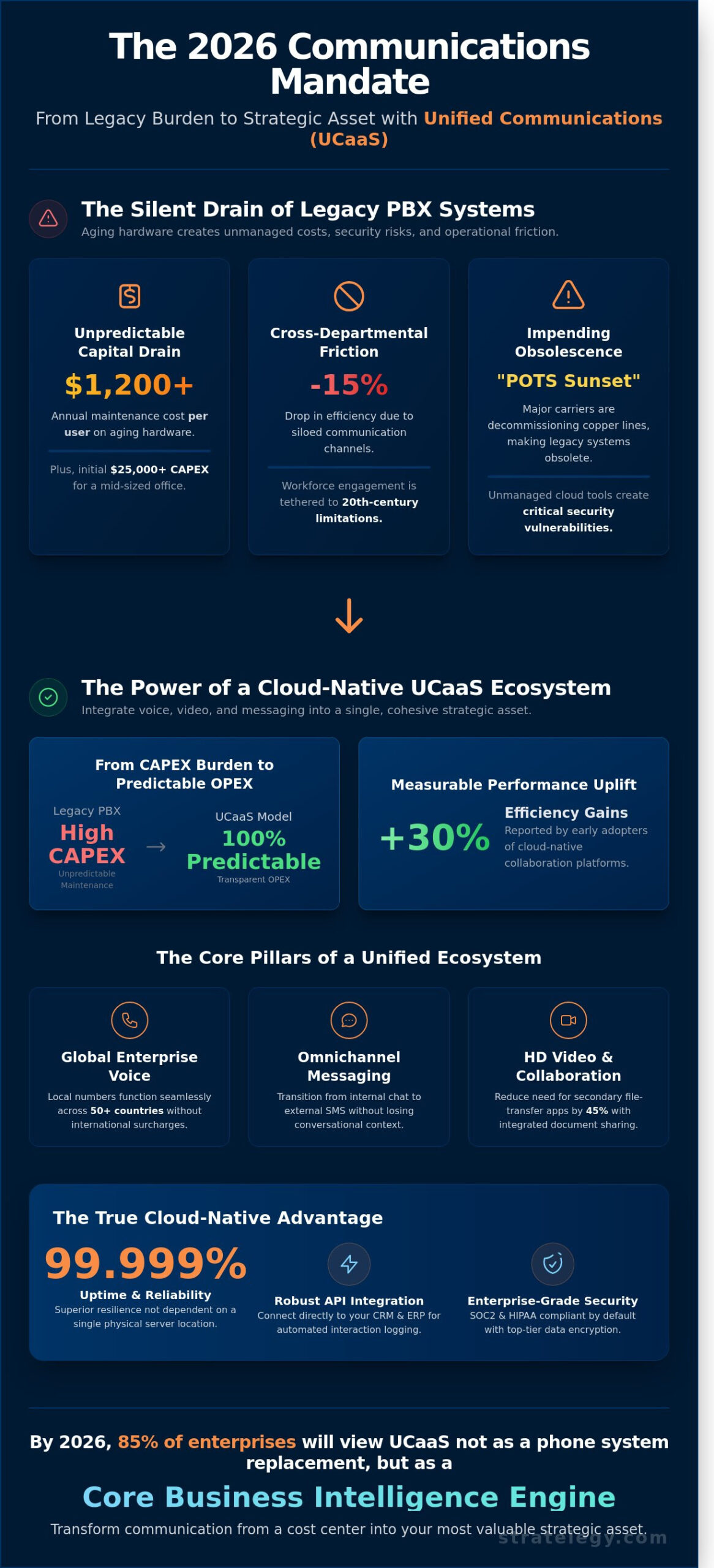
The legacy PBX sitting in your server room isn’t just a relic; it’s a silent drain on your capital, with unmanaged communication silos now accounting for a 15% drop in cross-departmental efficiency. By 2026, the distinction between high-performing enterprises and stagnant ones will rest entirely on their ability to transition toward a seamless unified communications as a service model. You likely feel the friction of spending over $1,200 annually per user to maintain aging hardware while your team’s security is compromised by unmanaged cloud tools. It’s a common frustration to see operational costs climb while workforce engagement remains tethered to 20th-century limitations.
You deserve a communication architecture that reflects the sophistication of your business strategy rather than one that complicates it. This framework promises to guide you through the transition from fragmented legacy systems to a cloud-native ecosystem designed for total enterprise resilience. We’ll examine the precise steps to eliminate hardware maintenance costs and establish a streamlined, scalable workflow that fosters genuine collaboration across your entire global footprint. By aligning your technology with a clear vision, you’ll transform communication from a cost center into a strategic asset.
Key Takeaways
- Transition from fragmented legacy hardware to a cloud-native ecosystem that integrates voice, video, and messaging into a single, cohesive strategic asset.
- Leverage AI-driven insights to transform your communication tools into a business intelligence engine that ensures perfect alignment with organizational objectives.
- Distinguish between internal collaboration and customer engagement models to architect a customized communication stack that balances efficiency with technical elegance.
- Secure your infrastructure against the “POTS Sunset” by identifying critical vulnerabilities in legacy lines and implementing a resilient transition framework.
- Master the deployment of unified communications as a service to bridge the gap between visionary strategy and high-performance operational execution.
What is Unified Communications as a Service (UCaaS)?
Strategic clarity begins with the consolidation of fragmented tools into a single, cohesive architecture. For Rochester organizations, unified communications as a service represents more than a software upgrade; it’s a fundamental shift in how human capital interacts with technology. By 2026, the reliance on disparate systems has become a liability that drains productivity and obscures operational visibility. UCaaS provides a cloud-native framework that integrates enterprise voice, high-definition video conferencing, and real-time messaging into a centralized environment. This model is built upon the broader principles of Unified Communications (UC), yet it adds the agility of the cloud to ensure that scaling is a matter of configuration rather than construction.
The transition from legacy on-premise Private Branch Exchange (PBX) systems to the cloud redefines the financial structure of IT departments. Traditional hardware requires a heavy upfront CAPEX, often exceeding $25,000 for a mid-sized office, followed by unpredictable maintenance cycles. In contrast, the “as a service” model shifts these costs to a transparent OPEX structure. This allows leaders to predict expenses with 100% accuracy, allocating capital toward transformative growth rather than depreciating hardware. It’s a move from ownership of hardware to the orchestration of outcomes. For a deeper exploration of what is UCaaS and how it redefines enterprise communication strategy, our comprehensive 2026 guide provides the architectural framework your leadership team needs.
Legacy infrastructure isn’t just outdated; it’s a barrier to entry in a competitive market. By January 2026, major carriers have accelerated the decommissioning of copper-based PSTN lines, making legacy systems functionally obsolete and expensive to bridge. Businesses that fail to migrate risk losing the 30% efficiency gains reported by early adopters of cloud-native collaboration. The 2026 imperative is clear: agility is the only viable baseline for a modern enterprise.
The Core Pillars of a Unified Ecosystem
Enterprise voice remains the foundation of professional presence, but it’s now evolved beyond simple VoIP into a global telephony network built for modern enterprise demands. Modern unified communications as a service platforms ensure that a Rochester local number functions seamlessly across 50 countries without international surcharges. Omnichannel messaging allows teams to transition from an internal chat to an external SMS without losing the conversation’s context. High-definition video and collaboration tools complete the ecosystem, providing integrated document sharing that reduces the need for secondary file-transfer applications by 45%.
The Technological Shift: Cloud-Native vs. Hosted
True cloud-native architecture offers superior uptime, often reaching 99.999% reliability, because it doesn’t rely on a single physical server location. Unlike “hosted” solutions, which are merely old software moved to someone else’s data center, cloud-native UCaaS is built for the internet. This structure uses robust APIs to connect your communications directly to your CRM or ERP, ensuring that every customer interaction is logged automatically. Security is no longer a localized concern; these platforms meet SOC2 and HIPAA standards by default, protecting data with encryption levels that were once reserved for global financial institutions.
The Anatomy of a 2026 UCaaS Strategy
A successful deployment requires more than a simple software license; it demands a structured harmony between technical capabilities and operational objectives. The architecture of communication is effectively the architecture of the business itself. As Gartner defines UCaaS, these platforms must integrate multiple communication channels into a single, cloud-based experience that facilitates seamless interaction. By 2026, 85% of Rochester-based enterprises will view unified communications as a service not as a legacy phone system replacement, but as a core business intelligence engine. This strategic alignment ensures that every digital interaction feeds back into the organization’s broader growth trajectory, turning passive data into a roadmap for transformative growth.
Strategic alignment involves a deliberate mapping of communication features to specific departmental KPIs. For a Rochester manufacturing firm, this might mean integrating voice data with ERP systems to track order fulfillment speed. For a professional services firm, it involves linking video conferencing metrics to client retention data. When tools and goals are synchronized, the resulting clarity eliminates the friction often found in fragmented technical environments. This level of structural harmony is what separates an average implementation from a truly sophisticated business asset. Organizations seeking to deepen this alignment will find that a thorough understanding of unified communications and collaboration as a cohesive strategic framework is essential to maximizing the return on every technology investment.
AI-Enhanced Workflows
Modern unified communications as a service platforms utilize machine learning to distill vast amounts of conversational data into actionable intelligence. Real-time transcription now achieves 98% accuracy, allowing leaders to focus on the nuance of a discussion rather than manual note-taking. Sentiment analysis identifies friction points in client calls before they escalate, providing a proactive layer of quality control. Automated meeting summaries and action-item tracking ensure that no strategic detail is lost in the transition from discussion to execution. AI-driven Agent Assist acts as a cognitive bridge between internal UCaaS intelligence and external customer experience by delivering real-time guidance to front-line staff.
The Network Infrastructure Backbone
A distributed, remote-first workforce requires a resilient foundation that transcends the limitations of standard residential internet. SD-WAN technology plays a vital role here by prioritizing voice and video packets over less critical background traffic; this ensures that remote Rochester employees maintain crystal-clear connectivity regardless of local bandwidth fluctuations. Redundancy is no longer an optional luxury. Achieving 99.999% uptime requires a multi-layered approach where the network can heal itself in real-time. Enterprise-grade cellular routers serve as the final line of defense, providing automatic failover to 5G networks during primary fiber outages. This level of structural integrity prevents the costly downtime that, as of 2025, averages $5,600 per minute for mid-sized firms.
User experience determines the ultimate success of any digital transformation. In 2026, the convergence of UX and employee engagement is absolute. Systems that feel intuitive and responsive reduce cognitive load, leading to a measured 25% increase in productivity for hybrid teams. When communication tools are elegant and reliable, they foster a culture of effortless collaboration rather than technical frustration. If you’re ready to design a communication architecture that reflects this level of sophistication, our team can help you build custom UCaaS frameworks tailored to your specific operational needs. High-performance teams deserve tools that match their ambition, and a well-designed UCaaS strategy provides exactly that.
Strategic Differentiation: UCaaS vs. CCaaS vs. CPaaS
Success in the Rochester market requires more than just connectivity; it demands a precise architectural alignment of communication tools. By 2026, the boundary between internal collaboration and customer interaction has blurred, yet the technical frameworks remain distinct. Unified communications as a service serves as the central nervous system for internal operations, facilitating seamless dialogue across distributed teams via voice, video, and messaging. Conversely, Contact Center as a Service (CCaaS) governs the external perimeter, managing complex customer journeys through AI-driven routing and omnichannel support. Organizations that fail to distinguish these roles often face operational friction, while those that synchronize them achieve a state of Total Experience (TX).
The latest UCaaS market trends indicate that 68% of high-growth enterprises now prioritize providers offering a converged UC and CC stack. This shift isn’t merely a technical preference; it’s a strategic mandate. For a mid-sized manufacturing firm in the Finger Lakes region, UCaaS might resolve internal supply chain bottlenecks, whereas CCaaS manages the high-volume inquiries from global distributors. The differentiation lies in the intent: one fosters team synergy, the other optimizes the client lifecycle. Strategic leaders recognize that while the tools differ, the data they generate must remain unified to drive transformative growth. Selecting from the elite UCaaS providers of 2026 requires this same level of strategic discernment to ensure your chosen platform delivers genuine architectural integrity rather than a simple feature checklist.
When to Integrate UCaaS and CCaaS
True operational elegance emerges when front-office agents and back-office subject matter experts inhabit the same digital environment. Adopting a single-pane-of-glass interface eliminates the cognitive load of switching between disparate applications. Statistics from 2025 deployments show that businesses integrating these platforms see a 14% improvement in Net Promoter Scores (NPS). This happens because agents can instantly consult internal experts via unified communications as a service tools to resolve complex queries in real-time. Consolidating these services also mitigates vendor sprawl; it typically reduces administrative overhead by approximately 22% for local IT departments.
The Role of CPaaS in Customization
Communication Platform as a Service (CPaaS) represents the artisan layer of digital transformation. It allows Rochester businesses to move beyond off-the-shelf limitations by using APIs to embed specific functions into proprietary software. By early 2026, 45% of non-technical department managers are expected to utilize low-code triggers to automate workflows without deep engineering support. Practical applications are already surfacing in the local market:
- Healthcare: Automated SMS appointment reminders triggered directly from patient management databases.
- Legal Services: Secure, cloud-based virtual faxing integrated into case management software to maintain 2026 compliance standards.
- Logistics: Real-time delivery alerts sent via WhatsApp or SMS based on geolocation triggers.
This level of customization ensures that the technology bends to the business process, not the other way around. It’s a move toward a more harmonized and responsive business model. Choosing between these models depends on the complexity of your client interactions. A professional services firm may only need the internal strength of UCaaS, while a retail operation with high call volumes requires the robust external capabilities of CCaaS, potentially augmented by a cloud contact center strategy for custom text-based marketing.
The 2026 Transition Framework: From Legacy to Cloud
Transitioning to unified communications as a service is no longer a simple IT upgrade; it’s a strategic realignment of your organization’s intellectual capital. By 2026, the financial burden of maintaining fragmented legacy systems in Rochester will become unsustainable. Organizations that fail to migrate face a 40% increase in maintenance costs compared to cloud-native peers. A disciplined, five-step framework ensures this transition remains an asset rather than a liability.
- Step 1: Comprehensive Audit. You must catalog every communication silo and piece of legacy hardware. This includes identifying underutilized desk phones and disparate messaging apps that create data blind spots.
- Step 2: POTS Inventory. Identify every critical analog line. Fire alarms, elevator phones, and security systems often hide on aging copper wires that providers are no longer required to maintain.
- Step 3: Persona Mapping. Define specific feature sets for different departments. A warehouse manager in a Rochester distribution center requires different mobile capabilities than a remote analyst based in Lake Mary.
- Step 4: Phased Migration. Execute the rollout in waves. Start with non-critical departments to refine the configuration before moving to high-stakes environments like customer support centers.
- Step 5: Analytical Optimization. Use real-time usage data to identify adoption gaps. If 60% of your staff ignores the video conferencing suite, you need to address training deficiencies immediately.
Modernizing Critical Infrastructure
The “POTS Sunset” is a mathematical certainty. Since 2019, the cost of traditional analog lines has surged by 450% as carriers prioritize fiber and LTE. For Rochester businesses, “POTS in a Box” solutions provide the necessary bridge. These devices convert analog signals from fire alarms and emergency phones into cellular data. This ensures life-safety compliance remains intact while eliminating the high costs of decaying copper infrastructure. You cannot compromise on safety; you must modernize the delivery mechanism.
Overcoming Adoption Barriers
The primary hurdle isn’t the technology; it’s the cultural attachment to the desk phone. In 2026, the softphone is the primary interface for high-growth enterprises. Managing this shift requires a robust change management plan that highlights the flexibility of hybrid work. Whether your team is collaborating across Rochester or coordinating with partners in Lake Mary, the experience must be seamless. Successful adoption relies on demonstrating how these tools reduce friction rather than just adding another application to the desktop.
Effective strategy transforms technical complexity into operational elegance. If your current infrastructure feels like a collection of disparate parts, it’s time to build a cohesive vision. Partner with Stratelegy to design your transition framework and secure your organization’s future connectivity.
Data from the 2025 Communications Benchmark Report indicates that firms utilizing continuous training see a 22% higher ROI on their cloud investments within the first 12 months. This isn’t a “set it and forget it” implementation. It’s an evolution of how your business speaks to the world. By focusing on usage analytics, you can pivot your strategy based on how your employees actually work, not how you assume they work. This data-driven approach removes the guesswork from your digital transformation.
Stratelegy: Elevating Your Communication Architecture
Stratelegy operates at the precise intersection of intellectual rigor and technical elegance. We don’t view unified communications as a service as a mere software subscription; we treat it as the foundational architecture of your modern enterprise. While many vendors focus on feature lists, we prioritize the strategic alignment of your technology with your long-term vision. Our frameworks replace the chaotic, fragmented systems that hinder 68% of mid-market firms with a streamlined, aesthetic operation. We’ve built our reputation on the belief that true business success is not just about efficiency. It’s about structural harmony and the ability to scale without friction.
Our approach centers on creating a bridge between sophisticated business strategy and the technical reality of your daily operations. We understand that a Rochester law firm or a regional healthcare provider needs more than a generic dial tone. They need a system that anticipates growth and mitigates risk. By choosing a partnership-first model, we move away from the “one-size-fits-all” trap. Instead, we deliver custom-engineered environments where every digital touchpoint serves a specific purpose. It’s a commitment to transformative growth that goes beyond simple connectivity.
Why Stratelegy for Enterprise UCaaS?
Stratelegy provides a unique combination of unified communications as a service expertise and critical life-safety infrastructure management. Since the FCC Order 19-72 implementation in August 2022, the cost of maintaining traditional copper lines has surged by over 300% for many New York businesses. We specialize in LTE POTS replacement, ensuring that your elevators, fire panels, and emergency lines remain compliant while you modernize your core communication stack. With a localized presence in Rochester, NY, and Lake Mary, FL, we offer national reach with the high-touch service of a boutique consultancy. Our team doesn’t just analyze data; we create visions that turn technical debt into strategic assets.
- Deep Technical Precision: We manage the complex transition from legacy hardware to cloud-native environments with zero downtime.
- Localized Authority: Our Rochester-based experts understand the specific regulatory and economic environment of the Finger Lakes region.
- Life-Safety Focus: We’re one of the few providers capable of integrating critical emergency infrastructure into a modern digital framework.
Taking the Next Strategic Step
The transition from “copper to cloud” is a journey that requires a visionary guide. Stratelegy simplifies this complex migration by conducting a comprehensive audit of your existing communication environment. We’ve seen Rochester organizations achieve a 42% reduction in operational overhead by consolidating disparate vendors into a single, cohesive architecture. This isn’t just about saving money; it’s about reclaiming the time your team spends managing outdated hardware. Our audits look at every dependency, from your front-desk reception to your back-end security protocols, ensuring nothing is left to chance.
We invite you to move past the limitations of standard service providers. Engaging with a Stratelegy visionary allows you to future-proof your business against the rapid shifts of the 2026 market. We don’t settle for “good enough” connectivity. We strive for an elegant, high-performance communication stack that reflects the sophistication of your brand. It’s time to stop managing software and start leading with a strategy that empowers your entire workforce. Contact our team today to schedule your architectural consultation and begin your transformation.
Architecting the Future of Enterprise Connectivity
Success in the 2026 digital landscape demands a shift from reactive technology adoption to intentional, strategic alignment. You’ve seen how the transition from legacy hardware to the cloud creates a foundation for transformative growth. Distinguishing between UCaaS, CCaaS, and CPaaS isn’t just a technical exercise; it’s a requirement for building a harmonized communication architecture. By integrating unified communications as a service into a broader business vision, you’re not just upgrading tools. You’re securing a competitive edge.
Stratelegy stands as a visionary partner in this evolution. We’re recognized as pioneers in LTE POTS replacement for critical infrastructure, providing the stability that modern enterprises require. Our framework delivers enterprise-grade reliability with 99.999% uptime targets, managed by our experts in Lake Mary, FL and Rochester, NY. We don’t just analyze data. We create the order your organization needs to thrive in a complex world. It’s time to transform your operational chaos into a masterpiece of structured efficiency.
Begin Your Strategic Communication Audit with Stratelegy
The path to a more elegant and resilient future starts with a single, well-planned step.
Frequently Asked Questions
What is the difference between VoIP and UCaaS?
VoIP focuses strictly on voice transmission over internet protocols, while unified communications as a service integrates voice, video, messaging, and collaboration into one strategic framework. A 2024 Gartner report indicates that 75% of enterprises now favor integrated platforms over standalone tools. This shift ensures a harmonious flow of data across your entire organization. It’s about moving from a simple utility to a sophisticated ecosystem that empowers your team. For enterprises evaluating this transition, our strategic guide to enterprise VoIP and cloud communications in 2026 provides the technical depth needed to make an informed architectural decision.
How does UCaaS reduce overall business communication costs?
Businesses typically see a 30% reduction in communication overhead by consolidating legacy hardware into a cloud-based model. You eliminate the $2,000 to $5,000 annual maintenance costs associated with on-premise PBX systems. This transition shifts capital expenditure into a predictable monthly operating expense. It allows for a more precise allocation of resources toward transformative growth initiatives rather than aging infrastructure.
Is UCaaS secure enough for healthcare and financial services?
Modern UCaaS platforms meet the rigorous standards of HIPAA, SOC2, and PCI-DSS, making them ideal for the 150 plus healthcare providers in the Rochester area. Data is protected by 256-bit AES encryption during both transit and rest. These frameworks provide the structural integrity required for financial services to maintain 99.999% uptime. Security isn’t an afterthought; it’s the foundation of a well-designed digital environment.
What happens to my fire alarm and elevator lines when I move to UCaaS?
Fire alarms and elevator lines require specialized POTS replacement kits because they rely on analog signals that standard digital lines can’t support. Under NFPA 72 standards, these life-safety systems must remain functional during power outages. We implement dedicated cellular gateways or Managed Facility Voice Overed solutions to bridge this gap. This ensures your Rochester facility remains compliant with local 2026 safety codes.
Can I keep my existing phone numbers when migrating to a UCaaS platform?
You can keep 100% of your existing phone numbers through a process called Local Number Portability mandated by the FCC. The migration typically takes 7 to 14 business days to complete without any downtime for your clients. This continuity is vital for maintaining the brand equity you’ve built in the Monroe County market. Our team manages the technical handoff to ensure a seamless transition between carriers.
How does UCaaS support a hybrid or remote workforce?
UCaaS enables a hybrid workforce by providing a single, secure application that works identically on laptops, smartphones, and desk phones. Recent data shows that Rochester firms using integrated platforms saw a 22% increase in remote employee engagement. It removes the friction of switching between disparate tools. This strategic alignment ensures your team remains productive whether they’re in a downtown office or a home workspace.
What are the bandwidth requirements for a reliable UCaaS implementation?
A reliable implementation requires approximately 100 Kbps of symmetrical bandwidth per concurrent call to maintain high-definition audio quality. For a Rochester office with 50 active users, a dedicated 10 Mbps slice of your fiber connection ensures crystal-clear communication. We recommend a 1:1 contention ratio for voice traffic. This technical precision prevents jitter and latency from disrupting your professional interactions.
How does AI improve the functionality of modern UCaaS solutions?
AI enhances unified communications as a service by automating routine tasks like meeting transcriptions and providing real-time sentiment analysis for customer calls. Companies adopting AI-driven communication tools report a 25% improvement in resolution times for client inquiries. These features transform raw data into actionable intelligence. It’s a forward-looking approach that turns every conversation into a strategic asset for your business.