
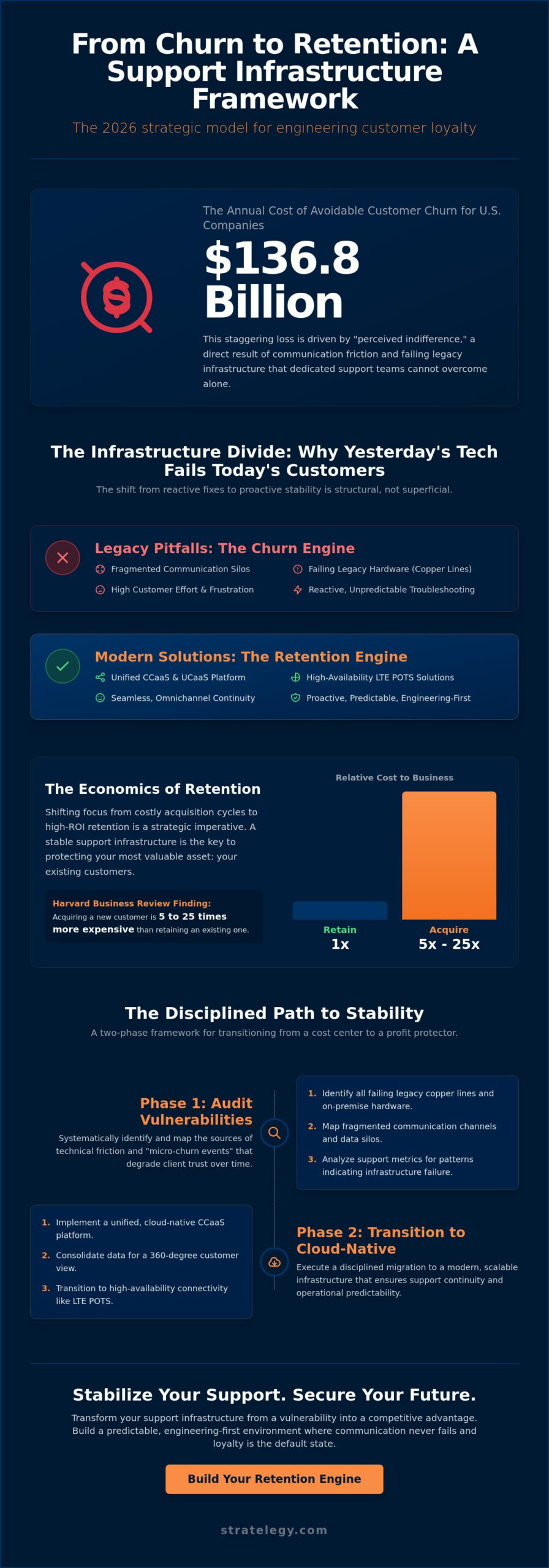
U.S. companies lose $136.8 billion every year due to avoidable consumer switching, often because customers feel a sense of perceived indifference. You’ve likely experienced high turnover rates even with a dedicated support team in place. Fragmented communication channels and the failure of legacy hardware create friction that your staff can’t fix with empathy alone. It’s a systemic vulnerability that threatens your long term operational health and your bottom line.
We believe that reducing customer churn with better support starts with the structural integrity of your communication stack. Discover how to transform your support infrastructure into a retention engine that proactively eliminates customer churn through architectural stability. This 2026 strategic framework breaks down the transition from reactive troubleshooting to a scalable CCaaS and UCaaS model that integrates modern data privacy compliance and unified connectivity. We’ll show you how to build a predictable, engineering first environment where communication never fails. By focusing on lifecycle management and technical governance, you can turn your support desk into a source of peace of mind and long term loyalty.
Key Takeaways
- Identify why customer tolerance for friction has plummeted in 2026 and how this shift demands a more resilient communication infrastructure.
- Discover the structural necessity of reducing customer churn with better support by consolidating fragmented silos into a unified CCaaS platform.
- Challenge traditional support metrics by prioritizing technical reliability and structural uptime over superficial speed measurements.
- Learn how to secure mission-critical support continuity by replacing failing legacy copper lines with high-availability LTE POTS solutions.
- Follow a disciplined, two-phase framework to audit operational vulnerabilities and transition your support environment to a cloud-native model.
The Economics of Retention: Understanding Customer Churn in 2026
Customer churn is the silent killer of enterprise predictability. It’s not just a line item on a report; it’s a fundamental erosion of your business foundation. In the 2026 market environment, the tolerance for technical friction has vanished. Clients expect seamless, high-availability interactions, and any deviation from this standard triggers immediate reconsiderations of the partnership. When your support infrastructure fails to keep pace with these expectations, you don’t just lose a ticket; you lose a long term asset.
The financial imperative for reducing customer churn with better support is undeniable. Research from the Harvard Business Review confirms that acquiring a new client is five to twenty-five times more expensive than retaining an existing one. Customer attrition often stems from a support-churn loop where legacy hardware failures and fragmented communication channels frustrate agents. These agents then provide suboptimal service, leading directly to client departures. By stabilizing the support infrastructure, you protect the high-margin recurring revenue that fuels your growth and eliminates the constant need for aggressive, low-ROI acquisition cycles.
Calculating the Real Impact of Support Friction
Standard churn percentages rarely tell the full story. You must look at Lifetime Value (LTV) Erosion. This metric tracks how small, recurring technical frustrations, or “micro-churn events,” slowly degrade the client’s commitment to your brand. A single dropped call or a siloed data point might not cause a cancellation today, but it builds the case for a competitor tomorrow. Maintaining a low First Response Time (FRT) is a critical component of technical governance that stabilizes these relationships before they fracture. It’s about engineering a support environment where reliability is the default state.
Support as a Profit Center vs. a Cost Center
Shift your internal perspective from resolving tickets to protecting recurring revenue. When your support team operates on a unified CCaaS platform, they stop being a drain on resources and start acting as an organic marketing engine. Reliability breeds confidence, and confident clients become vocal advocates. Churn is a failure of the support infrastructure to meet the customer’s pace. By prioritizing infrastructure stability, you ensure that every interaction reinforces the value of your partnership rather than highlighting its vulnerabilities. Reducing customer churn with better support is a strategic engineering decision that transforms your service desk into a predictable engine for long term financial health.
Why Modern Support Infrastructure is the Foundation of Retention
Support is only as effective as the infrastructure that carries it. Many leaders mistakenly prioritize soft skills while ignoring the technical failures that drive clients away. Contact Center as a Service (CCaaS) serves as the structural solution for support-driven retention. It replaces the fragility of on-premise systems with a cloud-native architecture designed for high availability and predictability. By moving your support environment to the cloud, you eliminate the hardware vulnerabilities that lead to downtime and customer frustration.
Siloed support systems are a primary cause of customer exhaustion. When communication channels are fragmented, data is lost in the handoff. This repetition is a significant driver of churn. Omnichannel continuity allows a client to transition from a digital chat to a voice call without repeating their history. This level of technical fluidity is essential for reducing customer churn with better support because it respects the customer’s time. It transforms a series of disconnected interactions into a coherent, reliable journey that builds long term trust.
The Role of CCaaS in Eliminating Communication Gaps
CCaaS eliminates communication gaps by centralizing customer data. This gives agents a comprehensive 360-degree view of every previous interaction. This visibility drastically reduces the Customer Effort Score (CES) by streamlining the path to resolution. Unlike legacy systems, cloud-based platforms maintain support uptime regardless of physical office challenges. You can read more about this in our Cloud Contact Center strategic framework. This structural reliability is one of the most overlooked customer retention strategies currently available to enterprise leaders.
Integrating UCaaS and CCaaS for Internal Alignment
Internal alignment is equally critical for long term health. Integrating unified communications as a service (UCaaS) with your contact center tools ensures that agents aren’t isolated. They can consult subject matter experts in the back office via instant messaging or video while remaining on the line with the client. This eliminates lengthy blind holds and improves first-call resolution rates. This technical synergy is vital for reducing customer churn with better support, as it resolves complex issues faster and with higher accuracy. If you’re looking to audit your current communication silos, our engineers can help you map a path toward infrastructure stability.
Moving Beyond Speed: Quality and Reliability as Churn Killers
Speed is a vanity metric. Many organizations obsess over Average Handle Time (AHT) while their churn rates continue to climb. This focus on efficiency over efficacy is a strategic error. Reducing customer churn with better support requires a transition toward measuring technical reliability and resolution quality. In the enterprise B2B space, predictability is the most valued trait. Clients don’t just want a fast answer; they want a stable solution that won’t require a follow up call.
Technical reliability is the silent driver of customer trust. When a support interaction is marred by high latency or jitter, it reflects poorly on your brand professionalism. These aren’t just minor technical inconveniences. They are indicators of a weak infrastructure. If your communication stack can’t handle a simple support call, a client will question if your core services are equally fragile. Understanding the Value of Keeping the Right Customers means recognizing that every high quality interaction is a reinvestment in the relationship.
The Trust Factor: Infrastructure Stability as a Retention Tool
Dropped calls and poor audio quality signal a lack of technical governance. To a high value client, these failures suggest that your business is operating on legacy systems that lack modern oversight. Infrastructure stability directly feeds the customer’s sense of peace of mind. They need to know that when a problem arises, the connection to help is immediate and clear. A failed support connection is the fastest way to trigger a cancellation request. By prioritizing communication uptime, you eliminate the technical friction that leads to voluntary attrition.
Leveraging Reporting Software to Spot Churn Risks
Modern contact center analytics allow you to move from reactive troubleshooting to proactive retention. You should use reporting software to identify accounts with high Support Recurrence rates. If a client is calling back for the same issue, your resolution process is failing. Spotting these trends early allows for executive intervention before the client reaches a breaking point. Monitoring call health via voip analytics ensures that your technical foundation isn’t the bottleneck. This data driven approach is essential for reducing customer churn with better support, as it highlights systemic vulnerabilities before they impact your recurring revenue.
Implementing a Proactive Support Strategy with CCaaS
Transitioning from a reactive posture to a proactive retention engine requires a disciplined, multi-phase implementation. Many organizations fail because they attempt to layer modern AI features over a crumbling legacy foundation. Success in reducing customer churn with better support is achieved through a structural overhaul of how your communication environment captures and utilizes data. This framework ensures that your support infrastructure remains an asset rather than a liability.
- Phase 1: Audit existing communication silos. Identify where customer context is lost between departments and where data “leaks” occur due to disconnected systems.
- Phase 2: Modernize the foundation. Transition from legacy on-premise hardware to a cloud-based CCaaS model to ensure high availability and structural reliability.
- Phase 3: Establish proactive trigger points. Use analytics to identify usage patterns that precede a cancellation and automate outreach before the client reaches a breaking point.
- Phase 4: Empower agents with a unified interface. Eliminate administrative friction and “alt-tab” fatigue by consolidating all support tools into a single, comprehensive pane of glass.
- Phase 5: Continuous optimization. Utilize AI-driven sentiment analysis to refine your proprietary maintenance frameworks and support feedback loops.
From Reactive Troubleshooting to Strategic Partnership
True retention occurs when support teams shift their focus from “fixing the product” to “ensuring the client’s success.” By using CCaaS scheduling tools, your team can move toward a model of regular success check-ins. These interactions allow agents to identify growth opportunities and resolve minor technical friction points during resolution calls. This proactive stance transforms the support team into a strategic partner, reinforcing the long term health of the business relationship. You can request a technical audit of your communication stack to begin this transition.
Automating the Low-Value, Escalating the High-Value
Structural efficiency depends on your ability to filter routine queries away from your most skilled engineers. Intelligent IVR and AI bots handle repetitive tasks, which frees human agents to focus on complex, high-risk churn cases. To prevent customer frustration, you must ensure a “warm handoff” where all context is passed from the AI to the human agent seamlessly. Modern unified communications and collaboration tools facilitate this rapid escalation by connecting support agents with back-office experts in real time. This engineering-first approach is the most effective method for reducing customer churn with better support while maintaining a lean, scalable operation.
Stabilizing Your Customer Base with Stratelegy’s Enterprise Solutions
Stratelegy operates as the foundational engineer for your customer engagement strategy. We don’t just provide software; we build the structural reliability required to protect your revenue. Reducing customer churn with better support is only possible when the underlying communication stack is immune to legacy failures. Our proprietary maintenance frameworks ensure that your CCaaS environment remains operational through systematic hardware updates and ongoing oversight. This level of technical governance provides the predictability that enterprise leaders require to eliminate the fear of obsolescence.
We approach support as a structural challenge rather than a service desk problem. Our engineering team has already anticipated the infrastructure hurdles that cause communication downtime. By prioritizing security, governance, and predictability, we offer a partnership that secures your business foundation. This focus on long-term operational health ensures that your retention efforts aren’t undermined by systemic vulnerabilities. We provide the peace of mind that allows you to focus on high-level strategy while we manage the technical lifecycle of your communication assets.
Modernizing Critical Infrastructure for Support Continuity
Support continuity is often threatened by the decay of legacy copper infrastructure. For businesses with mission-critical needs, pots line replacement is a mandatory strategic upgrade. Relying on aging analog lines for fire safety or emergency support access creates a systemic vulnerability that software cannot fix. We eliminate this risk by transitioning your facility to cellular-based LTE alternatives. These solutions ensure that your contact center environment remains reachable even during local network outages. Maintaining life safety and support uptime is a core component of reducing customer churn with better support, as it guarantees you’re available when your clients are most vulnerable.
The Stratelegy Advantage: Engineering Beyond the Software
Our commitment extends beyond the initial deployment. We prioritize the long-term health of your infrastructure through disciplined lifecycle management and rigorous security protocols. Because we focus exclusively on the B2B sector, your enterprise traffic is never diluted by residential network congestion. This specialization allows us to anticipate problems before they impact your operations. It’s time to move past reactive troubleshooting. Transition from a fragile support model to a growth-oriented communication engine that prioritizes excellence through engineering. We provide the structural reliability that allows you to secure your foundation and stabilize your customer base for the long term.
Securing Your Retention Engine through Engineering Excellence
Infrastructure stability is the only sustainable defense against customer attrition. You’ve seen how legacy failures and fragmented data silos trigger the perceived indifference that drives clients away. True excellence in reducing customer churn with better support requires a transition from reactive troubleshooting to a proactive, engineering-first framework. By prioritizing technical governance and structural uptime, you transform your support desk from a cost center into a predictable engine for recurring revenue.
Stratelegy provides the technical authority and specialized oversight needed to stabilize your engagement environment. Our proprietary maintenance frameworks and B2B-exclusive communication focus ensure your infrastructure remains a competitive advantage. With LTE-based reliability for critical systems, we eliminate the vulnerabilities of aging copper lines and provide the peace of mind your business deserves. It’s time to build a foundation that supports your long-term growth.
Scale your support infrastructure and stop customer churn with Stratelegy. We’re ready to help you engineer a future of predictable loyalty and operational health.
Frequently Asked Questions
How does customer support directly affect churn rate?
Customer support acts as the primary safeguard for recurring revenue by addressing friction before it leads to cancellation. Research indicates that 68% of customers switch providers because they perceive a sense of indifference from the company. When support is unreliable or technically flawed, it validates the customer’s decision to leave. Reducing customer churn with better support requires a focus on technical excellence to ensure every interaction reinforces the value of the partnership.
What is the best support metric for predicting customer churn?
The Customer Effort Score (CES) is the most accurate predictor of churn because it measures the ease of resolution. High-effort interactions, such as repeating information across siloed channels, correlate directly with voluntary attrition. While traditional metrics like speed matter, a low CES indicates that your infrastructure is successfully minimizing friction. Monitoring this metric allows you to identify structural weaknesses in your CCaaS environment before they impact your retention rates.
Can CCaaS software really reduce customer turnover?
CCaaS platforms reduce turnover by providing the omnichannel continuity necessary for a seamless customer journey. This cloud-native architecture eliminates the data gaps that occur when customers move between chat, email, and voice. By centralizing interaction history, agents can resolve issues with higher accuracy and less repetition. This structural fluidity is a critical component of reducing customer churn with better support in a competitive enterprise market.
What is the difference between reactive and proactive customer support?
Reactive support waits for a client to report a failure, while proactive support utilizes data to address issues before they escalate. A proactive model uses CCaaS analytics to identify usage drops or recurring technical errors that signal a churn risk. By initiating outreach through unified communication channels, you demonstrate a commitment to the client’s long-term success. This shift moves the relationship from a vendor-client dynamic to a strategic partnership.
How do communication silos contribute to customer churn?
Communication silos create technical friction by trapping customer data within disconnected departments. When a support agent lacks access to back-office information or previous interaction history, the customer is forced to repeat their problem. This repetition is a significant driver of frustration and perceived indifference. Consolidating these silos through integrated UCaaS and CCaaS models ensures that data flows naturally across the entire organization.
Why is infrastructure reliability more important than support software features?
Infrastructure reliability is the foundation upon which all support features are built. A contact center platform with advanced AI is ineffective if the underlying network suffers from high latency or dropped calls. Reliability builds the baseline of trust necessary for a long-term relationship. Prioritizing structural stability, such as replacing failing copper lines with LTE POTS alternatives, ensures that your support team remains accessible during mission-critical moments.
How can I identify at-risk customers through support data?
You can identify at-risk customers by monitoring Support Recurrence and negative sentiment trends within your CCaaS analytics. A high volume of repeat tickets for the same issue indicates a failure in your resolution process. Additionally, AI-driven sentiment analysis can flag interactions where frustration is peaking. Spotting these patterns early allows for executive intervention and proactive technical audits to stabilize the account before a cancellation request is filed.
What role does agent satisfaction play in reducing customer churn?
Agent satisfaction is directly linked to retention because agents with reliable tools provide higher quality service. When staff are forced to navigate legacy hardware and fragmented interfaces, their frustration is often reflected in the customer experience. Providing a unified interface and dependable UCaaS tools reduces administrative friction and “alt-tab” fatigue. Empowered agents can focus on strategic resolution rather than fighting with their own infrastructure, leading to better outcomes for the client.