

The global unified communications market is estimated to hit $128.63 billion in 2026, yet many organizations still struggle to connect their infrastructure spend to bottom-line results. You are likely managing a flood of data from fragmented sources while facing the constant pressure to justify your UCaaS and CCaaS investments. It is a common challenge. Information overload often masks the technical friction that quietly erodes team output. This guide provides a definitive framework for unified communications analytics for productivity to help you move beyond surface-level metrics.
We understand that operational stability is the bedrock of enterprise success. You need more than just a vendor; you need a strategic partner who prioritizes governance and predictability. This article outlines a disciplined approach to transforming raw communication data into a strategic engine for growth. You will discover how to establish clear productivity benchmarks, eliminate latency issues, and implement data-backed strategies that ensure your infrastructure remains resilient against obsolescence.
Key Takeaways
- Transition from reactive reporting to a proactive management model that treats communication data as a vital strategic asset for enterprise stability.
- Identify the four essential pillars of modern metrics to prioritize high-impact data, such as collaboration velocity, over traditional activity logs.
- Leverage unified communications analytics for productivity to empower your workforce by identifying resource gaps and preventing burnout through objective data.
- Align your communication infrastructure with specific business outcomes by auditing legacy silos and integrating UCaaS and CCaaS data into your growth strategy.
- Ensure the accuracy of your operational insights by focusing on foundational engineering and infrastructure uptime as the catalysts for reliable data.
Defining Unified Communications Analytics in the 2026 Landscape
Unified communications analytics is the systematic collection and analysis of interaction data across voice, video, and messaging platforms. In the current strategic landscape, this goes far beyond simple call counting. It represents a fundamental shift from reactive reporting to proactive ecosystem management. Unified communications analytics serves as the nervous system of modern enterprise operations. This system relies on a steady flow of information to function correctly. Dial-tone reliability is the essential prerequisite for meaningful data collection. If the connection fails, the insight disappears entirely.
The Evolution from Call Logs to Behavioral Insights
Legacy metrics from the POTS era were restricted to basic call accounting. Managers knew the duration and the destination of a call, but they lacked behavioral context. Modern Unified Communications (UC) environments provide a much richer data set. Today, unified communications analytics for productivity allows leaders to observe how teams interact across multiple channels in real time. Unified Communications as a Service (UCaaS) centralizes these disparate data streams into a single, manageable platform. Metadata now helps identify collaboration bottlenecks that were previously hidden. You can now see if specific teams are suffering from meeting fatigue or if technical friction is slowing down their response times.
Why Infrastructure Stability is the Foundation of Data Integrity
You cannot build a strategic growth engine on an unstable foundation. Technical flaws like packet loss or jitter do more than just disrupt conversations. They corrupt your data integrity. If a call drops due to network instability, your analytics might record it as a completed short interaction rather than a technical failure. This skewing of data leads to poor decision-making. This is why we prioritize “Foundational Engineering” as the basis for all data accuracy. Reliable unified communications analytics for productivity depends on a high-performance network. Modernizing your hardware is a critical step in this process. A planned POTS line replacement ensures that your data paths are secure and consistent. When your infrastructure is predictable, your analytics become a powerful tool for operational excellence.
The Core Metrics: Moving Beyond Activity to Impact
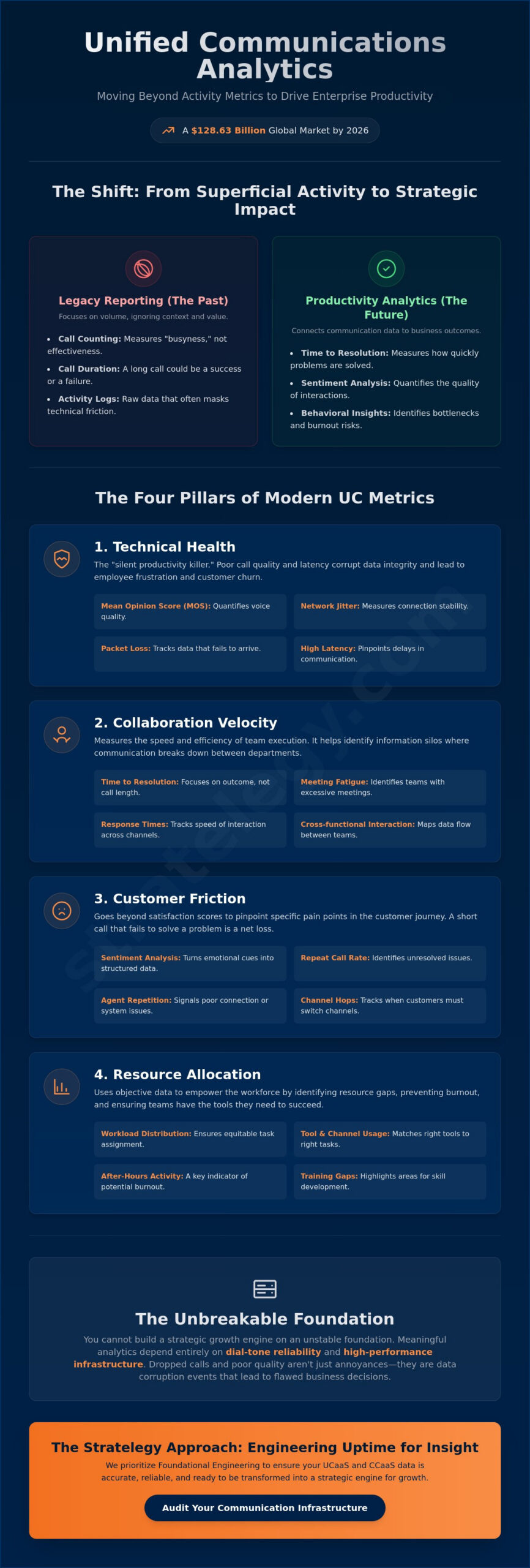
Activity is not productivity. Tracking how many calls an employee makes provides a superficial view of performance that ignores actual business value. To drive growth, 2026 strategic frameworks must focus on four key pillars: Technical Health, Collaboration Velocity, Customer Friction, and Resource Allocation. These pillars shift the focus from what is happening to what is being achieved. By prioritizing impact over volume, unified communications analytics for productivity becomes a diagnostic tool for the entire enterprise.
Measuring “Time to Resolution” offers significantly more insight than “Call Duration.” A short call that fails to solve a problem is a waste of resources. Conversely, a longer call that eliminates the need for follow-up is a success. Modern contact center software uses sentiment analysis to quantify these interactions, turning emotional cues into structured data. By analyzing cross-departmental interaction data, you can also identify “Collaboration Silos” where information stops flowing. Identifying these silos allows you to re-engineer workflows for better cross-functional output.
Technical Health: The Silent Productivity Killer
Technical friction destroys output. The Mean Opinion Score (MOS) provides a numerical value for voice quality. A low score correlates directly with increased worker frustration and cognitive load. High latency in cloud contact center environments degrades customer engagement and forces agents to repeat themselves, wasting valuable time. Real-time monitoring of network jitter and packet loss is no longer optional. It is a fundamental engineering requirement. If your current metrics feel disconnected from your business goals, it may be time to audit your communication infrastructure for hidden friction points.
Collaboration Velocity and Workforce Synchronization
Velocity is the speed of execution. We measure the interval between a message being sent and the associated task being completed. Effective unified communications and collaboration tools reduce “meeting fatigue” by facilitating asynchronous workflows. Accurate “Presence Status” metrics are also vital. When status indicators are reliable, teams spend less time searching for unavailable colleagues and more time on focused work. As organizations refine their people analytics, the focus must remain on removing obstacles rather than increasing surveillance. This disciplined application of unified communications analytics for productivity ensures that technology serves the worker, rather than the other way around.
Overcoming the ‘Big Brother’ Stigma: Analytics for Empowerment
Employee resistance is the primary barrier to sophisticated data strategies. Workers often view monitoring as a prelude to micromanagement. However, the 2026 strategic framework shifts this narrative. We view unified communications analytics for productivity as a tool for empowerment rather than surveillance. When data collection is transparent, it serves as an objective mediator between management expectations and actual operational capacity. It protects employees from unrealistic quotas by providing empirical evidence of what a sustainable workload looks like. This approach transforms data into a shield for the high-performer.
Trust is built through documented governance. Clear data collection policies must be communicated across the organization. This transparency eliminates the “Big Brother” stigma by defining exactly what is measured and why. Current research on UC and productivity highlights that when employees understand how these tools improve their daily workflows, adoption rates increase significantly. By focusing on systemic health instead of individual scrutiny, you position your brand as a technical partner in your team’s success. This is about engineering a better workday, not watching the clock.
Using Data to Identify and Prevent Workforce Burnout
Data provides the first warning signs of attrition. After-hours communication spikes are leading indicators that a team is over-extended. High-level unified communications analytics for productivity can identify these patterns before they lead to turnover. Instead of pushing for more activity, leaders can use these insights to suggest “quiet hours” or reallocate resources to overwhelmed departments. This proactive approach ensures long-term infrastructure health by protecting the human element of the network. It allows managers to act as strategic specialists who anticipate problems before they manifest as burnout.
Governance and Predictability in the Hybrid Era
Predictability is the ultimate goal of enterprise communication governance. In hybrid environments, you need clear KPIs that focus on outcomes rather than a “green light” presence status. A robust unified communications as a service deployment provides the necessary security and compliance layers to support this model. This structure ensures that remote work remains productive and secure without requiring invasive monitoring. By engineering a predictable environment, you provide your team with the peace of mind they need to perform at their best. Reliability in the infrastructure breeds reliability in the workforce.
Implementing a Productivity-First Analytics Strategy
Executing a high-level data strategy requires more than just software deployment. It demands a disciplined, step-by-step engineering approach that aligns technical capabilities with corporate objectives. For sectors requiring extreme precision, such as how LexQuest AI serves elite law firms, organizations that successfully leverage unified communications analytics for productivity follow a rigorous implementation roadmap to ensure data integrity and operational impact. This process moves the conversation from generic activity reports to actionable business intelligence.
- Step 1: Audit existing communication silos. You must identify legacy infrastructure and “dark spots” where data is currently unrecoverable.
- Step 2: Align UC metrics with business outcomes. Define specific goals, such as reducing the sales cycle or improving first-call resolution rates, to give your data purpose.
- Step 3: Deploy a unified data layer. Integrate your UCaaS and CCaaS platforms to create a single source of truth for all interaction data.
- Step 4: Establish a cross-departmental feedback loop. Ensure that IT data reaches HR and Operations leaders to inform resource allocation decisions.
- Step 5: Transition to predictive modeling. Use AI overlays to move beyond describing what happened to predicting what will happen next.
The Audit: From Legacy Copper to Cloud Intelligence
A comprehensive audit is the first step toward technical predictability. Many enterprises still harbor analog “dark spots” in the form of old POTS lines. These legacy connections hide valuable data and create systemic vulnerabilities. Modernizing fire, life safety, and elevator lines is essential for total facility connectivity. Transitioning to LTE-based communicators for remote or critical endpoints ensures that every interaction is captured and analyzed. Without this foundational upgrade, your unified communications analytics for productivity will remain incomplete. If you are ready to eliminate these blind spots, consult with our foundational engineers to begin your infrastructure audit.
Predictive Productivity: The 2026 Edge
The 2026 strategic edge lies in predictive modeling. AI now uses historical UC data to anticipate future staffing needs and identify potential system failures before they occur. Automated troubleshooting protocols can fix latency or jitter issues before the end-user even notices a decline in quality. This proactive maintenance is powered by VoIP, which acts as the primary engine for these advanced AI integrations. By engineering a system that anticipates needs, you eliminate the friction that typically slows down enterprise growth. Reliability is the catalyst for innovation.
The Stratelegy Approach: Engineering Uptime for Insight
Uptime is the silent architect of data accuracy. Without a stable network, your analytics are simply a collection of fragments. We position ourselves as the technical advisor that anticipates infrastructure failure before it has the chance to corrupt your data. Our approach to unified communications analytics for productivity begins at the physical layer. We prioritize structural reliability as the essential catalyst for meaningful business intelligence. When the foundation is secure, the insights follow.
Our proprietary maintenance frameworks are designed to meet 2026-level compliance standards. These systems ensure that every component of your ecosystem is monitored for longevity and performance. We integrate LTE POTS replacement with modern UCaaS and CCaaS suites to create a fail-safe environment. This convergence eliminates the systemic vulnerabilities often found in legacy setups. By engineering a predictable infrastructure, we provide the peace of mind necessary to focus on high-level strategic growth rather than troubleshooting connectivity.
Foundational Engineers, Not Just Service Providers
We are foundational engineers committed to the long-term health of your business infrastructure. Many vendors focus on the superficial novelty of software features, but we prioritize security, governance, and structural integrity. It’s a disciplined methodology that values technical excellence over sales volume. We don’t just provide a service; we build a partnership rooted in lifecycle management and ongoing oversight. This ensures your communication tools remain assets rather than liabilities. We invite you to a strategic partnership where technical authority is the standard, not the exception.
Securing the Future of Your Enterprise Communication
The fear of technological obsolescence is a common concern for business owners. We eliminate this anxiety through specialized technical expertise and a focus on specific regulatory certifications. Our managed solutions are built to evolve alongside shifting industry requirements. We anticipate the problems you haven’t encountered yet, ensuring your infrastructure remains resilient against future disruptions. By choosing a partner who understands the deep technical niches of critical communication, you secure the future of your enterprise operations. Experience the Stratelegy difference in unified communications and transform your data into a predictable engine for success.
Successful unified communications analytics for productivity requires a partner who understands that software is only as good as the hardware that carries it. We provide the disciplined engineering needed to turn raw interaction data into a strategic advantage. It’s time to move beyond superficial metrics and embrace a framework built for the complexities of the 2026 landscape.
Securing Your Competitive Edge Through Foundational Intelligence
The 2026 landscape demands a shift from passive reporting to active ecosystem management. You’ve seen how true impact is measured through collaboration velocity and technical health rather than simple call logs. By prioritizing infrastructure stability, you transform unified communications analytics for productivity into a reliable engine for growth. This strategic framework ensures that your data remains accurate and your workforce remains empowered. Modernizing your communication paths is no longer a luxury; it’s a structural requirement for any data-driven enterprise.
At Stratelegy, we provide the technical expertise required to maintain this high-performance environment. Our proprietary maintenance frameworks and specialized knowledge in critical life safety infrastructure guarantee that your systems are both compliant and resilient. We deliver enterprise-grade UCaaS and CCaaS solutions with 99.999% reliability to eliminate the risk of operational friction. Scale your enterprise productivity with Stratelegy’s Unified Communications and build a future rooted in engineering excellence. Your infrastructure is the backbone of your success, and we’re here to ensure it never falters.
Frequently Asked Questions
What is the difference between UC reporting and UC analytics?
UC reporting provides raw data on past events, such as total call volume or average duration. UC analytics interprets that data to identify patterns, friction points, and operational bottlenecks. This distinction is vital for unified communications analytics for productivity because it moves your strategy from reactive observation to proactive optimization. Analytics helps you understand the “why” behind the numbers to drive better business outcomes.
How can unified communications analytics improve remote team productivity?
Analytics improve remote productivity by identifying technical friction in home networks and measuring collaboration velocity. You can see if high latency is slowing down an agent or if a team is suffering from meeting fatigue. This data allows you to re-engineer workflows to better suit a distributed workforce. It provides the insight needed to support employees without relying on invasive surveillance or micromanagement.
Can I get analytics from my legacy POTS lines?
Legacy POTS lines cannot provide the granular data required for modern analytics. These analog connections are essentially “dark spots” in your infrastructure that hide valuable interaction metadata. To gain insight into these endpoints, you must transition to LTE POTS replacement. This modernization brings critical life safety and fire lines into your unified data ecosystem for better oversight and reliability.
Is UC analytics compliant with data privacy regulations like GDPR or CCPA?
Modern analytics platforms are designed to meet strict regulatory standards, including GDPR, CCPA, and the new 2026 state privacy laws in Indiana and Kentucky. We prioritize governance and security to ensure your data collection remains compliant. These systems utilize encryption and anonymization to protect consumer rights. This approach provides the business with necessary operational insights while maintaining high regulatory standards.
How does AI-driven predictive analytics work in a contact center?
AI-driven predictive analytics use historical interaction data to forecast future staffing requirements and customer needs. In a CCaaS environment, these tools can predict peak call volumes and suggest optimal scheduling. They also perform automated troubleshooting by identifying network jitter before it impacts the customer experience. This ensures your contact center remains a predictable engine for engagement and growth.
What are the most important KPIs for measuring UCaaS ROI?
The most important KPIs include collaboration velocity, time to resolution, and Mean Opinion Score (MOS). While traditional metrics focus on activity, these impact-based KPIs prove the actual ROI of your UCaaS investment. You should also track the reduction in sales cycle length and infrastructure uptime. These metrics provide a clear picture of the long-term health of your communications infrastructure.
Does Stratelegy provide the hardware for these analytics platforms?
Stratelegy provides the foundational hardware and managed services required for a fail-safe ecosystem. We deploy LTE communicators for POTS replacement and enterprise-grade endpoints for UCaaS and CCaaS suites. Our role as foundational engineers ensures that your hardware is always synchronized with your analytics platforms. This synchronization is essential for maintaining maximum data integrity and technical predictability.
How long does it take to see results from a UC analytics implementation?
Technical health results are often visible immediately after implementation. You can see real-time improvements in network stability and voice quality as soon as the system is active. Behavioral insights, such as collaboration patterns and workforce synchronization, typically require 30 to 90 days of data collection. This period allows for a more accurate unified communications analytics for productivity assessment and strategic planning.