

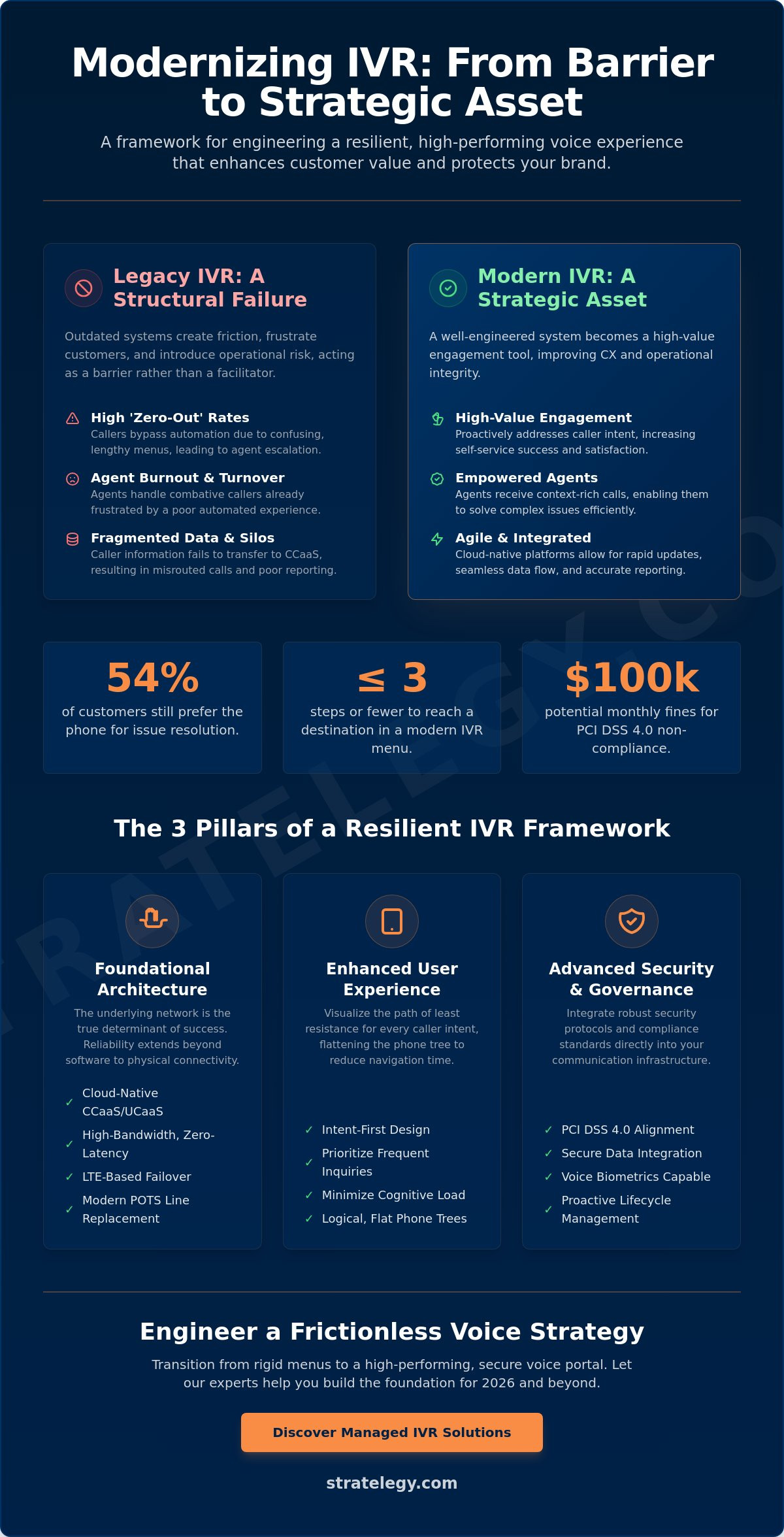
If your callers are pressing zero the moment your greeting starts, your IVR isn’t a gateway; it’s a structural failure that compromises your operational integrity. High zero-out rates and latency in legacy infrastructure don’t just frustrate customers. They signal a deeper vulnerability in how your business manages its primary communication entry point. Most technical leaders understand that outdated systems lead to fragmented data and missed self-service opportunities, especially when 54% of customers still prefer the phone for issue resolution. Adopting modern interactive voice response (ivr) design best practices is no longer about adding features; it’s about engineering a resilient, compliant foundation for your CCaaS environment.
We’ve developed this strategic framework to help you master the engineering principles required to eliminate friction and ensure long-term stability. You’ll learn how to align your IVR with PCI DSS 4.0 requirements to avoid monthly non-compliance fines that can reach $100,000. This article breaks down the transition from rigid menus to conversational AI agents while maintaining the strict governance your infrastructure demands. We’ll preview the essential maintenance cycles and integration protocols that turn your voice portal into a high-performing, secure asset for 2026 and beyond.
Key Takeaways
- Shift your voice strategy from a cost-reduction exercise to a high-value engagement tool that protects long-term brand equity and customer lifetime value.
- Engineer a logical blueprint using interactive voice response (ivr) design best practices to minimize cognitive load and eliminate caller friction.
- Secure your communication infrastructure by integrating advanced governance standards and voice biometrics within your cloud contact center environment.
- Transition to cloud-native CCaaS and UCaaS platforms to ensure your IVR remains resilient, scalable, and adaptable to emerging technical requirements.
- Adopt a proactive maintenance framework that prioritizes system health and lifecycle management to prevent the latency typical of legacy hardware.
The Strategic Cost of Poor IVR Design in 2026
Voice strategy is shifting from a cost-cutting barrier to an experience-enhancing asset. In previous decades, businesses used automation to deflect calls and reduce headcount. In 2026, this legacy mentality is a liability. A single poorly designed interaction can permanently erode customer lifetime value (LTV) and damage brand reputation. When callers encounter infinite loops or dead ends, they don’t just hang up; they churn. This friction also creates a toxic environment for agents. Callers who finally reach a human after a frustrating automated experience are often combative, which directly accelerates agent burnout and turnover rates.
Customer Friction and the ‘Zero-Out’ Phenomenon
The zero-out phenomenon occurs when callers immediately press zero to bypass automation. This happens because most systems act as gatekeepers rather than facilitators. Repetitive prompts and long menus exhaust caller patience, leading to immediate escalation. Modern interactive voice response (ivr) design best practices prioritize the caller’s intent over the company’s organizational chart. By transitioning to a facilitator model, you reduce the psychological load on the customer and ensure they reach the correct resource without the need for manual intervention.
The Hidden Operational Risks of Legacy Menu Logic
Rigid legacy hardware often blocks the simple menu updates required to stay competitive. These outdated architectures create data silos where caller information fails to transfer to the CCaaS platform. This results in misrouted calls and inaccurate reporting, which are expensive failures in high-volume enterprise environments. A foundational understanding of Interactive Voice Response (IVR) systems reveals that structural reliability is the only way to maintain accurate data flow. Adopting updated interactive voice response (ivr) design best practices ensures your infrastructure remains agile enough to support complex integrations without compromising system stability.
Foundational Architecture: Building a Resilient IVR Framework
IVR architecture serves as the logical blueprint for every voice interaction within your enterprise. It’s the structural foundation that dictates how data flows between your callers and your CCaaS platform. While many focus on the interface, interactive voice response (ivr) design best practices dictate that the underlying network is the true determinant of success. Cloud-native platforms provide the agility needed for rapid updates, but they require high-bandwidth connectivity to ensure zero-latency interactions. Without a stable network, even the most sophisticated AI prompts will suffer from dropped packets and jitter, leading to immediate caller abandonment.
Mapping the Caller Journey via Logical Phone Trees
Effective design requires visualizing the path of least resistance for every possible caller intent. You must flatten the tree to reduce navigation time. Modern standards suggest that callers should reach their destination in three steps or fewer. Use data-driven insights from your CRM to prioritize frequent inquiries at the top of the menu. This approach transforms the IVR from a complex maze into a streamlined tool. Strategic mapping ensures that high-value callers aren’t buried under administrative options, which maintains operational efficiency across the board.
Infrastructure Stability: Beyond the Software Layer
Structural reliability extends beyond the software layer into the physical connectivity of your facility. Implementing pots line replacement is a critical step for maintaining IVR uptime as legacy copper networks continue to degrade. LTE-based failover provides a necessary safety net, ensuring your voice services remain functional during primary fiber outages. This is especially vital for critical life-safety lines that must remain operational within your broader communication ecosystem. Ensuring your hardware is as modern as your software eliminates systemic vulnerabilities. If you are looking to secure your voice infrastructure, consider how unified communications as a service can provide a more predictable environment for your business.
Core IVR Design Best Practices for Enhanced User Experience
Engineering a high-performing user interface requires more than just clear audio; it demands a deep understanding of human cognitive limits. Adhering to interactive voice response (ivr) design best practices means implementing the ‘Rule of Three’ to ensure callers aren’t overwhelmed by choice. When menus exceed three to five options, accuracy drops and caller frustration climbs. We recommend a consistent, brand-aligned voice persona across all prompts to build technical familiarity and trust. These elements form the structural integrity of your voice channel, ensuring every interaction is predictable and efficient.
To further enhance the journey, integrate these essential technical features:
- Barge-In Capabilities: Allow experienced users to skip familiar prompts to reach their destination faster.
- Strategic Language Placement: Position language selection at the very beginning to ensure inclusivity and reduce navigation time.
- Universal Escape Hatch: Provide a clear path to a live agent at every level of the menu to prevent ‘zero-out’ frustration.
Streamlining the Menu: Brevity and Clarity
Main menus must never exceed a total duration of 30 seconds to maintain caller engagement and focus. Prioritizing information correctly is vital; always place the description before the action, such as “For technical support, press one,” rather than “Press one for technical support.” This sequence allows the caller’s brain to process the category before listening for the required digit. Eliminating internal jargon ensures that instructions are universally understood, regardless of the caller’s technical background or industry knowledge.
Conversational AI and Natural Language Processing (NLP)
The transition from DTMF touch-tone inputs to conversational prompts like “How can I help you?” marks a significant leap in interactive voice response (ivr) design best practices. Natural Language Processing (NLP) allows for a more intuitive interface that can handle complex, multi-step queries without human intervention. With 91% of customer service leaders under pressure to implement AI in 2026, training NLP models on industry-specific terminology and regional accents is a strategic necessity. However, always provide a keypad backup as a redundant layer. This ensures that automated speech recognition (ASR) failures don’t lead to dropped calls or system dead ends.
Advanced Security, Governance, and Data Integration
Security is the bedrock of any enterprise voice strategy. In 2026, interactive voice response (ivr) design best practices demand a move beyond simple menu logic toward a robust governance framework. This involves designing for cloud contact center security standards that prioritize end-to-end encryption and systematic audit trails. Voice biometrics represent a critical advancement in this space. By utilizing unique vocal characteristics for authentication, businesses reduce friction while simultaneously hardening their defenses against identity fraud. These systems provide a predictable, secure environment that protects both the organization and the end user from systemic vulnerabilities.
Securing the Voice Channel: Compliance-First Design
Compliance is a non-negotiable structural requirement. As of March 31, 2025, the mandatory implementation of PCI DSS 4.0 has raised the stakes for payment security. Modern IVR systems must utilize ‘Pause and Resume’ technology to ensure sensitive cardholder data is never recorded or stored in violation of these protocols. This level of oversight is equally vital for healthcare providers who require HIPAA-compliant menus to protect patient confidentiality. Integrating these standards into your enterprise voip infrastructure ensures that your communication remains secure. It also helps your organization avoid monthly fines for non-compliance, which range from $5,000 to $100,000.
Eliminating Data Silos: Contextual Handoffs
A fragmented data environment is a design failure. Effective interactive voice response (ivr) design best practices involve passing collected data directly to the agent’s screen through Computer Telephony Integration (CTI). Asking a customer to repeat an account number they just entered is an unnecessary friction point that signals a lack of technical coordination. By integrating IVR logic with your CRM platform, you enable personalized greetings and context-aware routing based on past interactions. This methodical approach to data management transforms the caller journey into a seamless, professional experience that reinforces brand trust. To secure your enterprise voice environment and eliminate legacy silos, explore our managed CCaaS solutions today.
Implementing Managed IVR Solutions with Stratelegy
Executing interactive voice response (ivr) design best practices requires more than a one-time configuration. It demands a lifecycle management approach rooted in structural reliability. We position ourselves as foundational engineers who prioritize the ongoing health of your communication infrastructure over superficial software features. Our proactive maintenance framework anticipates systemic vulnerabilities before they impact your operational uptime. This disciplined oversight ensures that your voice channel remains a stable entry point for your customers, regardless of shifting technical requirements.
Our managed approach centers on three core pillars of operational excellence:
- Zero-Obsolescence Policies: We implement systematic hardware and software update cycles to ensure your infrastructure never falls behind industry standards.
- Global Scalability: By leveraging unified communications as a service, we provide the elastic capacity required for enterprise growth.
- Strategic Partnership: We act as your technical advisors, focusing on long-term stability and regulatory compliance rather than simple vendor transactions.
Modernizing Critical Infrastructure for Future-Proof Voice
Transitioning from legacy copper networks to managed LTE and cloud solutions is a strategic necessity in 2026. Our ‘POTS in a Box’ solution provides the life-safety reliability required for critical lines while enabling modern IVR capabilities. This transition eliminates the latency and dropped calls associated with degrading copper infrastructure. By modernizing the physical layer, we ensure your IVR can evolve alongside your business through agile, centralized management. This structural shift provides the peace of mind that comes from knowing your foundation is secure.
The Path Forward: Engineering Excellence in Every Call
Excellent IVR design is a discipline of engineering. The shift toward experience-enhancing automation requires a partner who understands the intersection of network stability, security, and user psychology. We provide the technical expertise needed to build a resilient and friction-free communication ecosystem. Adopting interactive voice response (ivr) design best practices is the first step toward reclaiming your operational efficiency. To begin your transition toward a more predictable and modern voice environment, contact Stratelegy for a comprehensive strategic infrastructure audit.
Future-Proofing Your Enterprise Voice Strategy
Modernizing your communication entry point is no longer an optional upgrade; it’s a structural necessity for maintaining operational continuity and regulatory compliance. We’ve explored how transitioning to cloud-native CCaaS platforms and implementing interactive voice response (ivr) design best practices eliminates customer friction while securing sensitive data. By prioritizing logical phone trees and conversational AI, you transform a legacy liability into a high-performing asset. This evolution ensures that your business remains agile in a landscape defined by rapid technical shifts and stricter governance standards.
Stratelegy provides the B2B-exclusive technical expertise required to manage these complex transitions with precision. As a national leader in LTE POTS replacement, we offer proprietary maintenance frameworks that ensure your infrastructure remains resilient against obsolescence and systemic failure. Don’t let outdated hardware compromise your brand’s reliability or your security posture. Schedule a Strategic Infrastructure Audit with Stratelegy to secure your foundational architecture today. We’re ready to partner with you to engineer a more predictable and efficient future for your business.
Frequently Asked Questions
What is the most important IVR design best practice for 2026?
Structural reliability is the most critical factor for 2026. While superficial features are common, ensuring your voice channel is built on a stable, cloud-native foundation allows for the seamless integration of conversational AI. This approach ensures that interactive voice response (ivr) design best practices are grounded in operational uptime. A resilient framework prevents dropped calls and latency, which are the primary drivers of caller frustration in enterprise environments.
How many menu options should an IVR have?
An effective IVR should limit main menu options to between three and five selections. Exceeding this range creates cognitive overload, forcing callers to wait through long lists and increasing the likelihood of errors. By flattening the menu structure, you ensure that users reach their destination in three steps or fewer. This methodical approach prioritizes the caller’s time and significantly improves the overall efficiency of your CCaaS platform.
What is the difference between DTMF and NLP in IVR systems?
DTMF relies on physical keypad inputs, while NLP allows callers to use natural speech. DTMF is a reliable legacy standard, but it often feels rigid to modern users. NLP creates a more intuitive, human-like interaction that can handle complex queries. Most modern interactive voice response (ivr) design best practices recommend a hybrid approach, using NLP for primary navigation with DTMF as a redundant backup to ensure system accessibility.
How can I reduce the zero-out rate in my contact center?
Reducing zero-out rates requires eliminating the friction points that lead callers to bypass automation. You can achieve this by placing the most frequent inquiries at the top of the menu and using natural, brand-aligned voice prompts. If callers feel the system understands their intent, they’re less likely to demand a live agent immediately. Offering a callback option instead of long hold times also preserves the caller journey and reduces agent escalation.
Is it possible to make an IVR compliant with PCI-DSS or HIPAA?
Achieving PCI DSS 4.0 or HIPAA compliance is possible through specific engineering protocols. Secure systems use ‘Pause and Resume’ technology to prevent sensitive data from being recorded during payment processing. End-to-end encryption and strict access controls are also required to protect cardholder or patient information. These governance standards are essential for avoiding monthly fines, which can reach $100,000, and ensuring the long-term health of your business infrastructure.
What role does infrastructure play in IVR performance?
Infrastructure is the true determinant of IVR performance. Even the best software will fail if it runs on a degraded network or legacy copper lines. High-bandwidth connectivity ensures zero-latency interactions, while LTE-based failover provides a safety net during primary outages. Modernizing your physical layer through LTE POTS replacement guarantees that your voice services remain functional and reliable, providing the peace of mind that your communication foundation is secure.
How often should enterprise IVR menus be audited and updated?
Enterprise IVR menus should undergo a comprehensive audit at least every six months. This frequency aligns with PCI DSS 4.0 penetration testing requirements for segmentation controls. Regular audits allow you to use data-driven insights from your CRM to update menu priorities based on changing customer needs. This proactive maintenance ensures your system doesn’t become obsolete and continues to deliver a streamlined experience for every caller.
Can an IVR be integrated with my existing CRM and CCaaS platforms?
Integration with existing CRM and CCaaS platforms is a strategic necessity for modern enterprises. Using Computer Telephony Integration, your IVR can pass collected data directly to an agent’s screen before the call is even connected. This eliminates the need for customers to repeat their information, which is a common design failure. Seamless integration creates a personalized experience that reinforces your identity as a technically sophisticated and customer-centric organization.